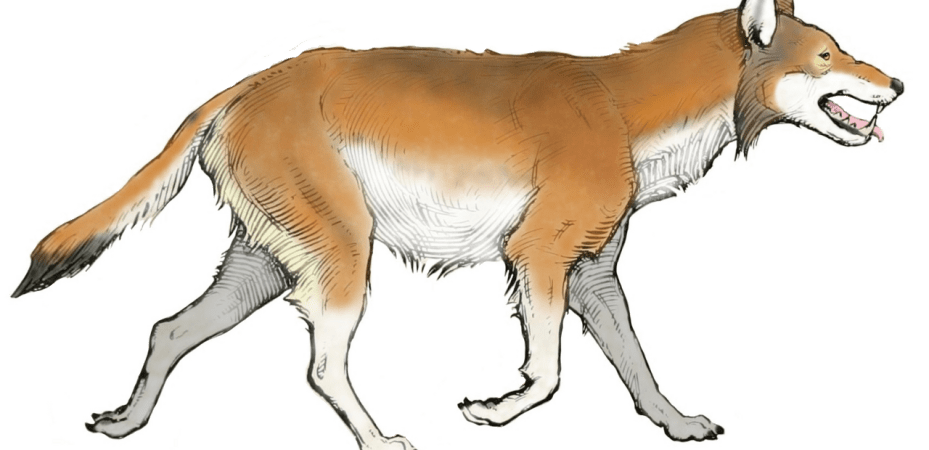
Parentheses are needed because this video is about the dire wolf (Aenocyon) but not that one in China —
— which was a Pleistocene individual whose partial mandible and tooth were recently found in northeast China.
According to the resulting paper (jargon alert), they knew it wasn’t from a gray wolf because of its size.
This addresses something I wonder about dire wolves: if they weren’t wolves, why did they look so much like the true wolves that lived alongside them?
Bone crunching, perhaps. Carnivores do sometimes evolve big teeth to break up bones and get at all that marrow.
In fact, there used to be bone-eating dogs in the world, living alongside “regular” early canids.
Hyenas fill that role today, and the paper’s authors suggest that the hyenas in Pleistocene Asia (but not in the Americas) might have outcompeted dire wolves there, which is why so few Aenocyon have been found.
🐺🐺🐺
Meanwhile, in modern China…
“Sure could use a nice robotic wolf with a flame-thrower right now.”
Apparently lining up is a habit:
Also in Sanjiangyuan National Park, a black wolf roams. (autotranslated).
For lagniappe:
Yes, there is (hopefully AI) video online of China’s “robotic wolves.”
This is much better, and something technology cannot ever copy:
Featured image: Wikipedia, public domain.
Sources:
- Schmökel, H.; Farrell, A.; and Balisi, M. F. 2023. Subchondral defects resembling osteochondrosis dissecans in joint surfaces of the extinct saber-toothed cat Smilodon fatalis and dire wolf Aenocyon dirus. PLoS ONE 18(7): e0287656. https://journals.plos.org/plosone/article?id=10.1371/journal.pone.0287656
- Tong, H.; Chen, X.; Zhang, B.; Rothschild, B.; and others. 2020. Hypercarnivorous teeth and healed injuries to Canis chihliensis from Early Pleistocene Nihewan beds, China, support social hunting for ancestral wolves. PeerJ 8:e9858 https://peerj.com/articles/9858/

