Could you casually walk among large and obviously hungry cats, while carrying large chunks of raw meat?
And then casually wave a stick at the large and obviously very hungry cats, turn your back on them, and walk back to the car for more meat?
Around 0:56. Here is Dr. Wikipedia on Oregon’s Wildlife Safari.
No, of course not, nor should we laypeople ever try it.
How did that lady pull it off?
Well, it’s true that, as a group, cheetahs are a little less aggressive than, say, lions or tigers.
It is also true that the lady and other caregivers at Wildlife Safari are cheetah whisperers professionals who know how to act around animals and probably had backup positioned somewhere close by, outside the camera’s range.
But I suspect that some unseen factors might be at work there, too.
For instance, maybe they are cheetah whisperers.
Back in the 1970s, Khayam — a young adult cheetah who was born at the park and raised by Wildlife Safari’s Laurie Marker — went to Namibia with her human “mom” Laurie and proved to the conservation world that these captive-born racers can learn to hunt in the wild.
Laurie soon moved to Namibia.
“[Khayam] gave me a vision and showed me the path,” Laurie would tell an Oregon Public Broadcasting (OPB) interviewer in April 2026.
Marker founded the Cheetah Conservation Fund, which today is actively protecting, rescuing, and, where possible, returning cheetahs to the wild in Namibia, Somaliland, Ethiopia, and India.
On a sadder note, several years before the above tourist video was filmed, the park and its cheetah population had gone through a terrible crisis.
After surviving that, no doubt the lady and those large and hungry cheetahs in the video share invisible bonds and know each other much better than the tourist spectators could know.
The largest die-off of captive cheetahs from FIP ever recorded
Coronavirus was the villain, but not the COVID-19 that gave us humans so many tragedies and difficulties in 2020.
Back in the early 1980s it was another kind of coronavirus, one that carried a nasty form of feline infectious peritonitis (FIP):
It was similar to but not exactly the same as the type that occasionally affects housecats. As I understand it, neither virus can be transmitted to humans, which is fortunate because it is deadly, with no cure and, for Fluffy, only an “iffy” vaccine.
All it took was the introduction of one infected cheetah to Wildlife Safari and soon all of the thirty-five cheetahs there tested positive for FIP.
More than half of them died.
What made this even more shocking to experts was that it occurred at Wildlife Safari — one of the first centers for global cheetah research, conservation, and breeding.
This, even though Wildlife Safari also is a drive-through park, with petting zoos and tourist facilities. Appearances can be deceiving.
Wildlife Safari routinely tests its animals and, back in the Eighties, they identified the FIP epidemic soon after it began. But there is no cure even today, and for cheetahs, no vaccine.
Staff did what they could, but nineteen of these extremely endangered cats died in the 1982-83 outbreak.
Since it soon became known that the virus had similarities to the form found in housecats — a common animal that cheetahs are exposed to both as captives and in the wild — zoologists started testing captive and wild-caught cheetahs throughout the world.
They found that almost a quarter of the cheetahs checked in both North America and East Africa tested positive for FIP.
Another problem came to light after the Wildlife Safari epidemic.
Genetic data from all these tests showed that the park’s cheetahs were unusually susceptible to the virus.
Indeed, it turned out that cheetahs in general have very little genetic variability. This is probably because of inbreeding since there are so few of them left now.
This genetic homogeneity, as it’s called, puts them at an even higher risk of extinction.
For example, if humans hadn’t treated sick cheetahs at Wildlife Safari in 1982 and 1983 with basic infectious-disease measures like isolation and the use of antibiotics for secondary infections, the whole population could have been wiped out.
There never would have been those large and hungry cats for the lady to feed in front of tourists that sunny day in 1989!
But the worst didn’t happen, and since then, zoologists and conservationists have made it a point to breed into captive cheetahs as much genetic variability as they possibly can.
All the subsequent genetic improvement in these cats, however, could not guarantee their survival in the wild — but that possibility has now been confirmed, thanks not only to groundbreaking work by Wildlife Safari’s Khayam and her human “mom” Laurie, but also all the efforts that have been made ever since then by countless cheetah fans, conservation experts, and open-minded local human residents in the world’s cheetah country.
“Oh, their eyes! Their eyes just look all the way through you and they hiss, they spat, they purr, they gurgle, they chirp like birds! And with that, they are so fast! And I was just caught and fascinated.” — Laurie Marks, on OPB.
Some lagniappe:
Turn the sound up…❤️
Meanwhile, in India…
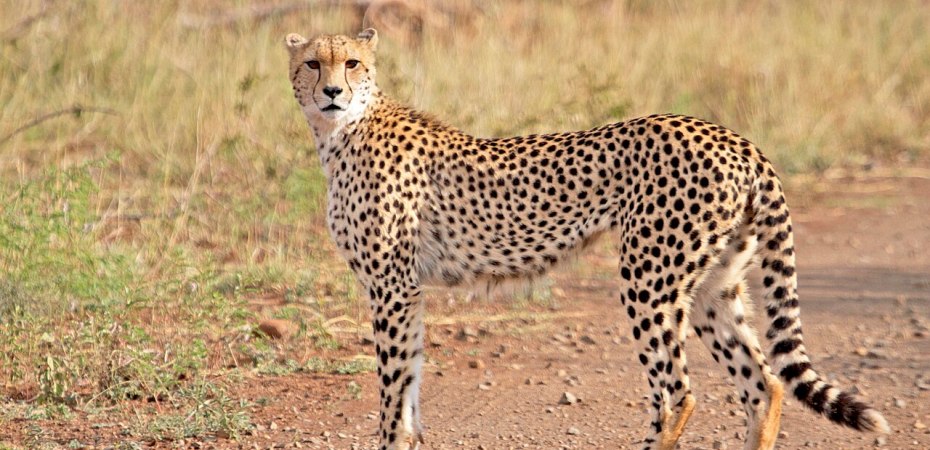
Featured image: A cheetah in South Africa’s Kruger National Park, by Will Sweet, CC BY-SA 2.0.
Sources:
- Evermann, J. F.; Heeney, J. L.; Roelke, M. E.; McKeirnan, A. J.: and O’Brien, S. J 1988. Biological and pathological consequences of feline infectious peritonitis virus infection in the cheetah. Archives of virology, 102(3): 155-171.
- Hernandez, R. (OPB). April 3, 2026. Cheetah researcher and conservationist Laurie Marker shows how her career began in Oregon. https://www.opb.org/article/2026/04/03/cheetah-researcher-laurie-marker-tol/

