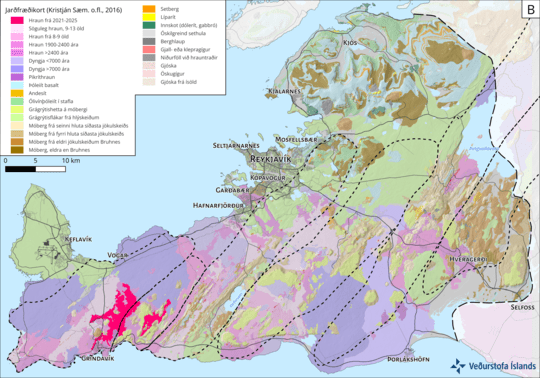
Iceland has begun to publish their long-term assessment of volcanic risk on the Reykjanes Peninsula, which awoke earlier this century from an 800-year-plus nap.
As they say themselves, “To compile a volcanic hazard assessment in a single project for a region with seven volcanic systems, sixteen municipalities and a number of critical infrastructures is unique in the world.”
It is ambitious but very necessary since they are on an island AND most of the population lives on this peninsula.
Here is the header to their article. The link will autotranslate that page into English, as well as the landing page for the new website (which is in beta version and, at the time of writing, doesn’t have the English version up yet):
The first part of the long-term risk assessment for lava flows on the Reykjanes Peninsula has been published.
The reports are part of a comprehensive assessment of volcanic hazards across the entire peninsula.
21.4.2026Main results for lava flows
• A long-term risk assessment for lava flows indicates which areas are potential eruption sites and which areas could be exposed to lava flows based on the area’s volcanic history.
• The assessment is not intended to predict where and when the next eruption will occur or whether lava will flow in a specific area in the coming years.
• The main goal of the assessment is to reduce damage with a focus on infrastructure, and the results are an important input into urban and land use planning.
• Results showing the “top 10% likely impact areas” on the Reykjanes Peninsula include two urban areas, four power plants, and two water sources.
• Scenarios presented in the reports show that the majority of the current settlements in the capital area are in areas where the probability of lava flows is assessed as “very low” or “low”.
• The results in the reports support what was already known and do not revolutionize knowledge of where lava hazards lie for settlements and infrastructure on the Reykjanes Peninsula.
• In parallel with the publication of the reports, the Icelandic Meteorological Office has launched a website and interactive map viewer.
About volcanic hazard assessment
• The two reports released today are part of the Icelandic Meteorological Office’s extensive project to assess the comprehensive volcanic hazard across the entire Reykjavik Peninsula.
• A total of four reports have been published in the project, which began in early 2024 and is due to be completed in 2027. This year, four more reports on fissure risk, two more reports on lava risk and one report on earthquake risk will be added.
Reports of volcanic eruptions, gas pollution, and groundwater contamination will follow next year.• To compile a volcanic hazard assessment in a single project for a region with seven volcanic systems, sixteen municipalities and a number of critical infrastructures is unique in the world.
• The results of a long-term risk assessment do not answer what is considered an “acceptable risk” in terms of living or operating in the area, but they do provide the basis for such a conversation and decision-making.

