The geysers we have visited in the last two posts aren’t the only hydrothermal features in and around Yellowstone Caldera.
But first, where do all these features come from?
In the following video, a ranger explains it. (I had some audio quality problems with it so, just in case, here also is the Park Service’s excellent page.)
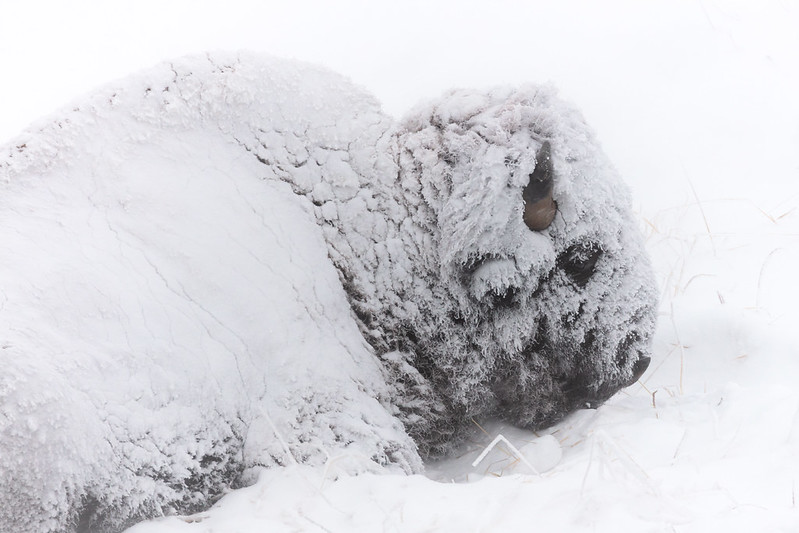
“Spring cannot get here too soon.” (Image: Yellowstone National Park, public domain)
Basically, much of that winter precipitation percolates into the ground (most of which is soil that formed out of rhyolite lava or rhyolite tuff). This groundwater forms an aquifer that gets heated and gassed by the magma reservoir sitting several miles below the ground surface. Chemical reactions turn that ordinary water into hydrothermal fluids that convect underground. (Lowenstern et al.)

Dietmar Rabich via Wikipedia, CC BY-SA 4.0
These fluids vent in several areas in and around the caldera, with the hottest and most active geysers and nonacid hot springs forming in topographic lows over the caldera’s collapse fracture zones. (Christiansen et al.)
Yes, there are acid hot springs and fumaroles, too — mainly located in topographic highs on or near those collapse fracture zones, as well as on parts of the northeast caldera rim. (Christiansen et al.)
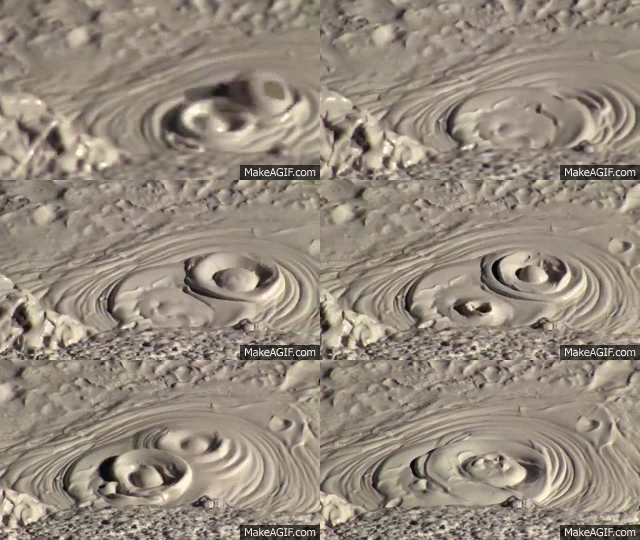
What’s really cool about some of these is that the acid turns Yellowstone’s rhyolite into clays and muds. (Lowenstern and Hurwitz)
For instance —
Unlike the geysers, these “vapor-dominant systems” operate mostly on gas and steam, although there still is quite a bit of fluid in the ground. Many of these large systems of mud pots, fumaroles, and acid pools are in the eastern part of the park. (Christiansen et al.)
Ask a chemist about Yellowstone’s acid pools and you will get a very enthusiastic answer!
To the north, bedrock changes and the groundwater also is not so acidic.
Instead of getting silica from rhyolite, which forms sinter — for example, the rocky pedestal that Old Faithful erupts from —
Incidentally, that “mountain” behind Old Faithful is part of one of the voluminous and sticky lava flows that have occurred during the roughly 630,000 years since the last supereruption. The most recent of these intracaldera lava flows occurred some 70,000 years ago.
— hydrothermal fluids in areas like Mammoth Hot Springs are loaded with calcium, which produces beautiful effects:
💧💧💧
💧💧💧
For lagniappe:
If I ever get to Yellowstone, it will be in a season when a light dusting of snow can make a morning walk feel cozy —
— as comfy and warm as these winter bison are in the Midway Geyser Basin:
Featured image: Make A GIF.
Sources:
- Christiansen, R. L.; Lowenstern, J. B.; Smith, R. B.; Heasler, H.; and others. 2007. Preliminary assessment of volcanic and hydrothermal hazards in Yellowstone National Park and vicinity. U. S. Geological Survey. (PDF)
- Lowenstern, J. B.; Smith, R. B.; and Hill, D. P. 2006. Monitoring super-volcanoes: geophysical and geochemical signals at Yellowstone and other large caldera systems. Philosophical Transactions of the Royal Society A: Mathematical, Physical and Engineering Sciences, 364(1845): 2055-2072.
- Lowenstern, J. B., and Hurwitz, S. 2008. Monitoring a supervolcano in repose: Heat and volatile flux at the Yellowstone Caldera. Elements, 4(1): 35-40.
- Poland, M. 2020. Caldera Chronicles: Caldera Systems — A World-Wide Family That Is More Than Just Yellowstone.

