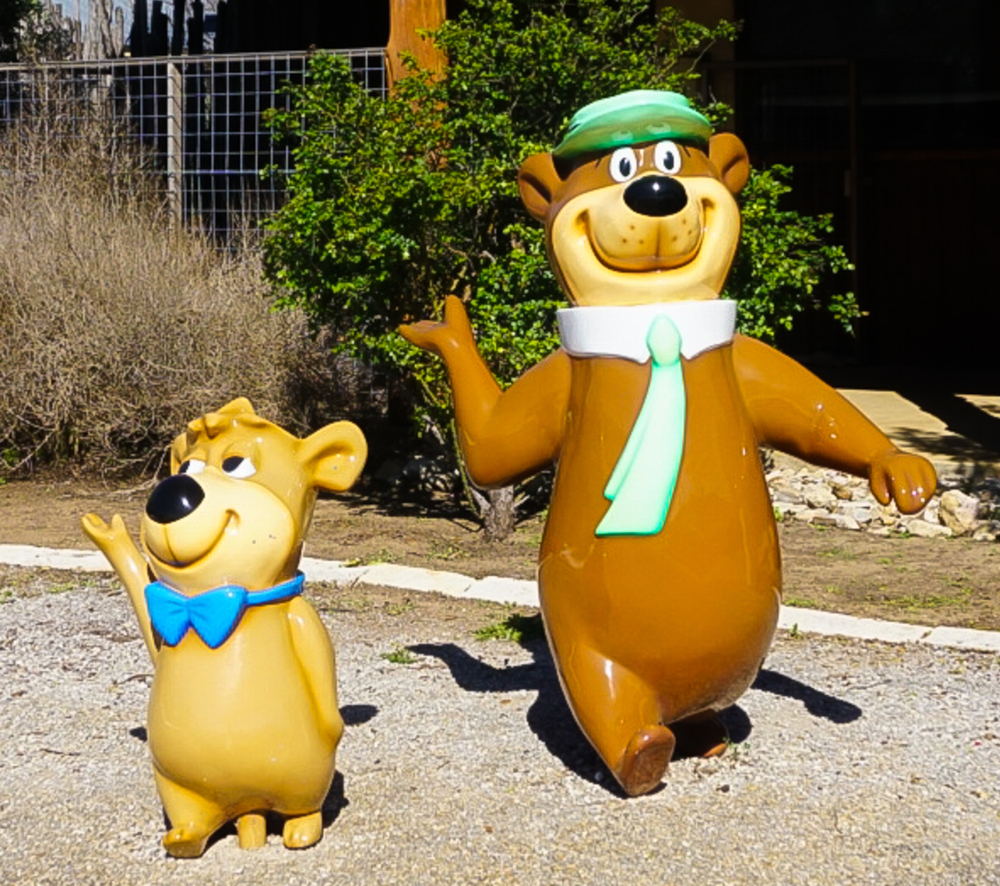
Yogi and Boo-Boo, still working in 2018, Fredericksburg, Texas. (Image: Jacqueline F. Cooper/Shutterstock)
What if Yellowstone had erupted during the innocent “feed the bears” days of the 1950s?
Fiction is too difficult a thing for me to attempt, but a good writer could go into great detail about the post-WWII American public’s very human reactions to precursory changes in “Jellystone’s” geysers and hot springs; the ground swelling and tree die-offs; scary fish kills at fly-fishing ponds and streams, and animals dropping dead at low spots all over the park; the new stench of sulfur everywhere, occasionally at toxic levels; and then, a flurry of strong earthquakes, followed by that astonishing and explosive plume — under which a great flow of rhyolite lava would creep out across the land for weeks and possibly even months to years.
Obsidian can form when rhyolitic lava cools too quickly to crystallize. (Yes, we’ve seen this video before, but rhyolite eruptions have been scarce during historic times and footage of an active lava flow is even scarcer.)
This being the 1950s, when most American adults knew firsthand the horrors of global war and the hungry, desperate times of economic depression before that, our story of a fictional Yellowstone eruption would have a happy ending.
With new and a few surviving old hydrothermal features; with its land devastated by wildfires that were set off by the lava, and still showing abundant evidence of volcanic ash from the eruption’s initial plinian-style phreatomagmatic bursts; with the famous bison herds still present but much reduced in numbers — with all that, the park would reopen.
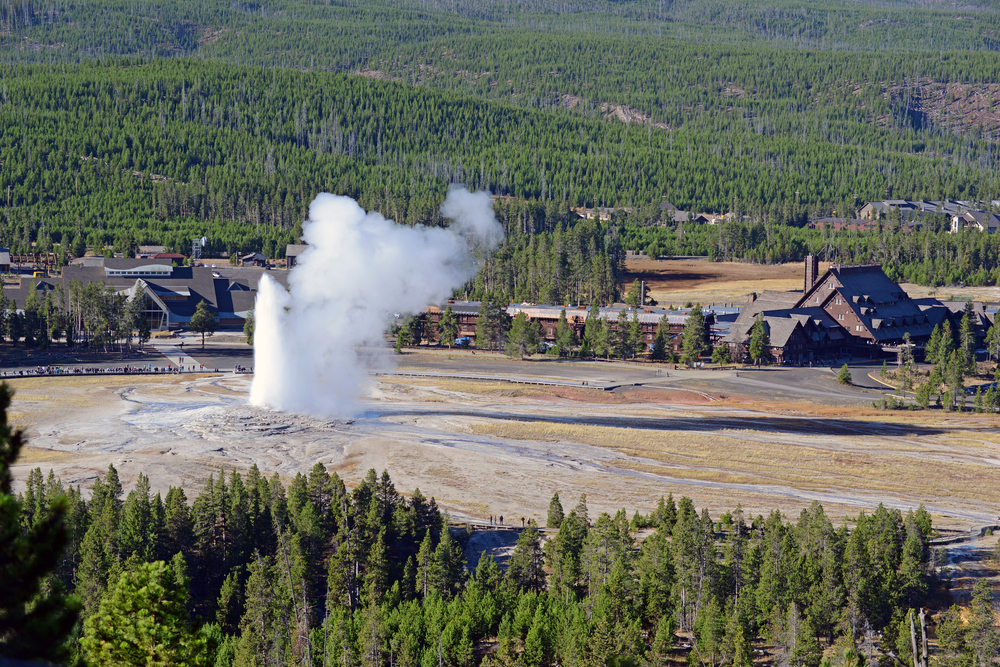
The inn and Old Faithful in real life, 2015, by nyker/Shutterstock
Thousands of people from around the world would attend the dedication ceremony of a new (and identically reconstructed) Old Faithful Inn, with Old Faithful itself still working (although less predictable) and now even taller whenever it did go off.
Then everybody would get into tour buses and go look at the new and massive Eisenhower Lava Flow — the latest of Yellowstone’s natural wonders!
🚙🏕🎣🥾
What?
You were expecting a supereruption?
If I were a novelist, yes, I would set off a supereruption in Yellowstone back in the day (after safely removing the US Geological Survey teams who in real life were busy mapping this complex volcano during the 1950s and were starting to realize its immense size); I would explore how different our lives in the 2020s might be because of that hypothetical mid-twentieth century catastrophe.
However, we must be realistic for this series.
I cannot write fiction well, and according to everything that I have read:
- Chances of any eruption in or around the Yellowstone Caldera during our lifetime are extremely low. (Stelten, 2024)
- The most likely type of eruption, if and when one comes, would be a lava flow, probably a runny red basalt flow outside but near the caldera; less likely — a sticky gray rhyolite flow, as described above, inside the caldera, similar to those that have occurred since that enormous Lava Creek supereruption formed Yellowstone Caldera about 630,000 years ago. The last rhyolite flow here happened about 70,000 years ago. (De Silva and Self; Lowenstern et al.; Schmandt et al.; Wilson et al.)
- I say “if” because some volcanologists suspect that Yellowstone might be on the way out, just as every one of its predecessors along the Eastern Snake River Plain hotspot track has gone out during the last 13 million years or so. (Mastin et al.; USGS; Watts et al.)
If true, this naturally raises a question about when and where the next “Yellowstone” will burst forth, but I haven’t seen any mention of it — which doesn’t mean that it hasn’t been addressed by scientists, of course: they address everything. It would occur too far in the future to have any relevance for us.
But what if the volcano were to decide that, statistics or no statistics, now is the time and we therefore saw headlines about the alert level being raised at Yellowstone and the park being closed?
Would we laypeople be any better prepared for it than folks in the 1950s would be?
Arguably we’d be worse off because we have been conditioned by sensational and clickbait presentations to expect the worst from any Yellowstone eruption.
Relax. The real hazards that you and I might actually face during our lives are not that extreme.
But experts are concerned that public perceptions of the volcanic threat from Yellowstone are such that the mere news of an impending eruption there — again, probably a lava flow that would just disrupt park operations (Lowenstern et al.) — could have serious socioeconomic impacts. (Wilson et al.)
Getting to know Yellowstone better
Fortunately for us all, geoscientists continued their mapping through the 1950s and 1960s, identifying what some today call the Yellowstone Plateau Volcanic Field.
It is composed of (Christiansen et al., 2002, 2007; Lowenstern et al.):
- Multiple calderas (at least four of them: three biggies — Yellowstone [Lava Creek Tuff], Island Park [Huckleberry Ridge Tuff], Henry’s Fork [Mesa Falls Tuff] — and the much smaller but still Crater-Lake-sized Bluff Point)
- At least thirty-three smaller vents that have erupted since the last supereruption formed Yellowstone Caldera
- Hydrothermal features, not only in and around Yellowstone Caldera but also scattered across the plateau
- The most prominent geoid high spot in the Western US. It is centered on Yellowstone. (Schmandt et al.)
In the late 1970s, geologists made a disquieting discovery.
Leveling surveys were performed in the park for the first time in fifty years. These showed that Yellowstone Caldera’s surface was almost 2½ feet higher than it had been at the time they did the last survey, in the 1920s. (Christiansen et al., 2002)
Needless to say, the boffins were on that like white on rice, and they learned that this was not an ominous sign: as they watched closely and time passed, it became apparent that, just like many other restless calderas (Acocella et al.), Yellowstone “breathes.”
By now, most of us have heard about this phenomenon in the Norris Geyser Basin, but it goes on inside the caldera, too, sometimes involving the whole thing, sometimes just parts of it. (Christiansen et al., 2007)
Cool fact: Yellowstone’s two resurgent domes, at Mallard Lake and Sour Creek, operate independently; one can be rising a bit while the other subsides or doesn’t move at all, and vice versa! (Lowenstern et al.)
There was no big public panic in the 1970s about the startling discovery of uplift at Yellowstone because no one told us about it.
This wasn’t sneakiness. Experts wanted to know more about it so they could make useful recommendations if it was a sign of looming trouble.
They saw subsidence, instead, and then a little uplift, then subsidence — in short, they realized that ground deformation and the accompanying earthquake swarms are just part of Yellowstone’s baseline behavior.
No, we members of the public didn’t get angsty over Yellowstone until 2000, when the BBC informally introduced us to the term “supervolcano.” (Miller and Wark, among other experts, later formalized it; per the National Park Service, some volcanologists prefer not to use the word because these volcanoes do have many more regular-sized eruptions than their one or more biggies).
Well.
We have been flooded with media coverage, not always reliable, ever since.
Cool, but not an accurate depiction of volcanism, let alone a supereruption. Check out the BBC/Discovery docudrama “Supervolcano” for a best-guess version of what that might be like; Miller and Wark call it realistic. Of course, we’ll never know for sure until one happens somewhere in the world.
But public interest can translate into research funding. (De Silva and Self)
During the twenty-some years since the BBC Horizons show on Yellowstone, lots of research into supervolcanoes has been done all over the world and, of course, at Yellowstone. In the US, the Yellowstone Volcano Observatory (YVO) started up in 2001. (Christiansen et al., 2007; Wilson et al.)
YVO’s website gives us goodies like a status report (Yellowstone is currently Normal/Aviation Code Green); live monitoring data; a variety of FAQs, maps, and multimedia; lots of background in the “Caldera Chronicles” and other web pages there; and, yes, they will also answer emailed questions.
That is the website we all will turn to for up-to-date and reliable information if — a big “if” — Yellowstone ever does wake up during our lifetime to burp out a little lava.
I could just leave this blog post at that, but there is so much more to Yellowstone. It’s interesting and, also, what I have learned in reading answers some questions and corrects some misconceptions that most of us didn’t even know we had.
For instance, in that BBC Horizons story linked above, why did Dr Christiansen attribute the deaths of all those poor Pleistocene rhinos out on the Great Plains to something called “Bruneau-Jarbridge” as if it was Yellowstone?
As for misconceptions, did you know that there might not actually be a deep mantle plume underneath Yellowstone and its famous hotspot track?
Scientific hypotheses to explain Yellowstone have always been controversial (Christiansen et al., 2007) — much more so than the nature programs typically show us.
In fact, a study published in April 2026 might show proof that this hotspot’s roots are shallower than previously thought (there’s no need for us to stress out over this — it’s a boffin thing and an interesting factoid, not something that changes everyone’s understanding of hazard here).
Speaking of hazard, a 2025 study reported finding a natural “safety valve” atop the Yellowstone magmatic system that lets gas escape instead of accumulating and pressurizing the reservoir down there (as usually happens before volcanoes erupt).
Yay!
But to understand that news in context, we need to get better acquainted with Yellowstone’s plumbing…next time!
For lagniappe…
Good luck digging up that pot’o’gold!
Featured image: inick25x/Shutterstock
Sources:
- Acocella, V.; Di Lorenzo, R.; Newhall, C.; and Scandone, R. 2015. An overview of recent (1988 to 2014) caldera unrest: Knowledge and perspectives. Reviews of Geophysics, 53(3): 896-955.
- Christiansen, R. L.; Foulger, G. R.; and Evans, J. R. 2002. Upper-mantle origin of the Yellowstone hotspot. Geological Society of America Bulletin, 114(10): 1245-1256.
- Christiansen, R. L.; Lowenstern, J. B.; Smith, R. B.; Heasler, H.; and others. 2007. Preliminary assessment of volcanic and hydrothermal hazards in Yellowstone National Park and vicinity. U. S. Geological Survey.
- DeSilva, S. and Self, S. 2022. Capturing the extreme in volcanology: the case for the term “supervolcano”. Frontiers in Earth Science, 10: 859237.
- Lowenstern, J. B.; Smith, R. B.; and Hill, D. P. 2006. Monitoring super-volcanoes: geophysical and geochemical signals at Yellowstone and other large caldera systems. Philosophical Transactions of the Royal Society A: Mathematical, Physical and Engineering Sciences, 364(1845): 2055-2072.
- Mastin, L. G.; Van Eaton, A. R.; and Lowenstern, J. B. 2014. Modeling ash fall distribution from a Yellowstone supereruption. Geochemistry, Geophysics, Geosystems, 15(8): 3459-3475.
- Miller, C. F. and Wark, D. A. 2008. Supervolcanoes and their explosive supereruptions. Elements, 4(1): 11-15.
- National Park Service. ___ “Super Volcanoes.” https://www.nps.gov/articles/000/-super-volcanoes.htm Last accessed November 13, 2024.
- Schmandt, B.; Jiang, C., and Farrell, J. 2019. Seismic perspectives from the western US on magma reservoirs underlying large silicic calderas. Journal of Volcanology and Geothermal Research, 384: 158-178.
- Stelten, M. 2024. So, when will the next eruption at Yellowstone happen? https://www.usgs.gov/observatories/yvo/news/so-when-will-next-eruption-yellowstone-happen
- US Geological Survey (USGS) ___ Questions about supervolcanoes https://www.usgs.gov/volcanoes/yellowstone/questions-about-supervolcanoes Last accessed November 13, 2024
- Watts, K. E.; Bindeman, I. N.; and Schmitt, A. K. 2012. Crystal scale anatomy of a dying supervolcano: an isotope and geochronology study of individual phenocrysts from voluminous rhyolites of the Yellowstone caldera. Contributions to Mineralogy and Petrology 164.1 (2012): 45-67.
- Wilson, C. J.; Cooper, G. F.; Chamberlain, K. J.; Barker, S. J.; and others. 2021>. No single model for supersized eruptions and their magma bodies. Nature Reviews Earth & Environment, 2(9): 610-627.

