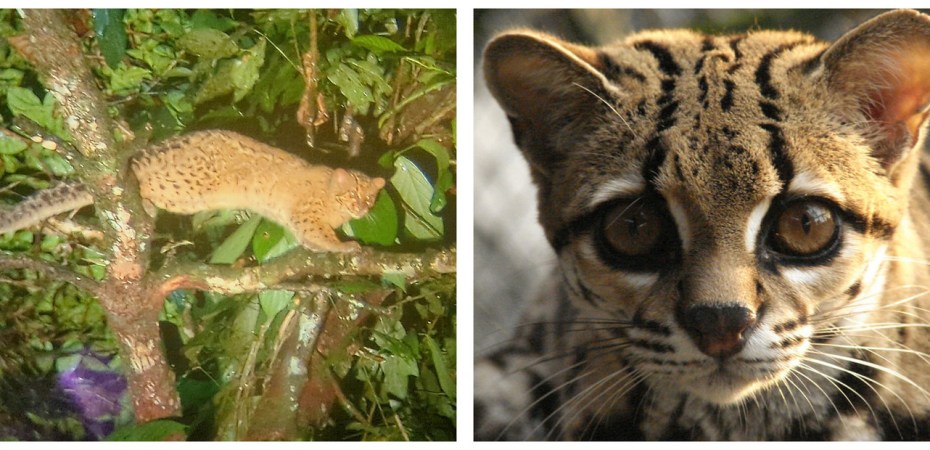
What do a Latin American small cat and a little Asian forest kitty have in common?
Besides beautiful coats, agility in trees, and major adorability, they are among the few cat species that can do this:
Neither species is well-known to most of us laypeople, and the marbled cat is extremely rare.
So let’s have an introduction to them today from the cat eBooks and then spend the rest of May’s Fridays finding out what they are up to in the wide natural world.
The marbled cat
Two subspecies have been recognized, but the names are debatable. Per the Cat Specialist Group and IUCN, these are:
- Pardofelis marmorata marmorata: Cats with grayer background fur and large “marbling,” found on Borneo, Sumatra, the southern Malay Peninsula, and southern Thailand.
- Pardofelis marmorata longicaudata: These are more yellowish-brown and don’t have as many “marble” blotches. Such marbled cats have been seen from Nepal to northeastern India and Bangladesh. and in Southeast Asia, including the northern part of the Malay Peninsula.
Lineage:
Bay cat (some call this the Asiatic golden cat lineage).
Outstanding Features:
- A more rounded head than most cats have, with a wide face and tiny ears that aren’t very pointed. (Cat Specialist Group)
- Marbled cats may be the oldest members of their lineage, i.e., older than bay cats and Asiatic golden cats. Phylogenetic studies suggest that today’s marbled cat goes back some six to six and a half million years. (Johnson et al.; Nyaktura and Bininda-Emonds)
- Since clouded leopards are the only other member of family Felidae with such a coat and are probably also the oldest line of modern big cats, Werdelin et al. speculate that this remarkable look might be the last remnant of a primitive coat pattern that all cats once had. While fascinating, this hypothesis is very difficult to prove, since fur patterns don’t fossilize.
- Arboreal adaptations. Marbled cats have unusually large feet for their size, as well as short, sturdy legs and a very long tail. In general, these physical characteristics help a variety of tree-top carnivores earn their living. Marbled cats are also one of only three feline species whose ankles can move through 180 degrees. This allows them to climb down trees head first. It’s tempting to think that such ankle flexibility, like the blotchy coat, might be a primitive feature, too, since clouded leopards and Latin America’s margay — the other two cats that are able to do this — are also very old species. However, what few fossils have been found of the very first known cats, some 20 million years ago, show that they had “normal” ankles like those seen on most cats today. (Cat Specialist Group; Kitchener et al., 2010; Turner and Antón; Werdelin et al.)
“Chermundy via Wikimedia, CC BY-SA 3.0
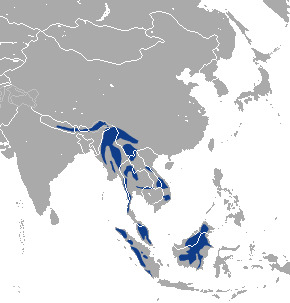
Marbled cats inhabit remote areas and may be rarer than other local small cats. They were first photographed only in the mid-1990s, when camera-traps became a thing, and their distribution still isn’t well understood. There seem to be small, isolated marbled cat populations that are spread out over a broad geographic range — from Nepal and northeastern India all the way to Yunnan Province in western China, and southward through Indochina to the islands of Sumatra and Borneo.
Marbled cats have been sighted from sea level up to almost 10,000 feet. They appear to depend on forests, particularly tropical rainforest and other moist woods. However, some have been found in plantations and previously logged stands.
The margay
In the past, boffins have identified up to eleven subspecies but that’s debatable now.
Kitchener et al. (2017) suspect there might be only three margay subspecies:
- Leopardus wiedii wiedii, south of the Amazon
- L. w. vigens, in South America north of the Amazon
- L. w. glauculus, in Central America
Lineage:
Ocelot.
Outstanding Features:
- Distinctive physical characteristics like huge, bulging eyes, which narrow this nocturnal predator’s muzzle and make the nose look almost pug-like; very large paws, the better to grasp tree bark and branches; and a long, thick tail that helps these cats balance during their tree-top acrobatics.(Cat Specialist Group; Kitchener et al., 2010)
- Strongly associated with forests, and better adapted to them than other tropical cats in the Americas. This fondness for trees misled early researchers into thinking that margays spend most of their lives up in the canopy. Camera traps and other studies now show that the margay probably just rests up there during the day, and at night it hunts and travels on the ground. But, while other cats are fairly flexible about their surroundings, margays do live almost exclusively in forests. Modeling by Espinosa et al. suggests that this might be due to the humidity and fairly steady temperatures that tropical forests provide. (Cat Specialist Group; Migliorini et al.; de Oliveira et al., 2010)
- The only New World cat with 180-degree ankles. With this feature, a margay’s hind feet can hold on while the cat comes out of a tree head first. Most other kitties would fall. Asia’s marbled cats and clouded leopards are the only other members of family Felidae with this ankle flexibility. (Cat Specialist Group; Migliorini et al.; de Oliveira et al., 2010)
- Not much sexual dimorphism. That sounds a little funky, but it only means that males and females are about the same size. Most other cats are dimorphic, that is, the males are bigger than the females. (Cat Specialist Group; de Oliveira et al. (2015))
- One of the Latin American cats most heavily exploited by the fur trade until the 1980s. Between the mid-1970s and mid-1980s, at least 125,000 margay pelts were traded. This species were added to the international treaties protecting endangered species in the late 1980s and it really helped. However, illegal hunting continues in some areas. (Cat Specialist Group)
BhagyaMani via Wikimedia, CC BY-SA 4.0
Margays are occasionally seen in the US Southwest, but these are probably just individuals from Mexico, wandering around.
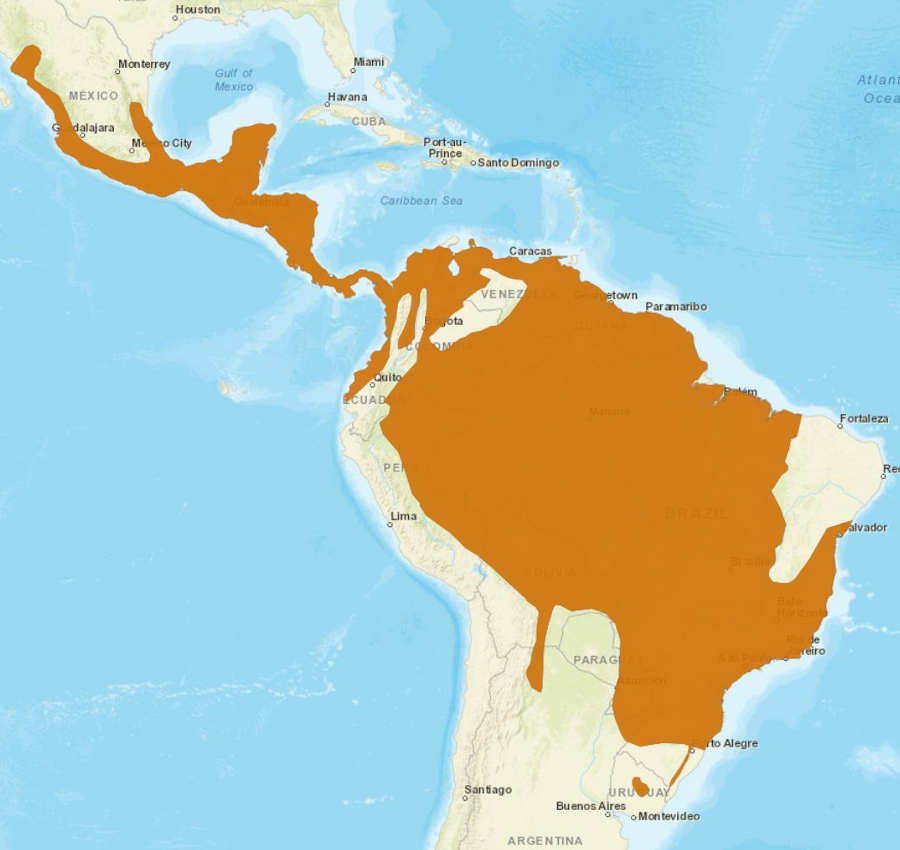
The margay’s main range isn’t well understood yet, since this is a shy, elusive forest dweller and very difficult to track. Per latest reports by the Cat Specialist Group and de Oliveira et al. (2015), breeding populations of margays are probably distributed from Mexico’s lowlands in the north down through Central America and into South America as far Uruguay and northern Argentina.
Their main stronghold probably is the Amazon Basin. Margays are common in some parts of Central America, but outside of Amazonia they seem to be rare, perhaps because of the “ocelot effect” (ocelots — bigger than margays and the dominant tropical small cat in the Americas — sometimes prey on their smaller feline neighbors, who therefore avoid them). (Cat Specialist Group; de Oliveira et al, 2010 and 2015)
Margays appear to be most comfortable from sea level up to around 5,000 feet, but they’ve been seen at elevations almost twice that high in the Andes. At those heights, plants must sometimes depend on passing clouds for moisture. Besides cloud forests, margays hunt through humid foothill woods, among deciduous trees, and in subtropical forests, as well as in the Amazon rainforest. They will use human-altered environments, like abandoned plantations, but seem to be less tolerant of such changes than tiger cats or ocelots. (Cat Specialist Group)
For lagniappe:
Featured image: Marbled cat (left) by Harsha Jayaramaiah via Wikipedia, CC BY-SA 4.0; Margay (right) by Márcio Motta, CC BY-NC-ND 2.0.
Sources:
Marbled cat:
- Cat Specialist Group. 2019. Marbled cat. http://www.catsg.org/index.php?id=122 Last accessed July 3, 2019.
- Hearn, A. J.; Ross, J.; Bernard, H.; Bakar, S. A.; and others. 2016. The first estimates of marbled cat Pardofelis marmorata population density from Bornean primary and selectively logged forest. PLoS One, 11(3): e0151046.
- International Society for Endangered Cats. 2020. Marbled cats. https://wildcatconservation.org/wild-cats/asia/marbled-cat/ Last accessed May 5, 2020.
- Johnson, W. E.; Eizirik, E.; Pecon-Slattery, J.; Murphy, W. J.; and others. 2006. The Late Miocene Radiation of Modern Felidae: A Genetic Assessment. Science, 311: 73-77.
- Kitchener, A. C.; Van Valkenburgh, B.; and Yamaguchi, N. 2010. Felid form and function, in Biology and Conservation of Wild Felids, ed. Macdonald, D. W., and Loveridge, A. J., 83-106. Oxford: Oxford University Press.
- Kitchener, A. C.; Breitenmoser-Würsten, C.; Eizirik, E.; Gentry, A.; and others. 2017. A revised taxonomy of the Felidae: The final report of the Cat Classification Task Force of the IUCN Cat Specialist Group. https://repository.si.edu/bitstream/handle/10088/32616/A_revised_Felidae_Taxonomy_CatNews.pdf
- Luo, S. J.; Zhang, Y.; Johnson, W. E.; Miao, L.; and others. 2014. Sympatric Asian felid phylogeography reveals a major Indochinese–Sundaic divergence. Molecular Ecology, 23(8): 2072-2092.
- Macdonald, D. W.; Loveridge, A. J.; and Nowell, K. 2010. Dramatis personae: An introduction to the wild felids, in Biology and Conservation of Wild Felids, eds. Macdonald, D. W., and Loveridge, A. J., 3-58. Oxford: Oxford University Press.
- McCarthy, J. L.; Wibisono, H. T.; McCarthy, K. P.; Fuller, T. K.; and Andayani, N. 2015. Assessing the distribution and habitat use of four felid species in Bukit Barisan Selatan National Park, Sumatra, Indonesia. Global Ecology and Conservation, 3: 210-221.
- Nyakatura, K., and Bininda-Emonds, O. R. P. 2012. Updating the evolutionary history of Carnivora (Mammalia): a new species-level supertree complete with divergence time estimates. BMC Biology, 10: 12.
- O’Brien, S. J., and Johnson, W. E. 2007. The evolution of cats. Scientific American. 297 (1): 68-75.
- Ross, J.; Brodie, J.; Cheyne, S.; Datta, A.; and others. 2016. Pardofelis marmorata. The IUCN Red List of Threatened Species 2016: e.T16218A97164299. https://www.iucnredlist.org/species/16218/97164299
- Sunarto, S.; Kelly, M. J.; Parakkasi, K.; and Hutajulu, M. B. 2015. Cat coexistence in central S umatra: ecological characteristics, spatial and temporal overlap, and implications for management. Journal of Zoology, 296(2): 104-115.
- Sunquist, M. and Sunquist, F. 2002. Wild Cats of the World. Chicago and London: University of Chicago Press. Retrieved from https://play.google.com/store/books/details?id=IF8nDwAAQBAJ
- Turner, A., and Antón, M. 1997. The Big Cats and Their Fossil Relatives: An Illustrated Guide to Their Evolution and Natural History. New York: Columbia University Press.
- Werdelin, L.; Yamaguchi, N.; Johnson, W. E.; and O’Brien, S. J. 2010. Phylogeny and evolution of cats (Felidae), in Biology and Conservation of Wild Felids, eds. Macdonald, D. W., and Loveridge, A. J., 59-82. Oxford: Oxford University Press.
- Wikipedia. 2019. Marbled cat. https://en.wikipedia.org/wiki/Marbled_cat Last accessed July 3, 2019.
Margay:
- Cat Specialist Group. 2019. Margay. http://www.catsg.org/index.php?id=89 Last accessed December 28, 2019.
- Culver, M.; Driscoll, C.; Eizirik, E.; & Spong, G. 2010. Genetic applications in wild felids, in Biology and Conservation of Wild Felids, ed. Macdonald, D. W., and Loveridge, A. J., 107-124. Oxford: Oxford University Press.
- Espinosa, C. C.; Trigo, T. C.; Tirelli, F. P.; da Silva, L. G.; and others. 2017. Geographic distribution modeling of the margay (Leopardus wiedii) and jaguarundi (Puma yagouaroundi): a comparative assessment. Journal of Mammalogy, 99(1): 252-262.
- Johnson, W. E.; Eizirik, E.; Pecon-Slattery, J.; Murphy, W. J.; and others. 2006. The Late Miocene Radiation of Modern Felidae: A Genetic Assessment. Science, 311:73-77.
- Kitchener, A. C.; Van Valkenburgh, B.; and Yamaguchi, N. 2010. Felid form and function, in Biology and Conservation of Wild Felids, ed. Macdonald, D. W., and Loveridge, A. J., 83-106. Oxford: Oxford University Press.
- Kitchener, A. C.; Breitenmoser-Würsten, C.; Eizirik, E.; Gentry, A.; and others. 2017. A revised taxonomy of the Felidae: The final report of the Cat Classification Task Force of the IUCN Cat Specialist Group. https://repository.si.edu/bitstream/handle/10088/32616/A_revised_Felidae_Taxonomy_CatNews.pdf
- Migliorini, R. P.; Peters, F. B.; Favarini, M. O.; and Kasper, C. B. 2018. Trophic ecology of sympatric small cats in the Brazilian Pampa. PloS one, 13(7): e0201257. https://journals.plos.org/plosone/article?id=10.1371/journal.pone.0201257
- Murray, J. L., and Gardner, G. L. 1997. Leopardus pardalis. Mammalian species, (548): 1-10. https://academic.oup.com/mspecies/article-pdf/doi/10.2307/3504082/8071434/548-1.pdf
- de Oliveira, T. G., and Pereira, J. A. 2014. Intraguild predation and interspecific killing as structuring forces of carnivoran communities in South America. Journal of Mammalian Evolution, 21(4): 427-436.
- de Oliveira, T. G.; Tortato, M. A.; Silveira, L.; Kasper, C. B.; and others. 2010. Ocelot ecology and its effect on the small-felid guild in the lowland neotropics, in Biology and Conservation of Wild Felids, ed. Macdonald, D. W., and Loveridge, A. J., 559-580. Oxford: Oxford University Press.
- de Oliveira, T.; Paviolo, A.; Schipper, J.; Bianchi, R.; and others. 2015. Leopardus wiedii . The IUCN Red List of Threatened Species 2015: e.T11511A50654216 https://www.iucnredlist.org/species/11511/50654216
- Werdelin, L., and Olsson, L. 1997. How the leopard got its spots: a phylogenetic view off the evolution of felid coat patterns. Biological Journal of the Linnaen Society, 62: 383-400.
- Wikipedia. 2019. Margay https://en.wikipedia.org/wiki/Margay Last accessed December 28, 2019.
- Wikipedia (Spanish). 2019. Leopardus wiedii. https://es.wikipedia.org/wiki/Leopardus_wiedii Last accessed December 28, 2019.

