
Middle of the week. Hump day. Same old, same old — why doesn’t anything exciting ever happen?, you think as you step out the door to start your appointed round.
And suddenly you get your wish:

Relax. It’s only slightly bigger than a Siberian tiger. And, yes, those are saberteeth. (Image: Mauricio Antón, CC BY-NC-ND-SA 4.0)
In a voice-over (text at that link), Antón explains why there’s no need to panic — yet — despite your sudden and unexpected immersion in primal terror:
…Concerning body language, if the cat is walking upright and with a casual cadence, you have reason to think it is just minding its business rather than stalking you. A relaxed mouth further indicates lack of aggression, but ears pointing slightly backwards are less simple to read. In the general context of a relaxed animal they don’t mean much, but it could be the sabertooth is not very happy about something. Better observe it for a few seconds…
Right. Which way are its ears pointing — like you have time to notice that!
You don’t even remember getting back into the house again, but there you are.
Walls, floor, and ceiling shake as the door takes the impact of this huge beast’s weight — and HOLDS.
Yay! (Actually the cat really was out for a stroll, relaxed mouth and all, but your sudden flight triggered it. Eventually it will wander back into the mysterious Cave Felem Woods from which it emerged.)
After notifying those who need to know it that you won’t be coming in today, you totter back to bed, crawl under the covers, and start to read about yet another Late Miocene sabertoothed member of Family Felidae: Amphimachairodus giganteus.
What is Amphimachairodus?
It’s one of the first known Miocene sabercats in a line that, according to many experts, somehow developed into Homotherium (the other ice-age sabercat besides Smilodon).
Size varied a bit, but as we have seen, Amphimachairodus generally was about as big as or slightly larger than today’s big-cat recordholders: the African lion and the Siberian (Amur) tiger. (Antón, 2013; Jiangzou et al.; Werdelin et al.)
This was one big kitty!
A. coloradensis (a North American species recognized by some paleontologists) probably made the 5-inch fossil Miocene pawprints that have been found at the Coffee Ranch in Texas. They were fresh back when that dig site was a waterhole that drew animals from all over the dry, savanna-like Miocene landscape. (Antón, 2013)
A little like this, perhaps, but in North America, not manmade, and with the more primitive ancestors of modern plant-eaters and their predators; see Prothero for those Miocene critters. There weren’t lions yet, or any other modern cats like those that you’ll occasionally see on this live cam, but the Coffee Ranch lake did have some pseudaelurine visitors.
According to one study, Amphimachairodus stalked the world — well, the Northern Hemisphere and Africa — from about 9 to 5.3 million years ago (Werdelin et al.), so most of humanity’s ancestors lucked out and missed this particular terror that paleoartist Mauricio Antón has summoned up in his artwork. (They had plenty of others to worry about, though!)

Remember this South African Amphimachairodus/Adeilosmilus skull from last time?
One thing Amphimachairodus is not, despite its impressive cutlery, and that’s Smilodon — a Pleistocene sabercat, in a different tribe, that only went extinct some 20,000 years ago — not even yesterday in geology terms.
Did you have any idea that there were so many prehistoric sabercats?
I didn’t, until seeing Antón’s work in various places, especially Werdelin et al. and Agustí and Antón, which led me to Sabertooth.
He really brings fossil animals alive — not just cats — and has probably inspired a whole generation of paleoartists.
Disclosure: I am just a fan of this paleoartist and have no personal, financial, or business connection with Mauricio Antón. I just think that readers of my blog would like to know about “Sabertooth” and the artist’s blog Chasing Sabretooths.
Amphimachairodus: A paleontology star
The boffins apparently get as excited about Amphimachairodus as we laypeople do with Smilodon.
Wang et al. call Amphimachairodus charismatic — Antón, who describes it as one of the most impressive sabertooths ever (Antón, 2015a), has captured that quality very well in the image up above.
Here it is again. (Image: Mauricio Antón, CC BY-NC-ND-SA 4.0)
Remember “sabercats = Ferraris/modern cats = Model T’s” in this post?
Amphimachairodus was one of the early sabercats and so was a Ferrari/Model T combo, although its cranial features were more advanced than Pogy’s were, over in the Smilodontini tribe.
Behind the sabers and skull, its build was more or less primitive, like that of a tiger or lion, as far as is known — most fossils are fragments and Antón (2013) notes that no complete skeleton has been found yet.
But Antón also included some of the exceptions in his Amphimachairodus portrait:
- The typical massive chest and foreleg musculature of a sabercat — much more powerful than anything seen in today’s tigers and lions. You can’t see it in this view, but the cat’s neck is longer and very muscular, too.
- A different head shape, narrower than a modern big cat’s head and with smaller eyes
- Longer legs.
- The huge dewclaw (see it on the cat’s right forepaw?) and relatively short other toes — very similar to the paw of Lokotunjailurus, a close but even more primitively built relative, per Werdelin et al.
This fossil glamour puss has other unique features that make it a research magnet, too.
One is its remarkably long saberteeth, along with some skull modifications, suggesting that Amphimachairodus might have had a different killing bite from other sabercats of its time. Perhaps this was more efficient and boosted the cat’s success rate. (Antón, 2015a; Jiangzuo et al.; Werdelin et al.)
Something certainly gave Amphimachairodus wings, so to speak, as well as tremendous staying power. (You’re welcome, for the image of a giant winged sabercat terrorizing Earth from the sky.)
Once it got going, Amphimachairodus only took a blink of geologic time — 100,000 to 200,000 years — to spread across the whole Northern Hemisphere! Then it held on as the world changed and older sabertooths like the barbourofelids (coming to the blog in September) and Nimravides (August 29) disappeared. (Anton, 2015a; Jiangzuo et al.; Wang et al.)
In North America, Amphimachairodus vanished at the Miocene’s end, just before a distant descendant — Homotherium — arrived along with Megantereon, which would evolve into Smilodon.
🐾🐾🐾
Ecomorph/Tribe: Homotherini tribe, by all accounts, but just exactly how Amphimachairodus was related to Homotherium is still under debate.
That debate is interesting, but we must also meet Machairodus, Nimravides (not a nimravid, if you’re familiar with that group), and the Metailurini.
We are getting closer to the origin of sabercats now and this section of each post over the next few weeks will be expanded to discuss the earliest known sabercats in a little more detail before we get to Pseudaelurus quadridentatus — “P-Quad” is my nickname for the very likely founder of Machairodontinae, the “Knife-Tooths,” or sabercats of Family Felidae.
Location: Eurasia, Africa, and North America.
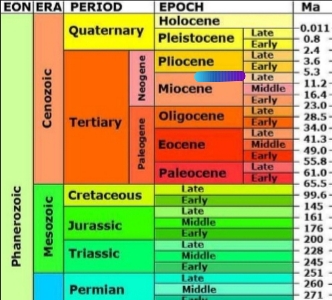
The blue-spectrum line is pointing at the Late Miocene. (Source, public domain)
Time: Late Miocene.
Satellite view: We are still in the Late Miocene, when Earth was cooling and drying out in middle latitudes, just as noted in other recent sabercat posts.
This video starts out with a satellite view of the culprit behind these changes: Antarctica.
They aimed for the Middle Miocene warm spell when even Antarctica hosted subtropical forests in some parts, while Pseudaelurus cats were hunting the tropical evergreen canopies of western Eurasia.
Then Antarctica started having ice ages. (Van Peer et al.) A number of explanations have been proposed for this unipolar freeze-up, but we don’t need to get into those here.
The world cooled overall. Sea levels dropped when more of Antarctica iced over and rose when some of the ice melted back.
But the ice cap got thicker in the latter half of that epoch; cooler climates brought less precipitation: more open, dry savanna-type lands spread: and, according to Agustí and Antón, sabertoothed cats in arid Asia followed Hipparion — a new and very successful North American immigrant across the Bering land bridge — into the fossil records of Asia Minor, Europe, and Africa.
Prey:
Anything Amphimachairodus wanted, much like the modern Siberian tiger:
The deadpan reassurance and advice to Canadian bears at the end cracks me up.
This was several million years ago, and there weren’t all that many modern-sized bears around yet (though in what’s now Langebaanweg, South Africa, Amphimachairodus — also known there as Adeilosmilus — might have chased the brown-bear-sized Agriotherium like that through a coastal forest).
More likely items on the menu in Eurasia would have been various antelopes, primitive giraffes (with short necks), rhinos, young proboscideans, and hipparionine (three-toed) horses. (Antón, 2013; 2015a)
In North America, A. coloradensis could choose from a rich assortment that included various rhinos (yes), diverse pronghorns, sundry camels (including one species with a long neck like the modern giraffe’s!), young mastodons, peccaries, and all sorts of primitive horses. (Prothero)
Of course, Amphimachairodus had favorites, and unlike Xenosmilus, it wasn’t peccaries.
Isotopic studies on fossils from a site in the Great Plains show that this sabercat ate a lot of horses. (Wikipedia)
And on the other side of the Bering Strait, it’s probably not a coincidence that the rich trove of Amphimachairodus fossils found in China is nicknamed the “Hipparion beds.” (Anton, 2013; Wang et al.)
Farther west, at the Pikermi fossil site near Athens where A. giganteus was first found, there are just so many Hipparion horse fossils. (Anton, 2013)
All diners need to change things up now and then. This illustration of a site in what’s now Spain shows Amphimachairodus sabercats relaxing near their bovine (autotranslated) kill.
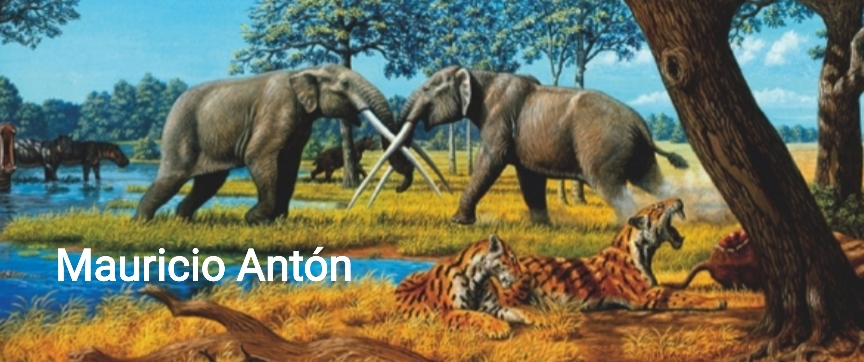
Figure 2.13, in “Sabertooth,” Antón 2013, CC BY-NC-ND-SA 4.0
In terms of competition, I’m still sorting it out.
In various places there were beardogs as well as bears, and some sizable hyena-like critters. With regard to other lion-sized cats, the way Amphimachairodus hung on during climate and habitat changes means that it overlapped with some other sabercat species as well as with the sabertoothed cat-like predators called barbourofelids in both western Eurasia and in North America; I’m not clear enough on all that to get into details yet.
And then there’s the question of where this sabercat came from — who was its daddy?
We will probably meet Amphimachairodus again next week, in the Machairodus post, as well as in the post after that, on Nimravides.
Featured image: coulombssymbol via Wikimedia.
Sources:
- Agustí, J., and Antón, M. 2002. Mammoths, sabertooths, and hominids: 65 million years of mammalian evolution in Europe. New York and Chichester: Columbia University Press. Retrieved from https://play.google.com/store/books/details?id=O17Kw8L2dAgC
- Antón, M. 2013. Sabertooth. Bloomington: Indiana University Press. Retrieved from https://play.google.com/store/books/details?id=dVcqAAAAQBAJ
- ___. 2015. Amphimachairodus coming your way — don’t panic. https://chasingsabretooths.wordpress.com/2015/12/11/amphimachairodus-coming-your-way-dont-panic/
- ___. 2015a. Don’t mess with Amphimachairodus: Sabertooth king of the Turolian. https://chasingsabretooths.wordpress.com/2015/12/03/dont-mess-with-amphimachairodus-sabertooth-king-of-the-turolian/
- Jiangzuo, Q.; Li, S.; and Deng, T. 2022. Parallelism and lineage replacement of the late Miocene scimitar-toothed cats from the old and New World. Iscience: 25(12).
- Prothero, D. R. 2006. After the Dinosaurs: The Age of Mammals. Bloomington and Indianapolis: Indiana University Press. Retrieved from https://play.google.com/store/books/details?id=Qh82IW-HHWAC.
- Ruiz-Ramoni, D.; Montellano-Ballesteros, M.; Rincón, A. D.; Solórzano, A.; and Guzmán, G. 2020. Presence of Amphimachairodus coloradensis (Cook, 1922)(Felidae: Machairodontinae) in the Neogene of Hidalgo, Central Mexico. Journal of South American Earth Sciences, 100: 102550.
- Van Peer, T. E.; Liebrand, D.; Taylor, V. E.; Brzelinski, S.; and others. 2024. Eccentricity pacing and rapid termination of the early Antarctic ice ages. Nature Communications, 15(1): 10600.
- Wang, X.; Carranza-Castañeda, O.; and Tseng, Z. J. 2023. Fast spread followed by anagenetic evolution in Eurasian and North American Amphimachairodus. Historical Biology, 35(5): 780-798.
- Werdelin, L.; Yamaguchi, N.; Johnson, W. E.; and O’Brien, S. J. 2010. Phylogeny and evolution of cats (Felidae), in Biology and Conservation of Wild Felids, eds. Macdonald, D. W., and Loveridge, A. J., 59-82. Oxford: Oxford University Press.
- Wikipedia. 2025. Amphimachairodus. https://en.m.wikipedia.org/wiki/Amphimachairodus Last accessed July 22, 2025
 Flight To Wonder