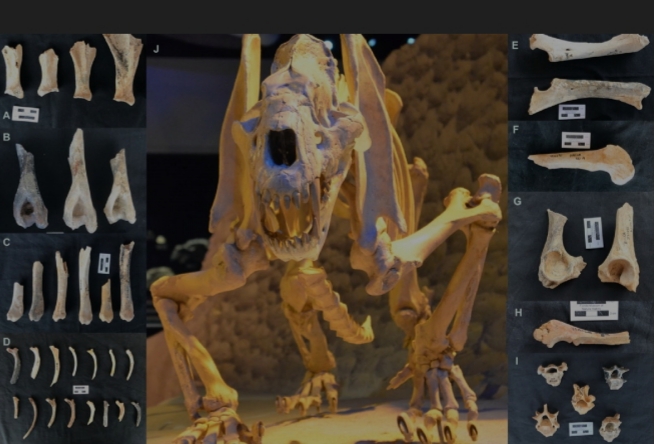
Gah! What’s this — the boss in a sabertooth nightmare game?
And yes, those are the bones of its victims arranged around this lion-sized skeletal sabertooth! (Dominguez-Rodrigo et al.)
Note, though, that they are not human bones, per Dominguez-Rodrigo et al., who made that image for Figure 1 (CC BY-NC-ND-SA 4.0) in their paper on the eating habits of Xenosmilus.
The story behind its dinner is actually kind of endearing (unless your scientific name is Platygonus).
A fanciful tale of two bro’s
First of all, Antón’s reconstructed Xenosmilus isn’t all that scary looking (in an image, anyway!):

Mauricio Antón via Wikimedia, CC BY-SA 3.0 nl
I think he drew the cat sitting because he wasn’t sure how it would stand and walk.
In Sabertooth, Antón writes that Xenosmilus, unlike other sabercats, had feet that were short and broad. It also had a few of the other physical details that plantigrade carnivores like bears typically display.
This raises the possibility that Xenosmilus, although obviously a member of Family Felidae, might have walked flat-footed, like a bear (and like us), rather than on its toes as most cats do.
We’ll see a bit later that this is hardly the only oddity about a very “strange” (xeno-) “double-bladed knife” (-smilus) sabercat.
But getting back to those dinners…
Heigh-ho! We’re in the Plio-Pleistocene again, among the most evolutionarily advanced sabercats — in this round of posts, we’ll start near the top of the Homotherini tribe on our journey back to more primitive Miocene times.
We’re also in Florida — subtropical forest/savanna early Pleistocene Florida — at a spot where the local limestone has eroded into a beautiful but complex landscape of fissures, caves, and sinkholes.
And to be honest about it, scary-looking Nightmare Xenosmilus, which is on display at the Florida Museum, is just a completed jigsaw puzzle.
It was assembled from the near-complete skeletons of two Xenosmilus cats that were found in one of these Pleistocene sinkholes at Haile Quarries, near Gainesville in north central Florida.
That particular sinkhole wasn’t deep enough to have trapped these cats. They might have used it as a den, although young cats weren’t found there. (Antón; Dominguez-Rodrigo et al.)
What those two Xenosmilus did do here was pile up the peccaries, specifically, Platygonus:
All the sources say that Platygonus was rather like a modern warthog, so here’s one of those, eluding a lion.
Just. So. Many. Peccaries.
Dominguez-Rodrigo et al. counted the remains of up to sixty individual peccaries down there with the two sabercats.
The sinkhole was too deep for peccaries to climb in and out of, so Xenosmilus must have brought each one in there to eat after a hunt. (Dominguez-Rodrigo et al.)
If this was indeed a den, then leftovers would have accumulated over time.
But it’s so tempting to imagine two toothy bro’s, bingeing down there in their cat-cave one rainy weekend on peccary BBQ while watching TV — maybe some hunt highlight videos plus a few seasons of “Top Saber” and “Game of Bones” — and one turns to the other to say “I can’t believe we ate them all” —
— but then gets terminally interrupted by a big flood of silty sediment that suddenly pours into the sinkhole during a cloudburst.
It will eventually turn into the clay that really was completely filling this “cat-cave,” preserving all the fossils — consumers as well as consumed — when it was discovered by humans in the early 1980s.
That’s fun to imagine, but Figure 3 in the Dominguez-Rodrigo et al. paper isn’t quite so endearing:
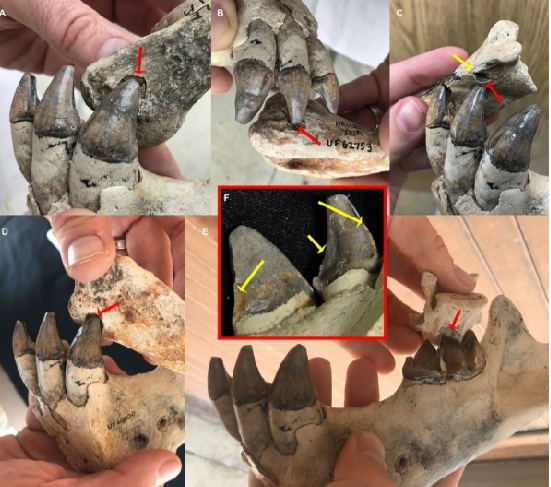
Figure 3, Dominguez-Rodrigo et al., CC BY-NC-ND 4.0
Those big gray pyramids are not claws. They’re the cat’s incisors, and researchers are matching them up to individual bite marks on the peccary bones (again, just SO many peccaries!)
🐾🐾🐾
Location: North America is confirmed; South America has been suggested, too, but that’s not yet established.
The Florida site is the only location where Xenosmilus has been definitely identified.
Some researchers suggest that certain sabercat fossils in Arizona (radius bone), Venezuela (skull), and Uruguay (jaw fragment) are Xenosmilus (Manzuetti et al.; Mones and Rinderknecht; White and Morgan), which would expand this sabercat’s date range as well as its geographic range, if confirmed, but those discussions are ongoing.

The blue-spectrum line is pointing at the Late Pliocene-Early Pleistocene line. (Source, public domain
Time: Per Antón, the only undisputed Xenosmilus fossils are those of our two cats from Florida, which were found in Early Pleistocene deposits.
If consensus can be reached on the other proposed Xenosmilus fossils, then its time range could extend from the late Pliocene to Middle Pleistocene.
Satellite view: Let’s concentrate on Florida because of the confirmed fossils there, keeping in mind that future discoveries might eventually show that Xenosmilus lived in a broad variety of environments.
Note: The cat they close this video with is not Xenosmilus. It might be a conical-toothed cat, but I’m just a layperson so don’t quote me on that.
Weather report: Generally speaking, north central Florida’s Pleistocene temperature and rainfall weren’t very different from today’s, except that it would have been drier during interglacial periods and winds might have been stronger at times. (Hine et al.)
Setting: In this subtropical savannaland were freshwater swamps that turned into oak and pine woods with scattered marshes and wetlands when there was an ice age on, farther north.
Xenosmilus
Here’s where the weirdness starts.
Before our two bro’s were dug up and described, paleontologists in the late twentieth and early twenty-first century had the idea that sabercats came in two general groups:
- Dirk-tooths: Smilodon, basically, and other sabercats with long, narrow saberteeth and a stocky wrestler-like build. It has been speculated that dirktooths may have been built that way because they hunted from ambush in wooded areas.
- Scimitar-tooths: Homotherium and other cats whose saberteeth are shorter and broader, and whose bodies seem better adapted for pursuit of prey in open habitats.

Figure 3.50 is my favorite image in “Sabertooth.” This is Homotherium. Note the relatively slender build — though with a sabertooth’s hefty front end — and long legs capable of covering a lot of ground very quickly.
When the two peccary epicures were found in Haile Quarries, paleontologists realized that there is a third way to build a sabercat: basically, give it the head of a scimitar-tooth and the body of a dirk-tooth.
A Xenosmilus skull has the short, broad, coarsely serrated teeth of a scimitar-tooth, as well as the huge and protuberant incisor arch that many homotherins display.
But its skeletal body shows a dirk-tooth’s short, heavy leg bones and insertions for massive and very powerful muscles.
Whether or not Xenosmilus walked on its tippy-toes or flatfooted like a bear, the cat definitely did not have the legs of a racer.
It will take more discoveries of near-complete fossil cats to eventually settle all the questions raised by Xenosmilus.
For now, there are only opinions. For example, according to one school of thought, Xenosmilus had a shark-like bite capable of tearing off huge chunks of flesh and sending its victim into shock. These researchers therefore christened it the “cookie-cutter cat.”
Antón interprets the dental details involved a little differently and suggests that Xenosmilus might have started out as a typical homotherine but for some reason got tired of chasing prey across savannas and settled into the forest ambusher role instead, which eventually gave it that typical muscular build.
Ecomorph/Tribe: Scimitar-tooth/Homotherini (Antón); Werdelin and Flink suggest Xenosmilus was in a sister group to Homotherini. The debate continues.
Future finds
The bros’ cat-cave is gone now. Haile Quarries is a business, and after boffins got the fossils out, that limestone was mined for human use.
Such things must be, and it’s good that the operators, like many other Floridians, are aware of the fossil treasures hidden in that grayish-white sedimentary rock.
Limestone is soft, for a rock, and it easily erodes into all sorts of openings in the ground that sometimes become natural carnivore traps that capture both plant-eaters and their predators.
The sabercat we met last time, Pogy, was a mystery to paleontologists for a very long time.
Pogy was known from only a few fragments until the 1990s, when more than twenty almost complete skeletons were found in a carnivore trap near Madrid, Spain.
Somewhere out there — in the Americas — there must be a similar collection of Xenosmilus fossils (and, who knows, maybe tons of peccaries!).
I hope they soon find it, because there are just so many questions about Xenosmilus that still need to be answered.
Featured image: Dominguez-Rodrigo et al., Figure 1, CC BY-NC-ND-SA 4.0.
Sources:
- Agustí, J., and Antón, M. 2002. Mammoths, sabertooths, and hominids: 65 million years of mammalian evolution in Europe. New York and Chichester: Columbia University Press. Retrieved from https://play.google.com/store/books/details?id=O17Kw8L2dAgC
- Antón, M. 2013. Sabertooth. Bloomington: Indiana University Press. Retrieved from https://play.google.com/store/books/details?id=dVcqAAAAQBAJ
- Christiansen, P. 2013. Phylogeny of the sabertoothed felids (C arnivora: F elidae: M achairodontinae). Cladistics, 29(5): 543-559.
- Domínguez-Rodrigo, M.; Egeland, C. P.; Cobo-Sánchez, L.; Baquedano, E.; and Hulbert Jr, R. C. 2022. Sabertooth carcass consumption behavior and the dynamics of Pleistocene large carnivoran guilds. Scientific Reports, 12(1): 6045.
- Hine, A. C.; Martin, E. E.; Jaeger, J. N.; and Brenner, M. 2017. Paleoclimate of Florida. https://repository.lib.fsu.edu/islandora/object/fsu%3A539192
- Mones, A., and Rinderknecht, A. 2004. The first South American Homotherini (Mammalia: Carnivira: Felidae). Paleontological Communications, National Museum of Natural History and Anthropology, 35:II. Via OnlineDocTranslator.com.
- Prothero, D. R. 2006. After the Dinosaurs: The Age of Mammals. Bloomington and Indianapolis: Indiana University Press. Retrieved from https://play.google.com/store/books/details?id=Qh82IW-HHWAC.
- Rincón, A. D.; Prevosti, F. J.; and Parra, G. E. 2011. New saber-toothed cat records (Felidae: Machairodontinae) for the Pleistocene of Venezuela, and the Great American Biotic Interchange. Journal of Vertebrate Paleontology, 31(2): 468-478.
- Werdelin, L., and Flink, T. 2018. The phylogenetic context of Smilodon. In Smilodon: the Iconic Sabertooth (pp. 14-29). Baltimore: Johns Hopkins University Press. (Preview only.)
- Werdelin, L.; Yamaguchi, N.; Johnson, W. E.; and O’Brien, S. J. 2010. Phylogeny and evolution of cats (Felidae), in Biology and Conservation of Wild Felids, eds. Macdonald, D. W., and Loveridge, A. J., 59-82. Oxford: Oxford University Press.
- Wikipedia. 2025. Xenosmilus. https://en.m.wikipedia.org/wiki/Xenosmilus Last accessed July 13, 2025.

