
“Why not zebra-maned fighting sabercats?” Mauricio Antón asks in a moment of admittedly playful speculation.
He drew these two Lokotunjailurus males with manes that remind me of a zebra’s but are actually based, Antón says, on those sported by today’s cheetah cubs.
Paleoartists always stay as close to real life as they can get.
Time out for an adorableness break!
Fun aside, Antón has a good point — that some features we most closely associate with modern cats, such as manes, tassels, and striped coats, don’t fossilize.
This is why paleontologists can’t ever know exactly what personal touches long-extinct species might have used to handle the challenges of wild cat life, which include:
- Hiding from prey or predators but not from friendly eyes:
- A unique ID:
- Communication tools:
- Signalling age, health, etc., to rivals and mates:
Since the sabertooths were cats, we can assume that, whatever their embellishments might have been, those were dramatic and strangely beautiful.
What is Lokotunjailurus?
The name itself comes from a local word for “cat” around Kenya’s Lake Turkana, where this sabercat’s first fossil specimen — a complete and articulated skeleton, preserved in volcanic ash — was found during the early 1990s. (Antón; Wikipedia)
We’ve seen an image that challenges our stereotype of sabercats by giving them a sort of mane. Now here’s a widely used Lokotunjailurus reconstruction that shows just how graceful this sabercat was:

Note the chest and flank ruffs, not fluffed out right now because the cat doesn’t feel threatened. (Image: Mauricio Antón via Wikimedia, CC BY-SA 3.0 nl)
Depending on location, Lokotunjailurus was jaguar-sized (South Africa) or as tall as a lioness, about 36 inches at the shoulder (Kenya and Chad) — but overall it was much more lightly built than either of those two living big cats, with long legs that must have given it some respectable speed. (Antón; Jiangzuo et al.; Wikipedia)
It nevertheless had a typical sabercat’s powerful front end as well as an incredibly huge and sharp dewclaw</a to help it bring down prey.

Again, with the mane. Of note, that hapless victim is a hipparionine horse — an older relative of today’s horses and zebras. Agustí and Antón note that Hipparion evolved in North America, crossed the Bering land bridge into Eurasia, and rapidly spread all over Eurasia and Africa, bringing along, among other critters, the sabertoothed cats, which probably first appeared in Asia during the Middle Miocene. I don’t know if there is a consensus on this view. (Image: Mauricio Antón, CC BY-NC-ND-SA 4.0)
We must go to Africa for Lokotunjailurus, and this brings us to the first sabertooth collection in our series.
There were sabercat “hotspots” in Mio-Pliocene Africa, and the toothy felids came in two sizes: large and (sort of) small. (Jiangzuo et al.)
In coming weeks we’ll meet two of the big ones: Amphimachairodus and Machairodus.
In the meantime, this video of a museum at the South African fossil bed shows, at around 1:56, the sabers of Amphimachairodus (right) — NOT Smilodon’s, which was an American Pleistocene cat.
Lokotunjailurus was one of the smaller African sabercats. Antón often gives it a ruff or mane in reconstructions, he notes, because it might have needed to look big at times.
Still, that Kenyan species was large enough to beat the other carnivores in this image, except perhaps the beardog (amphicyonid):

The other cat, lurking in front of the beardog, is Dinofelis — another small one in Mio-Pliocene Africa but nonetheless leopard sized, per Antón. We’ll meet it in September. (Image: Mauricio Antón via Wikimedia, CC BY-SA 3.0 nl)
🐾🐾🐾
Ecomorph/Tribe: There is ongoing discussion about this. Experts once saw Lokotunjailurus as a primitive scimitar-tooth/homotherin, but instead it might have been a sister group to homotherins. (Wikipedia) Werdelin et al. only note that Lokotunjailurus was probably closely related to the homotherins.
Location: Eastern, central, and southern Africa.

The blue-spectrum line is pointing at the Late Miocene/Early Pliocene. (Source, public domain)
Time: Late Miocene to Early Pliocene, with the two best known finds — in Kenya and South Africa — dated to around 5.2 million years ago. (Jiangzou et al.)
Werdelin et al. give a date range of 7.4 to 5.5 million years ago for the Kenyan species.
Satellite view/Weather report:
We are still in the same general Earth setting that we saw with Paramachaerodus, with ice caps, all of which were smaller than today’s massive ice cap, growing and shrinking on Antarctica. Although that continent probably was not totally ice-free at any point in the Late Miocene and Early Pliocene, parts of it occasionally hosted subtropical evergreen forest! (Agustí and Antón)
To the north of Africa, during Lokotunjailurus’ time, and as Paramachaerodus would also have seen, the Mediterranean mostly dried up as global sea levels dropped during antarctic glaciation episodes, but it flooded again when the world warmed and sections of Antarctica briefly greened up about 5 million years ago.
The Mediterranean area and Europe regrew forests, too, but in Africa things got drier and hotter the farther south you went.
One factor that isn’t mentioned by my paleontology reference books is volcanism associated with the development of the East African Rift that began to open up around the start of the Miocene, with the Ethiopian segment becoming active about 4 million years before the 7 Ma date that Werdelin et al. start Lokotunjailurus off on.
That volcanism must have been the source of ash that the first Lokotunjailurus fossil cat was found in, in Kenya, but I have seen no discussions of how this initiation of continental breakup might have affected the African sabercats and their evolution.
The ongoing process certainly has helped to expose fossils, though!
Setting: I’m not sure what the Chad paleoenvironment was like for Lokotunjailurus. Black describes, very generally, a mix of woods and grasslands near permanent sources of water.
Just as in the drier parts of Africa today, many plant-eaters and their predators lived near rivers.
Animal behaviors like migration don’t fossilize, either.
In what’s now Lake Turkana, Kenya, Lokotunjailurus lived near a large meandering river that was dry for about four months each year. Overall there was wooded savannaland, with patches of thorny trees and dense gallery forests along streambeds.
Farther south, along the southwestern coast of the African Horn, at a site which today is called Langebaanweg, South Africa, there was a Mio-Pliocene lagoon estuary, open to the sea but protected from the waves. (Jiangzou et al)
In addition to that, during one of the global high sea stands during an Early Pliocene warm spell, a shallow bay sat behind some islands. (Jiangzou et al)
Imagine all the sabercats that could thrive in the many different habitats this coastal setting created — some forest, some river, open lands, and even tidal zones! (Brits)
Well, we’ve already named those cats: Lokotunjailurus, Amphimachairodus (which has other scientific names, too, including Adeilosmilus), and Dinofelis. In addition, there was a metailurine cat (this group is also coming to the series in September). (Jiangzou et al.)
Here is another Langenbaanweg museum-trip video that incidentally shows a couple shots of reconstructed settings:
Amphimachairodus was not a saber-toothed “tiger,” either. Tigers have conical teeth, like all living cats and their ancestors.
Competition: The only difference in the sabercat guild between Chad and South Africa is that Dinofelis wasn’t present in Chad but there were some early representatives of the lineage leading to Megantereon. (Jiangzou et al.; Wikipedia) The researchers don’t specifically name Paramachaerodus, though.
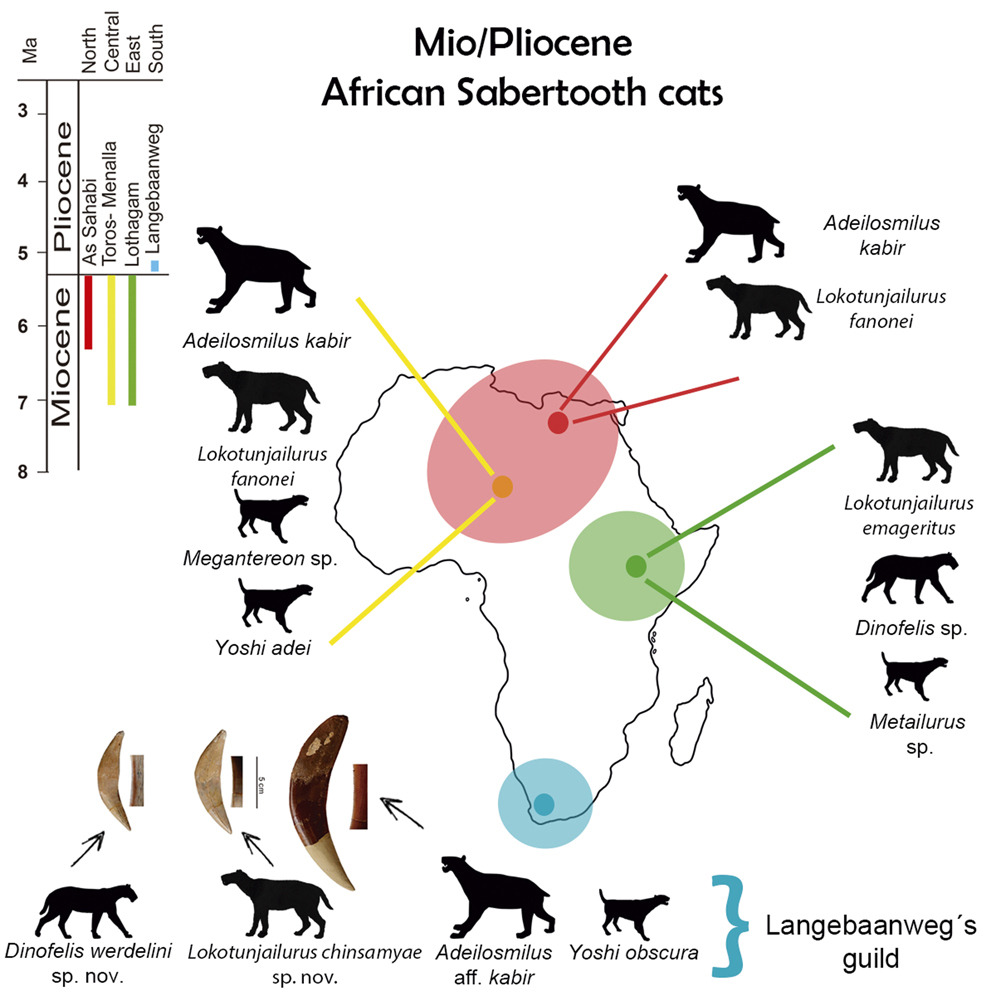
Jiangzou et al., CC BY-NC-ND-SA 4.0
Bear-dogs, as a group, were on their way out as the Miocene shut down and the Pliocene began, but perhaps Lokotunjailurs might occasionally have encountered one.

The “running hyenas” have their own feature at the fossil musem in South Africa.
Other Mio-Pliocene predators would have included hyenas — one of which was built rather like a cheetah! — as well as some canids, smaller carnivores, and Agriotherium, which was similar to the living brown bear but more carnivorous. (Agustí and Antón; Jiangzou et al.)
Prey: Besides hipparionine horses, there was a wide variety of herbivores, including but not limited to primitive giraffes, pig-like mammals, large bovine herbivores, primates, young hippos and proboscideans), and at Langebaanweg, maybe even penguins and seals. (Agustí and Antón; Brits)
Featured image: Mauricio Antón at Chasing Sabretooths.
Sources:
- Agustí, J., and Antón, M. 2002. Mammoths, sabertooths, and hominids: 65 million years of mammalian evolution in Europe. New York and Chichester: Columbia University Press. Retrieved from https://play.google.com/store/books/details?id=O17Kw8L2dAgC
- Antón, M. 2013. Sabertooth. Bloomington: Indiana University Press. Retrieved from https://play.google.com/store/books/details?id=dVcqAAAAQBAJ
- ___. 2015. Clean-cut cat: The surgical killing bite of Lokotunjailurus. https://chasingsabretooths.wordpress.com/2015/03/04/clean-cut-cat-the-surgical-killing-bite-of-lokotunjailurus/ Last accessed July 16, 2025.
- Black, R. 2011. Toumai and the sabercats. https://www.nationalgeographic.com/science/article/toumai-and-the-sabercats
- Brits, E. 2023. Sabre-tooth cat named after renowned scientist. https://www.nature.com/articles/d44148-023-00231-y Last accessed July 16, 2025.
- Jiangzuo, Q.; Rabe, C.; Abella, J.; Govender, R.; and Valenciano, A. 2023. Langebaanweg’s sabertooth guild reveals an African Pliocene evolutionary hotspot for sabertooths (Carnivora; Felidae). Iscience, 26(8).
- Prothero, D. R. 2006. After the Dinosaurs: The Age of Mammals. Bloomington and Indianapolis: Indiana University Press. Retrieved from https://play.google.com/store/books/details?id=Qh82IW-HHWAC.
- Werdelin, L., and Sardella, R. 2006. The “Homotherium” from Langenbaanweg, South Africa and the origin of Homotherium. Palaeontographica Abteilung A Paläozoologie, Stratigraphie, 277(1-6): 123-130.
- Werdelin, L.; Yamaguchi, N.; Johnson, W. E.; and O’Brien, S. J. 2010. Phylogeny and evolution of cats (Felidae), in Biology and Conservation of Wild Felids, eds. Macdonald, D. W., and Loveridge, A. J., 59-82. Oxford: Oxford University Press.
- Wikipedia. 2025. Lokotunjailurus. https://en.m.wikipedia.org/wiki/Lokotunjailurus# Last accessed July 16, 2025.

