
Okay, it’s called Anak Krakatau — Child of Krakatoa — now, but I suspect it is still “Krakatoa” to most folks outside Indonesia who don’t happen to be volcanophiles.
Update on name: Per the Royal Society’s 19th-century report on the 1883 eruption, this volcano’s name is related to a local word for “crab,” which it did resemble.

Chris DHDR via Wikimedia, public domain.
- MAGMA Indonesia still-image webcams.
- Darwin VAAC advisories.
- Global Volcanism Program (GVP) page.
Updates
December 10, 2025, 4:06 p.m., Pacific: Per the GVP, “On 19 April [2024] PVMBG lowered the Alert Level for Krakatau to 2 (on a scale of 1-4) based on visual observations and instrumental data. The public was warned to stay at least 2 km away from the crater.”
Krakatoa has been fairly quiet ever since, though not back to baseline apparently; because it is Krakatoa, I’m keeping it on the restless-volcanoes list.
December 25, 2023, 10:15 p.m., Pacific: The last VONA to date for Anak Krakatau is from the 16th, so perhaps this bout of increased activity is paused (which may or may not be a good thing, depending on its cause, whatever that might be).
In any event, all of these eruptions have left an amazing crust of sulfur on the island!
[1/2]
Large amounts of sulfur compounds deposited around the crater of #AnakKrakatau.
Two enhanced color images taken by @CopernicusEU #Sentinel2 in February and November 2023.
Data processed in @sentinel_hub @volcaholic1 @CultureVolcan @Wulkany1 #Indonesia #volcano pic.twitter.com/opsbonVjFM
— kosmi 🛰️🌍 (@kosmi64833127) December 25, 2023
https://platform.twitter.com/widgets.js
December 15, 2023, 8:43 p.m., Pacific: There has been no increased intensity, but Anak Krakatau is not backing off, either:
Terjadi erupsi G. Anak Krakatau pada hari Sabtu, 16 Desember 2023, pukul 10:24 WIB tinggi kolom abu teramati ± 1000 m di atas puncak. Erupsi terekam di seismograf dengan amplitudo maksimum 50 mm dan durasi 22 detik. https://t.co/j06HQyr5Iq via @id_magma pic.twitter.com/uRZCrAT3dl
— PVMBG (@PVMBG_) December 16, 2023
https://platform.twitter.com/widgets.js
December 5, 2023, 3:01 p.m., Pacific: No change in activity, but a nice image and summary from NASA:
Anak Krakatau is a small, unimposing volcanic island between the Indonesian islands of Java and Sumatra. However, its frequent blasts and explosions serve as a reminder of its mighty—and occasionally menacing—power.
The Operational Land Imager (OLI) on Landsat 8 captured this image of a volcanic plume drifting from the volcano on December 2, 2023. It includes an infrared signal (red) that was produced by the heat of molten rock in the crater near the island’s summit.
Geologists have tallied 57 eruptive periods from this location since the beginning of the Holocene, roughly 11,700 years ago. The most recent eruptive period, which started in May 2021 and continued into December 2023, has featured frequent but generally mild Strombolian blasts of volcanic gases and ash particles. Materials ejected from the volcano’s vent are typically lofted a few hundred meters above the summit, and small lava flows occasionally drain down the island’s flanks and into the sea.
Beginning on November 26, 2023, geologists with the Indonesian Center for Volcanology and Geological Hazard Mitigation began to report more intense explosions, with plumes of volcanic material rising up to 1,000 meters (3,280 feet) above the vent. Given the heightened unrest, the center has warned the public to stay at least 5 kilometers (3 miles) from the crater. The Volcanic Ash Advisory Center in Darwin, Australia, also issued multiple warnings to the aviation community of elevated risks of ash in the area.
I added emphasis to correct my mistakenly calling thise eruptions “vulcanian.”
December 4, 2023, 2:10 p.m., Pacific: Anak Krakatau continues to have a surprising number of these frequent low-level events. There is no sign of an uptick in activity, fortunately, but no evidence that this is likely to wind down soon, either.
Terjadi erupsi G. Anak Krakatau pada hari Senin, 04 Desember 2023, pukul 22:57 WIB tinggi kolom abu teramati ± 1500 m di atas puncak. Erupsi terekam di seismograf dengan amplitudo maksimum 64 mm dan durasi 150 detik. https://t.co/xMllSBUr4E via @id_magma pic.twitter.com/W8L3sV10z9
— PVMBG (@PVMBG_) December 4, 2023
https://platform.twitter.com/widgets.js
December 2, 2023, 12:26 p.m., Pacific: Business as usual — explosive, but within current episode intensity.
Ongoing eruption of #AnakKrakatau #volcano in #Indonesia.
Image taken today by #Landsat-8/9.
Panchromatic, NIR and SWIR bands.
Data processed in @sentinel_hub #Krakatau #Krakatoa pic.twitter.com/n9kD1UJKQV
— kosmi 🛰️🌍 (@kosmi64833127) December 2, 2023
https://platform.twitter.com/widgets.js
Indonesian volcanologists continue the Orange aviation code, but I’ll keep this pinned a little longer and see how things go.
November 29, 2023, 4:07 p.m., UTC: Anak Krakatau has been having a vigorous series of vulcanian eruptions over the last week or so:
Terjadi erupsi G. Anak Krakatau pada hari Selasa, 28 November 2023, pukul 00:00 WIB tinggi kolom abu teramati ± 2000 m di atas puncak. Erupsi terekam di seismograf dengan amplitudo maksimum 75 mm dan durasi 149 detik. https://t.co/Kf8WFVeRhp via @id_magma pic.twitter.com/Sa7FBuew8X
— PVMBG (@PVMBG_) November 27, 2023
https://platform.twitter.com/widgets.js
However, this is my favorite image thus far — an overhead view that not only shows the plume but also the stretch of water where Rakata Island used to be until the 1883 event:
#volcan #volcano #Krakatau #AnakKrakatau Fort signal thermique produit par l'éruption/Strong thermal emission produced by the eruption; via @sentinel_hub @esa @CopernicusEU pic.twitter.com/euc6pYMl8i
— CultureVolcan (@CultureVolcan) November 28, 2023
https://platform.twitter.com/widgets.js
I watched that old Dutch
film of Anak Krakatau’s birth in the early twentieth century and again was impressed by the power of those explosive eruptions.
Also, mindful of what Dr. Robock says about magma mixing in the Naked Science docudrama — something that doesn’t necessarily follow patterns — I’ll pin this again for a while, although the alert level there is unchanged.
June 10, 2023, 9:08 a.m., Pacific: Apparently Krakatau is having a series of relatively big blasts (compared to its recent activity), the last within the past six hours, per the latest VONA, released five hours ago.
On June 10th:
Eruption with volcanic ash cloud at 1050 UTC (1750 local). Best estimate of ash-cloud top is around 11702 FT (3657 M) above sea level or 11200 FT (3500 M) above summit. May be higher than what can be observed clearly. Source of height data: ground observer. Ash cloud moving to northwest. Volcanic ash is observed to be gray. The intensity of volcanic ash is observed to be thick…
Darwin VAAC has an advisory up.
I can’t find reliable video yet but will add it here if and when I find it.
Edit, 10:53 a.m., Pacific:
Terjadi erupsi G. Anak Krakatau pada hari Sabtu, 10 Juni 2023, pukul 17:50 WIB. Tinggi kolom letusan teramati ± 3500 m di atas puncak (± 3657 m di atas permukaan laut). Kolom abu teramati berwarna kelabu dengan intensitas tebal ke arah barat laut. pic.twitter.com/KS0woQa8BZ
— INFOMITIGASI™ (@infomitigasi) June 10, 2023
https://platform.twitter.com/widgets.js
Update, June 9, 2023, 11:21 a.m., Pacific: Late yesterday, Anak Krakatau had a good-sized blast.
Update, June 8, 2023, 11:25 a.m., Pacific: I admit my worry about this volcano has gone back to ordinary levels after learning that its MO is many years of edifice construction punctuated over geologic time by extremely violent self-destructive blasts.
The last such blast was yesterday, in geologic terms — though 1883 seems like a very long time ago to us.
While another 1883-style eruption is unlikely, Anak Krakatau can still be deadly, as the tsunami from flank collapse showed a few years ago.
And it is a fire mountain immersed in water (the Sunda Strait), which means explosions.
So, although volcanologists haven’t raised the alert level, I thought it would be well to pin this post again, with updates if needed during this present uptick in construction activity, as well as share this terrific cam view:

Source (autotranslated).
Update, June 6, 2023, 1:08 p.m., Pacific: Anak Krakatau has been industriously working on its new volcanic edifice construction project, and while there’s no VAAC advisory currently in effect and I can see no reason to pin this post just now, the volcanologists did issue a VONA today, which you can read here, along with older notices on A. Krakatau.
That link should include future activity notices, too.
Update, March 31, 2023, 9:31 a.m., Pacific: Krakatau reportedly is quiet today, but yesterday they got a wonderful picture of it from space:
#volcan #volcano #Krakatau Les émissions de cendres vue le 29/03 depuis l'espace. L'île de Panjang, à l'est d'Anak Krakatau,a été clairement impactée/Ash emissions seen from space on 29/03. Panjang Island, east of Anak Krakatau, is clearly impacted; via @NASA_Landsat @USGSLandsat pic.twitter.com/v7nVC5bq4Q
— CultureVolcan (@CultureVolcan) March 31, 2023
https://platform.twitter.com/widgets.js
March 28, 2023, 9:18 a.m., Pacific: Anak Krakatau has been simmering along since the last update several months ago.
It’s still simmering, actually, but just made the news because of a series of somewhat stronger but still low-level explosions that Indonesian volcanologists reportedly characterize as “…part of an eruption phase associated with the formation of a new body for the volcano.”
Here’s some video, although I don’t understand the Indonesian narration:
Per today’s alert (autotranslated), “There is no bang” currently. Level III continues unchanged.
November 22, 2022, 12:37 p.m., Pacific: All is well. I just came across a nice picture of Anak Krakatau, hard at work but, for now, not endangering anyone:
Satellite image of Krakatau volcano🌋 in Indonesia🇮🇩 today 20th November.
Processed Sentinel-2🛰️image @sentinel_hub pic.twitter.com/OjTWBjSxoJ
— Øystein L.A. (@oysteinvolcano) November 20, 2022
https://platform.twitter.com/widgets.js
June 29, 2022, 12:28 p.m., Pacific: There’s glow showing on one of the cams (it’s night, on June 30, in Indonesia).
Per the current VONA list, that “crab” out the Sunda Strait has had several vulcanian explosions recently.
The alert level has not been raised, though explosions are a little more frequent and incandescence must be from lava in that crater. It’s not really a new development. Krakatau had lava flows earlier in the current activity phase.
I think it just paused a bit until the magma reservoir could be recharged and now may have enough melt available, in the right conditions, to resume lava flows.
As the experts all say, the biggest hazard here right now is not an impending repeat of 1883’s events but collapse of the present volcanic edifice, with resulting tsunami (and air traffic hazards from any ash that might reach flight levels from an explosive burst).
No one wants a repeat of the 2018 tragedy.
June 16, 2022, 5:46 p.m., Pacific: Five VONAs released by MAGMA Indonesia since late on June 14th UTC, but all eruptions were small.
Or, as the volcano just tweeted:
I'm not causing problems. Just baby plumes for the photographers🥰🌋
— Anak Krakatau (@Krakatau_1883) June 16, 2022
https://platform.twitter.com/widgets.js
Aviation Code is still Orange and there’s a 5-km exclusion zone in effect (the Sunda Strait is much wider than that).
June 15, 2022, 10:21 a.m., Pacific: A visual — under difficult conditions — of Krakatau’s most recent vulcanian pop; there is power to it, so this will stay pinned.
June 15, 2022, ~ Eruption ~ Krakatau Volcano, Indonesia #volcano #krakatau #indonesia
Very poor quality, best left in this small format.
13:35 Hours pic.twitter.com/6lsVMVuGwZ— Volcano Time-Lapse (@DavidHe11952876) June 15, 2022
https://platform.twitter.com/widgets.js
June 11, 2022, 9:07 a.m., Pacific: Another small eruption about three hours ago.
Here is the Darwin advisory — the only information I can find just now (this 13-year-old post on how to read an advisory may help):
FVAU01 ADRM 111320
VA ADVISORY
DTG: 20220611/1320Z
VAAC: DARWIN
VOLCANO: KRAKATAU 262000
PSN: S0606 E10525
AREA: INDONESIA
SUMMIT ELEV: 813M
ADVISORY NR: 2022/158
INFO SOURCE: HIMAWARI-8
AVIATION COLOUR CODE: ORANGE
ERUPTION DETAILS: VA TO FL050 MOV W, LAST OBS AT 11/0130Z
EST VA DTG: 11/1300Z
EST VA CLD: SFC/FL050 S0606 E10526 – S0611 E10518 – S0604
E10514 – S0603 E10518 – S0605 E10525 MOV W 05KT
FCST VA CLD +6 HR: 11/1900Z SFC/FL050 S0605 E10527 – S0607
E10527 – S0611 E10520 – S0605 E10518 – S0603 E10524
FCST VA CLD +12 HR: 12/0100Z SFC/FL050 S0607 E10526 – S0611
E10521 – S0605 E10518 – S0603 E10524 – S0605 E10526
FCST VA CLD +18 HR: 12/0700Z SFC/FL050 S0608 E10527 – S0609
E10522 – S0605 E10519 – S0603 E10522 – S0602 E10526 – S0605
E10528
RMK: VA NOT DISCERNIBLE ON LATEST SAT IMAGERY DUE TO MET
CLOUD. HOWEVER, VA EMMISSION EXPECTED TO BE ONGOING.
FORECAST AND HEIGHT BASED ON HIMAWARI-8 AND MODEL GUIDANCE.
NXT ADVISORY: NO LATER THAN 20220611/1920Z=
Update, June 9, 2022, 6:25 a.m., Pacific: Anak Krakatau erupted yesterday.
Darwin VAAC gave it a “oneoff advisory,” but the visuals are interesting:
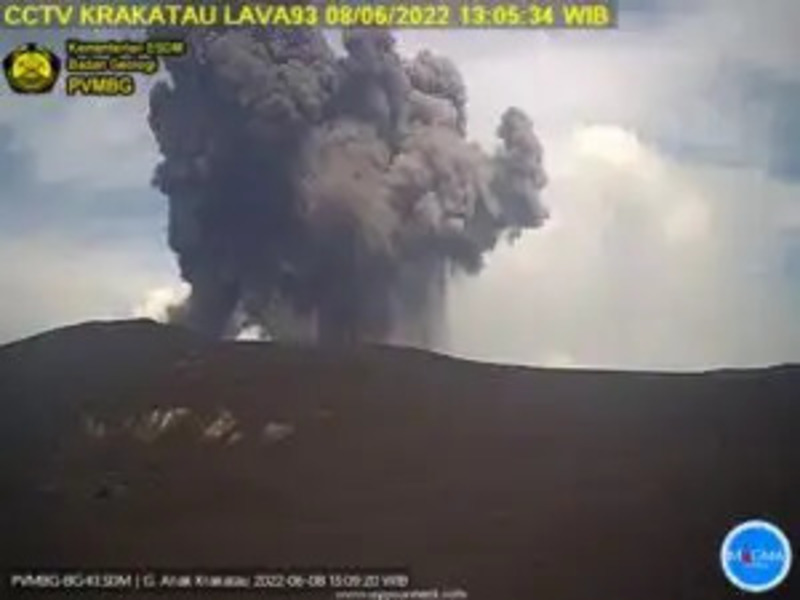
Gunung berapi #AnakKrakatau #Krakatoa pada tanggal 08-Juni-2022@CopernicusEU @CopernicusEMS @CopernicusLand pic.twitter.com/fF9H21ZgJA
— INFOMITIGASI™ (@infomitigasi) June 9, 2022
https://platform.twitter.com/widgets.js
The ash dissipated quickly, but it was ash, not just gas, and apparently an explosive eruption (vulcanian, per Volcano Discovery) rather than a steam-driven event, so I’ll pin this post again and wait to see if anything more happens.
June 4, 2022, 4:59 p.m., Pacific: A nice clear view! (No advisories currently from Darwin VAAC.)
Yesterday's view of #Krakatau #volcano in #Indonesia.
False color image taken by @CopernicusEU #Sentinel2 satellite.
Data processed in @sentinel_hub#AnakKrakatau #Krakatoa #AnakKrakatoa pic.twitter.com/XTG8zj4ZBa
— kosmi (@kosmi64833127) June 4, 2022
https://platform.twitter.com/widgets.js
May 20, 2022, 12:17 p.m., Pacific: Darwin VAAC issued the last advisory today.
Since clouds obscure the volcano, I’ll keep this pinned for a little while longer, but, hopefully, this episode has ended. 🤞
12:29 p.m.: So I get on Twitter after posting that update and find this. That “crab” out in the Sunda Strait still needs watching!
#volcan #volcano #Krakatau Fort signal thermique associé à dégazage intense toujours présent à proximité du nouveau cône/Strong thermal emission with strong gaz release still present near the new cone; via @sentinel_hub @esa @CopernicusEU pic.twitter.com/16LRYkyKMp
— CultureVolcan (@CultureVolcan) May 20, 2022
https://platform.twitter.com/widgets.js
May 17, 2022, 9:39 a.m., Pacific: There’s no change apparently. Darwin VAAC issued another advisory. Their remarks:
: VA NOT IDENTIFIABLE ON SATELLITE IMAGERY DUE TO MET
CLOUD IN AREA. WEAK VA PLUME LAST OBS 17/0930Z EXTENDING N
OF VOLCANO. WEBCAM SHOWS STEAM EMISSION ONGOING. VA HEIGHT
AND FCST MOV BASED ON HIMAWARI-8 IMAGERY AND MODEL GUIDANCE.
NXT ADVISORY: NO LATER THAN 20220517/1915Z=
I’ll post new advisories only if there is any change. Unfortunately, the CCTV images I can find online are almost a week old. Does anyone know of more frequently updated webcams?
May 15, 2022, 12:17 p.m., Pacific: An update yesterday, from Volcano Discovery — a tremendous resource.
#Krakatau #volcano (Sunda Strait, Indonesia): lava flow continues to feed new delta – The effusive eruption at the volcano resumes at moderate levels.
Today's cloud-free satellite observation confirmed the continuous new lava delt…https://t.co/6DtUj0hUGN— VolcanoDiscovery (@volcanodiscover) May 14, 2022
https://platform.twitter.com/widgets.js
Darwin VAAC still has the advisory listed, but no new ones. No VONA found on the MAGMA Indonesia page, and the Anak Krakatau Twitter account (whoever is running that) doesn’t mention anything new (they did forward this tweet).
Given that relaxed attitude locally, plus the fact that the ongoing activity is effusive (red lava) rather than explosive, my concern is less (whatever that’s worth from a layperson 😄 ).
Will keep this pinned until they lower the alert level, though. Krakatau is tricky because it can’t easily be monitored, being mostly underwater.
May 14, 2022 9:12 a.m., Pacific: Darwin VAAC has issued an advisory, but I’m still looking for information from local official sources.
If I understand aircraft terminology, it wasn’t a very big emission. FL080 is 8,000 feet, right? And it was mostly steam.
Wonder if it was a one-off shot or if Anak Krakatau is feeling restless again.
May 13, 2022, 1:18 p.m., Pacific: Things are still quiet, alert level still elevated.
Ongoing eruption of #Krakatau #volcano in #Indonesia.
SWIR images taken by #Sentinel2 and #Landsat-8,9 satellites since April 2.
Data processed in @sentinel_hub #AnakKrakatau #Krakatoa pic.twitter.com/cnA0UVeyWp
— kosmi (@kosmi64833127) May 12, 2022
https://platform.twitter.com/widgets.js
May 4, 2022, 10:50 a.m., Pacific: Nothing new, but here is a neat satellite view and update in English:
#Krakatau #volcano (Sunda Strait, Indonesia): lava continues to enter sea, tongues of lava form glowing horseshoe-like shape – The latest satellite image from 2 May shows the advancing lava flow into the newly existing sea entry.
…https://t.co/s4fQEK2ahm— VolcanoDiscovery (@volcanodiscover) May 4, 2022
https://platform.twitter.com/widgets.js
Hope it stays at this level!
April 30, 2022, 9:13 a.m., Pacific: Still quiet, still at elevated alert.
Spectacular footage of Anak Krakatau (the new central land built since the much larger caldera, mostly underwater as shown here, blew in 1883).
Twitter translation:
Another angle of the image of Mount Anak Krakatau as of April 28, 2022.
It can be seen that the crater holes that were open after the 2018 eruption and tsunami were closed and the growth of the mountain body was very significant.
Sudut lain gambar Gunung Anak Krakatau per tanggal 28 April 2022.
Terlihat lobang kawah yang terbuka paska erupsi dan tsunami 2018 sudah tertutup dan pertumbuhan badan gunung sangat signifikan. pic.twitter.com/MyiFffsxBE— Abdul Muhari (@abdulmuhari) April 28, 2022
https://platform.twitter.com/widgets.js
April 29, 2022 12:12 p.m., Pacific: A new cone!
My new cone! Also, Boris is a trusted source of info. https://t.co/3TwaHVlqD0
— Anak Krakatau (@Krakatau_1883) April 28, 2022
https://platform.twitter.com/widgets.js
Things have been quiet, fortunately. At the moment, there only appears to be a hint of incandescence from the shore.
Per satellite view on the 27th:
#volcan #volcano #Krakatau Le nouveau champ de coulée encore à haute température aujourd'hui; l'île de Panjang (à l'est) couverte de cendres/The new lava flow field is still hot today; the Panjang island (east) covered by ash; via @sentinel_hub @esa @CopernicusEU pic.twitter.com/EzrUUtgmi8
— CultureVolcan (@CultureVolcan) April 27, 2022
https://platform.twitter.com/widgets.js
April 27, 2022, 7:06 a.m., Pacific: Per the latest VONA (scroll down):
Eruption with volcanic ash cloud at 05.00 UTC (12.00 local). Eruption and ash emission is continuing. Best estimate of ash-cloud top is around 10102 FT (3157 M) above sea level, may be higher than what can be observed clearly. Source of height data: ground observer. Visuals directly from the cctv were observed eruptions with the color of the thick white-grey-black eruption smoke 3000m from the top of the volcano, the wind direction slowly to the south-southwest.
It’s night there now, and the cam view appears quite dark, though there is a hint of clouds. Whether these are meteorological or volcanic is impossible to tell (though you would think some incandescence would show if it was ash).
Per Darwin VAAC at 1115 UTC, “VA NOT IDENTIFIABLE ON LATEST SAT IMAGERY DUE TO MET CLOUD. HOWEVER, ERUPTION IS EXPECTED TO BE ONGOING.”
It is not a massive eruption, though. Authorities and Anak Krakatau, Twitter are more focused on potential for cone collapse and tsunami.
Here’s the ash advisory tweet from AK Twitter:
#krakatau #AnakKrakatau #Krakatoa Volcanic Ash Adv Plume 02:OO WIB 27/04/2022 pic.twitter.com/nOioevAncg
— INFOMITIGASI™ (@infomitigasi) April 27, 2022
https://platform.twitter.com/widgets.js
Original post:
And it is firing up. Volcanologists have raised the alert level (Indonesian) and reportedly also are warning people to watch out for tsunamis, especially at night.
Anak Krakatau is a very active volcano, and I’ve been watching it but was spurred to do this post after seeing just how much deformation the volcano showed on this April 14th image, tweeted today:
pemantauan Gunung Api #krakatau #Anakkrakatau #krakatoa via satelit Sentinel-1 pada tanggal 14/04/2022
cc: @id_magma @PVMBG_ @widjokongko pic.twitter.com/LFIU8a1Hma— INFOMITIGASI™ (@infomitigasi) April 25, 2022
https://platform.twitter.com/widgets.js
The second factor leading to a post was how the eruption looks in video currently showing with this article — the original Indonesian for the Google-Translated one linked up above the tweet.
I am strictly a layperson, so take it FWIW, but that eruptive column looks like there’s some power behind it. And this is Krakatoa.
So let’s watch this and see what happens.
Webcam. There is no live stream at the moment, but scroll down for cam images.
Local monitoring updates (Indonesian).
Oystein Lund-Andersen, Twitter.
 Flight To Wonder