
Volcanoes are agents of chaos.
That’s what it feels like to us, anyway, when seemingly eternal landscapes abruptly break open —
How it began:
🌋🌋🌋
How it went:
This is the La Palma eruption of 2021, with lavafalls down sidewalk steps, buildings collapsing onto lava, lava pouring into a swimming pool — just so much lava flowing through a densely populated countryside! At least everyone was able to get themselves personally out of the way, and those dogs were rescued.
— Volcanoes, even when they don’t kill or injure us, still up-end our daily routine and change our lives and property forever.
This trouble factor is even more unsettling when something as big as Yellowstone is involved: a beautiful national park at one moment; boom! An apocalypse, the next!
Or so it always plays out in the movies and tabloids.
It must have been catastrophic in real life, too, in a different setting from our own time, when those two supereruptions occurred, 2 million and then 630 thousand years ago, out of the roughly eighty times that this volcanic field has erupted. (Lowenstern et al.)
But who knows for sure what such cataclysms are like?
No supereruption has ever happened in recorded history, although some — like those of Kikai and Toba, for example — might have profoundly influenced prehistoric human societies regionally and possibly globally, too. (Sources and more information given in the linked blog posts.)
Despite the lack of scientific observation, tabloids and movies continue to do a thriving business on our very natural concern, ever since we first learned that Yellowstone is a supervolcano (Klemetti/comment by Lowenstern), about the possibility of existential chaos that a supereruption might inflict upon our carefully ordered human world.
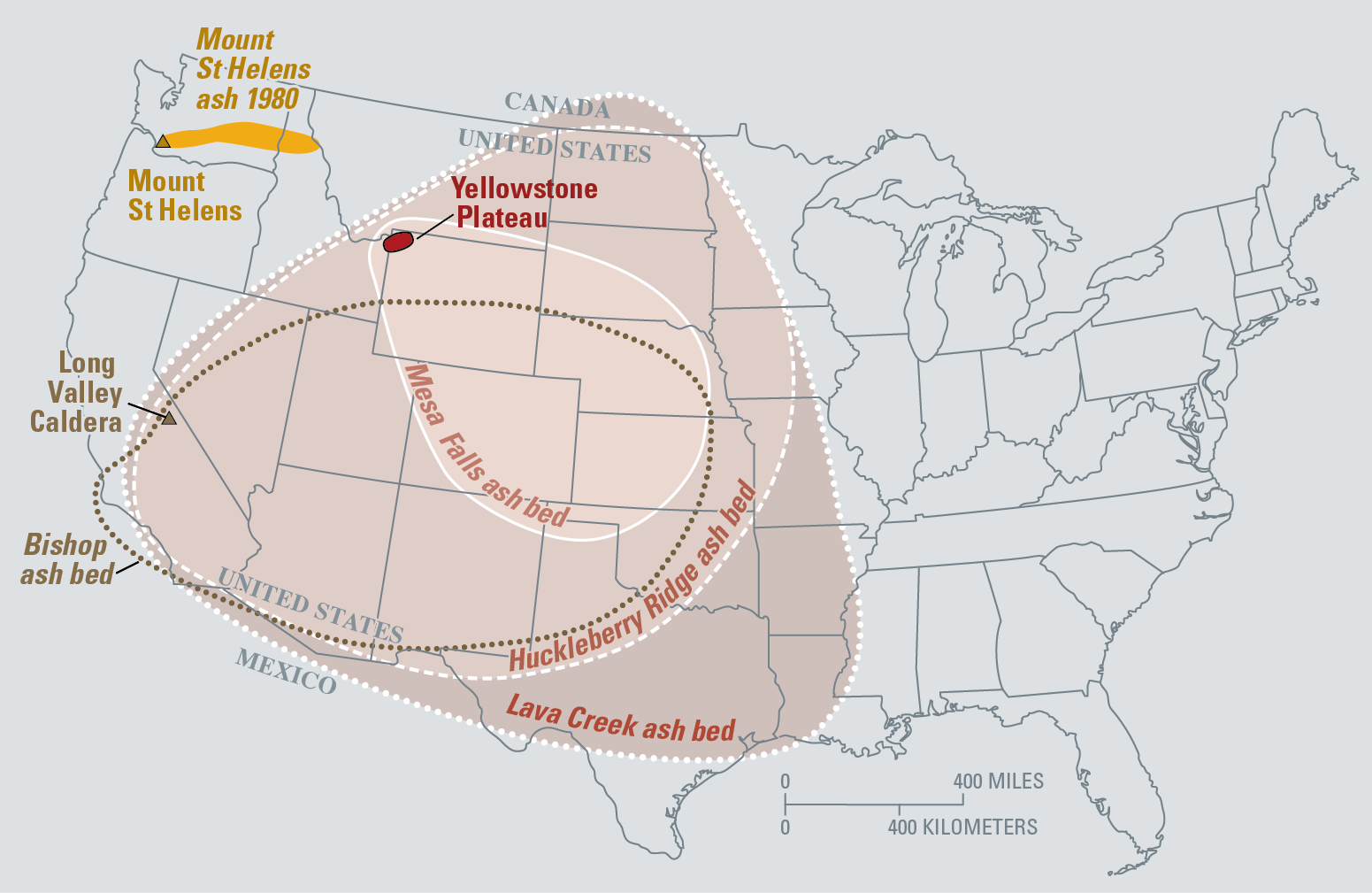
Extent of ash fall from Yellowstone’s three Big Ones, with the Mount St. Helens eruption (1980) and Long Valley supereruption ash falls added for comparison. (Image: US Geological Survey [USGS])
We’ll look at what is known about Yellowstone’s two supereruptions in detail next time, along with its third Big One.
Yes. In addition to Huckleberry Ridge and Lava Creek, the Yellowstone Plateau Volcanic Field hosted a magnitude 7.8 Mesa Falls blast about 1 million years ago.
That might not have technically qualified as a VEI 8 supersized eruption, but it was no picnic, either.
This Big One probably would have been equally devastating to humanity, had it occurred in the modern era.
🔬🌋🥼
Terminology note: What’s the difference between magnitude and VEI?
Magnitude numbers like that 7.8, which is from LaMEVE database (last accessed June 14, 2026), are similar to the more familiar VEI numbers; magnitude is just calculated a little differently. (Deligne et al.; Mason et al.; Oppenheimer)
The rather arbitrary (Miller and Wark) magic number that defines a supereruption is still 8, although the magnitude scale does have a 9 (looking at you, Toba!).
Magnitude gives a more precise idea of the size of one eruption compared to another.
For instance, instead of having a misleading impression that the Mesa Falls eruption was “only” a VEI 7 (which is ten times smaller than an 8 on that logarithmic VEI scale), we can see that the boffins currently rate Mesa Falls as almost a supereruption at 7.8 (about 94% the size of Lava Creek’s magnitude 8.3, if this layperson has done the math correctly).
Precision like that matters to volcanologists, and it’s helpful to us laypeople, too, once we get a feel for how this system works.
🔬🌋🥼
Geologists see organization, not chaos

“Did somebody say ‘pic-a-nic’?” (Image: Jacqueline F. Cooper/Shutterstock)
Geologists can see through the chaos and, to some extent, down into the intricate structural roots of a volcanic system — the upper part of those roots, anyway. (Bachmann and Huber; Farrell; Foulger et al., 2015; Giordano and Caricchi; Miller and Wark)
They also can study fossil systems for clues about what might be happening at depths beyond the range of their monitoring technology, as far down as the bottom of Earth’s crust and into the uppermost mantle. (Bachmann and Huber; Cashman and Sparks; Deligne et al.; Giordano and Caricchi; Harmon, part 2; Hildreth, 2021; Watts et al.)
To geologists, ALL volcanoes are, among other things, leaky valves (Acocella et al.) on our pressure cooker of a planet.
Volcanologists have learned that, no matter how chaotic things might get in an eruption, what we are seeing is only the geological instant when a stable and long-lived magmatic plumbing and gas venting system briefly loses its internal balance (for reasons that are still under debate) and goes nonlinear.
This happened at Indonesia’s Dukono volcano in 2025 — a year before the recent tragedy there in 2026. Like moths to a flame…Sigh. Boffins sometimes can forecast that a volcano is likely to erupt, but they can’t say exactly when it will go off. This is why there are exclusion zones, people! Please don’t ignore them.
After an eruption, the experts know that equilibrium will eventually return.
At first, there typically is a little more restlessness and activity — but not as strong as before.
The volcano’s plumbing, after all, goes much deeper underground than anything that we call a volcano up here at the surface, and it all has been seriously disrupted. It needs to recover.
Then gradually, using heat and chemistry and physics, the magmatic system reorganizes itself in a way that might or might not resemble its previous configuration.
(At the end of this post we will see what Yellowstone’s magma system possibly looks like after a reorganization 300,000 years ago, which would have been after the last supereruption but, I think, before the start of its voluminous — though not supersized — lava flows.)
If a volcano, after erupting, starts to fill with magma again, then the whole system may once more start functioning as one of Earth’s stable leaky pressure valves; OR it might go dormant for a while (as Cashman and Sparks note, quiet volcanoes are not necessarily sleeping!); OR it might go out completely, if fresh magma doesn’t come back in.
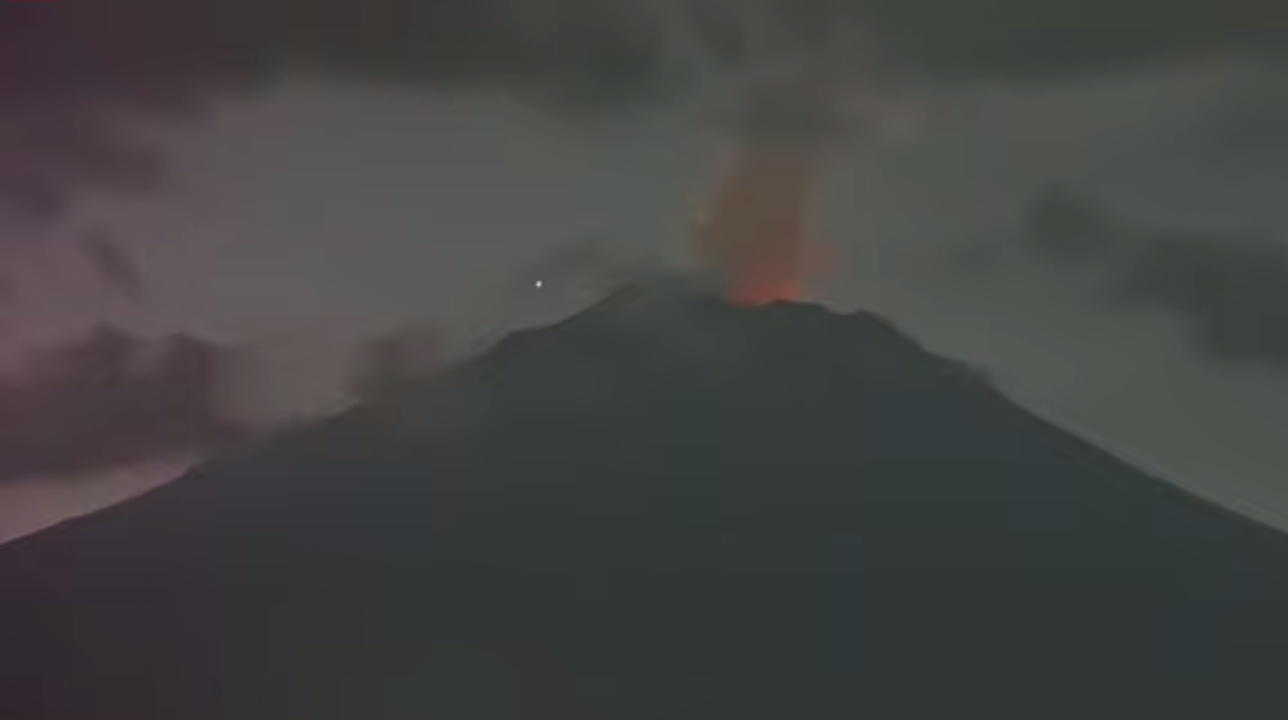
Earth venting heat through its leaky valve Popocatépetl, while the planet Venus — Earth’s twin, but with a whole ‘nother history — shines in the twilight sky over central Mexico. (Image: Screenshot, May 19, 2026, 0256 UTC, Diegoxx Popocatepetl webcam.
At some of the large calderas on our list, a supereruptive destabilization has happened just once — at Long Valley, for example. At others, including Yellowstone, the whole process apparently repeats in cycles. (Bachmann and Huber; Christiansen et al., 2002, 2007; Wilson et al.)
This leads to an interesting question among the boffins: Is Yellowstone still in its Lava Creek cycle; is a fourth cycle underway; or is Yellowstone (but not the hotspot) heading into extinction? (Christiansen et al. 2007; Mastin et al.; Stelten, 2024; Watts et al.)
That important question is difficult to answer due to the complexity of all the geology and earth science that’s involved, as well as the limitations on human understanding of Yellowstone at present (but, per the US Geological Survey [USGS] on its “Questions About Supervolcanoes” page, geoscientists have come a long way in that understanding over the last few decades). (Cashman and Sparks; Lowenstern et al.; Wilson et al.)
As for us and this series, in order to look into that important question (which we will do in Part 5, the last post), we first need to know a little more about all three cycles at Yellowstone PLUS the more than 600 km3 of magma (Christiansen et al., 2007; Watts et al.)
that Yellowstone has thus far erupted as lava flows since the Lava Creek supereruption (not all at once).
And even before doing that, we should have a basic picture of why all this is happening.
What’s going on underneath Yellowstone supervolcano?
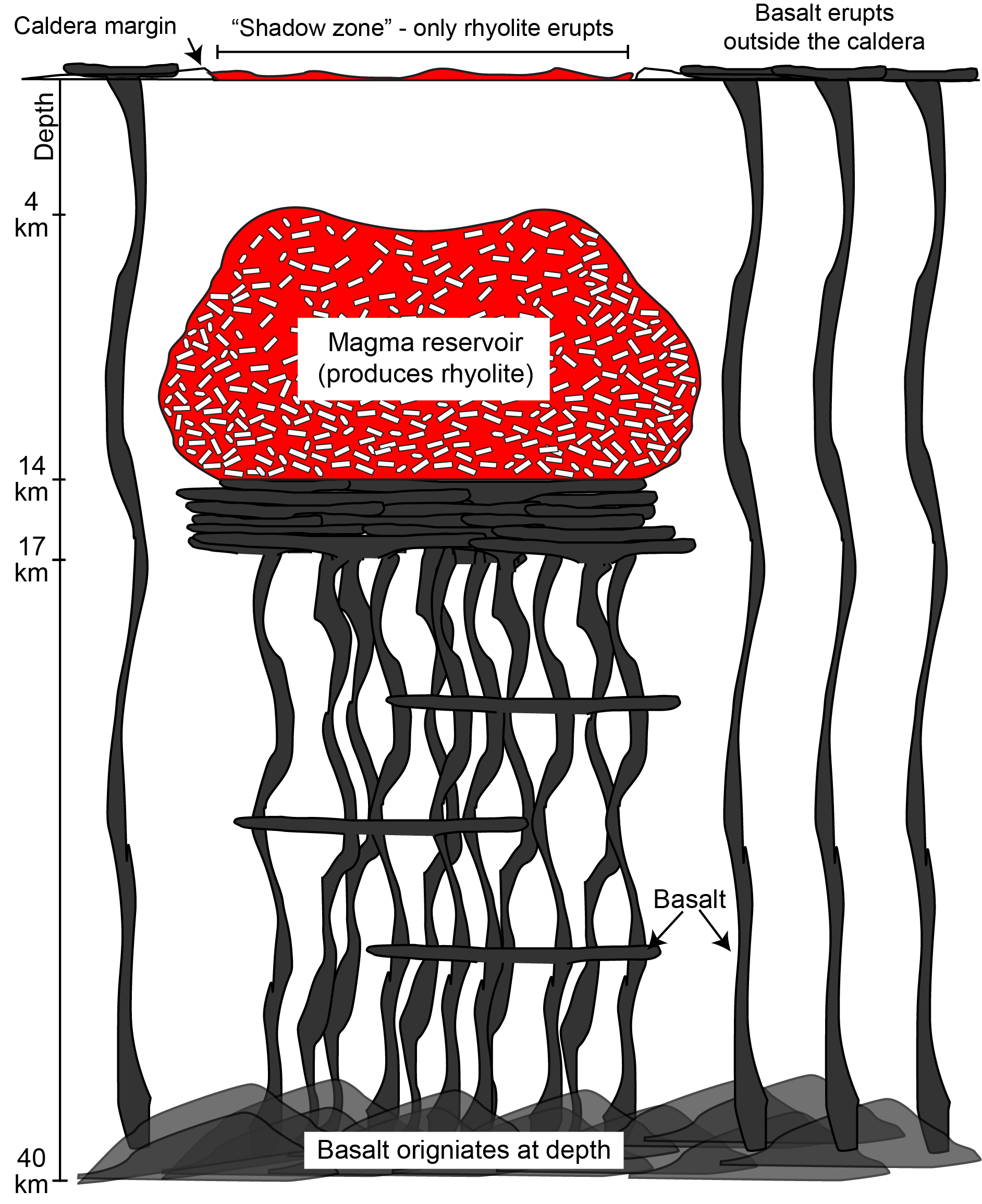
Aliens. (Image: M. Stelten/USGS, public domain)
No, it isn’t aliens.
The black stuff on that schematic is basalt — an iron- and magnesium-rich magma that is dark after it erupts, as we can see in Hawaii, Iceland, and many other places.
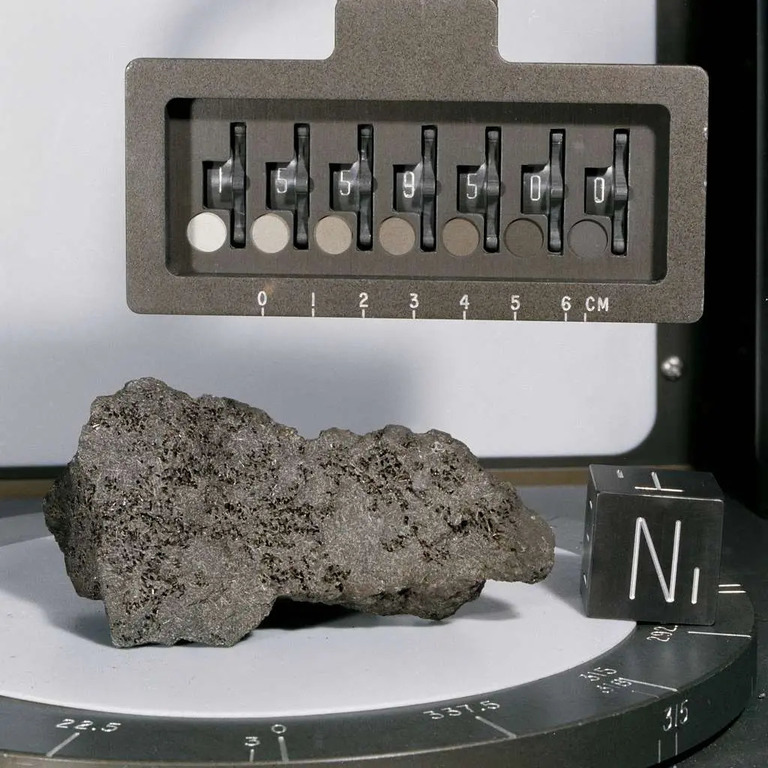
Basalt exists elsewhere in the Solar System, too. This sample is from the Apollo 15 landing site on the eastern edge of our Moon’s Mare Imbrium. (Image source, public domain)
The heat of this basalt, as it comes up from the mantle, runs Yellowstone’s transcrustal magmatic system, as well as the supervolcano’s renowned hydrothermal system. (Christiansen et al., 2007; Hildreth, 2021; Lowenstern et al.)
And that basalt is cooked up in…
The pressure cooker

Some 1800 miles below your feet, Earth’s core is as hot as the Sun, and gravitational forces down there are powerful enough to affect Time.
But there’s no need for existential dread, despite the distance between you and that time-warping furnace being only the same, roughly speaking, as the driving distance between Chicago and Phoenix.
Fortunately for us, very early in its history Earth wrapped a thick mantle of peridotite around its core.
This stony blanket is just the thing to effectively control how much core heat can reach us up here on the outer planetary crust.
Believe it or not, that mantle is mostly solid, even though it surrounds something as hot as the Sun! (Oppenheimer)
Why is it solid?
Because physics and chemistry — i.e., geological “pressure cooking” — can change minerals deep inside something as big as the Earth.
However, Dr. Clive Oppenheimer notes in his book’s Section 1.1 that, because of the planet’s intense central heat, the mantle does slowly convect, just like simmering soup does on the stove.
🍯🌋🍯
Quick reality check:
For this post only, it’s a good idea to temporarily let go of those images you might have seen of something that isn’t one of these convection currents: a vast plume rising through Earth underneath the hotspot.
It’s not that there is no unusual upwelling of magma under Yellowstone.
There is!
That’s why Yellowstone exists.
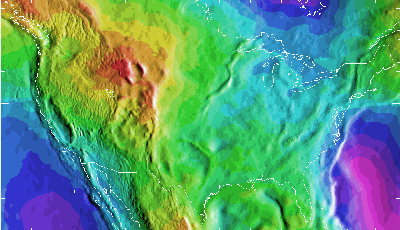
National Geodetic Survey, public domain
Yellowstone sits atop the highest geoid abnormality in North America (Smith and Braile); in plain English, upwelling from below raises the many-miles-of-solid-rock-thick Yellowstone Plateau almost 40 feet above the surrounding mountainous terrain, according to the National Geodetic Survey. (Correction, June 20, 2026: While reading up for the next post, I realized more specifically that Yellowstone itself is centered on the almost 40-foot geoid high, but the Yellowstone Plateau is raised almost 2,000 feet above its montane surroundings, per Lowenstern et al., 2006!)
Something down there has a lot of ooomph! But let’s not worry about it right now; it will still be there when Part 5 comes around.
It’s just that:
- Mantle plumes are a complicated and controversial topic, one that will make more sense after we’ve gotten to know Yellowstone’s basics a little better.
- For various regional and geological history reasons, Earth’s mantle under the western US is very complex (Foulger et al., 2015, 2015a) — much more so than we need to get into today.
All we want to do right now is to get molten rock inside Yellowstone so that, in the next post, we can blow it all over western and central North America (Christiansen et al., 2007; Matthews et al.) in two supereruptions and one hìgh-end VEI 7 blast.
And even that simple step of Magma + Volcano = Eruption is going to be quite a challenge, considering that the planet’s 1800-mile-thick mantle is made of solid rock.
If it doesn’t melt near the Earth’s fiery core, why would it melt up here, next door to cold Space?
Well, let’s follow it along, starting with those convection currents, and see what happens.
🍯🌋🍯
How can solid rock convect?
Well, why not? It’s easy to forget a fact that we all do know: solid crystalline material can move internally.
At the other end of the thermometer from our hot mantle, ice creeps sideways over the ground in glaciers.
Alaska’s LeConte glacier, flowing into the sea.
Under a certain range of pressure cooking extreme pressures and temperatures, mantle rock does the same thing, only it goes up (and, eventually, down again). Sloooowly.
So, after geological amounts of time have gone by, hot convecting peridotite eventually gets up to about 200 miles below our feet. (Oppenheimer)
Now it actually does start to melt, because the pressure on it up here is much less than it was farther down under that additional 1600 miles of rock.
As Dr. Oppenheimer puts it (not that Oppenheimer; this one):
…Volcanoes exist because the mantle melts…peridotite, like many rocks, is composed of several minerals. The different minerals have different melting temperatures; in fact, individual minerals themselves display a range of melting point according to their chemistry…Melting points are not only sensitive to chemical composition, they are also strongly dependent on pressure. With falling pressure, melting point drops…Crucially, the ascending mantle current is not so hot that all of it melts by this process. Instead, it is just those mineral constituents with the lowest melting points that melt; the high-melting-point minerals remain solid. Typically, somewhere between 1 and 20% of the peridotite melts, and hence the process is known as ‘partial melting’. It is extremely important in the Earth since, over the course of geological time, it has changed the mantle’s composition…and led to the growth of the crust and continents…a typical decompression event yields a…melt [that] is typically referred to as ‘basaltic’ and contains around 45% silica (SiO2) by mass. The great pressure squeezes the basalt ‘melt’ from the crystals remaining in the mantle, a process a bit like depressing the plunger in some coffee makers. The melt percolates upwards forming pools of magma, which continue to rise owing to their lower density…
I had to quote him at length, since as a layperson I could not be so clear, jargon-free, and succinct about a process that, after all, is the only reason why there is any magma in the first place.
Okay. We have magma!
Now let’s get it into the volcano.
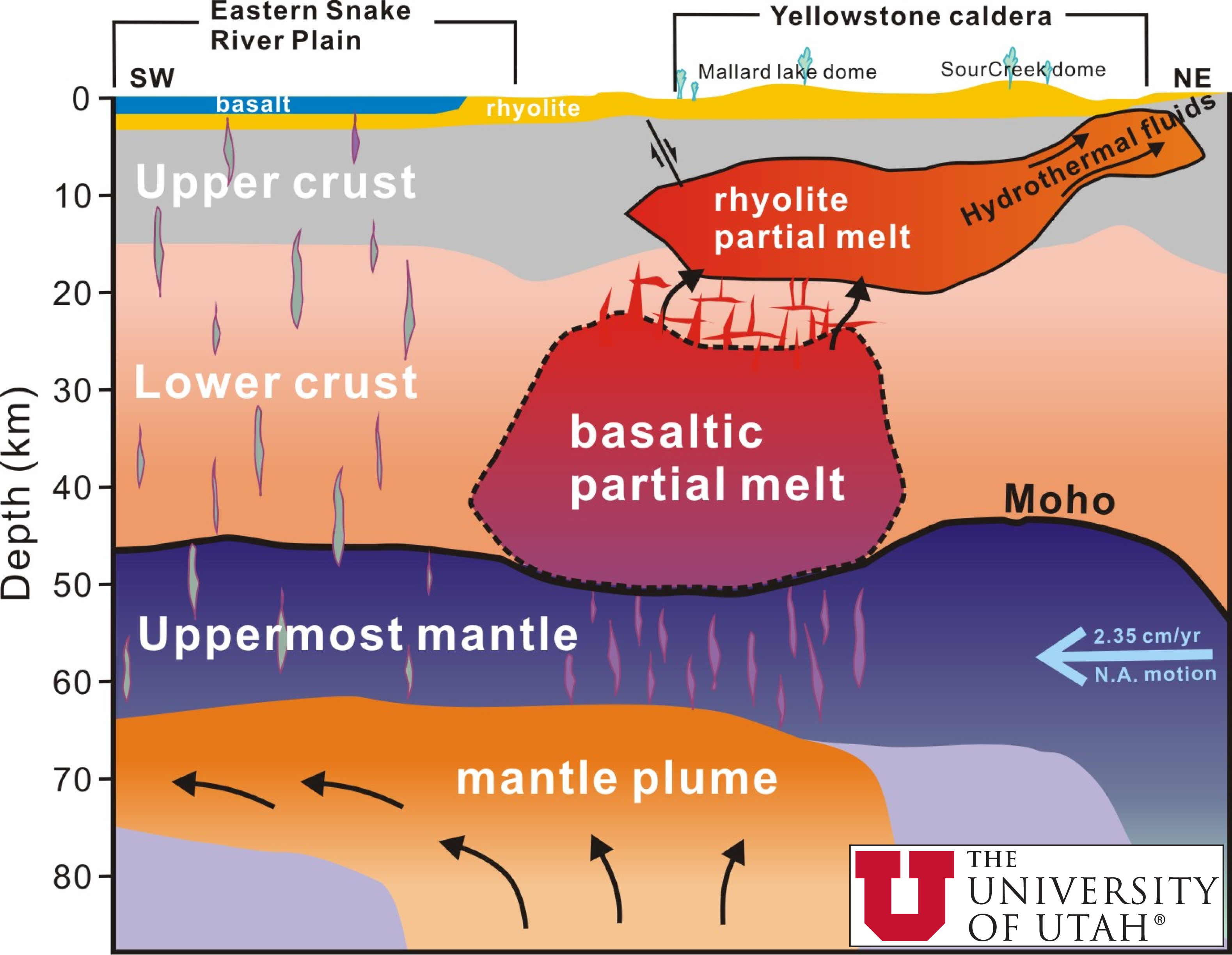
Spoiler: This science cartoon shows that magma does get into the volcano.
(Image: USGS)
- Remember, we’re calling plumes “mantle upwelling” for now.
- The purple layer in that science cartoon is the upper mantle melting zone (which is also the squishy layer that continents like North America (N. A.) drift on).
- The Moho marks our planet’s crust-mantle boundary.
- Those two magma chambers formed at the neutral buoyancy points for basalt (denser magma) and rhyolite (less dense, and therefore higher up).
- We’ll cover the Eastern Snake River Plain, a/k/a the “Yellowstone hotspot track,” in Part 5.
What are those red drippy-looking things rising up through the purple layer?
Those are the blobs that mantle material forms as it melts, and they don’t stop rising when they first hit the crust.
Once basaltic mantle magma reaches the Moho, many things can and do happen.
Most importantly for this post, with comparatively cold crustal rock coming into contact with molten mantle material, lava-lamp physics comes into play — but even more sloooooowly than in the toy.
Yes, really! Although I don’t know that awareness of the geologic process inspired this beautiful invention back in the 1960s.
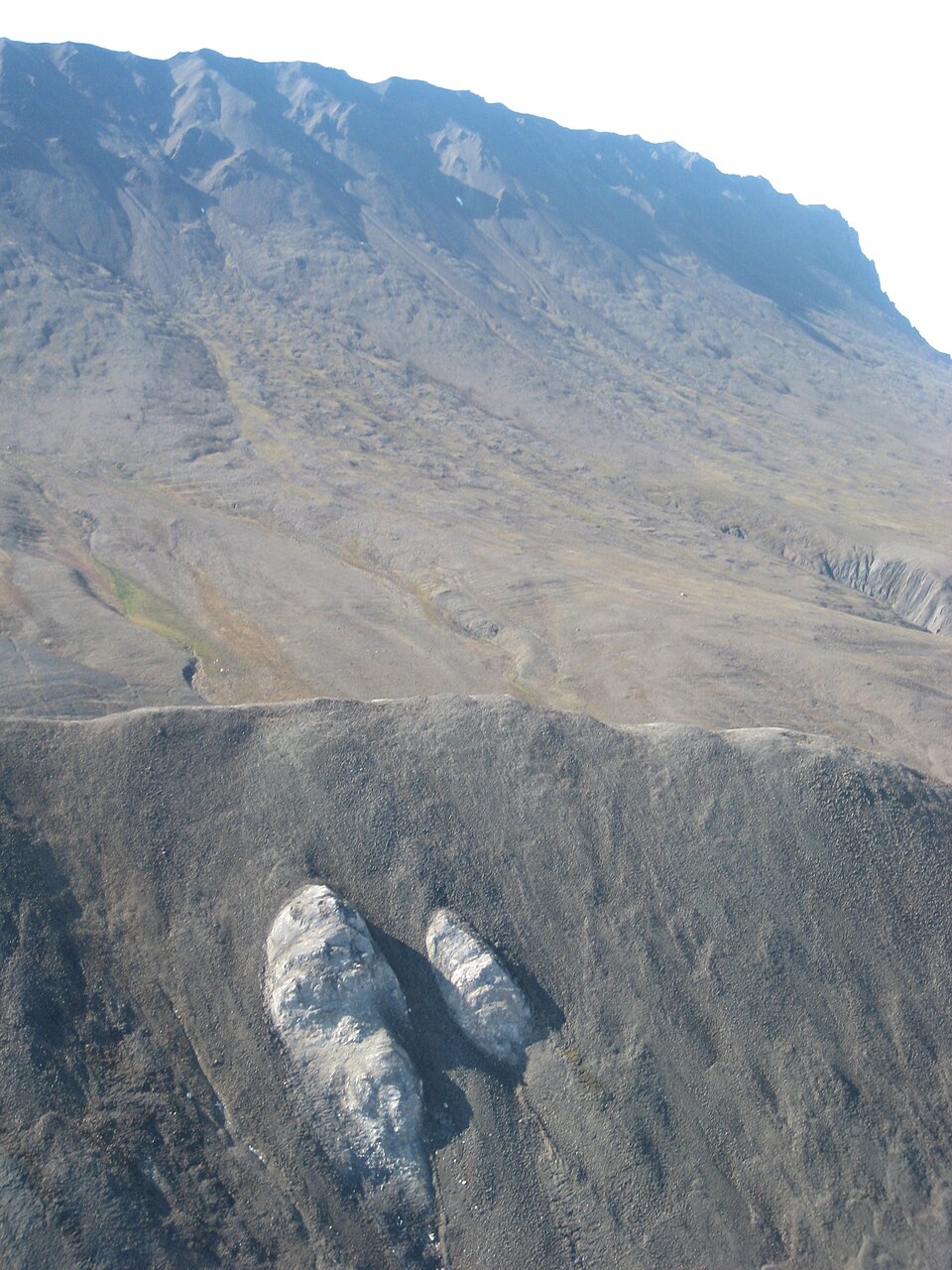
Closer to the surface, salt formations, which are less dense than rock, form similar blobs and rise in much the same way, like this exposed one at Heiberg Island, Canada, that has eroded into a lovely shape. (Image: Penny Higgins, CC BY-SA 2.0)
Like those blobs of hot wax in the lamp, blobs of basaltic melt
continue to rise through the colder crust rock just as far up as buoyancy will take them, stopping only when they achieve neutral buoyancy. (Hildreth, 2004)
However, buoyancy alone never takes them all the way up to the surface. As this layperson understands it, any kind of rock from the mantle, no matter how hot, is too dense for that.
Yes, pumice is rock and it floats on water, but that’s not directly from the mantle — it’s a sponge-like rock that started out as gassy silicic magma being pressure-cooked inside the volcano’s magmatic system (physical chemistry doesn’t stop working at the Moho).
That magma bubbled up into foam just before it was blown out of the vent, probably at supersonic speeds (in the right circumstances, gas gives magma quite a “push!”).
Once outside the volcano, rock foam almost instantly froze into pumice.
When this happens near or under the sea, pumice rafts can become a traffic hazard! (I think this pumice might be from the ongoing Titan Ridge eruption in the Bismarck Sea.
Yellowstone has produced plenty of pumice in its time.
But molten rock deeper inside any magmatic system only reaches the surface with some sort of an assist, say, from gas pressure (gases do bubble out of solution as magma rises and/or as certain geochemical reactions occur). (Oppenheimer)
There also can be a tectonic contribution — in fact, tectonics is another topic I am saving for the last post because Yellowstone’s tectonic setting is, to put it technically, absolutely bonkers.
Also, the lava-lamp comparison only goes so far.
Once a basalt blob stops rising, it never goes back down.
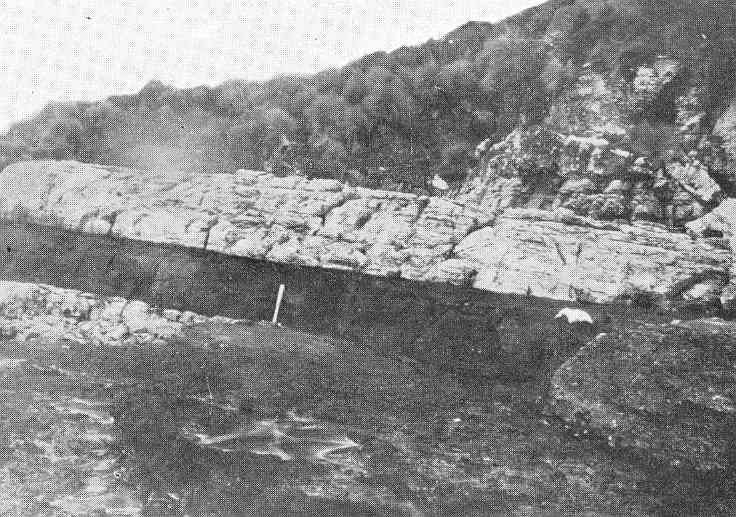
An exposed sill in North-West Bay, Campbell Island, New Zealand, in 1909. (Image: Charles Chilton via Wikimedia, public domain)
It might spread out flat into a sill, if crustal conditions allow that, or it could keep its blob shape.
Regardless, unless other factors (like gas bubbling or tectonic stresses) drive it upwards and into an eruption —
Which isn’t always explosive.
— that blob’s melt will eventually freeze into place as a pluton or come together with other blobs to form a magma chamber.
A very small magma chamber, compared to Yellowstone’s, but one that we can visit.
Yellowstone is big enough to have more than one reservoir of molten rock.
In fact, a 2025 study using magnetotellurics (MT) suggests that Yellowstone’s magmatic plumbing is intricate, beautiful — and breathtaking in size!
But let’s start out small and simple, continuing with the cartoon diagram of Yellowstone’s plumbing, as well as that “space aliens” schematic.
The leaky valve: Yellowstone
The science cartoon we saw earlier showed two magma chambers underneath Yellowstone: a huge lower chamber
of partially molten basalt and a smaller upper chamber of partially molten rhyolite. (As we’ll see later in this section, that 2025 study showed that there appear to be several more reservoirs down there, too.)
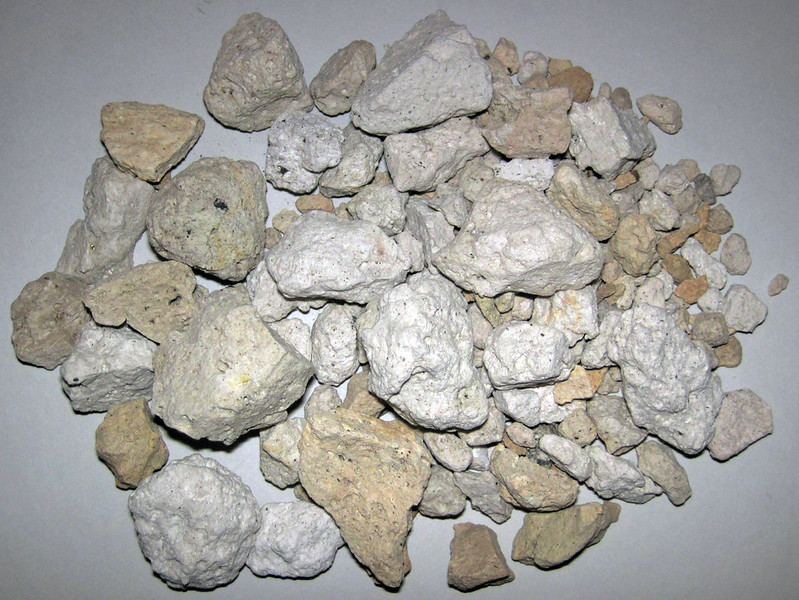
Rhyolite pumice from one of Valles Caldera’s Big Ones. (Geologists never see things as “just a bunch of rocks”! 🙂) (Image: James St. John, CC BY-SA 2.0)
Rhyolite is a higher-silica kind of magma that is very sticky, compared to runny basalt, and it can erupt explosively (Christiansen et al., 2007), as we have already seen at many of the other supervolcanoes covered in this series.
Did somebody place an online order for home delivery — where did this Yellowstone rhyolite come from?
It has cooked up out of the lower basalt chamber, with additional ingredients and water from the surrounding crust. (Lowenstern et al.; see Oppenheimer for geological cookery details.)
Earth’s pressure cooking doesn’t ever stop until that core heat is released!
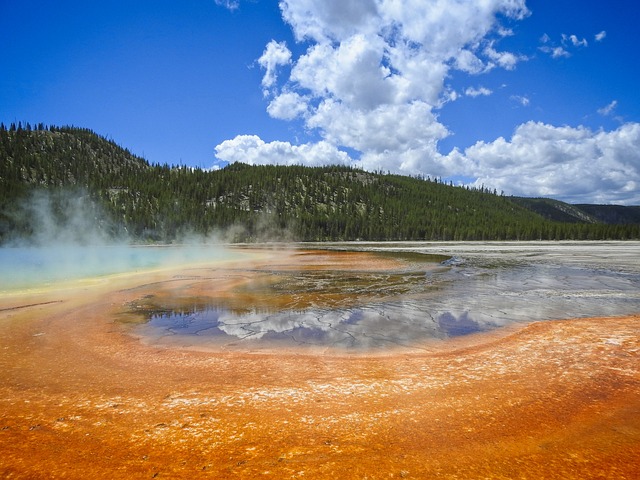
Free Photos at divvypixel.com from Pixabay, public domain
.
Some core heat carried by the basalt comes out directly through the ground (though the basalt doesn’t, inside Yellowstone caldera) and heat also escapes through the famous hydrothermal system. (Lowenstern and Hurwitz)
You won’t get your toes toasted unless you’re foolish enough to ignore park rules, but overall Yellowstone emits more than 30 times the heat produced by the continental crust. (Christiansen et al., 2007; Lowenstern et al.)
Some of the core heat carried in basalt that rises up from the mantle depths goes to work and powers various magmatic system processes (Hildreth, 2021; Lowenstern et al.; Wilson et al.), which include but aren’t limited to slow-cooking batches of rhyolite (of course, there is a lot of physical chemistry involved, as well, and “slow” means hundreds of thousands of years or more).
Partially molten rhyolite isn’t as dense as basalt, so at Yellowstone, this chamber sits a little higher up in the crust.
That partially molten rhyolite actually blocks the basalt from rising! (Christiansen et al., 2007)
This blockade is what first clued volcanologists in on the size and the partially molten state of Yellowstone’s rhyolite magma chamber. (Christiansen et al., 2007; Lowenstern et al.; Lowenstern and Hurwitz)
If it were solid, cold rhyolite, then yes, that rising hot basalt would get through when conditions were right for eruption — just as basalt started getting through the old Huckleberry Ridge (to the right, on the schematic) and Mesa Falls (left) calderas, about a million years after each caldera’s last rhyolite activity. (Christiansen et al., 2007; Lowenstern and Hurwitz)
For the record, Yellowstone caldera’s last rhyolite eruption was only “this morning” in geologic terms — a lava flow about 74,000 years ago. There has been at least one basalt eruption since then, too, but it was outside the caldera.
Yellowstone is dormant but still active. (Lowenstern et al.)
There is still magma sitting several miles below our feet in that beautiful caldera, fueling those geological wonders.
And chances look pretty good that this rhyolite chamber will NOT launch another lava flow any time soon, that is, within the next few thousand years. (Lowenstern et al.; Lowenstern and Hurwitz; Stelten, 2022)
Yay!
🌋🌋🌋
If basalt ever does erupt inside Yellowstone caldera — it never has yet (Lowenstern and Hurwitz) — then scientists would know that Yellowstone’s days of Big Ones and rhyolite lava flows are over. (Christiansen et al., 2007)
And a great quiet shall come over this part of North America…until the hotspot blasts a new hole in the crust, a little farther to the northeast, millions of years from now.
🌋🌋🌋
There is the rhyolite chamber, buoyancy-blocking the basalt! (Image: M. Stelten/USGS, public domain)
On that “aliens” schematic, see the blank space between the top of the rhyolite chamber and the surface?
They didn’t forget to fill it in.
At present there is no large body of magma detected in the upper crust very close to the caldera surface here or at any known supervolcano. (Lowenstern et al.; Wilson et al.)
This, too, is good news.
Short-lived shallow reservoirs apparently do form at times. If conditions in the crust are otherwise not ready for an eruption, then the extremely shallow reservoir will freeze up into a pluton or batholith. But if everything else is a go, there will be an eruption — either explosive or effusive (lava flows). (Harmon, part 2; Watts et al.; Wilson et al.; Wotzlaw et al.)
As for supereruptions, while one has never been observed in recorded history, we did see in the Taupo post that a large and temporary collection of magma probably does first accumulate between the top of the magmatic system and the surface when a supereruption is brewing, perhaps over decades to centuries, maybe longer (Cashman and Sparks; Watts et al.):
Watch the reddish orange diagram at the bottom of this Oruanui supereruption animation from the Museum of New Zealand Te Papa Tongarewa. Another spoiler, too: As we’ll see next time, Yellowstone’s Huckleberry Ridge blast, while much larger, might have unfolded like this. (Wilson et al.)
Still, there is all that rhyolite down there, and rhyolite can erupt explosively.
Just what exactly do they mean by saying (as they do in the cartoon) that those two humungous magma chambers are partly molten?
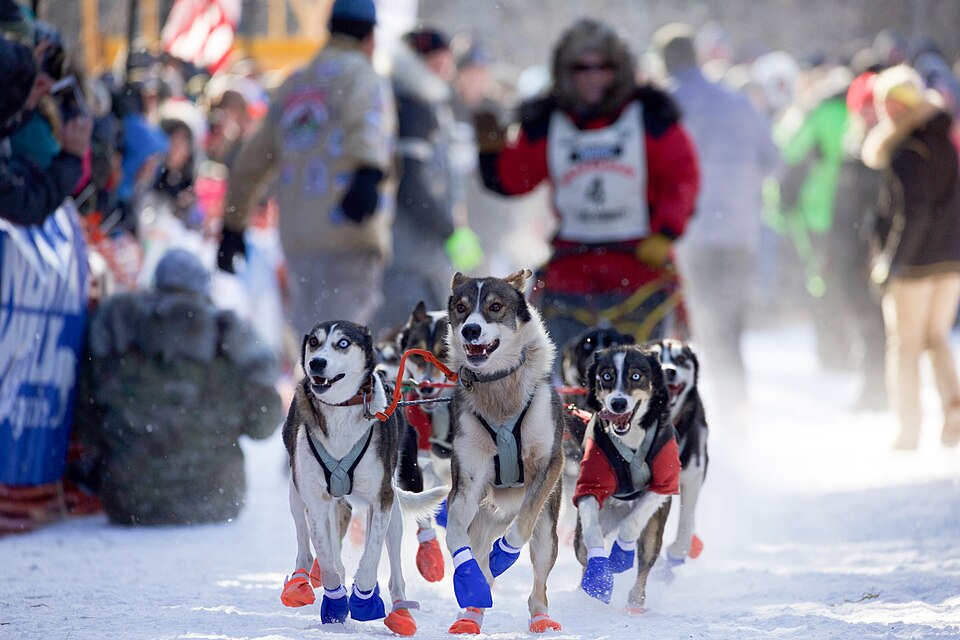
No. (Image: Andy Witchger via Wikimedia, CC BY-SA 2.0)
They mean “mush.”
As this layperson understands it, the most widely used scientific model of what is going on inside magma chambers and reservoirs is the so-called mush model. (Bachmann and Huber; Cashman and Sparks; Harmon, part 2; Hildreth, 2004, 2021; Miller and Wark; Stelten, 2022; Wilson et al.)
There is still a lot of debate over it, but what I have read (and understood) of such models for Yellowstone do always include two points that Dr. Oppenheimer also mentioned in his quote earlier:
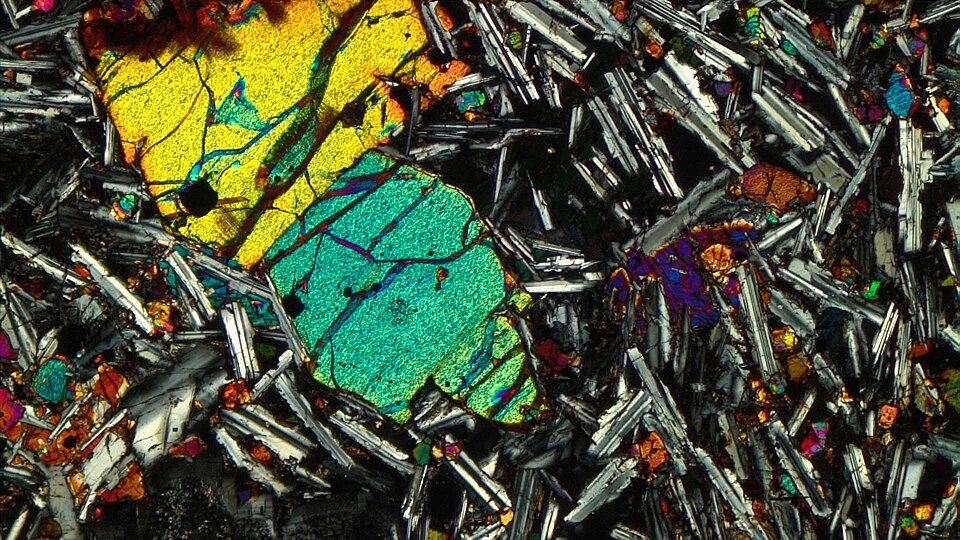
- Crystals. Water freezes into ice crystals. Molten rock crystallizes, too, under the comparatively low pressures at or near Earth’s surface.
Thin sections of the minerals found in magma crystals are pretty. (Image: Tiffany A. Rivera, CC BY-SA 4.0)
In the relatively cold upper crust, this crystallization constantly occurs in magma chambers; however, because of inflow of hotter melt from below some melting also goes on.
Inflow is geologically slooooow, though, and these reservoirs are incredibly large, so crystal mush dominates the chamber contents. (Caricchi et al.; Schmandt et al.)
And yet it isn’t solid rock.
True melt is scattered here and there throughout the mush in each chamber. It also tends to rise toward the top of the chamber, partly because of buoyancy but also because of…
- Pressure. There is much pressure on Yellowstone’s crystal mushes because there are still tens of miles of crustal rock pressing down on those chambers — note that, unlike the geoscientists, we can afford to ignore complicating but very important factors, like tectonics and gas exsolution, which also can pressurize magma reservoirs and can even trigger eruptions.
For this post, it’s enough to know that Dr. Oppenheimer’s simile of the coffee press squeezing liquid melt from the crystal “grounds” applies here.
Of course, that is all much too oversimplified to be very accurate, but I hope it gives you a general sense of what is going on underneath Yellowstone.
That will help you to really appreciate the model of Yellowstone’s magmatic system that they came up with in 2025, using magnetotellurics.
Like most other large caldera systems, Yellowstone’s plumbing is transcrustal, extending from less than 10 miles below the surface all the way down to the Moho.
Everything that we have looked at — heat, pressure, chemistry, magma supply, lava-lamp physics, and so on — have worked together in constructing this intricate system that probably took on its present shape during a reorganization some 300,000 years ago (see Stelten, 2022 for details).
Here is Figure 2 from the study:
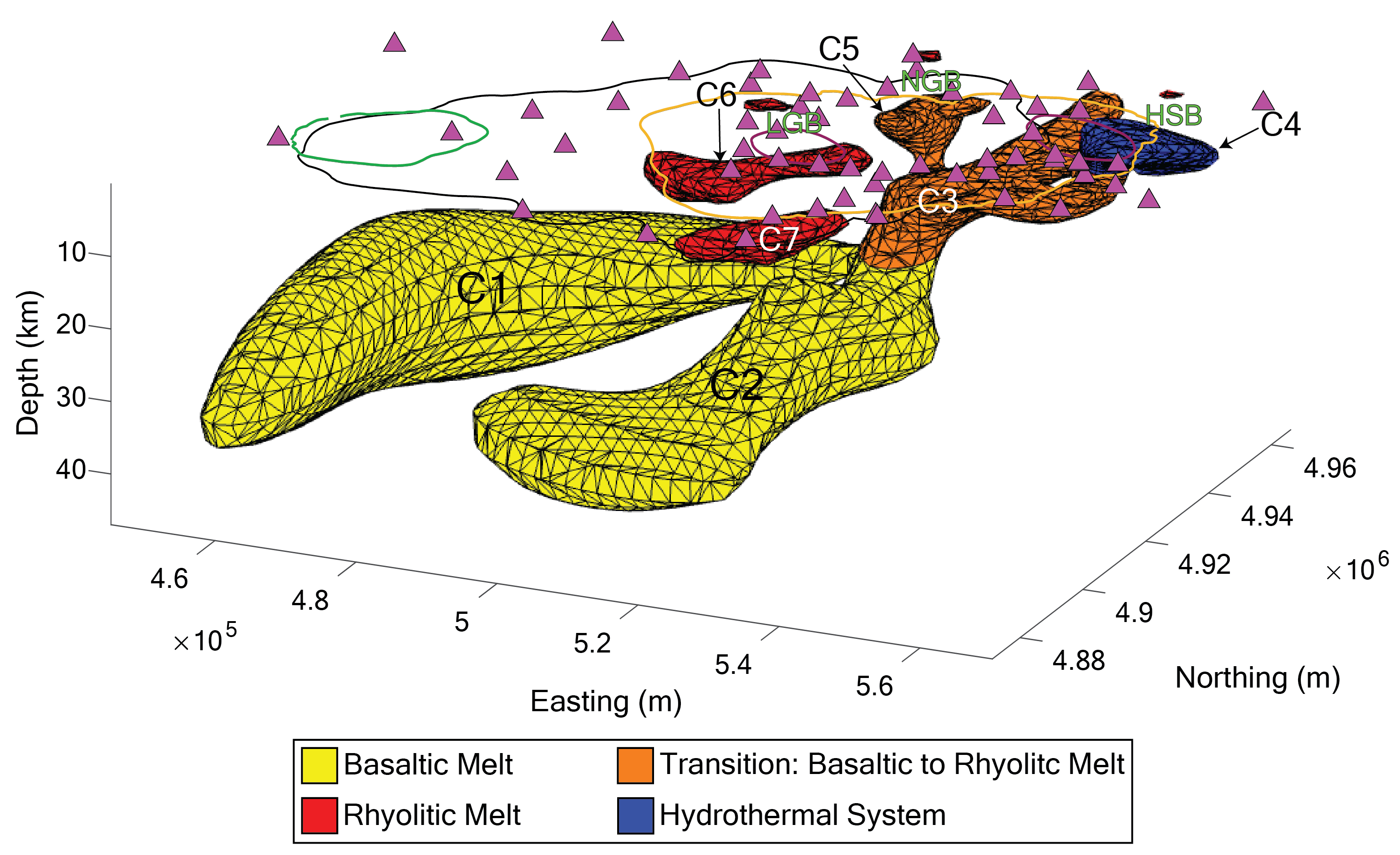
For a quick sense of scale, the Yellowstone Caldera is roughly 50 by 30 miles in size (USGS, Supervolcanoes). Green line = Mesa Falls caldera. Black line = Huckleberry Ridge caldera. Yellow line = Lava Creek (current) caldera. NGB = Norris Geyser Basin. LGB = Lower Geyser Basin. (Image: USGS, public domain)
- The reddish areas on Figure 2 are the rhyolite and transitional basalt/rhyolite magma chambers.
- The “elven slippers” represent basaltic magma chambers. No, the boffins didn’t get whimsical; that’s how they interpret their findings.
- The basalt in those modeled green
tap shoesmagma chambers is quite hot and is melting a little of that rhyolite in the upper chambers — some of which is likely leftover Lava Creek magma, while the rest might be material from Yellowstone’s last lava flow. (Bennington; Lowenstern et al.; Stelten, 2022)By the way, that Lava Creek magma is not especially dangerous just because it once fueled a supereruption.
Despite the sensational headlines, supervolcanoes are only leaky valves on this planet-sized pressure cooker, just like all volcanoes are.
There is nothing “super” about their magma — it’s the same sort of stuff you might find in any “normal” volcano. (Miller and Wark)
What’s unusual and, fortunately, very rare is the vast quantity of magma that can accumulate close to the surface in one of those short-lived chambers before erupting at magnitude ≧8. (Miller and Wark)
- Again, the magma in these chambers is mostly solid and is not in an eruptible state. (Bennington; Lowenstern et al.; Maguire and Schmandt)
So, how much rhyolite do they think is down there in total?
Keep in mind that this is only an estimate, since current monitoring methods can’t accurately measure precise melt volumes or locations yet. (Giordano and Caricchi)
The volume of rhyolite in the largest of those chambers is estimated to be about as much as the amount of magma that came out in the Mesa Falls blast. (Bennington)
BUT…also keep in mind that:
- This is crystal mush plus melt. And according to current estimates, there isn’t much rhyolite melt in there: only between 15% and 20% of the total.
Contrary to what they say in the excellent docudrama Supervolcano, it takes a volume of more than 50% to make melt eruptible. (YVO, 2015)
- The recent MT study suggests that the concentration of melt in each rhyolite chamber is too low to feed an eruption at present. (Bennington)
- There is an estimated 2% melt in the lower chambers (basalt). (Wilson et al.; Wu et al.; YVO, 2015)
- Numbers vary for estimates of total system’s molten component.
Overall, Wu et al. reported in 2023, Yellowstone’s plumbing system is less than 10% molten.
A different study, using supercomputers on 20 years’ worth of data, found that, at most, Yellowstone could contain 16% to 20% melt overall. (Maguire and Schmandt)
So 20% melt overall is the highest estimate of melt in Yellowstone’s magmatic system that I could find, with most numbers being actually much lower than that depending on which part of the system one looks at.
And a melt percentage of at least 50% is believed necessary to make that magma eruptible.
Once again — good news as far as we humans can presently understand this extremely well monitored and extensively studied volcano.
That understanding does only go so far, of course, and Yellowstone continues to be the most extensively geophysically studied volcano in the world. (Wilson et al.)
A surprising and very reassuring discovery recently came out of that research.
Yellowstone’s “lid”
This magmatic system apparently has a “pressure-release lid”!
In 2020, the boffins went out and whomped Yellowstone caldera with a big truck, as one does.
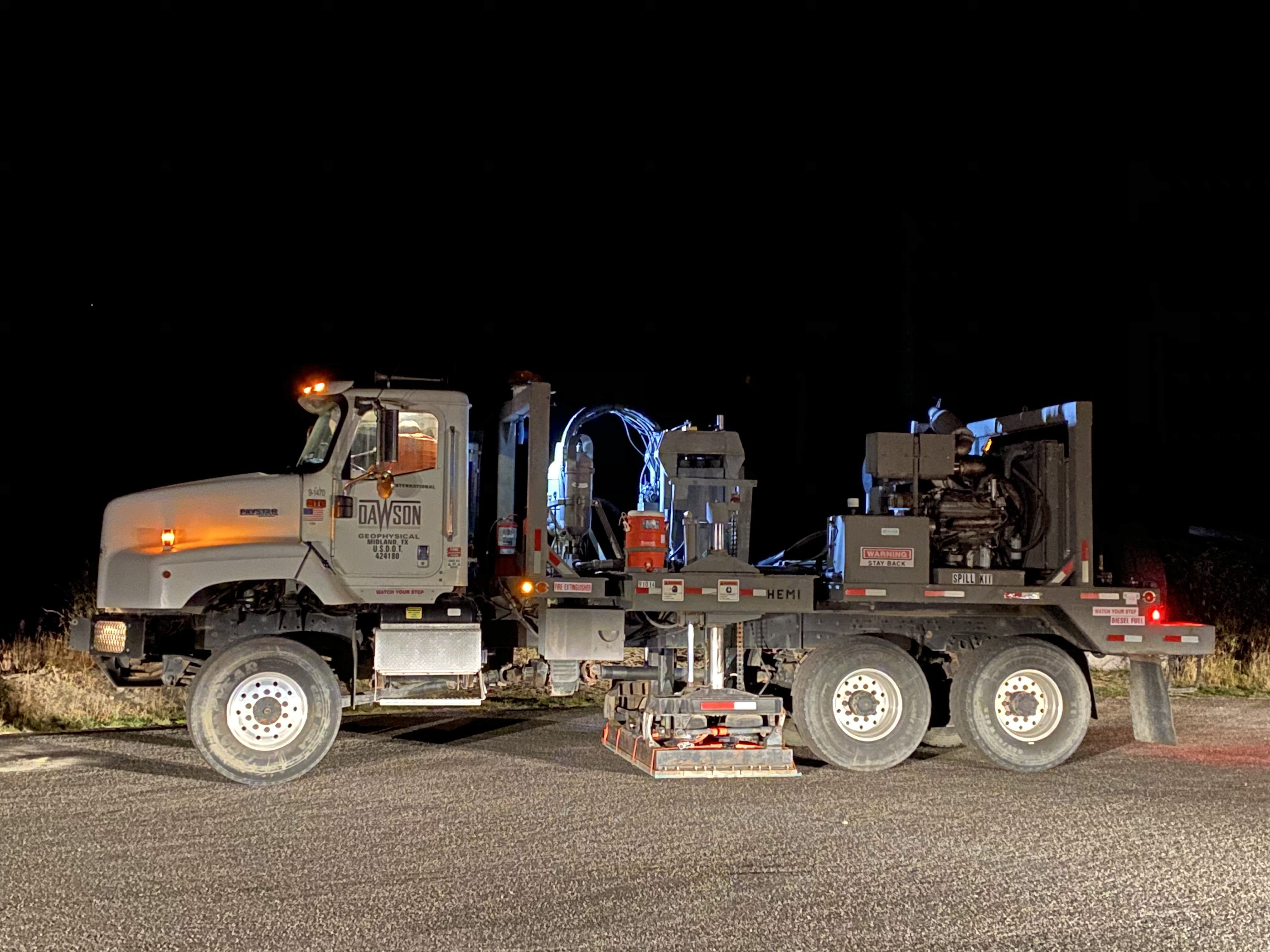
A big whomping truck, too awesome to be seen by the light of day. (Image: USGS, public domain)
Then they looked to see what those very precisely tuned seismic waves might reflect off of in the upper levels of the caldera’s plumbing.
That flurry of waves from the vibroseis truck showed that, almost 2½ miles below the surface but still above the top of Yellowstone’s magmatic system, sits a thin, hard layer made out of a mixture that seems to be composed of 14% silicate magma/supercritical fluid bubbles and 86% solid mineral crystals. (Duan et al.; Schmandt and Duan)
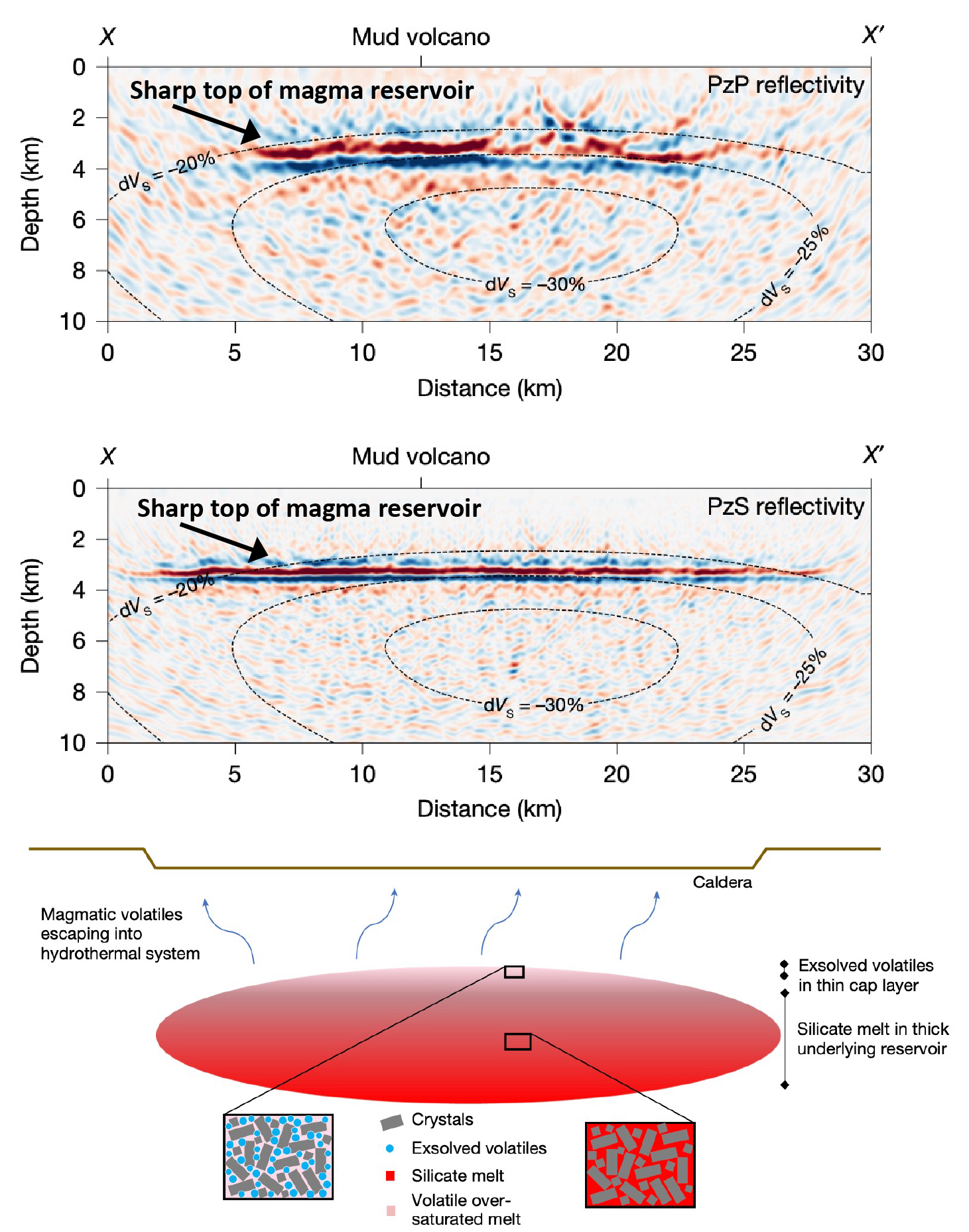
The researchers report that this surprising “lid” is strong enough to maintain the plumbing system’s stability. At the same time, it has the right configuration to efficiently release volcanic gases that might otherwise build up pressure in the system and thus possibly trigger an eruption. (Schmandt and Duan)
Volcanologists now are looking for similar “lids” at other large caldera systems! (Schmandt and Duan)
So whomping trucks are not only fun but also make for good science.
And it looks as though we are good for now at Yellowstone and can continue to safely scare ourselves with movies and sensational tabloid headlines.
Yellowstone in real life is likely to just keep on doing what it’s doing now for the foreseeable future. (Stelten, 2022)
“How long is that in pic-a-nic numbers?” (Image: Jacqueline F. Cooper/Shutterstock)
🌋🌋🌋
Yay! We now have magma in the volcano!
But even with some assurance of safety during our lifetimes, we still can’t help wondering: what is Yellowstone capable of?
In the next two posts, we will look at what this volcanic field has done in the past (as geoscientists currently understand it AND as this layperson understands the geoscientists), starting with Yellowstone’s Big Ones.
Then a subsequent post (Part 4, if you’re counting) will explore Yellowstone’s big lava eruptions — the most likely eruption style to expect if Yellowstone ever does breach the surface again.
Tune in next time…
Featured image: inick25x/Shutterstock
Sources:
- Acocella, V.; Di Lorenzo, R.; Newhall, C.; and Scandone, R. 2015. An overview of recent (1988 to 2014) caldera unrest: Knowledge and perspectives. Reviews of Geophysics, 53(3): 896-955.
- Bachmann, O., and Huber, C. 2016. Silicic magma reservoirs in the Earth’s crust. American Mineralogist, 101(11): 2377-2404.
- Bennington, N. 2025. An electromagnetic view of how magma is stored beneath Yellowstone. https://www.usgs.gov/observatories/yvo/news/electromagnetic-view-how-magma-stored-beneath-yellowstone
- Caricchi, L.; Annen, C.; Blundy, J.; Simpson, G.; and Pinel, V. 2014. Frequency and magnitude of volcanic eruptions controlled by magma injection and buoyancy. Nature Geoscience, 7(2): 126-130.
- Christiansen, R. L.; Foulger, G. R.; and Evans, J. R. 2002. Upper-mantle origin of the Yellowstone hotspot. Geological Society of America Bulletin, 114(10): 1245-1256.
- Christiansen, R. L.; Lowenstern, J. B.; Smith, R. B.; Heasler, H.; and others. 2007. Preliminary assessment of volcanic and hydrothermal hazards in Yellowstone National Park and vicinity. U. S. Geological Survey.
- Deligne, N. I.; Coles, S. G.; and Sparks, R. S. J. 2010. Recurrence rates of large explosive volcanic eruptions. Journal of Geophysical Research: Solid Earth, 115(B6).
- DeSilva, S. and Self, S. 2022. Capturing the extreme in volcanology: the case for the term “supervolcano”. Frontiers in Earth Science, 10: 859237.
- Farrell, J. 2026). Magma plumbing beneath Yellowstone. Science, 392(6794): 143-144. https://www.science.org/doi/10.1126/science.aeg3511 (Abstract only)
- Foulger, G. R.; Christiansen, R. L.; and Anderson, D. L. 2015. The Yellowstone “hot spot” track results from migrating basin-range extension. The Interdisciplinary Earth: A Volume in Honor of Don L. Anderson: Geological Society of America Special Paper, 514: 215-238.
- Giordano, G., and Caricchi, L. 2022. Determining the state of activity of transcrustal magmatic systems and their volcanoes. Annual Review of Earth and Planetary Sciences, 50(1): 231-259.
- Harmon, L. J.; Gualda, G. A.; Gravley, D. M.; Smithies, S. L.; and Deering, C. D. 2024. The Whakamaru magmatic system (Taupō Volcanic Zone, New Zealand), part 1: Evidence from tephra deposits for the eruption of multiple magma types through time. Journal of Volcanology and Geothermal Research, 445, 107966.
- Harmon, L. J.; Smithies, S. L.; Gualda, G. A.; and Gravley, D. M. 2024. The Whakamaru magmatic system (Taupō Volcanic Zone, New Zealand), part 2: Evidence from ignimbrite deposits for the pre-eruptive distribution of melt-dominated magma and magma mush. Journal of Volcanology and Geothermal Research, 447, 108013.
- Hildreth, W. 2004. Volcanological perspectives on Long Valley, Mammoth Mountain, and Mono Craters: several contiguous but discrete systems. Journal of Volcanology and Geothermal Research, 136(3-4): 169-198.
- ___ 2021. Comparative rhyolite systems: Inferences from vent patterns and eruptive episodicities: Eastern California and Laguna del Maule. Journal of Geophysical Research: Solid Earth, 126(7): e2020JB020879.
- Jellinek, A. M., and DePaolo, D. J. 2003. A model for the origin of large silicic magma chambers: precursors of caldera-forming eruptions. Bulletin of Volcanology, 65: 363-381.
- Li, Y.; Weng, A.; Xu, W.; Zou, Z.; and others. 2021. Translithospheric magma plumbing system of intraplate volcanoes as revealed by electrical resistivity imaging. Geology, 49(11): 1337-1342.
- Lowenstern, J. B., and Hurwitz, S. 2008. Monitoring a supervolcano in repose: Heat and volatile flux at the Yellowstone Caldera. Elements, 4(1): 35-40.
- Lowenstern, J. B.; Smith, R. B.; and Hill, D. P. 2006. Monitoring super-volcanoes: geophysical and geochemical signals at Yellowstone and other large caldera systems. Philosophical Transactions of the Royal Society A: Mathematical, Physical and Engineering Sciences, 364(1845): 2055-2072.
- Maguire, R., and Schmandt, B. 2022. Yellowstone’s magma reservoir comes into sharper focus. https://www.usgs.gov/observatories/yvo/news/yellowstones-magma-reservoir-comes-sharper-focus
- Mason, B. G.; Pyle, D. M.; and Oppenheimer, C. 2004. The size and frequency of the largest explosive eruptions on Earth. Bulletin of Volcanology, 66(8): 735-748.
- Mastin, L. G.; Van Eaton, A. R.; and Lowenstern, J. B. 2014. Modeling ash fall distribution from a Yellowstone supereruption. Geochemistry, Geophysics, Geosystems, 15(8): 3459-3475.
- Matthews, N. E.: Vazquez, J. A.; and Calvert, A. T. 2015. Age of the Lava Creek supereruption and magma chamber assembly at Yellowstone based on 40 Ar/39 Ar and U‐Pb dating of sanidine and zircon crystals. Geochemistry, Geophysics, Geosystems, 16(8): 2508-2528.
- Miller, C. F. and Wark, D. A. 2008. Supervolcanoes and their explosive supereruptions. Elements, 4(1): 11-15.
- National Park Service. ___ “Super Volcanoes.” https://www.nps.gov/articles/000/-super-volcanoes.htm Last accessed November 13, 2024.
- Oppenheimer, C. 2011. Eruptions That Shook the World. Cambridge: Cambridge University Press. Retrieved from https://play.google.com/store/books/details?id=qW1UNwhuhnUC
- Schmandt, B.; Jiang, C., and Farrell, J. 2019. Seismic perspectives from the western US on magma reservoirs underlying large silicic calderas. Journal of Volcanology and Geothermal Research, 384: 158-178.
- Schmandt, B., and Duan, C. 2025. Using custom earthquakes to define the top of Yellowstone’s magma reservoir. https://www.usgs.gov/observatories/yvo/news/using-custom-earthquakes-define-top-yellowstones-magma-reservoir
- Self, S. 2006. The effects and consequences of very large explosive volcanic eruptions. Philosophical Transactions of the Royal Society A: Mathematical, Physical and Engineering Sciences, 364(1845): 2073-2097.
- Smith, R. B., and Braile, L. W. 1994. The yellowstone hotspot. Journal of Volcanology and Geothermal Research, 61(3-4): 121-187. (Abstract only)
- Stelten, M. 2022. Yellowstone’s magmatic system comes into sharper focus. https://www.usgs.gov/observatories/yvo/news/yellowstones-magmatic-system-over-past-631000-years
- ___. 2024. So, when will the next eruption at Yellowstone happen? https://www.usgs.gov/observatories/yvo/news/so-when-will-next-eruption-yellowstone-happen
- US Geological Survey (USGS) n.d. Questions about supervolcanoes https://www.usgs.gov/volcanoes/yellowstone/questions-about-supervolcanoes Last accessed November 13, 2024
- ___. How big is Yellowstone’s magma chamber? https://www.usgs.gov/faqs/how-big-magma-chamber-under-yellowstone Last accessed November 13, 2024
- Watts, K. E.; Bindeman, I. N.; and Schmitt, A. K. 2012. Crystal scale anatomy of a dying supervolcano: an isotope and geochronology study of individual phenocrysts from voluminous rhyolites of the Yellowstone caldera. Contributions to Mineralogy and Petrology 164.1 (2012): 45-67.
- Wilson, C. J.; Cooper, G. F.; Chamberlain, K. J.; Barker, S. J.; and others. 2021>. No single model for supersized eruptions and their magma bodies. Nature Reviews Earth & Environment, 2(9): 610-627.
- Wotzlaw, J. F.; Bindeman, I. N.; Stern, R. A.; D’Abzac, F. X.; and Schaltegger, U. 2015. Rapid heterogeneous assembly of multiple magma reservoirs prior to Yellowstone supereruptions. Scientific reports, 5(1): 14026.
- Wu et al. 2023. New views of how magma is stored beneath Yellowstone provided by hundrefs of sensors. https://www.usgs.gov/observatories/yvo/news/new-views-how-magma-stored-beneath-yellowstone-provided-hundreds-seismic
- Yellowstone Volcano Observatory (YVO) website.
- YVO. 2015. Using seismic waves to image the Yellowstone storage system. https://www.usgs.gov/observatories/yvo/news/using-seismic-waves-image-yellowstone-magma-storage-region

