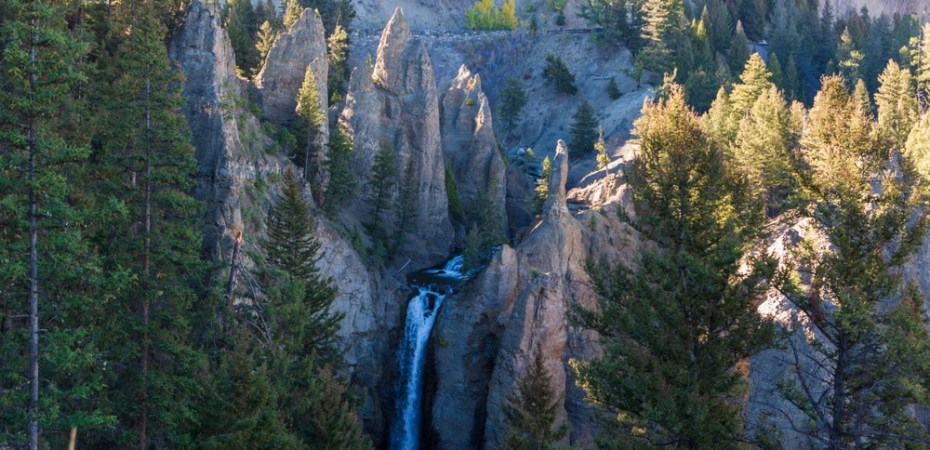
There are the towers, which are pinnacles of volcanic material eroded out of debris left by the last supereruption here 631,000 years ago.
And here is the waterfall (note: it isn’t easy to find close-up videos of Tower Falls; access to the foot of this beautiful cascade has been closed for decades because of landslides):
That might not look like what you were expecting: the big, broad gush of Lower Falls in the Grand Canyon of the Yellowstone, which is a little farther downstream on the Yellowstone River and is very famous. We’ll be going there next time.
Tower Falls doesn’t get that much media coverage, but it’s still the second most popular waterfall in Yellowstone National Park, and it also played a role in Yellowstone’s being designated a national park!
The view from below is gorgeous, as seen in old-time pictures like the ones in the first part of this video:
Landscape artists also painted Tower Falls’ portrait, and one of those paintings is shown in this video on the Tower area, which is outside the caldera and northeast of Norris Geyser Basin:
About that columnar basalt…
James St. John, who knows a lot about the geology he photographs, shared this image (CC BY-SA 2.0) and noted that —

This is a famous outcrop of a thick basalt lava flow in the northeastern portion of Yellowstone National Park. The lowest part of the flow shows nice, regularly-spaced, vertical fractures. Eroded, detached blocks from this lower layer show that it is composed of hexagonal columns. This is columnar jointing, formed by cooling, solidification, and slight contraction of molten lava into basalt rock. A columnar-jointed lower portion of a lava flow is called the lower colonnade. The thick layer that overlies the lower colonnade in the above photo is part of the same basalt lava flow. The regular columnar jointing of the colonnade is absent here. Instead, an irregular fracture pattern is present – this is called the entablature.
Stratigraphy: Overhanging Cliff Flow, Junction Butte Basalt, Upper Pliocene, 2.01-2.15 Ma
Locality: roadside exposure along Grand Loop Road just north of Tower Falls, northeastern Yellowstone National Park, Wyoming, USA…
And that is probably why geologist Shawn Wilsey concentrates on the Overhanging Cliff while the rest of us are still staring at the gorgeous Yellowstone River canyon and spectacular column formations across the valley!
What absolutely fascinates me are those holes (vesicles) from bubbling and steaming when the lava met that water.
Two-million-year-old evidence of bubbles like these!
More information:
- On Tower Falls
- Tower Falls Wikipedia page and a National Park Service page
- The US Geological Survey on Yellowstone’s basalt flows
PS: I think that the hydrothermal area Dr. Willsey mentions and that is seen in the distance is Calcite Springs:
It’s closed to visitors, but Cowboy State Daily interviewed Dr. Mike Poland about it — the springs have, in addition to calcite, molten sulfur and, believe it or not, oil!
For lagniappe:
Farther downriver, south of the park and plateau…
Featured image: James St. John via Wikimedia, CC BY-SA 2.0.

