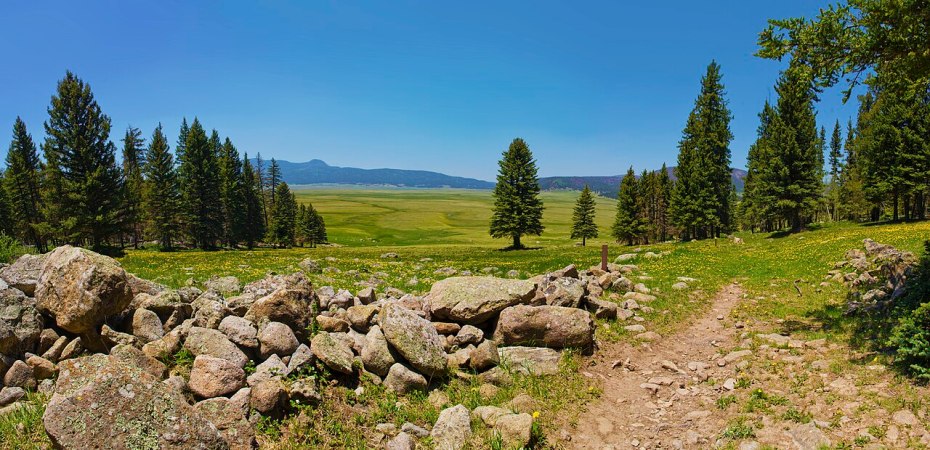
La tierra encantada — “the enchanted land.”
That’s one accurate way to describe the US state of New Mexico.
“Weird” is another description that came to mind when I lived and worked there, in Albuquerque, for a year and a half during the 1980s.
“Weird” in the original sense of that word, which isn’t so very different from “enchanted,” although perhaps with slightly more disturbing overtones.
New Mexico’s sublime sights are both natural (just look around!) and human (a triple-junction of Anglo, Latino, and Puebloan heritages, not always coexistent).
Yet daily life in New Mexico is as mundane and practical as anything you will experience during a ranch work day, or in an office, or in a tribal community.
And while you might not be expecting it of an active supervolcano, the subject of this post — Valles Caldera, up in the Jemez Mountains a two-hour drive northwest of Albuquerque — is like that, too: a surprising combination of the sublime and the commonplace.
Plus (ahem) the hot and very large Bandelier magmatic system, starting some three to four miles down, which might still be ten to twenty percent molten. (Goff et al., 2011; Poland; Schmandt et al.; Song et al.; Zimmerer et al.)
The good news: Trouble does not loom on the horizon, so far as anyone can see — Valles Caldera is sleeping soundly. Also, most of the eruptions in this system’s almost two-million-year-long history have not been supersized. (Waeklens; YVO)
However, two of them were supereruptions, with the most recent catastrophe, ~1.2 million years ago, forming the Valles Caldera.
Smaller eruptions then filled in parts of that caldera’s floor, with the last activity thus far occurring some 40,000 years ago. (Kempter; YVO)
Again — yay! — an eruption of any sort at Valles Caldera does not appear likely right now or in the short-term future. (Goff et al., 2011)
So let’s start off our visit to the Valles with a side trip to something friendly and sublime, but not at all commonplace.
Valles Caldera and people — Part 1
Bandelier National Monument is just south and east of the caldera.
To make those cliff dwellings eight to nine centuries ago, Ancestral Puebloans delved into huge pyroclastic flows (a/k/a ignimbrite) that passed through here during at least one of the Bandelier system’s two supereruptions.
I can’t find an authoritative statement on ignimbrites and cliff dwellings but have learned that the pinkish, mostly solid material (upper Bandelier tuff) is from the most recent supereruption, about 1.2 Ma (million years ago), and I suspect that it hosts all of the cliff dwellings.
The lighter colored layers (lower Bandelier tuff) are from a somewhat larger supereruption that had happened almost 400,000 years earlier; generally speaking, this material is so crumbly that trees and other plants can grow in it. (Kempter)
Dr. Wikipedia tells us that Ancestral Puebloans used these cliff dwellings and ground structures until around 1500 AD, when the group moved farther south (where their descendants now dwell in places like Cochiti and San Ildefonso Pueblos).
Four and a half centuries after they moved out, some Anglo humans would dig into another part of the Upper Bandelier Tuff, near the caldera’s eastern rim, to store something that was much less pleasant.
“Designs.” (That’s Godzìlla in that link, takìng Operation Crossroads right in the face. The kaiju was not pleased.)
Yep. This supervolcano is home to a secret lab that has built weapons of mass destruction!
I wonder if that is how the supervillain meme started.
Anyway, Los Alamos National Labs monitors Valles Caldera today with a seismic network, but the data are not publicly available. (Wilgus et al.)
In an email response to my query through their website, the US Geological Survey (USGS) told me that their nearest seismic station is at Cochiti Dam (about 19 miles away, per Google AI).
Researchers do occasionally set up temporary monitoring networks in and around the caldera.
Overall, Valles is not a restless caldera. There are some hot springs and sulfur deposits but very little seismicity or ground movement. (Poland; Schmandt et al.; Song et al.)
In fact, it’s a very pleasant place to hike in.
Although the preserve is desolate in parts because of a bad wildfire that happened here in 2011 and also burned through most of Bandelier National Monument. However this video does give you some idea of the preserve’s size.
The floor of Valles Caldera is about 2,000 feet higher than the cliff dwellings in Bandelier National Monument, which translates into cooler temperatures and more rain up here, leading to diverse microclimates that support a variety of plant and animal life, ranging from grasslands to Douglas fir; butterflies and prairie dogs to elk and black bears.
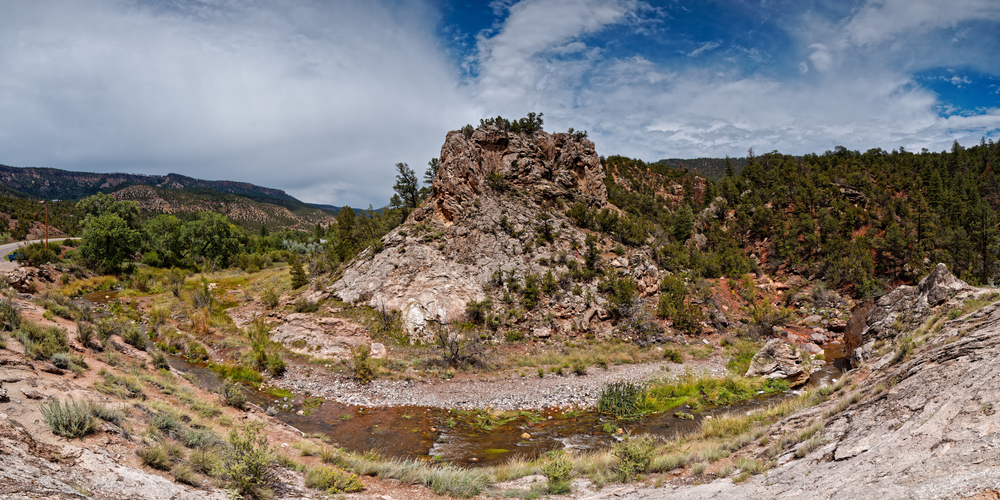
Battleship Rock and Jemez Springs panorama, by Silvio Ligutti/Shutterstock
At Battleship Rock, three streams come together, amid gallery forests scattered across the grassy floor, to form the Jemez River. (Goff et al., 2011)
Higher still, conditions favor conifer tree stands.
Those forested “hills,” except for the central Redondo Peak, are actually big lava domes that erupted, one after the other, in a circle around the caldera’s center after the last supereruption.
Valle means “valley”; lava domes divide the caldera into several grassy valles, with Valle Grande being the one closest to the road.
Native peoples, as well as the Spanish and then Mexican ranchers, used the Valles seasonally for pasture, and this did sometimes lead to clashes and raids. (Wikipedia)
However, for much of the last 1½ centuries — until 2000 — Valles Caldera has been privately owned.
It was overgrazed at various times by sheep and cattle, devastating the grasslands and making a “browse line” on the trees.
The US government bought most of it in 2000 to establish the Valles Caldera National Preserve. Since 2015, the National Park Service has been running it in cooperation with Santa Clara Pueblo and various state and federal agencies.
Today, the Park Service describes Valles as an ecosystem in recovery.
That’s probably why video visits here have a weird sense of being both wilderness and trimmed park.
Wikipedia has an extensive filmography for this caldera, including but not limited to “Longmire.”
Later this century, the preserve will look much more wild.
But ecosystems are not the only recovery feature here.
The ground itself rose up after the supereruption!
Resurgent domes
For earth scientists, Valles is the type example of a resurgent caldera. (Goff et al., 2011; Wilgus et al.)
What’s that?
It refers to a high spot found in the center of many large explosive calderas around the world.
This should not be. The center is where you would naturally expect to find the deepest part of a collapse hole.
Kilauea’s summit crater, collapsing after the effusive 2018 East Rift eruption emptied out its underlying magma reservoir. The center of Kilauea’s new caldera was very deep indeed, although episodic lava eruptions have been filling it in ever since.
At Toba, for example, Samosir Island is the central high spot.
As we’ll see in the last post of this series, Yellowstone also is a resurgent caldera.

Redondo peak, by Aaron Zhu, CC BY-SA 3.0
In Valles Caldera, this central high spot is called Redondo Peak. (Goff et al., 2011)
For a long time, no one understood why such features form after large caldera collapses.
Then, in the late 1960s, a team of volcanologists came up with a very reasonable explanation, based on their mapping of Valles Caldera over several decades. (Kempter)
As this layperson understands it, their model shows that collapse of a caldera “smooshes out” what little magma remains in that reservoir as the supereruption ends.
Soon — in Valles’ case, less than 30,000 years later, which is fairly quick in geological terms (Goff et al., 2011; Waelkens) — that “smooshed-out” magma oozes back into the old reservoir area (Poland), along with whatever new magma is trickling up because of inflow into the magmatic system’s roots from our planet’s ever-plentiful mantle supply.
After a caldera collapse, though, there is no strong crustal lid left to lock down this melt and to start pressurizing a new magma chamber; there are only collapse faults and broken rocks from the former chamber’s roof.
So, inch by inch, as the magma pools in the deep center of that new collapse structure, the caldera-fill material above it rises.
Inches add up over geologic time.
At Valles Caldera, 1.25 million years after the last supereruption, resurgent dome Redondo Peak now towers more than half a mile above the grassy valles.
But that’s obviously not the only volcanic business going on here.
What about those lava domes?
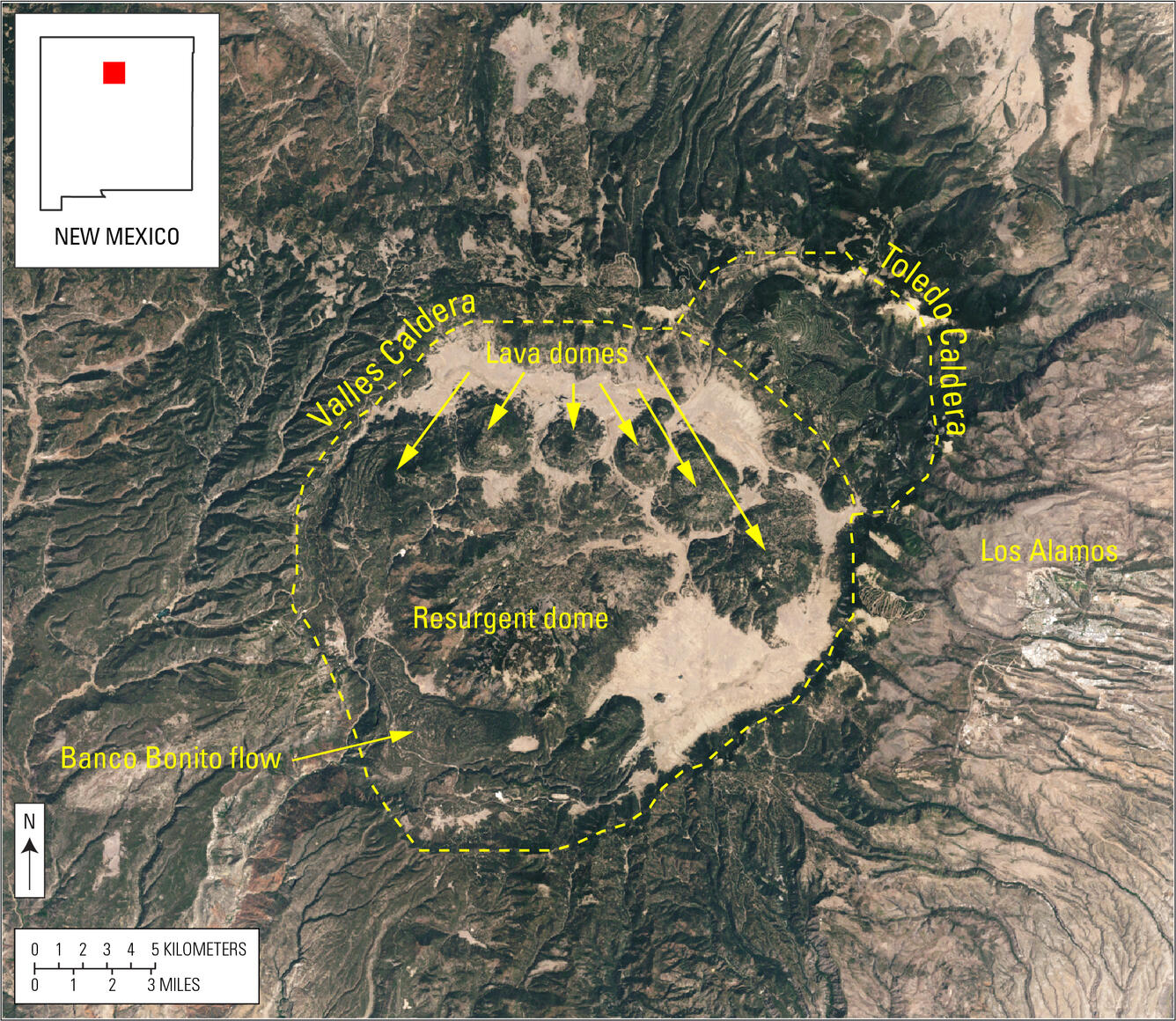
USGS, public domain)
To see where those fit in, we first should check out the big picture.
What exactly is Valles Caldera? What were the two supereruptions? And will it erupt again?
Valles Caldera virtual field trip
As back story, and putting it very simply, Valles Caldera is a roughly 14-mile-wide hole in the Jemez Mountains of northern New Mexico.
Those 14- to 17-million-year-old mountains are made of layer upon layer of basalt, while the Bandelier magmatic system erupts mostly rhyolite (Chapin et al.; Goff et al., 2011; Poland; Schmandt et al.) — a high-silica, hot, and sticky type of magma that erupts very explosively.
Rhyolite lava flows are where obsidian comes from.
Until roughly 2 million years ago (Waelkens), it didn’t used to be that way here. At Stop 1 of the field trip playlist coming up, dark basalt is overlain by white rhyolite pumice from the Toledo Caldera supereruption — the one that occurred almost 400,000 years before the slightly smaller Valles Caldera supereruption.
I haven’t read a paper that discusses why things changed in this part of the Jemez Mountains, although there probably is a whole subset of scientific literature addressing that excellent question.
I didn’t research it in depth for this general introduction because geology of the western United States is complex (also see Chapin et al.), and New Mexico touches upon many of those complicating factors, including but not limited to Basin and Range, the Rio Grande Rift, and a regional history of involvement in the mid-Cenozoic ignimbrite flare-up back in the days when what we know as the San Andreas Fault was a subduction zone.
We don’t need to get into that any farther than geologist Kirt Kempter does in this 2020 field trip that he and a friend recorded during the pandemic crisis.
Yes, this has been posted before, but it really is special, for scenery and for the talk; he makes you feel as though you are there during these eruptions!
Tuff, not “tough” (although the more welded parts of the Upper Bandelier Tuff were tough and could not be scooped out for cliff dwellings).
This field trip was in 2020. That’s only six years ago, but the boffins already have come up with clever ways to visualize Toledo Caldera, despite most of it having been obliterated by the subsequent Valles Caldera blasts.
Its shape is gone (except for the Toledo Embayment), but some Toledo Caldera rocks are still scattered across the landscape — puzzle pieces waiting to be put back together again.
Petrologists and other experts can read information, preserved in these rocky fragments of something that was once the size of Valles caldera, and learn important details about the Toledo caldera and its processes.
Naturally experts would want to do this, since understanding everything they possibly can about two almost identical supereruptions from the same magmatic system, occurring less than half a million years apart, might help them work out the probability of a three-peater.
(No one is ruling that out, but most references I checked, as well as Dr. Kempter in the video, suggest that the next Valles eruption likely will be similar in size to the lava-dome eruptions that have already taken place and probably will not happen in our lifetime.)
Super “twins”
Dr. Kempert covers the 1.6-million-year-old Toledo supereruption thoroughly at Stop 1 on his field trip.
It was the first caldera-forming eruption in the Jemez Mountains (Poland) and began as a powerful plinian eruption from a single central vent (Kempert; Waelkens) right where the Valles Caldera is now, depositing that spectacular Guaje Pumice that our roadside geologist shows us so clearly at Stop 1.
Then the magma chamber roof foundered; the ground cracked open in gigantic ring fractures; and huge pyroclastic flows burst forth.
These are now called the Otowi ignimbrite, which together with the Guaje Pumice makes up the Lower Bandelier Tuff.
The Otowi pyroclastic flows covered the land in every direction where they were not blocked by the Jemez highlands. (Kempert; Waelkens)
Waelkens and Boro et al. describe much the same thing happening during the Valles supereruption 360,000 years later:
- A central vent again opened up near the old Toledo Caldera vent.
- A powerful plinian eruption laid down the Tsankawi Pumice.
- The magma chamber roof again broke, releasing the Tshirege pyroclastic flows through a circle of enormous ring faults. This ignimbrite plus the Tsankawi Pumice forms the Upper Bandelier Tuff.
That’s the first “twin” phenomenon (my word for it, not the experts’) between the Toledo and Valles supereruptions.
The second major twinning involves those lava domes. Let’s start with the ones that we can see today.
After the Valles supereruption 1.25 million years ago, a total of eight major lava domes formed, one after the other, in a counterclockwise fashion along the old collapse ring faults.
Each of these domes is the product of multiple eruptions over tens of thousands to hundreds of thousands of years. (Poland)
Since field evidence is still intact, volcanologists have also identified up to seventeen separate volcanic events at Valles thus far, including things like the El Cajete blast, the Banco Bonito obsidian flow, and so forth. (Goff et al., 2011; Meszaros et al.; Nasholds and Zimmerer)
Most of the lava dome eruptions occurred between about 1.23 Ma (million years ago) and 500 Ka (thousand years ago), when South Mountain formed. (Song et al.; Wilgus et al.)
Then there was a quiet spell for more than 400 millennia.
Then Valles got active again with El Cajete around 74 Ka, followed by the Banco Bonito lava flow in ~69 Ka. (Wilgus et al.)
Most recently, Valles erupted the East Fork formation between about 60 Ka and 34 Ka. (Waelkens)
When it comes to the long-vanished Toledo Caldera, of course, geoscientists can’t be that precise.
Nevertheless, they do report that, soon after the Toledo Caldera supereruption ended, a series of rhyolite lava domes and other volcanic products did erupt! (Meszaros et al.; Schmandt et al.; Waelkens)
As far as I know, there is no way to know if these formed in a circle, as the post-Valles lava domes have done, but Meszaros et al. count at least forty-two smaller eruptive events in Toledo Caldera between the two supereruptions.
They also recognize a quiet period in the post-Toledo supereruption record, just as there is one, about three times longer, in the post-Valles record.
To us laypeople, these lengthy quiet spells are nowhere near as interesting as those moments to hours of excitement and terror when a volcano is erupting (probably days, for a supereruption).
But volcanologists are fascinated by periods of seeming dormancy. They know that volcanoes do many other things besides erupt.
It all goes on underground, out of sight.
The eruption, when it comes, is the culmination of a long series of hidden steps that scientists work very hard to understand.
At the Bandelier magmatic system back in its Toledo Caldera days, Meszaros et al. argue, its 160,000-year-long dormancy was an important period during which the volcano developed a capability to move rapidly (in geologic terms) into another supereruption.
Is that what the much longer dormancy between Valles’ South Mountain and El Cajete eruptions was, too?
Nobody really is sure.
Perhaps not. Those 420,000 years of inactivity, as well as the caldera’s apparently comatose state today, might well be evidence that the magmatic system continues to cool down.
On the other hand, boreholes show that there is still a lot of heat close to the surface in Valles. (Wilgus et al.)
This raises a theoretical possibility that the subsurface heat might make rocks soft enough to flow instead of breaking. In that case, seismic monitoring networks would not pick up signals of rising magma or other pre-eruptive activity right away, reducing warning time. (Goff et al., 2011; Nasholds and Zimmerer; Schmandt et al.; Song et al.; Wilgus et al.; Wolff and Gardner)
Fortunately, there are other ways to monitor volcanoes, and anyway, this system doesn’t ever seem to be in a hurry to do its thing, no matter how we short-lived humans choose to look at it.
But mention of warning time and monitoring does bring us to…
Hazards and risks
It has been almost 40,000 years since Valles Caldera hosted an eruption. That is not unusual: tens to hundreds of millennia passed in between each of the lava-dome eruptions. (Poland; Waelkens; YVO)
On the human time scale, H. sapiens has been in the Americas for at least 15,000 to 20,000 years.
Some spear points near the cliff dwellings in Bandelier National Monument are thought to be 11,000 years old, although most structures there were built between roughly 1150 and 1500 AD. (Wikipedia, 2026, 2026a)
All in all, it looks as though humanity has not yet experienced one of the Bandelier system’s smaller eruptions, let alone either of the two big ones.
Today, though, many cities, including Albuquerque and Santa Fe, sit within a hundred miles of Valles Caldera, which is also close to important land and air transportation routes. (GVP; USGS)
They certainly would be disrupted by the most likely volcanic hazard here — a repeat of one of the small eruptions, causing widespread ash fall outside this remote caldera. (Goff et al., 2011; Nasholds and Zimmerer; Poland)
In fact, that would be expensive and messy for much of the American Southwest (Nasholds and Zimmerer) — but it would not be an existential threat.
The Yellowstone Volcano Observatory (which monitors other volcanoes besides the high-threat Big Y) ranks Valles as a moderate threat on its web page.
Another piece of good news: While it probably will go off again eventually (Meszaros et al.), all sources agree that this isn’t likely to happen soon.
The Bandelier system is not as hyperactive as Taupo is, in New Zealand.
Also unlike Taupo, it follows definite patterns:
- The similarity between its two Big Ones
- The eruption of multiple lava domes after those supereruptions
- And even the seemingly “obsessive-compulsive” counterclockwise formation, over the last million years, of post-supereruption lava domes around the Valles caldera-collapse ring faults.
Patterns help volcanologists understand volcanic behaviors and can make their forecasts of future events more reliable.
Some key data on this system are missing, though, and researchers are doing their best to fill in the gaps. (Nasholds and Zimmerer; Schmandt et al.; Wilgus et al.)
However, Valles Caldera isn’t giving them much to work with.
While it does have some hydrothermal features like Yellowstone (mainly hot springs), Valles Caldera is nowhere near as restless. (Meszaros et al.; Poland; Schmandt et al.; Song et al.)
Ground deformation? Zilch, although continuous monitoring has not yet been done. (Schmandt et al.)
Seismicity? Next to none, as far as the scientific literature reports go (again, Los Alamos National Labs has a seismic network on the eastern rim, but that information is not publicly available, according to Wilgus et al.)
And yet, as we have seen, boreholes on the caldera floor reveal very high temperatures not far below the surface. (Wilgus et al.)
Valles Caldera is a little weird (there’s that word again).
The boffins can look inside volcanoes just as your doctor can use a CT to check on your own inner workings.
The view that they report of Valles Caldera sounds reassuring to this layperson, despite that theoretical concern about high heat flow reducing warning time.
Schmandt et al., for example, report that there is an estimated magma volume of about 500 km3 down there — wait, don’t panic. It’s mostly crystallized, with a total of maybe 50 km3 of melt scattered here and there throughout the reservoir.
Song et al. describe the melt as highly immobile — it is in small collections that are separated by crystallized layers too thick for such a small volume to melt.
And, crystallized or molten, it’s all three miles or more below the surface. (Goff et al., 2011; Poland; Schmandt et al.)
What about a supereruption?
Let’s get very improbable here and look at what might happen in a Valles supereruption.
This is all layperson speculation. I haven’t come across any models. At most, real authorities just point out that precursors would show up before the actual event. (Poland; Self)
But what if…?
[Layperson speculation]
Most likely, another supereruption from the Bandelier system would be similar to its Toledo and Valles events.
No more cliff dwellings. No more Los Alamos (Godzilla’s revenge!).
A new flat plain of fresh ignimbrite covering the eroded remainders of the two previous ones.
This much smaller ignimbrite is from Earth’s biggest 20th-century eruption.
Air-fall ash at least as far as Iowa. (Treiman)
As for pyroclastic flows, I was surprised to see, during the field-trip videos, that Dr. Kempter’s map showed them relatively close to the vents and able to be blocked by the Jemez highlands in several directions.
However, we recently visited Taupo, whose Y eruption, although not supersized, was extraordinarily violent, so this impression may be due to enhanced expectation and also to the fact that Valles is smaller than Yellowstone, which has been the subject of multiple supereruption scenarios, all of which are chilling.
But if Waelkens is correct about the Bandelier system, we still might encounter an existential threat from its hypothetical supereruption.
She suggests that the Toledo supereruption released about 48,000 Tg (megatonnes aren’t the same exact measurement but the numbers are the same) of chlorine, while the Valles caldera-forming eruption released 21,000 Tg.
This is not chlorine gas surging over the landscape in green poisonous clouds. It is blown up into the stratosphere, where it immediately starts to destroy ozone molecules.
Remember how Atitlan’s chlorine release might have caused an ultraviolet catastrophe?
According to Brenna et al., Atitlan “only” released some 1,200 megatonnes of chlorine.
What would forty times that much chlorine do?
Well, we don’t know, and this type of study (using melt inclusions) comes with some major uncertainties, per Cartwright.
Whatever it did to the environment and to land life on Earth, it did it 1.6 million years ago, and then again to a lesser degree 1.2 million years ago.
We may never know just what the results were.
Out of curiosity, I did look up that general time period in my two paleontology references from the sabercat series — Prothero; Agustí and Antón — and saw no mention of any bottlenecks or unusual extinction events.
But supereruptions are very brief compared to the large igneous province eruptions that sometimes have been associated with major mass extinctions.
Also, halogens like chlorine remain in the stratosphere for less than two decades. (Brenna et al.)
I don’t know that the fossil record is fine-tuned enough to show evidence of effects on life from these two short events.
But the high chlorine content, particularly for the Toledo eruption, is remarkable. It’s a fairly new finding, too, and we’ll see how other workers confirm and/or expand on Waelkens’ discovery.
[/Layperson speculation]
As mentioned, no one can rule out a three-peater, but all references suggest that it won’t happen in our lifetime.
How fortunate we are to see this Valles — recovered from the eruptions, in recovery from some human overuse, and a great place to go for a hike.
Valles Caldera and people — Part 2
“New Mexico’s Yellowstone,” as some call it, is in no hurry. It just sits there, in the Jemez Mountains as if under a magician’s spell.
People appreciate that — and the sense of enchantment.
As Leslie Bucklin, a spokeswoman for Los Alamos County told a reporter: “When we’re frustrated or had a hard day or we’re just exhausted or we just need to get away from something, we come up here, just stare at it…It sounds like an insignificant thing when you say it out loud, but [when we say], ‘I have to go for a quick drive,’ that always means, ‘I’m going to the Valle —’ ”
It’s a great place to look for wildlife (and maybe find rainbows, too) —
People bring their grandkids here to make life-long memories of sunshine, greenery, and splashing water —
And others just sit quietly in the deepening twilight to watch the sun set and the evening “star” (Venus) come out over the caldera rim —
All of this recovered world some day will have to struggle for survival again.
But probably not on our watch.
Featured image: Thomas Shahan via Wikimedia, CC BY-SA 2.0.
Sources:
- Agustí, J., and Antón, M. 2002. Mammoths, sabertooths, and hominids: 65 million years of mammalian evolution in Europe. New York and Chichester: Columbia University Press. Retrieved from https://play.google.com/store/books/details?id=O17Kw8L2dAgC
- Boro, J. R.; Wolff, J. A.; and Neill, O. K. 2020. Anatomy of a recharge magma: hornblende dacite pumice from the rhyolitic Tshirege member of the Bandelier Tuff, Valles Caldera, New Mexico, USA. Contributions to Mineralogy and Petrology, 175(10): 96.
- Brenna, H.; Kutterolf, S.; Mills, M. J.; and Krüger, K. 2020. The potential impacts of a sulfur-and halogen-rich supereruption such as Los Chocoyos on the atmosphere and climate. Atmospheric Chemistry and Physics, 20(11): 6521-6539.
- Cartwright, J. H. 2018. Volatile and Sr Isotope Analysis of Melt Inclusions from the Bandelier Tuff, Valles Caldera, New Mexico: Insights into Pre-Eruptive Magma Conditions (Master’s thesis, Auburn University).
- Chacon, D. 2024. Efforts underway to make Valles Caldera ‘one of the highest visited national park sites’ in U.S. https://www.santafenewmexican.com/news/local_news/efforts-underway-to-make-valles-caldera-one-of-the-highest-visited-national-park-sites-in/article_2e5ead62-12d3-11ef-9e15-8b0fa09173cf.html
- Chapin, C. E.; Wilks, M.; McIntosh, W. C.; Cather, S. M.; and Kelley, S. A. 2004. Space-time patterns of Late Cretaceous to present magmatism in New Mexico—Comparison with Andean volcanism and potential for future volcanism. New Mexico Bureau of Geology and Mineral Resources Bulletin, 160: 13-40.
- Goff, F., and Grigsby, C. O. 1982. Valles caldera geothermal systems, New Mexico, USA. Journal of Hydrology, 56(1-2): 119-136.
- Goff, F.; Gardner, J. N.,; Reneau, S. L.; Kelley, S. A.; Kempter, K. A.; and Lawrence, J. R. 2011. Geologic map of the Valles caldera, Jemez mountains, New Mexico. New Mexico Bureau of Geology and Mineral Resources Geologic Map, 79(scale 1), 50.
- Goff, F.; Goff, C. J.; Chipera, S.; Schiferl, D.; and others. 2023. The goblin colony: Spectacular monoliths and walls of altered Bandelier tuff South of the Valles Caldera, New Mexico. New Mexico Geology, 44(1): 1-23.
- Kempter, K. 2020. Field trip to the Valles Caldera (see playlist video in post)
- Meszaros, N. F.; Zimmerer, M. J.; and Gardner, J. E. 2025. Evolution of eruption rate between two caldera-forming eruptions in the Jemez Mountains volcanic field, New Mexico, USA. Journal of Volcanology and Geothermal Research, 457, 108216. Abstract and snippets only.
- Nasholds, M. W., and Zimmerer, M. J. 2022. High-precision 40Ar/39Ar geochronology and volumetric investigation of volcanism and resurgence following eruption of the Tshirege Member, Bandelier Tuff, at the Valles caldera. Journal of Volcanology and Geothermal Research, 431,: 107624.
- Poland, M. 2023. New Mexico’s Answer to Yellowstone: The Geological Story of Valles Caldera.
https://www.usgs.gov/observatories/yvo/news/new-mexicos-answer-yellowstone-geological-story-valles-caldera - Prothero, D. R. 2006. After the Dinosaurs: The Age of Mammals. Bloomington and Indianapolis: Indiana University Press. Retrieved from https://play.google.com/store/books/details?id=Qh82IW-HHWAC.
- Schmandt, B.; Jiang, C.; and Farrell, J. 2019. Seismic perspectives from the western US on magma reservoirs underlying large silicic calderas. Journal of Volcanology and Geothermal Research, 384: 158-178.
- Self, S. 2006. The effects and consequences of very large explosive volcanic eruptions. Philosophical Transactions of the Royal Society A: Mathematical, Physical and Engineering Sciences, 364(1845): 2073-2097.
- Song, W.; Schmandt, B.; Wilgus, J.; Lin, F. C.; and others. 2026. Silicic magma reservoir anisotropy persists through protracted crystallization and low strain rates. Communications Earth & Environment.
- Tremain, A. 2003. Bandelier Tuff — Valles Caldera. https://www.lpi.usra.edu/science/treiman/greatdesert/workshop/bandelier/index.html
- Waelkens, C. 2021. Magmatic processes in a silicic caldera-forming system: Valles caldera, New Mexico, USA. PhD thesis, McGill. https://escholarship.mcgill.ca/downloads/db78th85g
- Wikipedia. 2026. Valles Caldera. https://en.wikipedia.org/wiki/Valles_Caldera Last accessed February 16, 2026.
- ___. 2026a. Bandelier National Monument. https://en.wikipedia.org/wiki/Bandelier_National_Monument Last accessed February 16, 2026.
- Wilgus, J.; Schmandt, B.; Maguire, R.; Jiang, C.; and Chaput, J. 2023. Shear velocity evidence of upper crustal magma storage beneath Valles Caldera. Geophysical Research Letters, 50(5): e2022GL101520.
- Wolff, J. A., and Gardner, J. N. 1995. Is the Valles caldera entering a new cycle of activity?. Geology, 23(5): 411-414. Abstract only.
 Flight To Wonder