
And you thought Halloween was 🎃ver.
That fangly specimen was drawn by E. D. Cope in 1880.
Here is a photograph of another fossil from this same White River Group predator genus. It was found in Nebraska’s badlands during the 1950s:
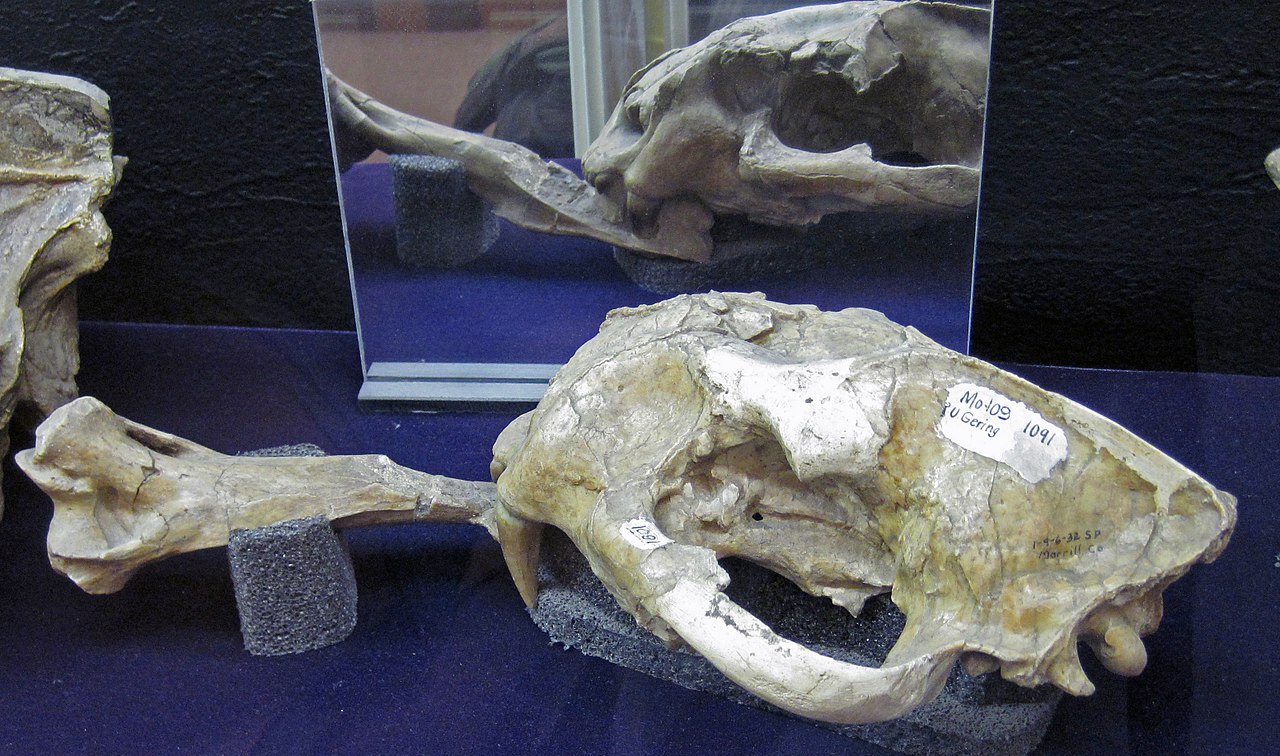
James St. John, CC BY-SA 2.0
The sight of it moved one of its discoverers to describe what’s going on there in free verse:
Once in the sun-fierce badlands of the west
in that strange country of volcanic ash and cones,
runneled by rains, cut into purgatorial shapes,
where nothing grows, no seeds spring, no beast moves,
we found a sabertooth, most ancient cat,
far down in all those cellars of dead time.
What was it made the mystery there? We dug
until the full length of the striking saber showed
beautiful as Toledo steel, the fine serrations still
present along the blade, a masterpiece of murderous art conceived
by those same forces that heaved mountains up
from the flat bottoms of Cretaceous seas.
Attentive in a little silent group we squatted there.
This was no ordinary death, though forty million years
lay between us and that most gaping snarl.
Deep-driven to the root a fractured scapula
hung on the mighty saber undetached; two beasts
had died in mortal combat, for the bone
had never been released; there was no chance
this cat had ever used its fangs again or eaten—
died there, in short, though others of its kind
grew larger, larger, suddenly were gone
while the great darkness went about its task,
mountains thrust up, mountains worn down,
till this lost battle was exposed to eyes
the stalking sabertooths had never seen…— From “The Innocent Assassins” (PDF), by Loren Eiseley
In the Nebraska State Museum of Natural History where the Innocent Assassins skull/scapula complex is displayed, there is a reconstruction of the two nimravids, briefly shown in this video:
It is the only reconstructed close-up of this nimravid that I could find.
That oversized upper canine definitely was sharp and strong enough during life to pierce another powerful nimravid’s shoulder blade (nimravids, apparently, were feisty), but…
Is it really a sabertooth?
Nowadays, that “most ancient cat,” along with its Eocene/Oligocene/Miocene kindred, is often placed in Family Nimravidae, not Felidae.
And, surprisingly, many experts in ancient life do not consider its “striking saber…beautiful as Toledo steel” to be a sabertooth.

The business end of diapsid T.-rex. Despite appearances, these are not the synapsid hypertrophied canines known as saberteeth. (Image: James St. John, CC BY-SA 2.0)
The impressive fang reminded Cope (who named its owner Nimravus) of dinosaur teeth, and he saw the “masterpiece of murderous art” as a spike, not a saber. (Cope, 1880)
In the very next sentence of that paper, Cope credited Dinictis with having the first saberteeth in Order Carnivora.
Flanges
Overall, E. D. Cope decided that Nimravus was not a sabertooth because it didn’t have a jaw flange — if you’re wondering what that is, check out the flange on Hoplophoneus here, upper left, in this Figure 1.10 by Mauricio Antón from Sabertooth (CC BY-ND-NC-SA 4.0):

That’s Nimravus, upper right; Smilodon, lower left; and one of today’s big cats, lower right. None of them have a jaw flange, though Smilodon shows a slight bulge. (Image: Mauricio Antón, from Figure 1.10 in “Sabertooth,” CC BY-NC-ND-SA 4.P)
The views of paleontologists have changed a bit since 1880.
A jaw flange is not considered diagnostic these days. Some sabertooths had it, some did not.
For example, Smilodon — most definitely a sabercat — was one of the many sabertooths lacking a flange (which raises questions about a widely accepted hypothesis that these flanges evolved as protective holsters for long sabers).
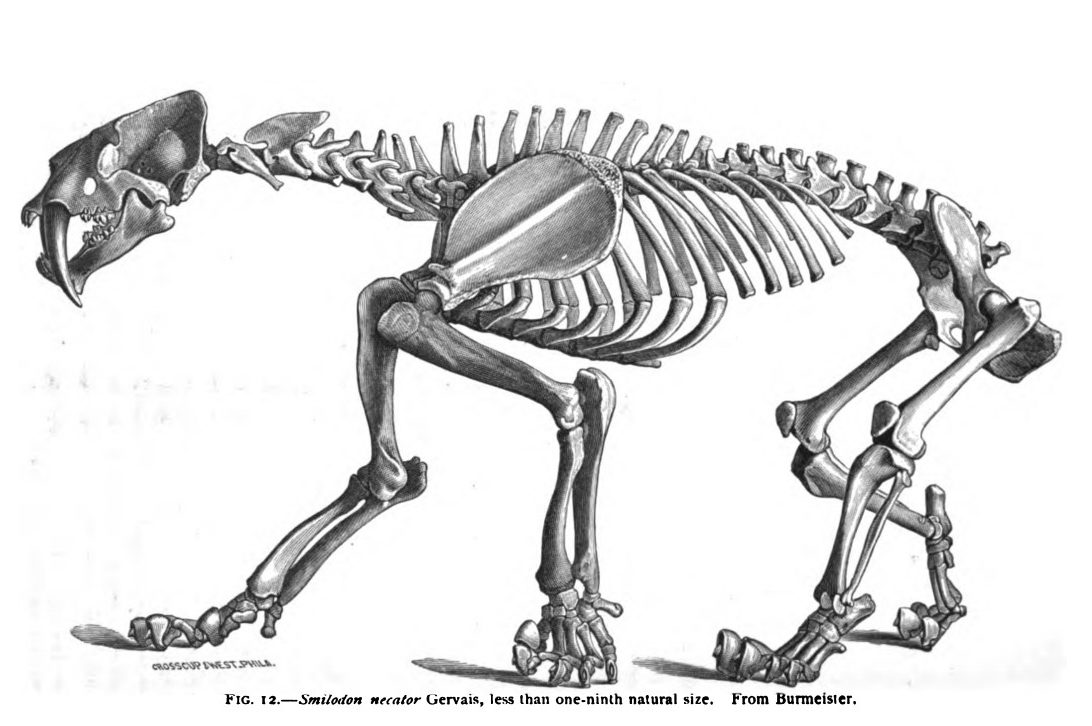
“How do you unholster them? Smilodon wants no flanges!” — S. populator. (Image: Frontispiece, Cope, 1880)
Not that flanges are uncool.
Several sabertooths besides Hoplophoneus did develop them, especially in Nimravidae, with a few taking it to dramatic extremes (looking at you, B. fricki!).

Figure 1, Chatar et al., 2024, CC BY-ND-NC-SA 4.0
What a wide variety of jaw and fang shapes in cats and nimravids!
Sabers
As we have seen in this series, sabertoothed cats and cat-like predators can have almost “normal” upper fangs while displaying other typical sabertooth dentition, including (but not limited to) enlarged carnassial cheek teeth and a row of oversized, outward arching incisors, as well as various cranial adaptations required by sabertooth musculature. (Antón, 2013)
Here it is again. (Image: Mauricio Antón, from Figure 1.10 in “Sabertooth,” CC BY-NC-ND-SA 4.P)
The Nimravus fangs in Figure 1.10 do resemble those of the modern big cat, but its skull has a different shape and its cheek teeth and incisors look rather sabertooth-like to these untrained eyes.
However, my opinion doesn’t count for much. Antón (whose Sabertooth is the inspiration and guide for this post series) includes Nimravus — along with Dinaelurus, Eofelis, and bear-sized, bear-like Quercylurus — in a group of nimravids that were, at most, just a little bit sabertoothed.
However, there are other equally learned points of view.
Barrett (2016), for instance, lists Dinaelurus — the one that Antón says could best be described as a cone-toothed cat — as the only non-sabertoothed nimravid.
Nimravus, perhaps, is one of those “gray-area” predators, like Felidae’s Metailurus and Dinofelis, that some experts classify as sabertooths and others don’t.
First?
As this layperson understands it, no one really knows which nimravid group in Order Carnivora first developed saberteeth.
The oldest known nimravid fossils are Middle to Late Eocene teeth and jaw fragments that have only been found thus far in southern Asia, where the group presumably got started. (Averianov et al.)
As far as anyone can tell, those ancient nimravids were not yet very fangly, but their upper canines usually were enlarged and slightly flattened. (Averianov et al.)
And Nimravus was among them, as well as something that Averianov et al. call a “Hoplophoneus/Eusmilus clade” – perhaps these nimravids were ancestral to the two extreme North American sabertooths that we have already met. (Averianov et al.)
So maybe Nimravus had weird fangs because it was primitive and still learning how to sabertooth?
If so, it didn’t change much as everybody moved into North America, over the Bering land bridge, and evolved in a variety of ways during the Late Eocene as well as through most of the Oligocene. (Chabrol et al.)
Model-T Nimravus thrived there, alongside all those new Ferraris.
As for Eurasia, Oligocene fossils of Asian nimravids are rare, but North America’s toothy Eusmilus and some other nimravids must have wandered back into Asia at some point — these highly evolved North American predators eventually left fossils in Europe during that epoch (but not during the Eocene), along with other fossil feliforms that included the ancestors of Family Felidae. (Augustí and Antón; Averianov et al.; Poust et al.; Werdelin et al.)
And a relatively unchanged Nimravus was with them.
Nimravus really got around, and it also had a long run, being present throughout almost the entire time that Family Nimravidae terrorized life on Earth (not counting the barbourofelids, that was from around the Middle Eocene to maybe the earliest Miocene epoch — a respectable chunk of geologic time).
If it was a primitive nimravid, why didn’t Nimravus evolve as the other primitive sabertooths did, either by developing more extreme sabers or by founding a line of less toothy animals like itself, as Family Felidae did to a limited extent with the metailurines)?
Nimravus seems to have been very successful right from the start. Why mess with perfection?
“Seems” is the key word — fossils of any cat or cat-like predator are seldom found, but nimravid fossils are very rare. (Barrett, 2016)
If nimravids had lived closer to our own day, in a global environment more like the one we know, we probably would have more fossil information about them and would see Nimravus & Co. in a clearer, more detailed light.
In any event, whatever one calls those fangly spikes on Nimravus, they certainly worked well for that apex predator both in acquiring food AND coexisting in the same ecosystem with other hypercarnivores.
🐾🐾🐾
Overall, based on our limited understanding of them, it does appear as though nimravids wrote the sabertooth playbook that felids would use tens of millions of years later — although it was cats that came up with small forms. (Chatar et al., 2022, 2024)
Also, if Chatar et al. (2022, 2024) are right, terms like “first” and “sabertooth” might not even have any meaning.
The researchers suggest that a continuum of dentition and hunting styles could have existed among nimravids and, later on, cats, instead of the conetooth/sabertooth dichotomy that has always been used to classify them.
However, such ideas go way past the brief introduction to sabertooths that this post series can provide.
🐅🐾🐆
Both the skull drawn by Cope and the Innocent Assassins skull are from what is now labeled Nimravus brachyops — type species for Family Nimravidae and also type species for the subgroup Nimravini — nimravids that weren’t anywhere near as extremely sabertoothed as their hoplophonine relatives were. (Antón, 2013; Bryant)
It seems odd that boffins would choose such a feline-like type to represent a collection of major sabertooths (only a few of which we have met in this series).
As odd as if Clark Kent was selected to represent all superheroes.
After a little thinking, though, I can see that there can be no superhumans without first a human.
And apparently there could be no extremely sabertoothed nimravids without first a nimravid – that is, a common ancestor (thus far undiscovered) for both Nimravus and the “Hoplophoneus-Eusmilus clade.’
Nimravus, one of the first known nimravids, might have resembled that common ancestor, which probably wasn’t very fangly.
Nimravus also was incredibly successful, spanning the northern continents and lasting for a long time.
When Nimravus, Pogonodon, and the other remaining nimravids finally disappeared, there was a “cat gap” in North America’s fossil record.
It lasted five or six million years, until cats showed up in what is now Nebraska. (Hunt; Prothero)
This was in the Miocene, but to close our series we now must fast-forward through that epoch as well as the Pliocene and most of the Pleistocene towards our rendezvous, in a cave, with Homotherium, the other Ice-Age sabercat…
Featured image: Figure 7, Cope (1880), public domain.
Sources:
- Agustí, J., and Antón, M. 2002. Mammoths, sabertooths, and hominids: 65 million years of mammalian evolution in Europe. New York and Chichester: Columbia University Press. Retrieved from https://play.google.com/store/books/details?id=O17Kw8L2dAgC
- Antón, M. 2013. Sabertooth. Bloomington: Indiana University Press. Retrieved from https://play.google.com/store/books/details?id=dVcqAAAAQBAJ
- ___. 2017. A glimpse into an Eocene lost world. https://chasingsabretooths.wordpress.com/2017/01/18/a-glimpse-into-an-eocene-lost-world/
- Averianov, A.; Obraztsova, E.; Danilov, I.; Skutschas, P.; and Jin, J. 2016. First nimravid skull from Asia. Scientific Reports, 6(1): 25812.
- Barrett, P. Z. 2016. Taxonomic and systematic revisions to the North American Nimravidae (Mammalia, Carnivora). PeerJ, 4: e1658.
- ___. 2021. The largest hoplophonine and a complex new hypothesis of nimravid evolution. Scientific Reports, 11(1): 21078.
- Best, M. G.; Christiansen, E. H.; and Gromme, S. 2013. Introduction: The 36–18 Ma southern Great Basin, USA, ignimbrite province and flareup: Swarms of subduction-related supervolcanoes. Geosphere, 9(2): 260-274.
- Best, M. G.; Christiansen, E. H.; de Silva, S.; and Lipman, P. W. 2016. Slab-rollback ignimbrite flareups in the southern Great Basin and other Cenozoic American arcs: A distinct style of arc volcanism. Geosphere, 12(4): 1097-1135.
- Bryant, H. N. 1991. Phylogenetic relationships and systematics of the Nimravidae (Carnivora). Journal of Mammalogy, 72(1), 56-78.
- Chabrol, N.; Morlon, H.; and Barido-Sottani, J. 2025. The Fossilized Birth Death Process with heterogeneous diversification rates unravels the link between diversification and specialisation to a carnivorous diet in Nimravidae (Carnivoraformes). bioRxiv, 2025-07.
- Chatar, N.; Fischer, V.; and Tseng, Z. J. 2022. Many-to-one function of cat-like mandibles highlights a continuum of sabre-tooth adaptations. Proceedings of the Royal Society B, 289(1988), 20221627.
- Chatar, N.; Michaud, M.; Tamagnini, D.; and Fischer, V. 2024. Evolutionary patterns of cat-like carnivorans unveil drivers of the sabertooth morphology. Current Biology, 34(11): 2460-2473.
- Cope, E. D. 1880. On the extinct cats of America. The American Naturalist, 14(12), 833-858.
- ___. 1882. The Tertiary formations of the central region of the United States. The American Naturalist, 16(3): 177-195.
- Figueirido, B.; Janis, C. M.; Pérez-Claros, J. A.; De Renzi, M.; and Palmqvist, P. 2012. Cenozoic climate change influences mammalian evolutionary dynamics. Proceedings of the National Academy of Sciences, 109(3): 722-727.
- Jicha, B. R.; Scholl, D. W.; and Rea, D. K. 2009. Circum-Pacific arc flare-ups and global cooling near the Eocene-Oligocene boundary. Geology, 37(4), 303-306.
- Larson, E. E., and Evanoff, E. 1998. Tephrostratigraphy and source of the tuffs of the White River sequence.
- McClaughry, J. D.; Ferns, M. L.: Streck, M. J.; Patridge, K. A.; and Gordon, C. L. 2009. Paleogene calderas of central and eastern Oregon: Eruptive sources of widespread tuffs in the John Day and Clarno Formations. https://pubs.geoscienceworld.org/gsa/books/edited-volume/885/chapter-abstract/3930413/Paleogene-calderas-of-central-and-eastern?redirectedFrom=fulltext.
- Meachen-Samuels, J. A. 2012. Morphological convergence of the prey-killing arsenal of sabertooth predators. Paleobiology, 38(1): 1-14.
- Mohr, M. T.; Famoso, N. A.; Samuels, J. X.; Laib, A. C.; and Schmitz, M. D. 2025. U-Pb zircon geochronology and chronostratigraphy of the Eocene–Miocene John Day Formation of central and eastern Oregon. Geosphere.
- Poust, A. W.; Barrett, P. Z.; and Tomiya, S. 2022. An early nimravid from California and the rise of hypercarnivorous mammals after the middle Eocene climatic optimum. Biology Letters, 18(10): 20220291.
- Prothero, D. R. 2006. After the Dinosaurs: The Age of Mammals. Bloomington and Indianapolis: Indiana University Press. Retrieved from https://play.google.com/store/books/details?id=Qh82IW-HHWAC.
- Rose, K. D. 2006. The Beginning of the Age of Mammals. JHU Press.
- Slater, G. J., and Van Valkenburgh, B. 2008. Long in the tooth: evolution of sabertooth cat cranial shape. Paleobiology, 34(3): 403-419.
- Van Valkenburgh, B. 1988. Trophic diversity in past and present guilds of large predatory mammals. Paleobiology, 14(2): 155-173.
- ___. 2007. Déjà vu: the evolution of feeding morphologies in the Carnivora. Integrative and comparative biology, 47(1), 147-163.
- Welsh, E. (2014, January). The first record of Osbornodon (Carnivora: Canidae) from the Orellan of South Dakota. In Proceedings of the South Dakota Academy of Science (Vol. 93, pp. 43-53).
- Werdelin, L. 2024. Hypercanines: Not just for sabertooths. The Anatomical Record. https://anatomypubs.onlinelibrary.wiley.com/doi/10.1002/ar.25510
- Werdelin, L.; Yamaguchi, N.; Johnson, W. E.; and O’Brien, S. J. 2010. Phylogeny and evolution of cats (Felidae), in Biology and Conservation of Wild Felids, eds. Macdonald, D. W., and Loveridge, A. J., 59-82. Oxford: Oxford University Press.
- Wikipedia. 2025. Nimravus. https://en.wikipedia.org/wiki/Nimravus Last accessed November 1, 2025.
- Zack, S. P.; Poust, A. W.; and Wagner, H. 2022. Diegoaelurus, a new machaeroidine (Oxyaenidae) from the Santiago Formation (late Uintan) of southern California and the relationships of Machaeroidinae, the oldest group of sabertooth mammals. PeerJ, 10: e13032.
 Flight To Wonder