It’s crouching behind you, right now.
Well, perhaps not unless you have time-traveled to late Eocene or early Oligocene western North America.
If you have, you are out of luck.
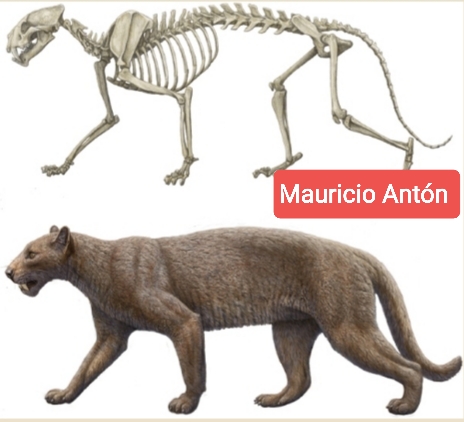
Figure 3.12 in “Sabertooth,” Mauricio Antón, CC BY-NC-ND-SA 4.0
Dinictis has longer, more gracile legs than some other nimravids and it is capable of short-term bursts of speed. (Antón, 2013)
Don’t take comfort in your track shoes and those H. sapiens arm and leg muscles just yet, pardner.
Even if you escape Dinictis, the slightly larger and much more massive Hoplophoneus that is lurking up ahead behind an enormous, liana-shrouded tropical tree trunk will probably snap you up.
And, depending upon where exactly we are in geological time, that sound of a breaking twig echoing through the suddenly silent forest might be Eusmilus, sneaking around nearby. Or maybe a wild dog, a bear-dog, or one of the hyaenodonts (apex predator Hoplophoneus’ only serious competition).
The bushes quiver. A snout appears. Oh, it’s just a peccary — a wild pig.
Your thoughts are returning to the Dinictis behind you when the unsuspecting peccary walks past that tree up ahead and extremely sabertoothed Hoplophoneus makes its move.
The ensuing violence and noise rattle both you and the Dinictis, with the two of you running off in opposite directions — the nimravid quickly and quietly vanishing while you blunder around for a mile or three among the trees.
Finally you calm down enough to stop and sit on what looks to be a whitish chunk of volcanic rock to catch your breath.
There is a little volcanic ash on the ground, too, but not much, and the only sounds you can hear are bird calls and the wind rustling leaves in that green canopy far overhead.
It is a soothing sound.
A squirrel climbs head first down the vine on a nearby tree, sees you, and freezes.
In your overwhelming need for something familiar and nonthreatening, you don’t notice how primitive looking that little animal is.
This reassuring sight is soon followed by another one. From greenery near your left foot, something that might be a rabbit peers up at you and twitches its nose.
Then it disappears in one bound. The squirrel is gone, too, but obviously they were scared off by you, not by a predator.
The birds are still gossiping among themselves up above, and here comes a small herd of something that sort of resembles deer but probably isn’t.
They walk by casually, more interested in leafy browse than in you, although a few of them do give you a curious glance.
The herd of whatevers gradually wanders off into the green twilight of a pristine paratropical forest.
Clearly there are no threats here at present…
Whoa! What you thought was a rock over there just put its head up!
A cold terror turns you weak and numb for a moment, until you see that the elephant-sized fat rhino — well, that’s what it looks like [spoiler: it’s a brontothere, distantly related to rhinos and horses, both of which also have many close relatives and ancestors here in these woods] — the fat “rhino” is munching on leaves.
Aww, it’s got a router-shaped double-pronged horn. That’s adorable!
Briefly fantasizing about riding the “rhino” back to Death Glade, swinging a lightsaber and crushing/slicing Hoplophoneus and Dinictis out of existence, you relax again and take a deep breath of relief.
This Amazon-like jungle air is rich and a little funky but in a good way. It is wonderfully refreshing, like breathing in food.
There is the smell of water, too, and off in the distance even some lightening of the verdant shadow and a glint of sunlight from what could be the surface of a big river.
Good. All the running has made you thirsty, and that’s where you’ll head when you’re feeling back to normal after the fright.
The forest here otherwise looks much the same as it did back in the Death Glade, but fortunately it is a little safer.
Your heart has stopped pounding, but now you know to stay alert.
In addition to an apparently active volcano somewhere in the neighborhood, there are likely to be wonders and deadly hazards everywhere, no matter what part of western North America this is — trees and nimravids and a surprisingly diverse crowd of other animals [spoiler: it is the western Great Plains and this particular spot, greatly changed some 35 million years from now, will be called South Dakota’s Big Badlands].
The sort of African-style wooded savannas and grasslands that now are the only place for us to see such a wild abundance of carnivores and herbivores? Not so much.
Not yet. Not until Miocene and Pliocene times.
Here is a video from modern-day Africa, though, to help you see Dinictis, as well as Hoplophoneus, with the eyes of imagination.
Remember that from last time?
In “Sabertooth,” Antón notes that Dinictis was about the size of a small female leopard, and there is a nice backlit view in this video of the male and female leopards together to give you an idea of that size difference between Hoplophoneus and Dinictis.
Only I don’t know if Hoplophoneus — said by Antón to be a little bit larger than Dinictis and much more robust — would have been as massive as Mr. Bongwe is here.
Also, the two different kinds of nimravid probably didn’t fraternize as this pair of leopards does. Mutual murder was more likely to be on their minds!
Going back to nimravid times, the perilous late Eocene and early Oligocene tropical and subtropical forests that we just visited did cover most of North America, extending up even into the Rocky Mountain cordillera. (Antón, 2013; Prothero)
These forests then disappeared, mainly because Earth developed a different agenda.
It cooled down and dried out during the late Eocene and on into the Oligocene as Antarctica got more and more icy.
In response to less precipitation, vegetation almost everywhere outside the tropics, including forests, switched over to more drought-resistant species.
Too, open patches began to appear here and there in the World Wide Woods.
This was bad news for North American animals that were adapted for the earlier tropical and subtropical food sources and habitats.
But it was fine for a new group of critters: dryness-adapted nimravids and other animals that migrated in from Asia when Antarctic ice sheet formation and growth dropped sea level below the Bering land bridge surface, opening up that intercontinental transportation highway. (Agustí and Antón; Antón, 2013; Prothero)
This global climate trend continued during the Oligocene. Eventually open woodlands (but not savannas) became the norm throughout much of central and western North America, which is the only place where Dinictis has been found. (Antón, 2013; Bryant; Figuerido et al.; Prothero)
At the same time, and quite close to these nimravid hunting grounds, an enormous fireworks show — not a single volcanic eruption — was happening.
Called the Great Ignimbrite Flare-up (Best et al., 2013, 2016), it not only intermittently incinerated or entombed montane plants and animals but also buried the Laramie Mountains themselves! (Moll et al.)
That’s a lot of volcanic ash.
Each big eruption in the flare-up also dropped huge loads of volcanic ash — not a little sprinkling, since supereruptions were common — onto the adjacent western Great Plains from the air as well as over land via massive lahars and repeated river flooding. (Best et al., 2013, 2016; Evanoff; Moll et al.)
This, but MUCH bigger.
Each catastrophe destroyed a sector of the Eocene forest or a part of the Oligocene open range there, along with its inhabitants.
But the resulting moonscape soon (in geological terms) was covered with and transformed by life.
Let’s say it together: “Life finds a way.” (🦕🥚🦖)
Since volcanic ash contains a lot of nutrients, plants and microorganisms quickly stabilized that powdery or muddy white stuff almost as soon as it had cooled down and they turned it into colorful soil — red, brown, gray, green: whatever hues the involved minerals, local weathering, and biological processes could produce.
As this went on, Oligocene life of all kinds would eventually settle in again and get back to business.
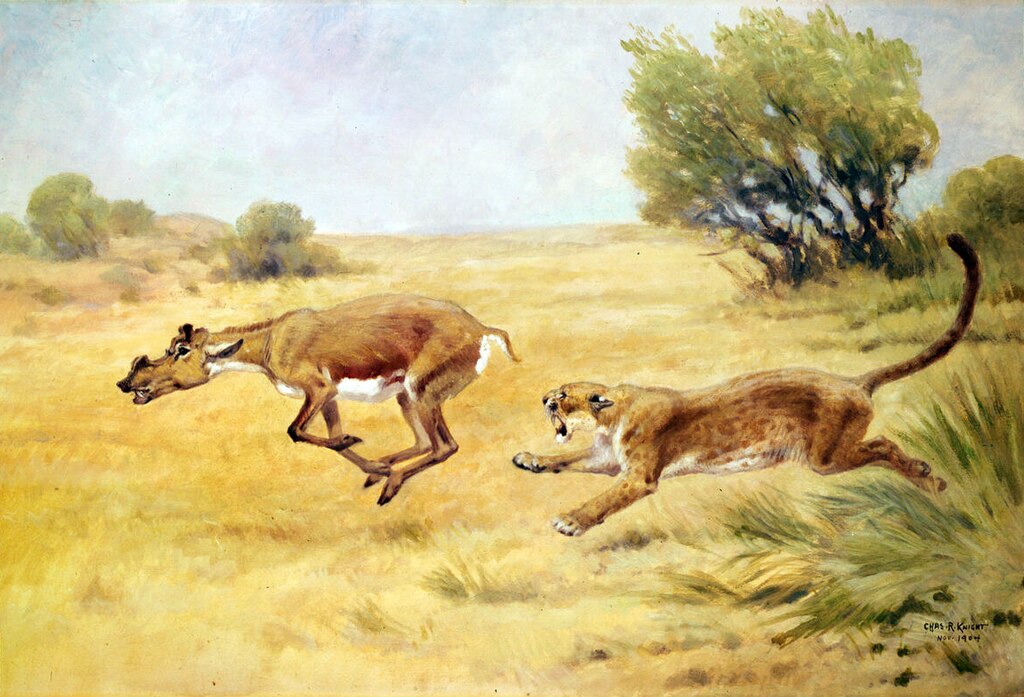
Dinictis chasing a primitive and humpless camelid. (Image: Charles R. Knight via Wikimedia, public domain)
Then, after hundreds to thousands of centuries (Best et al., 2013, 2016), along would come another eruption cloud and ashfall, more ashy floods, and the landscape would go all white and sterile again.
Each time this happened, animal carcasses, logs, plant particles, and other debris would collect in the new layer, frequently becoming fossilized by those fine-grained volcanic sediments.
Over and over again this cycle went — all through the days and nights of the nimravids and beyond.
Today, that’s all past.
All the ash and sediment has hardened into tuff, claystone, mudstone, and siltstone, which makes for some spectacular scenery as well as one of the richest known fossil sites on Earth:
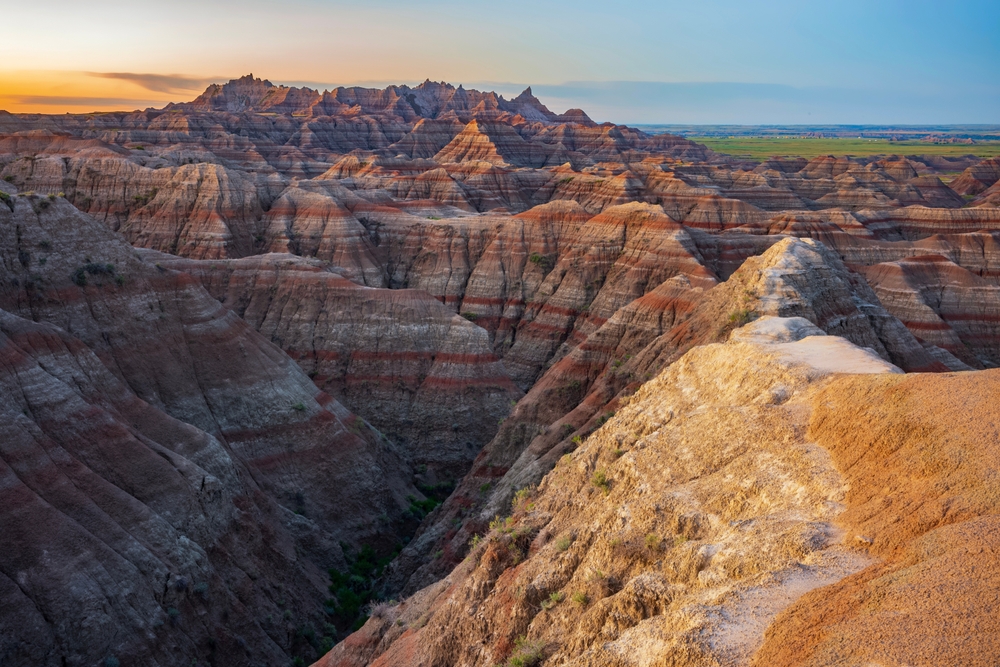
JWCohen/Shutterstock
🐾🐾🐾
To sum up, there was a lot going on as the Eocene epoch transitioned into the Oligocene (Best et al., 2016; Jicha et al.; Poust et al.; Prothero; Zack et al.), but the animals that we met earlier and their fellows were survivors, not victims.
Except for a few groups, including (sadly) the brontotheres, predator and prey alike did just as well in the later Oligocene woodlands and open areas of the Plains as they had done in those earlier paratropical woods. (Antón, 2013; Chabrol et al.; Prothero)
Why not?

Just for reference, here we are in the Holocene– marked with a blue-spectrum line. (Source, public domain>
They were the White River Chronofauna and nothing fazed them — not even an ignimbrite flare-up! — from their start in the middle to late Eocene epoch through most of the Oligocene. Even after the inevitable evolutionary shake-up occurred in late Oligocene times, they still hung more or less together into the early Miocene. (Prothero; Welsh)
What was Dinictis?
It was one of the oldest North American nimravids, and like Hoplophoneus, it was already fairly well along the feliform sabertooth path when it first shows up in the fossil record.
No “missing-link” fossils have been found for either cat nimravid, but this is probably just because both oldsters — Dinictis and Hoplophoneus — likely originated and developed in Asia somewhere during the Early and/or Middle Eocene. (Zack et al.)
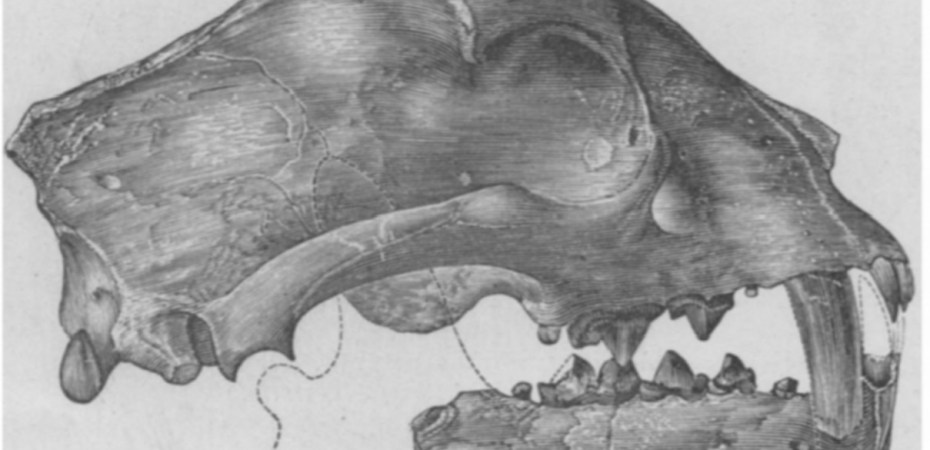
Dinictis already had a cat-like shortened face and dental features, but it also had sabertooth characteristics. (Van Valkenburgh, 2007)
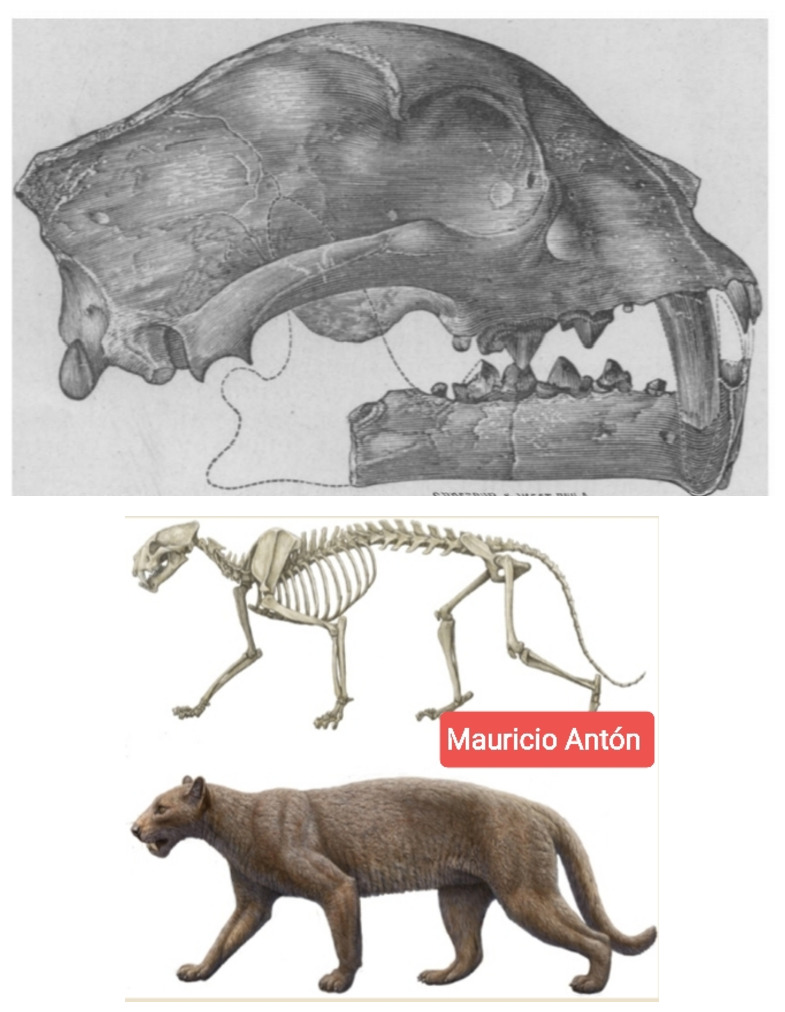
Here they are again. (Image: Cope, Figure 8, public domain, top; Antón, Figure 3.12 in Sabertooth,” CC BY-ND-NC-SA 4.0)
Those large, protruding incisors, for example, are typical of sabertooths. Experts also note that Dinctis had various sabertooth adaptations in its skull. (Antón, 2013; Van Valkenburgh, 2007)
All of these features are only moderate, though, and Dinictis sabers were less extreme than those in Hoplophoneus or Eusmilus. (Antón, 2013)
Dinictis doesn’t fit very well into either the very felid-like nimravine or the fangly hoplophine nimravid groups identified in a 2016 study by Barrett.
Several Dinictis skeletons discovered in the Rockies show the size and build of the most common (and, according to some taxonomists, only) known species — D. felina. (Antón, 2013; Barrett, 2016, 2021; Bryant)
As mentioned, it was about the size of a small leopard. Its estimated weight was around 44 pounds. (Antón, 2013)
That doesn’t sound like much, compared to, say, a Siberian tiger, but as renowned paleontologist E. D. Cope put it, back in 1880 while describing Dinictis, “Its powers of destruction must have excelled those of the catamount.”
This many-named American cat is still known as a catamount in some parts.
See? You really were in danger during that Eocene text adventure!
How did Dinictis and Hoplophoneus get along?
We can’t really go back in time to observe them, but computer models of fossil jaws have shown that they handled mechanical stresses differently. According to the researchers, this suggests that the two nimravids might have coexisted by hunting and feeding differently. (Chatar et al., 2022)
That could also explain their different saberteeth styles. However, this layperson speculation quickly takes us into major uncertainty because no one knows for sure how sabertooths actually used their cutlery.
In whatever ways they lived and coexisted, old Dinictis and Hoplophoneus were quite successful despite massive climate and environmental changes, not to mention the ignimbrite holocaust going on to their south and west.
What animals were in the White River Chronofauna?
I can’t begin to name all the animals that were in that White River Group forest we briefly explored at the start of this post.
Sure, the group changed a bit over time as climate change opened up the landscape and turned it into a dry and dusty mix of woodlands, gallery forests, and grassy patches — the brontotheres, for example, went away. (Prothero)
Overall, though, it was the same group right up until the late Oljgocene, when, like all distinctive faunal groups in the fossil record, it began to change in major ways that we need not get into here since we’re just focusing on nimravids.
Wikipedia does makes the attempt to list major White River Fauna, with accompanying illustrations.
Just to give you some idea, besides cat-like nimravids there was a variety of caniforms, including the first true dogs.
Plant-eaters included equids, camelids, rhinoceratids, some animals such as brontotheres and oreodonts that were very successful in their day but now are extinct, and a host of other large and small animals.
What happened to them?
They either went extinct eventually, like the oreodonts, or moved on. This latter group included camels, ruminants, horses, and rhinos.
All the information in this section is from Prothero.
He also writes that nimravids did apparently outlast hyaenodonts in North America, but when these cat-like carnivorans finally went extinct here, there would be no cat-like predators — a “cat gap” — on the continent (as far as anyone knows at the moment) for almost 6 million years, until the true cat Pseudaelurus wandered in.
(Note that there are other ideas about the early history of cats in North America, as we saw in the Pseudaelurus post; however it actually went, nimravids were not there to see it.)
The dog family, which had evolved here, diversified during this time (cats apparently evolved in Eurasia or Europe, per Werdelin et al., but see the Pseudaelurus post)
About those supereruptions…?
I couldn’t ignore those! 😸
But neither can I get into much detail about them because it is a huge topic and also because it only tangentially touches on the sabertooths.
So, out of many different sources and hypotheses found in some reading, I selected one — Best et al., 2013, 2016 — for a few facts that could serve as the basis of another little adventure to close this post.
More general facts come from references listed at post’s end and, for the carpet analogy, an online academic slideshow about the Laramide Orogeny that I can’t find again to list.
The interpretation of how Great Basin extension got started is my own and will not affect the ongoing scientific debate about that one bit.
🐾🌋🐾
Why are North America’s Great Plains so vast and so flat?
Because, long ago, there used to be a mountain range where the Rockies now stand, and the forces of erosion — wind, rain, ice, and plant roots — tore it down and washed much of it eastward into the low-lying center of the continent where it turned into deep and very fertile soil.
In the meantime, another mountain chain arose — the Rockies — until about 66 Ma (million years ago), when the force that was pushing it up (Plate Tectonics) took a break.
While on its break, Plate Tectonics looked around and realized that these mountains it was building over and over again, via subduction of an oceanic plate off the western coast, were in the wrong place.
They were hundreds of miles inland instead of in the subduction zone!
(While Plate Tectonics was what-the-helling its middle managers, a whole bunch of animals from Asia, including nimravids, sneaked into North America across the Bering land bridge.)
The problem with these mountains turned out to be incorrect tool usage: that slab of ocean floor subducting underneath the edge of North America was going in at the wrong angle, sliding along more or less flat underneath the continent instead of dipping down into the mantle as it should.
This was crinkling up the continent’s surface, just as friction will wrinkle up a carpet on a rough floor.
Okay. Plate Tectonics ordered the slab returned to its proper ~45° subduction angle and got back to work.
This being the Earth and involving rock, the slab correction took more than 30 million years.
While it was underway, another problem popped up.
Literally.
When the correction began, some of the incredibly hot material that North America moves around on leaked over the shifting slab’s edge, far underground, and began to melt the continent’s bottom.
At least 500,000 cubic kilometers of that melt made it to the surface, mostly through explosive silicic eruptions — not all at once, fortunately.
A lot of it did cover part of Mexico, but a little farther north, in what’s now the Great Basin region, on average there only was a big boom or, commonly, a superboom every few hundred thousand to a million years or so.
The biggest one known happened around 28 Ma and erupted an estimated 5,000 km3 of magma. It’s now known as the Fish Canyon Tuff — a VEI 9 on that eight-point scale.
(Meanwhile, thriving in some of the mountains and out on the western Great Plains, in a region that would become the White River geologic formation of today’s Montana, Saskatchewan, Dakotas, Wyoming, Colorado, Oregon, and Nebraska, were the animals that had sneaked in from Asia, including nimravids as well as whatever locals, like dogs, that had survived a greenhouse-icehouse climate shift that was also going on at the time.)
All those eruptions produced volcanic ash, of course.
Some of it fell out of a darkened sky as far away as western Nebraska. The forces of erosion (minus plants on those initially sterile ignimbrite fields) handled the rest of it.
Wind blew it, over and over again, eastward. Water washed it into the lowlands in mudflows and rivers. Ice formed on ash particle nuclei and came down as dirty, often acid rain or snow.
And through all this, from the late Eocene through the Oligocene and into the earliest Miocene, animals of the White River Group, including Hoplophoneus, Eusmilus, Dinictis, and other nimravids, perished, left their bones in the muddy ash layers, and eventually returned, thriving until the next big catastrophe.
Around 16 Ma or so, Plate Tectonics came back, saw the mess, and was so upset that it punched the ground, which has been spreading east and west ever since as the Basin and Range.
“This botched job is shut down!” Plate Tectonics yelled as it closed the west coast subduction zone by turning it into a transform fault that humans now call the San Andreas.
After that and other shutdown measures, Plate Tectonics stormed off.
Everything was quiet again.
The forces of erosion continued to work away. The animals that had come from White River continued to evolve.
And here we are today.
Coda:
Starting in the late 1840s AD, US collectors began to send specimens they had collected in the South Dakota badlands to Joseph Leidy, back East.
Leidy was a physician turned researcher and teacher who was making a name for himself by using his anatomical and biological training to identify and study ancient life as it has come down to us in fossil form.
As the National Park Service puts it, “The number, diversity, and high degree of preservation of the fossils exposed in the White River Badlands not only spawned the growth of vertebrate paleontology in America, but the fossils contained within the White River Group also provided a wealth of information regarding the evolution of Cenozoic mammals. Within a matter of decades the White River Badlands became a mecca for vertebrate paleontologists.”
It still is that today.
And Dr. Joseph Leidy, who first identified and named Dinictis, is now known as the “Father of Vertebrate Paleontology.”
Featured image: Cope, Figure 8, public domain.
Disclosure: I am just a fan of paleoartist Mauricio Antón and have no personal, financial, or business connection with him. I just think that readers of my blog should know about Sabertooth and his blog.
Sources:
- Agustí, J., and Antón, M. 2002. Mammoths, sabertooths, and hominids: 65 million years of mammalian evolution in Europe. New York and Chichester: Columbia University Press. Retrieved from https://play.google.com/store/books/details?id=O17Kw8L2dAgC
- Antón, M. 2013. Sabertooth. Bloomington: Indiana University Press. Retrieved from https://play.google.com/store/books/details?id=dVcqAAAAQBAJ
- ___. 2017. A glimpse into an Eocene lost world. https://chasingsabretooths.wordpress.com/2017/01/18/a-glimpse-into-an-eocene-lost-world/
- Averianov, A.; Obraztsova, E.; Danilov, I.; Skutschas, P.; and Jin, J. 2016. First nimravid skull from Asia. Scientific Reports, 6(1): 25812.
- Barrett, P. Z. 2016. Taxonomic and systematic revisions to the North American Nimravidae (Mammalia, Carnivora). PeerJ, 4: e1658.
- ___. 2021. The largest hoplophonine and a complex new hypothesis of nimravid evolution. Scientific Reports, 11(1): 21078.
- Best, M. G.; Christiansen, E. H.; and Gromme, S. 2013. Introduction: The 36–18 Ma southern Great Basin, USA, ignimbrite province and flareup: Swarms of subduction-related supervolcanoes. Geosphere, 9(2): 260-274.
- Best, M. G.; Christiansen, E. H.; de Silva, S.; and Lipman, P. W. 2016. Slab-rollback ignimbrite flareups in the southern Great Basin and other Cenozoic American arcs: A distinct style of arc volcanism. Geosphere, 12(4): 1097-1135.
- Bryant, H. N. 1991. Phylogenetic relationships and systematics of the Nimravidae (Carnivora). Journal of Mammalogy, 72(1), 56-78.
- Chabrol, N.; Morlon, H.; and Barido-Sottani, J. 2025. The Fossilized Birth Death Process with heterogeneous diversification rates unravels the link between diversification and specialisation to a carnivorous diet in Nimravidae (Carnivoraformes). bioRxiv, 2025-07.
- Chatar, N.; Fischer, V.; and Tseng, Z. J. 2022. Many-to-one function of cat-like mandibles highlights a continuum of sabre-tooth adaptations. Proceedings of the Royal Society B, 289(1988), 20221627.
- Chatar, N.; Michaud, M.; Tamagnini, D.; and Fischer, V. 2024. Evolutionary patterns of cat-like carnivorans unveil drivers of the sabertooth morphology. Current Biology, 34(11): 2460-2473.
- Cope, E. D. 1880. On the extinct cats of America. The American Naturalist, 14(12), 833-858.
- Figueirido, B.; Janis, C. M.; Pérez-Claros, J. A.; De Renzi, M.; and Palmqvist, P. 2012. Cenozoic climate change influences mammalian evolutionary dynamics. Proceedings of the National Academy of Sciences, 109(3): 722-727.
- Jicha, B. R.; Scholl, D. W.; and Rea, D. K. 2009. Circum-Pacific arc flare-ups and global cooling near the Eocene-Oligocene boundary. Geology, 37(4), 303-306.
- Larson, E. E., and Evanoff, E. 1998. Tephrostratigraphy and source of the tuffs of the White River sequence.
- National Park Service 2006. Badlands Historic Resource Study, Chapter 2. Source: National Park Service (.gov) https://www.nps.gov/parkhistory/online_books/badl/hrs/chap2.pdf (PDF)
- Poust, A. W.; Barrett, P. Z.; and Tomiya, S. 2022. An early nimravid from California and the rise of hypercarnivorous mammals after the middle Eocene climatic optimum. Biology Letters, 18(10): 20220291.
- Prothero, D. R. 2006. After the Dinosaurs: The Age of Mammals. Bloomington and Indianapolis: Indiana University Press. Retrieved from https://play.google.com/store/books/details?id=Qh82IW-HHWAC.
- Rose, K. D. 2006. The Beginning of the Age of Mammals. JHU Press.
- Slater, G. J., and Van Valkenburgh, B. 2008. Long in the tooth: evolution of sabertooth cat cranial shape. Paleobiology, 34(3): 403-419.
- Van Valkenburgh, B. 1988. Trophic diversity in past and present guilds of large predatory mammals. Paleobiology, 14(2): 155-173.
- ___. 2007. Déjà vu: the evolution of feeding morphologies in the Carnivora. Integrative and comparative biology, 47(1), 147-163.
- Welsh, E. (2014, January). The first record of Osbornodon (Carnivora: Canidae) from the Orellan of South Dakota. In Proceedings of the South Dakota Academy of Science (Vol. 93, pp. 43-53).
- Werdelin, L. 2024. Hypercanines: Not just for sabertooths. The Anatomical Record. https://anatomypubs.onlinelibrary.wiley.com/doi/10.1002/ar.25510
- Werdelin, L.; Yamaguchi, N.; Johnson, W. E.; and O’Brien, S. J. 2010. Phylogeny and evolution of cats (Felidae), in Biology and Conservation of Wild Felids, eds. Macdonald, D. W., and Loveridge, A. J., 59-82. Oxford: Oxford University Press.
- Wikipedia. 2025. Hoplophoneus. https://en.wikipedia.org/wiki/Hoplophoneus Last accessed October 10, 2025.
- Zack, S. P.; Poust, A. W.; and Wagner, H. 2022. Diegoaelurus, a new machaeroidine (Oxyaenidae) from the Santiago Formation (late Uintan) of southern California and the relationships of Machaeroidinae, the oldest group of sabertooth mammals. PeerJ, 10: e13032.
 Flight To Wonder