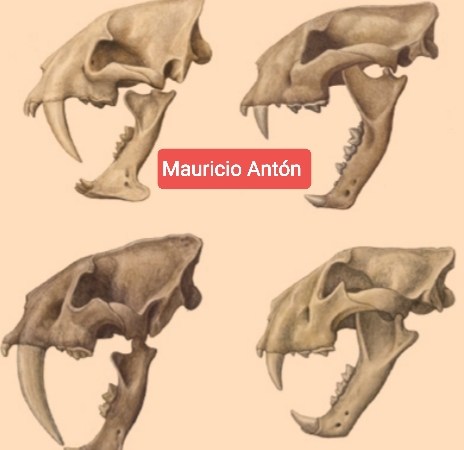
Pop quiz: These four Halloween skulls (part of Figure 1.10 in Sabertooth, CC BY-NC-ND-SA) are from:
- Two nimravids
- A Smilodon
- A modern big cat
Can you tell them apart?
Yes, that’s Smilodon down there in the lower left, per Antón’s image caption, with today’s featured nimravid — Hoplophoneus — above it.

A Hoplophoneus “glamour shot.” (Image: Mauricio Antón, CC BY-NC-ND-SA 4)
This pictured species, Hoplophoneus mentalis, was about the size of a modern leopard but it was much more muscular than a leopard, especially in the forelegs. (Antón, 2013)
And leopards already are muscular enough!
Like all nimravids, mentalis was rather flat-footed, unlike a leopard, and then there were its saberteeth plus that holstering jaw flange.
If we saw mentalis today, we could easily see that, although dangerous, it wasn’t a big cat.
But Antón writes that, if paleontologists came upon such a living beast in sabertooth times, at a glance they might not be able to tell it apart from sabercats such as Megantereon, ancestor of Smilodon.
In fact, those Smilodon and Hoplophoneus skulls are so much alike that it’s hard to believe the two sabertooths, although members of the same Order Carnivora, belonged to two different biological groups (clades) and lived more than 30 million years apart!
Yet paleontologists currently accept both of these facts. (Anton, 2013; Averianov et al.; Barrett, 2016, 2021; Bryant; Poust et al.; Werdelin, 2024)

Here it is again. (Image: Mauricio Antón, from Figure 1.10 in “Sabertooth,” CC BY-NC-ND-SA 4.P)
The other two skulls, on the right, are also separated by tens of millions of years and also resemble each other.
Once again Antón has put the cat — a member of Panthera (the big-cat group) — at the bottom.
Up above it is Nimravus, with a post in this series due in a few weeks, type species for Family Nimravidae (Bryant), and chomping on the watermark in that image.
The big cat, of course, is not a sabertooth, but what about Nimravus, which is almost a Panthera doppelganger?
Going by some features of what Antón calls a sabertooth complex and Werdelin (2024) calls a gestalt — the smaller lower incisor, the wider gape, and the skull shape changes, for instance — Nimravus probably was a sabertooth, but one that converged on what we know today as the feline condition. (Agustí and Antón; Barrett, 2021; Werdelin, 2024)
After all, that’s what sabercats Yoshi and Dinofelis, as well as other metailurines, would do in the Miocene epoch.
Back in Eocene and Oligocene times there were other nimravids like Nimravus (Barrett, 2021), including one called Dinaelurus that Antón, in our current blog series’ main guidebook Sabertooth, says might well be described as a cone-toothed nimravid!
What’s going on here, Evolution?
Did cat-like predators 30-40 million years ago (Poust et al.) actually sort themselves into sabertooths and conetooths just like Family Felidae would do tens of millions of years later, from the Miocene until very recently?
🐾🐾🐾
We-e-ell…the boffins now realize that nimravids are not the granddaddies of Family Felidae, but they do say that nimravids are the oldest cat-like carnivorans found thus far in the fossil record. (Averianov et al.; Bryant; Poust et al.; Werdelin et al.)
Nimravids also are the first members of Order Carnivora to develop saberteeth. (Barrett, 2021)
That’s about all that is definitely known (at least to me) about their evolution and any potential connections to Felidae.
A little more can be said, though.

Hoplophoneus. (Image: Rama via Wikipedia, CC BY-SA 2.0 Fr)
Most nimravids were sabertooths, with the really fangly ones like Eusmilus and Hoplophoneus appearing at around 35 Ma (million years ago), followed by the less extreme Nimravus & Co. after about 30 Ma. (Antón, 2017; Barrett, 2016; Werdelin, 2024)
Family Felidae, on the other hand, had conetooths and sabertooths living at the same time throughout most of its history.

“Boo!” — Wildcat Ghost. (Image: Museum of Veterinary Anatomy FMVZ USP / Wagner Souza e Silva, CC BY-SA 4.)
And, unlike Nimravidae, the felids have developed a line of small forms that, in their own way, have evolved just as far away from the original Dawn Cat blueprint as the sabercats did. (Chatar et al., 2022, 2024)
So, you see, the evolution of cats and cat-like predators is very complicated.
(Note: For simplicity’s sake, I am ignoring here the critters in Africa called barbourofelids that came at least 5 million years after the last Eurasian and North American nimravid went extinct, per Werdelin, 2024; barbourofelids have been linked to Family Nimravidae several times but it is still under debate and, anyway, we already have met them, twice.)
Very few other details are available on toothy hoplophonines and the feline-like nimravines, as Barrett (2021) labels the two nimravid groups.
It was such a long time ago, and so very few of their fossils have come down to us, sometimes as mere fragments.
Too, we shouldn’t draw many parallels with modern cats — the world was very different back when nimravids were alive.
For intricate and not totally understood reasons, Earth’s thermostat back then was moving from a “Greenhouse” setting (which H. sapiens has never experienced) to “Icehouse” (our familiar bipolar ice-capped world, though the freeze was only on-again/off-again and only in Antarctica during nimravid times).
And the nimravids seemed to handle it quite well. They even diversified during the major greenhouse/icehouse transition that marks the Eocene/Oligocene boundary, with Hoplophoneus leading the way! (Barrett, 2021; Poust et al.)
This layperson’s understanding of the story behind Hoplophoneus and other early nimravids goes something like this:
🦕🐾🌏🐾🐆
About 66 million years ago, the nonavian dinosaurs went away. So did many other organisms “up and down the food chain,” as Prothero puts it, but not everything.
For example, bony fish and amphibians “marched through the K/T boundary unscathed” (all of this K/T information is from Prothero, including quotes).
So did turtles, crocodilians, insects, avian dinosaurs birds, and most mammals.

The Hell’s Creek Formation in eastern Montana and the western Dakotas contains a superb end-Cretaceous fossil record, Prothero notes. (Image: Michael Barera via Wikipedia, CC BY-SA 4.0)
Marsupials, which had been the dominant mammal group in North America before the K/T (a/k/a K/Pg) mass extinction (Rose), took a hit, and gradually placentals like us became more common.
“Gradually” is the key word here.
Regardless of which groups lose or win, overall it takes 15 to 30 million years for life on Earth to fully recover from a major mass extinction like that. (Prothero)
So mammals did not suddenly explode onto the scene as our age began, although once we got going, we diversified very quickly. (Agustí and Antón; Prothero; Rose).
As Agustí and Antón note:
…[A]lthough the Paleocene [the first 10 million years after the K/T extinction] was mammalian in character, we do not recognize it as a clear part of our own world; it looks more like an impoverished extension of the late Cretaceous world than the seed of the present Age of Mammals. But the seeds were there.
Some of those seeds sprouted modern mammal orders — like rodents and the odd- and even-toed plant eaters (distant, very primitive ancestors of modern groups that now include horses and cows, respectively) — during the next epoch: the Eocene.
There were plenty of nuts, seeds, fruit, and leafy greenery for herbivores to munch on.

Or maybe it was Finn McCool, working up a sweat. (Image: Stefan Klopp, CC BY-NC-ND 2.0)
As the Paleocene ended and the Eocene began, Earth’s temperature suddenly (in geologic terms) soared, perhaps in response to events connected with intense volcanism as the North Atlantic opened. (Agustí and Antón; Prothero)
Our planet went full greenhouse for the next six million years or so, during the Early Eocene.
A variety of tropical forests and/or rainforests covered most continents and even as far north as Ellesmere Island, where warmth-loving plants and animals like crocodiles, monitor lizards, and primates thrived. (Prothero)
A different fauna inhabits Ellesmere Island today. It does occasionally include primates, but they’re just visiting.
Yes, primates, though these were primitive ones and, like the other plant-eaters, they didn’t look much like modern forms.

Pantodonts were not pretty, but they got the niche filled, CC BY-SA 4.0.
Most animals were comparatively small, too, with cow-sized pantodont herbivores being the largest land mammal. (Prothero)
While its origin is uncertain, the Order Carnivora seed probably sprouted around this time, too.
However, we’re not talking apex predators yet.
Already at the top of the lower Eocene food chain were:
- The “terror birds”: diatrymas, human-sized and the largest land predators in North America and Europe right on into the Middle Eocene. (Augustí and Antón; Prothero)
- Hyaenodonts (not at all related to hyenas, but very, very successful).
- The weird and wolf-like mesonychids with little hoofs instead of claws.
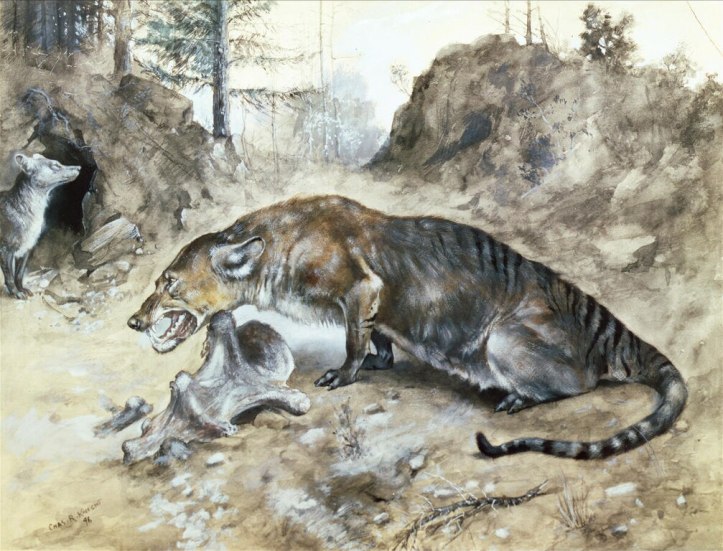
Yes. (Image: Charles R. Knight via Wikipedia, public domain)
- Oxyaenids, which we met last time, including a sabertooth — the first one known in Class Mammalia! It was no bigger than Fluffy and looked like a cat-otter mix. (Antón, 2013)
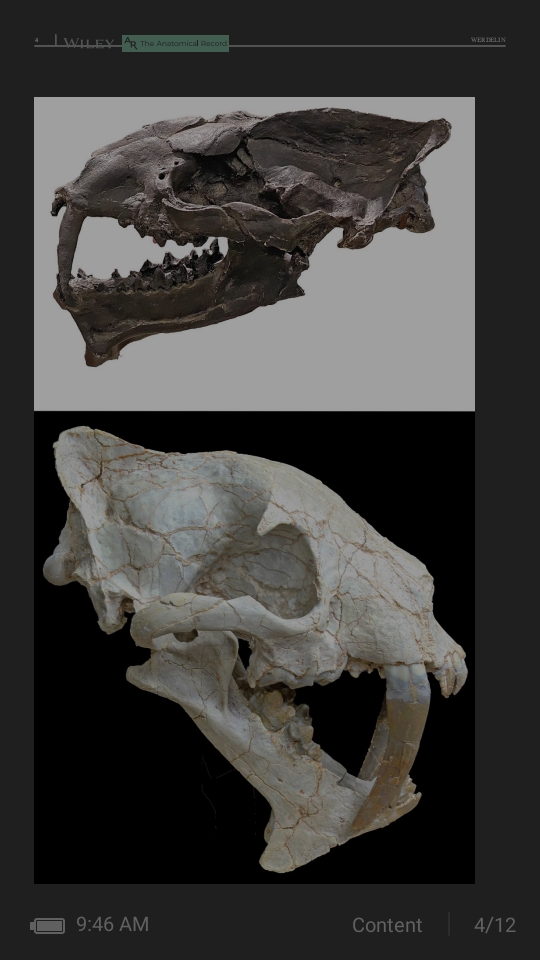
Remember this? That’s the tiny oxyaenid “M. eothen” at the top, with Hoplophoneus shown below. The images aren’t to scale and the two sabertooths are separated by millions of years in geologic time. (Werdelin, 2024; Zack et al.) (Image: Figure 3, Werdelin, 2024, CC BY-NC-ND-SA 4.0)

Given this competition, carnivorans probably kept a low profile through most of the Middle Eocene, preying on small mammals and perhaps scavenging, as the planet began to slowly cool down and dry off a bit while heading toward an icehouse state.
Such climate change, mild and intermittent as it was at first, drastically affected Middle Eocene plants and animals (Prothero), but I’m not sure of its effects on each of the apex predators.
For whatever reason, though, “terror birds” and oxyaenids did vanish late in the Middle Eocene.
Hyaenodonts would stick around, in one form or another, into the Early Miocene (which is amazing), but the main point for us is that there was now room at the top for carnivorans.
They filled it with a variety of meat-eaters, including nimravids.
🐾🐆🐾🐆
The earliest known nimravids appeared some 25 million years after the K/T extinction, towards the end of the Middle Eocene. (Averianov et al.; Poust et al.)
They already had cat-like features but only slight sabertooth characteristics at first. Nimravids might have first evolved in Middle Eocene Asia; that’s where the oldest fossils have been found, anyway. (Averianov et al.; Poust et al.; Van Valkenburgh)
Averianov et al. suggest that these early nimravids migrated across the Bering land bridge to North America, where they diversified quickly as cooler, drier Late Eocene conditions restructured ecosystems there from top to bottom, allowing all carnivorans to become high-level predators. (Poust et al.)
Some of these “new” nimravids then migrated back to Asia, Averianov et al. suggest, and eventually they made their way — along with multiple feliforms, including ancestors of the cat family (Agustí and Antón) — from Asia into Europe during the Oligocene “Grande Coupure” (French).
Hoplophoneus, however, has only been recognized in North America, but it isn’t the first one known there.
The oldest nimravid identified thus far in North America —Pangurban egiae from the San Diego, California, area — already showed, at around 41 Ma, some hypercarnivorous features and other characteristics that Hoplophoneus would soon take to extremes. (Chabrol et al.; Poust et al.)
H. mentalis, the size of today’s lynx, is the earliest well-known Hoplophoneus species. (Antón, 2013, 2017)
Here Antón shows it prowling through sone Late Eocene North American woodlands around 35 Ma:

Mauricio Antón, CC BY-NC-ND-SA 4)
But mentalis is not the only well-known species.
A study by Chabrol et al. finds that Hoplophoneus thrived and multiplied soon after the Eocene/Oligocene transition.

Hoplophoneus, lurking. Its only serious competition, per Antón (2013), was the hyaenodonts. (Image: Charles R. Knight via Wikimedia, public domain)
Hoplophoneus primaevus has been identified in geological formations of multiple western US states, going back to about 36 to 31 Ma, according to Wikipedia.
It was not huge — Wikipedia puts its weight somewhere between 30 and 35 pounds, but it was both fierce and rugged.
I say that because Wikipedia also notes that a primaevus skull found in the Badlands during 2010 fieldwork showed bite marks from another hoplophonine, as well as bone regrowth — the individual survived that trauma!
It must have been quite a fight, although a nimravid probably wouldn’t have caved in the side of a tourist vehicle, had any been around.
Why not manes? These and other features don’t fossilize but probably would suit the evolutionary forces that produced nimravids just as well as they have in cats.
That said, Antón does not “dress up” his reconstruction of the other well-known species, Hoplophoneus occidentalis, as he did with Lokotunjailurus

Mauricio Antón, Figure 3.16 in “Sabertooth,” CC BY-NC-ND-SA
It feels weird to see a sabertooth with a long tail.
As far as I know, no one has come up with a definitive explanation of why many sabercats had stubby, lynx-like tails — or, for that matter, why lynxes have stubby tails — but it clearly wasn’t an issue for the very first cat-like sabertooths.
Occidentalis up there has been found in the 31- to 33-million-year-old formations of Nebraska, the Dakotas, and Wyoming. It was a little taller than primaevus, about 2 feet high at the shoulder, but its overall size is debatable. (Wikipedia)
Hoplophoneus primaevus seems to have outlived H. occidentalisa little bit, but both of these cat-like critters were apex predators, along with various other carnivorans during their respective times.
Generally speaking overall, those could have included other hoplophonines like Eusmilus and Dinictis (who we will meet next time), as well as bear-dogs, true dogs (Hesperocyon), and hyaenodonts.
Hyaenodon, the largest hyaenodont of their time, would probably have been the nimravids’ only serious competition, apart from each other.
🐾🐾🐾
Most of my life, before looking into this with the help of the Internet and some university libraries, I used to think (on the rare occasions of thinking about it at all) that the sabercat (Smilodon) lived during the Ice Age (just one), which came shortly after the dinosaurs went extinct and mammals inherited the Earth.
Now I know how limited that impression was, both in knowledge and in sense of geologic time.
Life is a process that has been going on for billions of years, always building on itself, tearing itself down, and then rebuilding in slightly different ways.
As we are seeing now, thanks to Sabertooth and many other paleontological works, there were many sabercats as well as sabertoothed animals in other groups besides Felidae.
And these cats and other sabertooths needed lots and lots of time to develop, flourish, and then fade away.
There were many Pleistocene ice ages, too, and before that, warm/cool spells and even a greenhouse.
The story of Hoplophoneus comes closest to my old perception, though.
It and other sabertooths did appear towards the end of the K/T extinction recovery phase. It and its kind did rule the Earth during a Big Chill.
But, unlike “the” sabercat, nimravids kept on for millions of years after major climate change had forced so many other living beings out of existence.
And that story continues next time in our series, not with sagas of life and death but with a nimravid and its fellows that were part of a group of North American animals so long-lived in the fossil record that experts in ancient life have labeled them a “chronofauna.”
Featured image: Part of Figure 1.10 in Antón’s book Sabertooth, CC BY-NC-ND-SA 4.0. I watermarked it, as he does with images on his blog, and hope that it might encourage you to purchase his book, with all its wonderful artwork and detailed information on sabertooths from Permian times on down to yesterday, some 12,000 years ago.
Disclosure: I am just a fan of this paleoartist and have no personal, financial, or business connection with Mauricio Antón. I just think that readers of my blog should know about Sabertooth.
Sources:
- Agustí, J., and Antón, M. 2002. Mammoths, sabertooths, and hominids: 65 million years of mammalian evolution in Europe. New York and Chichester: Columbia University Press. Retrieved from https://play.google.com/store/books/details?id=O17Kw8L2dAgC
- Antón, M. 2013. Sabertooth. Bloomington: Indiana University Press. Retrieved from https://play.google.com/store/books/details?id=dVcqAAAAQBAJ
- ___. 2017. A glimpse into an Eocene lost world. https://chasingsabretooths.wordpress.com/2017/01/18/a-glimpse-into-an-eocene-lost-world/
- Averianov, A.; Obraztsova, E.; Danilov, I.; Skutschas, P.; and Jin, J. 2016. First nimravid skull from Asia. Scientific Reports, 6(1): 25812.
- Barrett, P. Z. 2016. Taxonomic and systematic revisions to the North American Nimravidae (Mammalia, Carnivora). PeerJ, 4: e1658.
- ___. 2021. The largest hoplophonine and a complex new hypothesis of nimravid evolution. Scientific Reports, 11(1): 21078.
- Bryant, H. N. 1991. Phylogenetic relationships and systematics of the Nimravidae (Carnivora). Journal of Mammalogy, 72(1), 56-78.
- Chabrol, N.; Morlon, H.; and Barido-Sottani, J. 2025. The Fossilized Birth Death Process with heterogeneous diversification rates unravels the link between diversification and specialisation to a carnivorous diet in Nimravidae (Carnivoraformes). bioRxiv, 2025-07.
- Chatar, N.; Fischer, V.; and Tseng, Z. J. 2022. Many-to-one function of cat-like mandibles highlights a continuum of sabre-tooth adaptations. Proceedings of the Royal Society B, 289(1988), 20221627.
- Chatar, N.; Michaud, M.; Tamagnini, D.; and Fischer, V. 2024. Evolutionary patterns of cat-like carnivorans unveil drivers of the sabertooth morphology. Current Biology, 34(11): 2460-2473.
- Poust, A. W.; Barrett, P. Z.; and Tomiya, S. 2022. An early nimravid from California and the rise of hypercarnivorous mammals after the middle Eocene climatic optimum. Biology Letters, 18(10): 20220291.
- Prothero, D. R. 2006. After the Dinosaurs: The Age of Mammals. Bloomington and Indianapolis: Indiana University Press. Retrieved from https://play.google.com/store/books/details?id=Qh82IW-HHWAC.
- Rose, K. D. 2006. The Beginning of the Age of Mammals. JHU Press.
- Van Valkenburgh, B. 2007. Déjà vu: the evolution of feeding morphologies in the Carnivora. Integrative and comparative biology, 47(1), 147-163.
- Werdelin, L. 2024. Hypercanines: Not just for sabertooths. The Anatomical Record. https://anatomypubs.onlinelibrary.wiley.com/doi/10.1002/ar.25510
- Werdelin, L.; Yamaguchi, N.; Johnson, W. E.; and O’Brien, S. J. 2010. Phylogeny and evolution of cats (Felidae), in Biology and Conservation of Wild Felids, eds. Macdonald, D. W., and Loveridge, A. J., 59-82. Oxford: Oxford University Press.
- Wikipedia. 2025. Hoplophoneus. https://en.wikipedia.org/wiki/Hoplophoneus Last accessed October 10, 2025.
- Zack, S. P.; Poust, A. W.; and Wagner, H. 2022. Diegoaelurus, a new machaeroidine (Oxyaenidae) from the Santiago Formation (late Uintan) of southern California and the relationships of Machaeroidinae, the oldest group of sabertooth mammals. PeerJ, 10: e13032.
 Flight To Wonder
