
This is a worthy ancestor for Smilodon!
In fact, the Early Pleistocene’s Smilodon gracilis might have resembled its Plio-Pleistocene daddy here, Megantereon. (Gigantic Smilodon populator? Not so much.)
That leopard-like coat is just the paleoartist’s educated guess, based on fur patterns that today’s cats display in various habitats.
Fossils suggest that Megantereon was leopard- or jaguar-sized and that it inhabited woodland savannas and forests, as these two living pantherines do.
Break out the spots!
However, the only thing we know for sure about sabercat pelts is that one hapless Homotherium cub had shaggy, dark brown fur.
Megantereon’s attention-grabbing sabers — and those of all the sabertooths that we’re going to meet in this series — are the same upper canines that all mammals have, not a totally different kind of tooth.
In sabertooths these upper canines evolved, for reasons that are still debated, into an extended, side-to-side flattened, and front-to-back curved shape.
Mauricio Antón’s reconstruction of Megantereon up there shows other sabertooth features, too — the so-called “sabertooth complex,” which included:
- A row of enlarged incisors, protruding outward as a toothy arch and with lower canines downsized to be not much more than another tooth in the incisor arch.
- Massive jaw, neck, shoulder and chest muscles, and though we can’t see it in this reconstruction, much heavier bones to support those muscles than the same bones in today’s cats.
- The sabercat’s skull is shaped a little differently, too, to accommodate these muscles and the jaw movements needed as the cat hunted and ate, which it could do perfectly well using its sharp cheek teeth called carnassials — the same teeth that Fluffy and Fido are using when they eat with the side of their mouths.
Antón is a fan of Megantereon — so much so that he used that image as the cover of his book Sabertooth:
And his description of the sabercat tells us all we need to know about —
Megantereon
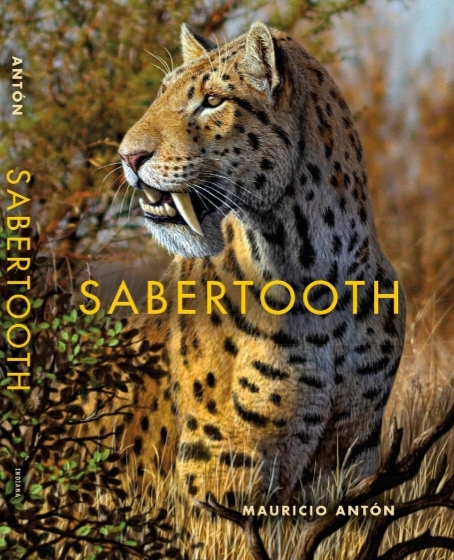
Just as many naturalists consider the leopard to be the ultimate big cat, I find Megantereon to be the ultimate sabertooth. Less imposing than the hyper-robust Smilodon, Megantereon struck a balance between strength and grace. In size and proportions it was similar to the modern jaguar, although it had a longer neck and a shorter tail. Like the jaguar, it could explode out of concealment with lightning speed, and it was large enough to hunt big prey such as horses and deer but still agile enough to be a proficient climber. Its skull and neck displayed all the adaptations of a derived sabertooth, and it would have been swift and efficient in killing its prey. This combination made it enormously successful, allowing it to spread from South Africa to Greece, and from Spain to China and to North America…
— Mauricio Antón, in “Sabertooth”
For reference, here’s a jaguar exploding onto unsuspecting prey:
Panthera onca is the only living native American big cat. It’s now an apex predator but occupied middle levels of the food chain back in Pleistocene days when Smilodon called the shots. Perhaps that’s why it is so water adapted?
Megantereon appeared in Eurasia some 3.2 million years ago, along with the sabercat we’ll meet in November: Homotherium. (Agustí and Antón)
Megantereon roamed Europe until about 900,000 years ago, which is when today’s leopards, lions, and lynxes replaced it. (Agustí and Antón)
Now, just the lynx is left there.
In China, Megantereon is found in the fossil record up until about 500,000 years ago. (Agustí and Antón)
The sabercat probably reached North America during Early Pliocene times by crossing the Bering land bridge when sea level dropped during a glaciation episode. (The South Pole ice cap has 33-million-year-long history of shrinking, expanding, and even disappearing at times; in the early Pliocene there was no Arctic ice cap although this would change, 1 or 2 million years after Megantereon got here.)
That North American sabercat did just fine through the Plio-Pleistocene ice ages that began after the first North Pole freeze-up 3 to 3½ million years ago.
Then it vanished around the time that glacial periods intensified during the Middle Pleistocene. (Prothero)
But new iterations of Megantereon, as Smilodon, had appeared in the Americas roughly 2 million years ago, and they continued on, flourishing through to the last ice age’s end, some 13,000 years ago, after which these last of Earth’s sabercats disappeared forever, along with many other end-Pleistocene megafauna.
🐾🐾🐾
Location:
All of the northern continents, as well as Africa.
Time:
Throughout the Pliocene and early Pleistocene.
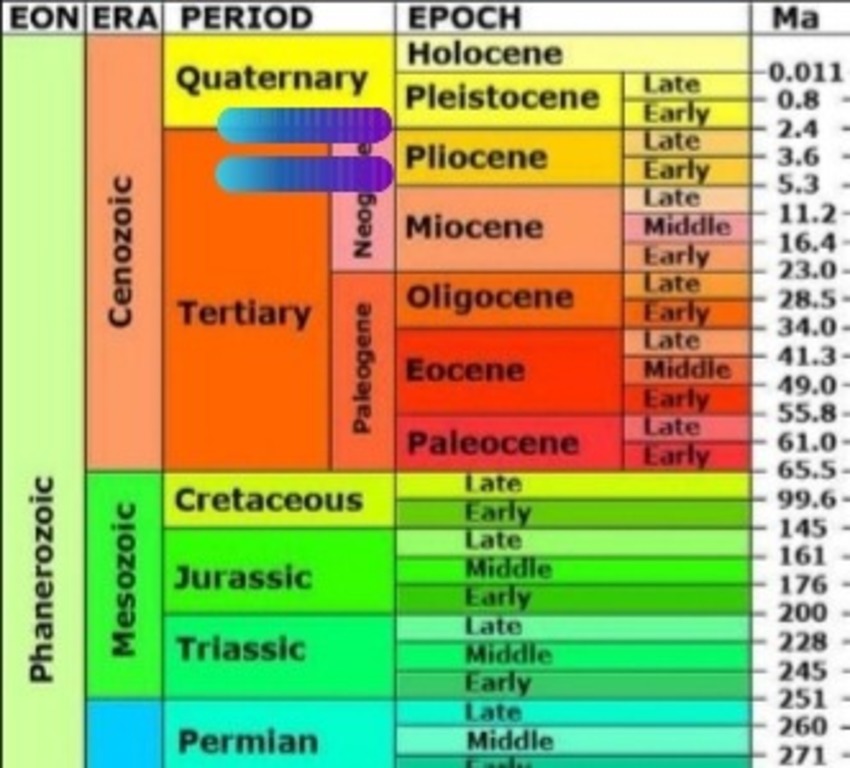
The blue-spectrum lines are pointing at the whole Pliocene epoch and the early Pleistocene. (Source, public domain)
Satellite view:
Continents were in much the same positions that they occupy today, except that North and South America hadn’t quite connected up yet as the Pliocene started.
That connection happened during Megantreon’s almost 6 million years of time on Earth.
However, the most dramatic visual changes from space would have been the fluctuations of ice cover on Antarctica, the appearance of glaciers in Greenland, and the freezing over of the Arctic Sea.
An Arctic ice cap formed, for the first time sice the Permian (Agustí and Antón), which began cycling into advances and retreats in the latter part of the Pliocene and then really got down to ice-age business about 900,000 years ago.
It’s hard to find an image or video showing this dramatic Plio-Pleistocene transition.
Here is a plate tectonics reconstruction, with ice ages, that shows just how unusual the geologically recent freeze-up was — more than 200 million years pass and then, right at the end, suddenly ice!
Weather report:
For several million years Megantereon not only survived but thrived in climate changes that would have our heads spinning (and, occasionally, all our stuff in coastal and low-lying areas drowned).
Basically, the Pliocene started out pleasantly and turned into an icehouse that got more chilly during the Pleisocene.
Setting:
The early Pliocene was warm — on average about 9° F toastier than today — which is why evergreen forest and bald cypress swamps covered much of Eurasia, and crocodiles and giant tortoises inhabited parts of western Europe.
The Mediterranean area was a little drier, even then, but this sparkling sea was a lot bigger, with shallow arms that extended into eastern Europe.
North America was fairly dry, too, with widespread grasslands in its central regions. The Gulf Coast was a subtropical savanna, and the Pacific Northwest was densely forested.
The big chill started about 3½ million years ago, but it came on slowly and with plenty of pauses in which the world could warm up again.
Since cold air doesn’t hold as much water vapor as warm air does, precipitation was much less during the cold spells, and forests gave way to open tundra close the ice front, and farther south, steppe and grasslands,.
The Mediterranean got its present climate, and the Sahara region was now a desert.
And, surprisingly, most animals seem to have mostly taken these Plio-Pleistocene habitat changes in stride. The main effect of these early and relatively mild glaciations was the opening of land bridges when new ice formation lowered sea level. (Agustí and Antón)
That’s how Megantereon, Homotherium, jaguars, and some other creatures got into North America, by migrating over the Bering land bridge. (Prothero)
Ecomorph/Tribe:
Dirktooth/Smilodontini (Antón); see Antón’s in-depth discussion of these two terms.
Prey:
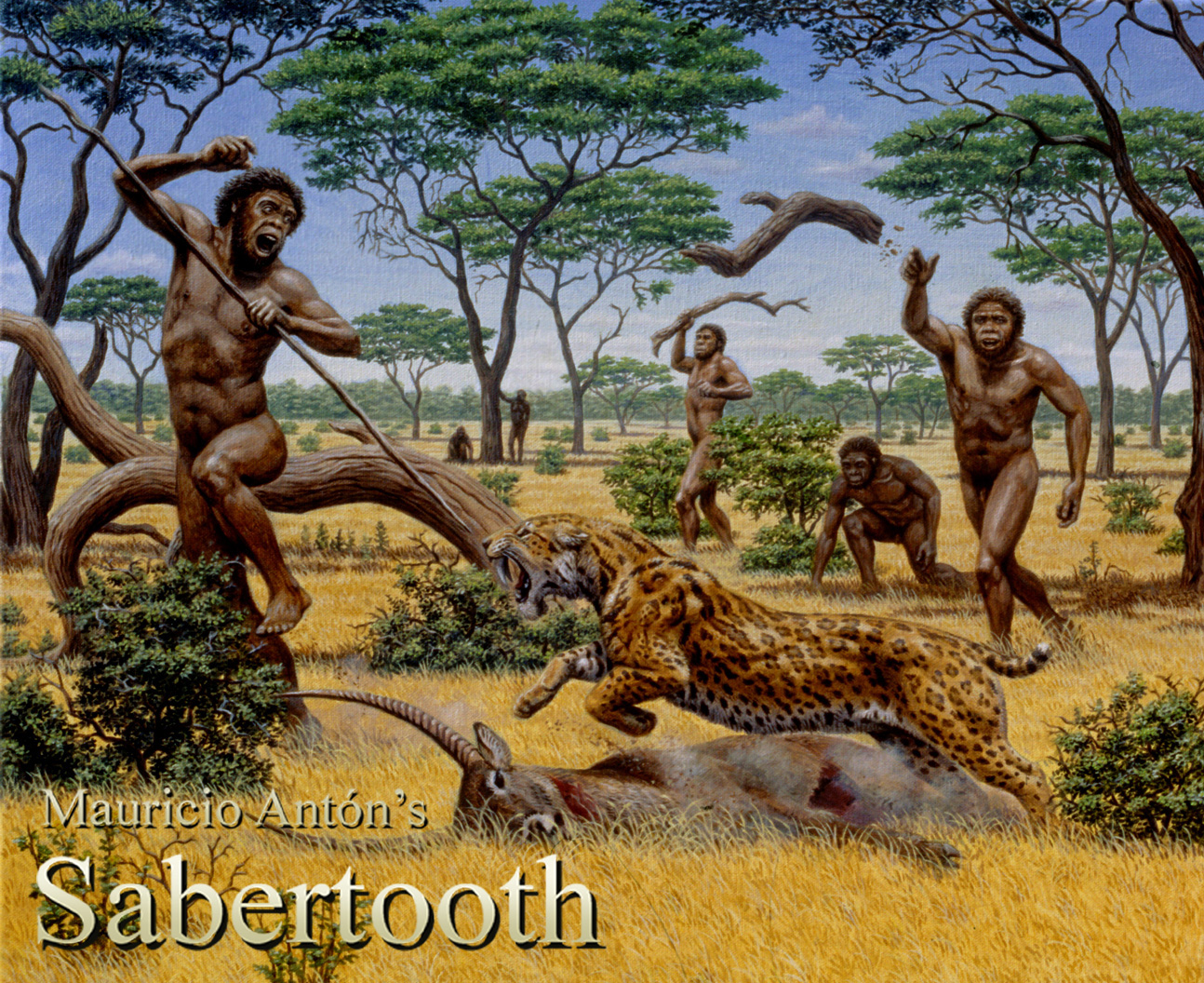
Depending on location, Megantereon generally had a diverse selection of pigs, deer, antelopes, cattle, horses, rhinos, proboscideans (the group that includes but isn’t limited to mammoths, mastodons, and eventually elephants), and other beasts — and hominids, in Africa and Eurasia.
There is a theory that some of our very distant ancestors might have scavenged sabercat kills. If so, then medium-sized Megantereon would have been a likely target.
It might have lost some kills to a determined, hungry, and perhaps even vengeful band of hominids!
Competition:
Antón mentions that Megantereon was about the size of a modern leopard while Homotherium, whose fossils are often found at the same time, was lion-sized.
He notes that these two sabercats might well have coexisted just as leopards and lions do today, with Megantereon haunting forested areas, catching browsing herbivores and never wandering far from its escape route: a tall tree.
Homotherium’s legs were rather lionlike, per Antón, although the front legs were longer, giving this cat a hyena-like shape. Also like today’s hyenas, it may have been able to pursue prey and so would have dominated the open savannas and grasslands, if Antón is correct.
A third sabercat — Dinofelis (who we will meet in September) — was still around in Africa and parts of Eurasia during the early Pliocene. Megantereon would also have had to deal with the first lions, bears, a variety of hyenas, and other, mostly smaller carnivorans. (Agusti and Antón; Prothero)
Dinofelis wasn’t in North America, but a sabercat that Prothero calls Ischyrosmilus was, along with Megantereon’s migration buddies Homotherium and Panthera onca.
The classification of Ischyrosmilus is one of those cases where paleontologists disagree.
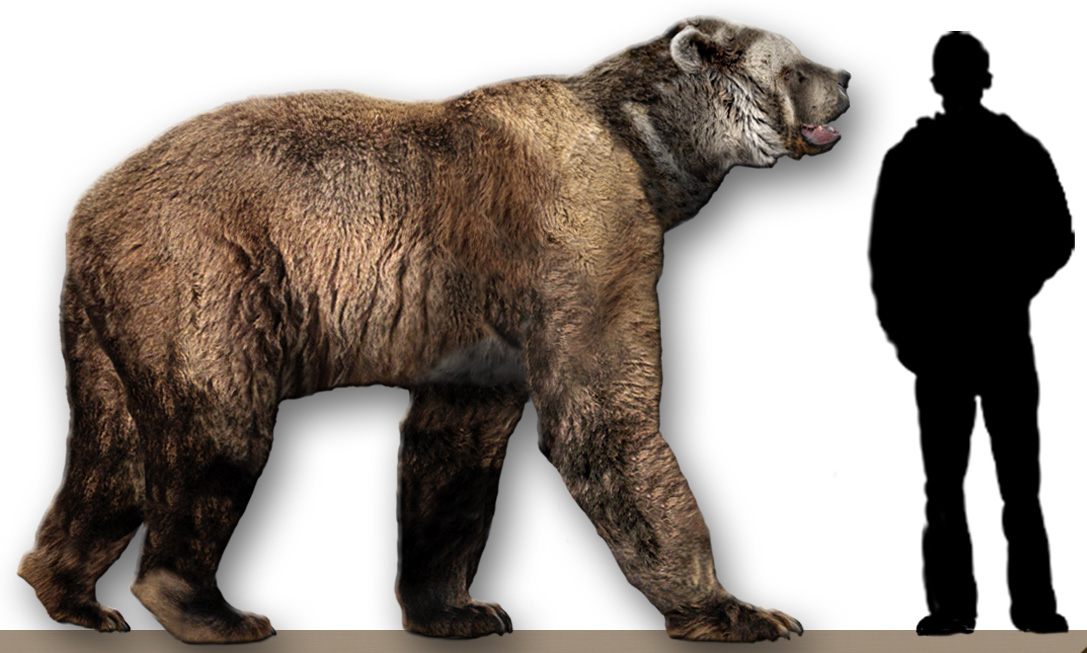
North America’s giant short-faced bear wasn’t competition so much as boss. (Image: Dantheman9758 via Wikimedia, CC BY-SA 3.0)
Wikipedia explains here that many experts consider it another name for Homotherium. Antón is among them, so for this series I’ll call it a Homotherium, too.
Megantereon also had to deal with bears (including some big ones), hyenas, canids, and a variety of smaller carnivores. (Prothero)
Featured image: Figure 3.63 in Antón’s book Sabertooth, CC BY-NC-ND-SA 4.0. I watermarked it, as he does with images on his blog, and hope that it might encourage you to purchase his book, with all its wonderful artwork and detailed information on sabertooths from Permian times on down to yesterday, some 12,000 years ago.
Disclosure: I am just a fan of this paleoartist and have no personal, financial, or business connection with Mauricio Antón. I just think that readers of my blog should know about Sabertooth.
Sources:
- Agustí, J., and Antón, M. 2002. Mammoths, sabertooths, and hominids: 65 million years of mammalian evolution in Europe. New York and Chichester: Columbia University Press. Retrieved from https://play.google.com/store/books/details?id=O17Kw8L2dAgC
- Antón, M. 2013. Sabertooth. Bloomington: Indiana University Press. Retrieved from https://play.google.com/store/books/details?id=dVcqAAAAQBAJ
- Prothero, D. R. 2006. After the Dinosaurs: The Age of Mammals. Bloomington and Indianapolis: Indiana University Press. Retrieved from https://play.google.com/store/books/details?id=Qh82IW-HHWAC.
- Werdelin, L.; Yamaguchi, N.; Johnson, W. E.; and O’Brien, S. J. 2010. Phylogeny and evolution of cats (Felidae), in Biology and Conservation of Wild Felids, eds. Macdonald, D. W., and Loveridge, A. J., 59-82. Oxford: Oxford University Press.
 Flight To Wonder