
- Current Aviation Code: Yellow
- Global Volcanism Program (GVP) page
- KVERT page (Note: Website is in Russia and not secure.)
- Tokyo VAAC advisories
December 16, 2025, 10:14 a.m., Pacific: I am updating all these posts. According to the most recent GVP update:
Most Recent Weekly Report: 3 December-9 December 2025
The Kamchatkan Volcanic Eruption Response Team (KVERT) reported that a large thermal anomaly over Bezymianny was identified in satellite images during 28 November-4 December. The Aviation Color Code remained at Yellow (the second lowest level on a four-level scale). Dates are reported in UTC; specific events are in local time where noted.
April 23, 2025, 11:40 p.m., Pacific: KVERT just lowered the Aviation Code back to Orange, noting:
…The strong explosive eruption of the Bezymianny volcano began at 23:10 UTC on 23 April, and ended about 03:00 UTC on 24 April. The explosions sent ash up to 11 km a.s.l., and ash plume extended for about 232 km from the volcano. Ashfalls were noted at Atlasovo, Lazo, Milkovo Villages. At now, no ash explosions observed at the volcano, but a large ash cloud 110×175 km in size continues to move to the southwest of the volcano. Ash cloud was noted at 7-7,5 km a.s.l., in the distance about 320 km of the volcano at 05:10 UTC on 24 April. KVERT continues to monitor the Bezymianny volcano.
The activity of the volcano continues. Ongoing activity could affect international and low-flying air craft…
The last two satellite images at Tokyo VAAC don’t show a plume at the volcano.
That was a one-shot deal, not sustained — like yesterday’s explosion, basically, except a bit stronger.
April 23, 2025, 5:41 p.m., Pacific: Per KVERT a little while ago:
…The strong explosive eruption of the Bezymianny volcano began at 23:10 UTC on 23 April. The ash cloud 36×26 km in size continues to move to the north-northeast of the volcano. KVERT continues to monitor the Bezymianny volcano.
An explosive eruption of the volcano continues. The danger of ash explosions up to 15 km (49,200 ft) a.s.l. remains. Ongoing activity could affect international and low-flying aircraft.
(12) Volcanic cloud height: 10000-11000 m (32800-36080 ft) AMSL Time and method of ash plume/cloud height determination: 20250423/2310Z – Himawari-9 14m15
(13) Other volcanic cloud information: Distance of ash plume/cloud of the volcano: 32 km (20 mi)
Direction of drift of ash plume/cloud of the volcano: NNE / azimuth 25 deg
Time and method of ash plume/cloud determination: 20250423/2310Z – Himawari-9 14m15
Here’s a satellite image taken ten minutes into the eruption — that is considerable, but it doesn’t look to this layperson like a plinian cloud:

KVERT also briefly shifted Bezymianny to Red yesterday, when the volcano had an explosive eruption.
Time will tell whether this is it or if further, possibly more intense eruptions are on the way.
April 22, 2025, 7:48 p.m., Pacific: A “big one” hasn’t occurrrd yet, but Bezymianny keeps up the intensive lava effusion and pyroclastic flows resulting from the sticky lava flow front collapse.
Here is the current KVERT update:
…Volcanic Activity Summary:
An effusive eruption of the volcano continues, this is accompanied by powerful gas-steam emissions and hot avalanches. Satellite data by KVERT show a bright thermal anomaly over the volcano. Ash plume from hot avalanches extended for about 35 km to the west of the volcano.
An effusive eruption of the volcano continues. Ash explosions up to 10-15 km (32,800-49,200 ft) a.s.l. could occur at any time. Ongoing activity could affect international and low-flying aircraft.
(12) Volcanic cloud height: 3500-4000 m (11480-13120 ft) AMSL Time and method of ash plume/cloud height determination: 20250422/0100Z – Himawari-9 14m15
(13) Other volcanic cloud information: Distance of ash plume/cloud of the volcano: 35 km (22 mi)
Direction of drift of ash plume/cloud of the volcano: W / azimuth 272 deg
Time and method of ash plume/cloud determination: 20250422/0100Z – Himawari-9 14m15
April 11, 2025, 11:29 p.m., Pacific: Per KVERT:
An extrusive-effusive eruption of the volcano increased significantly on 11 April: hot avalanches collapsed on the eastern slopes of the lava dome, and the ash from which rose up to 3-4 km a.s.l. Satellite data by KVERT showed an ash plume extending about 90 km to the north-east of the volcano…
April 10, 2025, 5:45 p.m., Pacific: This Kamchatkan Mount St. Helens-style explosive volcano packs a punch (scroll down for a look at its 1956 plume), and a powerful eruption might be coming.
There are some towns nearby but at a distance. The main hazard would be to air traffic and any tourists that might be in the area.
Per the Global Volcanism Program page:
Most Recent Weekly Report: 2 April-8 April 2025
The Kamchatkan Volcanic Eruption Response Team (KVERT) reported that a thermal anomaly over Bezymianny was identified in satellite images during 30-31 March and 1-3 April. The volcano was obscured by weather clouds on the other days of the week. According to the Institute of Volcanology and Seismology (IVS) of the Far Eastern Branch of the Russian Academy of Sciences (FEB RAS), occasional ash plumes rose as high as 1.2 km above the summit and drifted NE and E. On most days, incandescent debris avalanches descended the SE flank and summit incandescence was visible during dark hours. Weather conditions occasionally obscured webcam and satellite views. The Aviation Color Code remained at Orange (the second highest level on a four-color scale). Dates are reported in UTC; specific events are in local time where noted.
Sources: Kamchatkan Volcanic Eruption Response Team (KVERT), Institute of Volcanology and Seismology (IVS) of the Far Eastern Branch of the Russian Academy of Sciences (FEB RAS)
Per KVERT on April 9th:
An effusive eruption of the volcano continues, this is accompanied by gas-steam emissions. But the number of hot avalanches is gradually increasing. Satellite data by KVERT show a bright thermal anomaly over the volcano. Probably the volcano prepare for a strong explosive eruption. KVERT continues to monitor the Bezymianny volcano.
An effusive activity of the Bezymianny volcano is gradually increasing, probably the volcano is preparing for a strong explosive eruption. Ash explosions up to 10-15 km (32,800-49,200 ft) a.s.l. could occur at any time. Ongoing activity could affect international and low-flying aircraft.
Original post, from 2020
Here is another view of “Nameless,” the volcano we met last week.
Pretty, no?
Yet this is a very complicated part of Kamchatka.
Perhaps the easiest approach here for us laypeople is to think of that picture of Bezymianny as a crime scene photograph — a murder mystery.
Here’s why.
You can’t see them, but two of Eurasia’s highest volcanoes are just off to the right.
Each towers more than half a mile over little Bezymianny.
The closest of these bullying heavyweights is called Kamen. Its snowy flank forms the right-hand background of our picture.
And there sits Bezymianny, steaming innocently in the morning sun, while all around her lies part of Kamen’s cold corpse (those foothills in the foreground).
I told you it’s a murder mystery. That’s not steam — it’s a smoking gun!
Or is it?
Holmes takes the case

Small size, 25-mile-high eruption column in 1956. Is this suspect given to overcompensation and edifice envy? (Image: Source, in Russian)
Now we’re in the Land of Stone Torches here, but Kamen is dead (as far as anyone can tell). (Churikova et al., 2012; KVERT)
About 1,200 years ago, Kamen’s eastern flank collapsed. So did a small part of nearby Zimina Volcano.
Geologic evidence shows that the suspect Bezymianny, located on Kamen’s southeastern flank, was probably erupting at the time.
Coincidence?
Probably not. Earthquakes during that eruption could have shaken down Kamen’s weak rock and affected Ziminy, too. (Ponomareva et al.)
Of course, the “murder mystery” approach only goes so far — Kamen didn’t actually “die” 1,200 years ago.
It has had no known eruptions for ten millennia or more, while almost all of Bezymianny only goes back some 4,700 years.
However, there was an older “Pra-Bezymianny” here, starting about 11,000 years ago.
And Sherlock Holmes would certainly raise an eyebrow upon learning that Bezymianny has taken over Kamen’s old magma system! (Churikova et al, 2012, 2013; Thelen et al.)
So let’s carry on with it.
Here’s an appropriately lit picture of the “crime scene.”
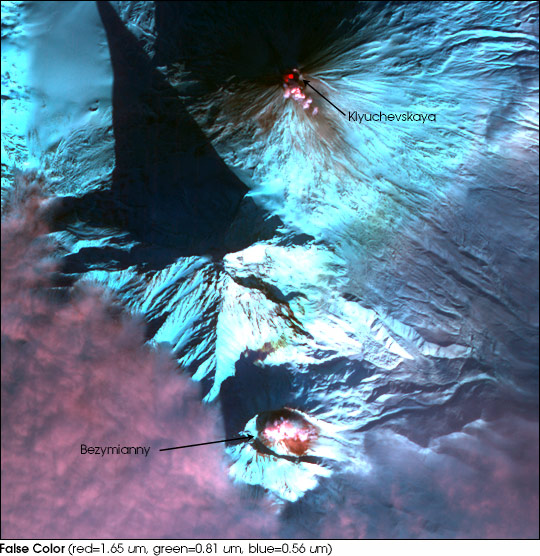
That’s the corpse — extinct Kamen — in the middle. (Image: J. Allen/NASA via Wikimedia, public domain)
Did Bezymianny have:
- Opportunity? Check.
- Motive? Check (the magma system).
- Means? That depends on what’s going on underground, where all the inciting action is.
Watson, look! There is at least one more active individual here.
A little investigation shows that it is big — much larger than the suspect, Bezymianny — and also violent.
Beautiful, beautiful violence . . .
Ahem.
That is not a smoking gun, Watson — it is an assault weapon firing in full auto mode.
Although they appear to be separate entities on the surface, I believe that there may be deeply hidden connections between this violent individual and the suspect Bezymianny.
The two, after all, are only six miles apart.
And in between them? The remains of poor Kamen.
Furthermore, the Baker Street Irregulars — in this case, Churikova et al., 2012, 2013; and Thelen et al. — have linked Bezymianny to the deceased. They also have found some extraneous material near the corpse that may be connected to our mystery guest.
I have also studied a map, which clearly shows a cluster of volcanoes here in Central Kamchatka.
Bezymianny, the late Kamen, and this stranger are at the group’s center.
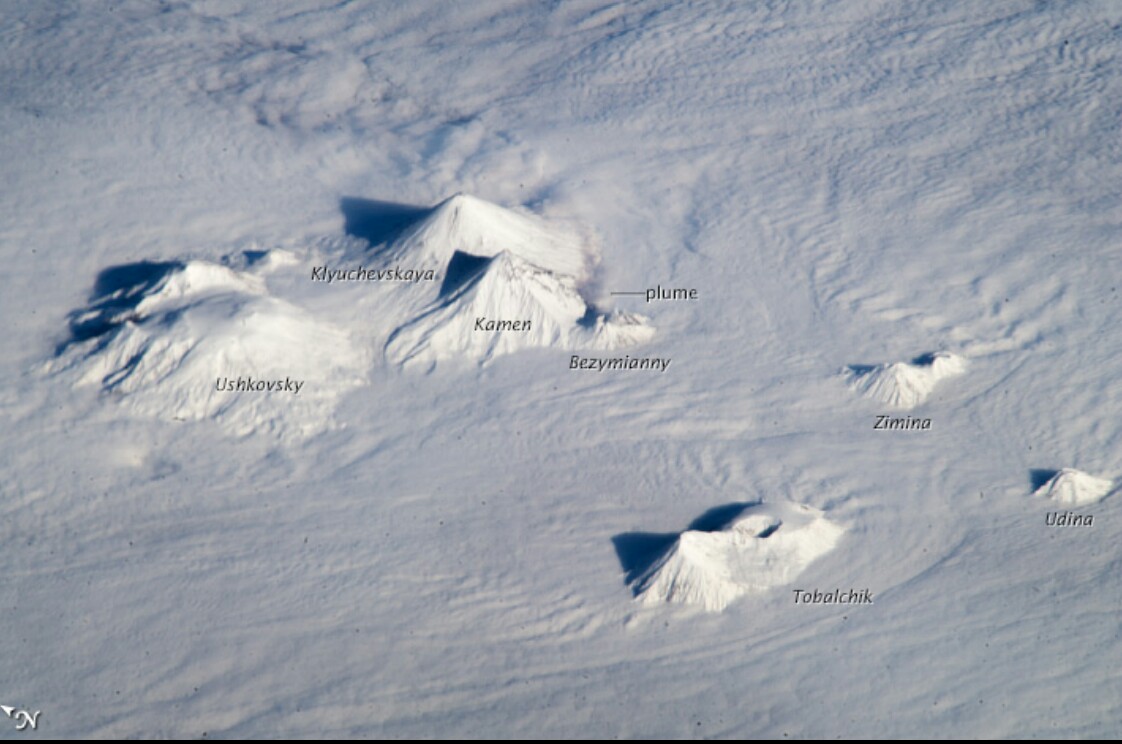
These are just the tallest ones. Their peaks rise above a cloud deck, not snow fields. Note the plume coming from Bezymianny.
(Image: NASA)
So close together, yet each one — there are many more under the clouds — so different from the others.
Watson, something rather complicated is going on here below Earth’s surface, but what could it be? (A clew, particularly that red part at the end, which is also seen at the start of another clew. )
Data! We must have more data!
Until additional information becomes available next Sunday, let us possess our souls in patience and content ourselves with adding Bezymianny to the scrapbook.
Location:
55.972° N, 160.595° E, in Kamchatka, Russian Federation. The GVP Volcano Number is 300250.
Nearby Population:
Per the Global Volcanism Program:
- Within 5 km (3 miles): 0
- Within 10 km (6 miles): 0
- Within 30 km (19 miles): 47
- Within 100 km (62 miles): 11,728
Overhead: Local air traffic and many international flights between Asia and North America.
Current Status:
Aviation Code Yellow. (Note: Last update seems to be September 2021.)
Update, March 18, 2022: Volcano Discovery reports code Orange and shares a satellite image from the 16th showing ash drifting from the volcano.
A little more investigation online revealed this thread:
Extra timelapse:
Second version of the extrusive eruption of #Bezymianny volcano (#Kamchatka) – Situation as of 28/02, 15/03, 28/03 2022 🌋#Copernicus #Sentinel2 🛰️ #EO #Earth #volcanoes
HD -> https://t.co/nujNWKJnyH pic.twitter.com/hRYvTd3HOO— Iban Ameztoy (@i_ameztoy) March 18, 2022
https://platform.twitter.com/widgets.js
Eruptions:
- Eruption styles: Lava extrusion and domes (sticky “gray” lava, not the runny “red” Hawaiian style), explosions, pyroclastic flows. Bezymianny erupts once or twice a year these days. It had been sleeping for roughly a thousand years before it stirred in 1955-56 with an eruption sequence that was eerily similar to what happened at Mount St. Helens in 1980, down to and including an enormous landslide, lateral blast, and Plinian eruption column. Since then, Bezymianny has worked hard at rebuilding its cone, and the volcano is expected to return to its pre-blast appearance in about 15 years, barring surprises. (Bogoyavlenskaya et al.; Ponomareva et al.; Shevchenko et al.; Thelen et al.)
- Biggest recorded event: The 1956 eruption, VEI 5.
- Most recent eruption: Ongoing. Volcanologists report that Bezymianny has started a new dome.
- Past history: See the GVP for details.
Monitoring:
Kamchatka Volcanic Eruption Response Team (KVERT), Institute of Volcanology and Seismology. (Again, the last update seems to be September 2021.)
Webcams (if your browser doesn’t translate, scroll down to Безымянный ).
Featured image: G. E. Bogoyavlenskaya/KVERT
Sources:
Some of these sites are in Russian and were translated by the browser.
Belousov, A.; Voight, B.; Belousova, M.; and Petukhin, A. 2002. Pyroclastic surges and flows from the 8–10 May 1997 explosive eruption of Bezymianny volcano, Kamchatka, Russia. Bulletin of Volcanology, 64(7): 455-471.
Bogoyavlenskaya, G. E.; Braitseva, O. A.; Melekestsev, I. V.; Kiriyanov, V. Y.; and Miller, C. D. 1985. Catastrophic eruptions of the directed-blast type at Mount St. Helens, Bezymianny and Shiveluch volcanoes. Journal of Geodynamics, 3(3-4): 189-218.
Churikova, T. G.; Gordeichik, B. N.; and Ivanov, B. V. 2012. Petrochemistry of Kamen volcano: A comparison with neighboring volcanoes of the Klyuchevskoy group. Journal of Volcanology and Seismology, 6(3): 150-171.
Churikova, T. G.; Gordeychik, B. N.; Ivanov, B. V.; and Wörner, G. 2013. Relationship between Kamen Volcano and the Klyuchevskaya group of volcanoes (Kamchatka). Journal of Volcanology and Geothermal Research, 263: 3-21.
Global Volcanism Program, 2020. Report on Bezymianny (Russia). In: Sennert, S K (ed.), Weekly Volcanic Activity Report, 15 April-21 April 2020. Smithsonian Institution and US Geological Survey.
https://volcano.si.edu/showreport.cfm?doi=GVP.WVAR20200415-300250___. 2020. Kamen https://volcano.si.edu/volcano.cfm?vn=300251
Last accessed September 15, 2020.Kamchatka Volcanic Eruption Response Team (KVERT).
2020. Bezymianny Volcano. http://www.kscnet.ru/ivs/kvert/volc?name=Bezymianny&lang=en Last accessed September 15, 2030.Koulakov, I.; Abkadyrov, I.; Al Arifi, N.; Deev, E.; and others. 2017. Three different types of plumbing system beneath the neighboring active volcanoes of Tolbachik, Bezymianny, and Klyuchevskoy in Kamchatka. Journal of Geophysical Research: Solid Earth, 122(5): 3852-3874.
Oregon State University: Volcano World. 2020. Bezymianny. http://volcano.oregonstate.edu/bezymianny Last accessed September 15, 2020.
Ponomareva, V. V.; Melekestsev, I. V.; and Dirksen, O. V. 2006. Sector collapses and large landslides on Late Pleistocene–Holocene volcanoes in Kamchatka, Russia. Journal of Volcanology and Geothermal Research, 158(1-2): 117-138.
Shapiro, N. M.; Sens-Schonfelder, C.; Luhr, B. G.; Weber, M.; and others. Understanding Kamchatka’s extraordinary volcano cluster. https://eos.org/science-updates/understanding-kamchatkas-extraordinary-volcano-cluster Last accessed September 15, 2020.
Shevchenko, A. V.; Dvigalo, V. N.; Walter, T. R.; Mania, R.; and others. 2020. The rebirth and evolution of Bezymianny volcano, Kamchatka after the 1956 sector collapse. Communications Earth & Environment, 1(1): 1-15.
Sorenko, V. A.; Droznina, V.; Ivanova, P. I.; and others. 2004. Bezymianny, in Active Volcanoes of Kamchatka. http://kcs.dvo.ru/ivs/volcanoes/bezym.html Last accessed September 15, 2020.
Thelen, W.; West, M.; and Senyukov, S. 2010. Seismic characterization of the fall 2007 eruptive sequence at Bezymianny Volcano, Russia. Journal of Volcanology and Geothermal Research, 194(4): 201-213.
Volcano Disovery. 2020. Bezymianny Volcano. https://www.volcanodiscovery.com/bezymianny.html Last accessed September 15, 2020.
 Flight To Wonder