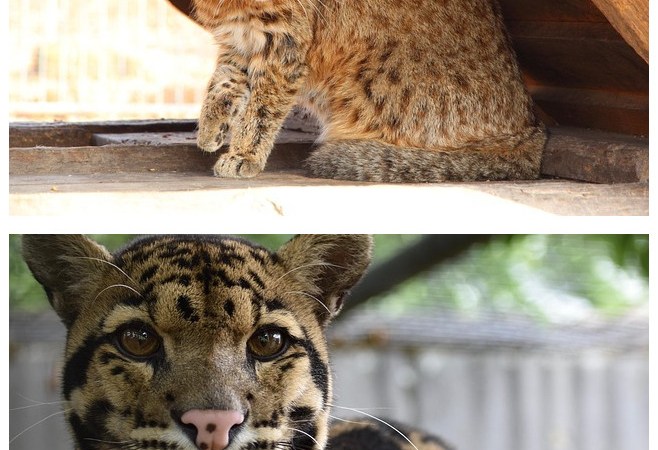
This month, there are a couple of two-fers on Feline Friday because, otherwise, three-quarters of the posts would be on little Prionailurus bengalensis, whose Sunda model we met last week.
The little spotted cat
Leopard cats are very adaptable and so they’re found in many environments, but until watching this video from the Mekong River region, I didn’t know they were this agile!
Here is a riverside night view of a mainland leopard cat — where, I don’t know, but the granite boulders are cool.
“Tryin’ to be a night stalker here, people.”
More information:
- Ecology Asia mainland leopard cat page.
- ISEC doesn’t split the difference on their leopard cat page, but there is much good information here, including a spoiler for next week’s leopard-cat iteration.
- Singapore not only has otters but also a few leopard cats, and those cats are at risk (from us).
The big spotted cat
Well, technically, this carnivore’s coat markings are called “clouds” rather than spots, and it is considered an evolutionary link between small cats and the genus Panthera.
On trail cams, though, it certainly walks and acts like a big cat —
— in captivity and while learning to climb, not so much:
Here’s how it’s done, cubs:
More information:
- There are two species of clouded leopard — mainland and Sunda.
- A paper on mainland clouded leopards and poaching.
- This article is one of the relatively few online that get the teeth right — clouded leopards have fangs reminiscent of saberteeth, but that’s all. Sabertoothed cats had a whole ‘nother thing going on in a world that apparently was very different than our own (because it supported sabercats, and ours doesn’t):
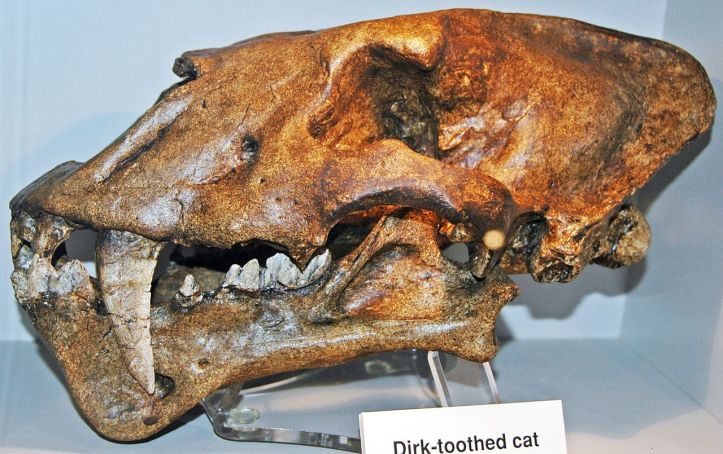
James St. John, via Wikimedia, CC BY 2.0

Some lagniappe:
National Geographic was lucky it was Leopard Cat Day in the forest, not Ninja Day:
That’s Cirque du Soleil doing some of the tree stunts.
Featured image:
- Leopard cat (top): Image by Светлана from Pixabay
- Clouded leopard (bottom) Image by Rachel Leslie from Pixabay

