
Some thirty miles northeast of Kikai Caldera, which lurks at shallow depths below the East China Sea, two peninsulas on the southern coast of Japan’s Kyushu Island open up and lead quite a lot of marine traffic inland via Kagoshima Bay.
Multiple urban areas ring inner Kagoshima Bay. Aira Caldera underlies the bay’s northern end while Aira’s “smokestack,” iconic Sakurajima Volcano, sits on the caldera’s submerged south rim, smoking and smouldering opposite Kagoshima City.
There also is a full-blown land supervolcano in the neighborhood.
Ninety miles north of Kagoshima Bay, on the other side of — surprise! — nonvolcanic mountains that divide Kyushu into northern and southern volcanic regions (Hata et al., 2020), there is Aso-san, a 16 x 11-mile-wide hole in north central Kyushu that hosts an entire range of 4,000 to 5,000-foot-high volcanoes in its caldera.
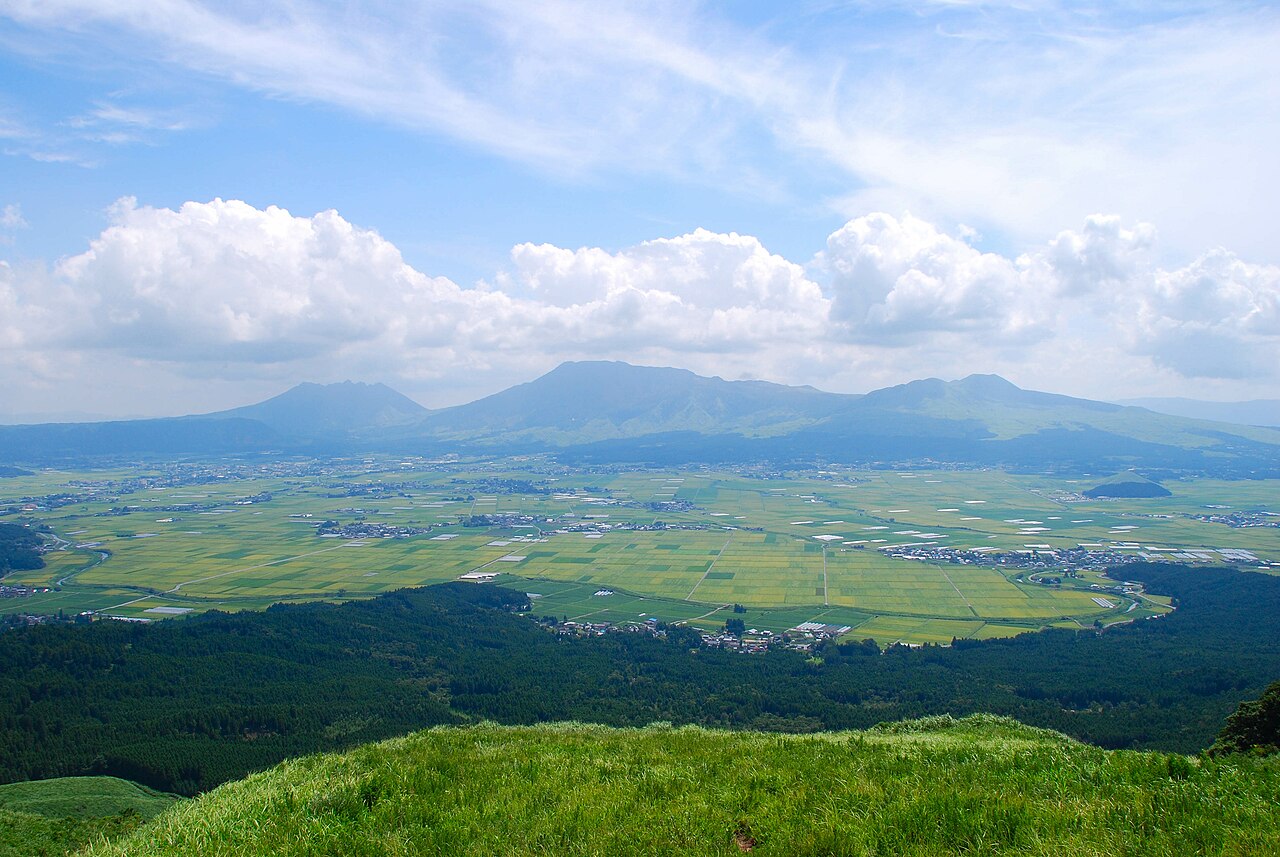
A view of some of the central volcanoes from the caldera rim.
(Image: miya.m via Wikimedia, CC BY-SA 3.0)
These are the Five Mountains, and just one of them — Nakadake, in the center — is active now.
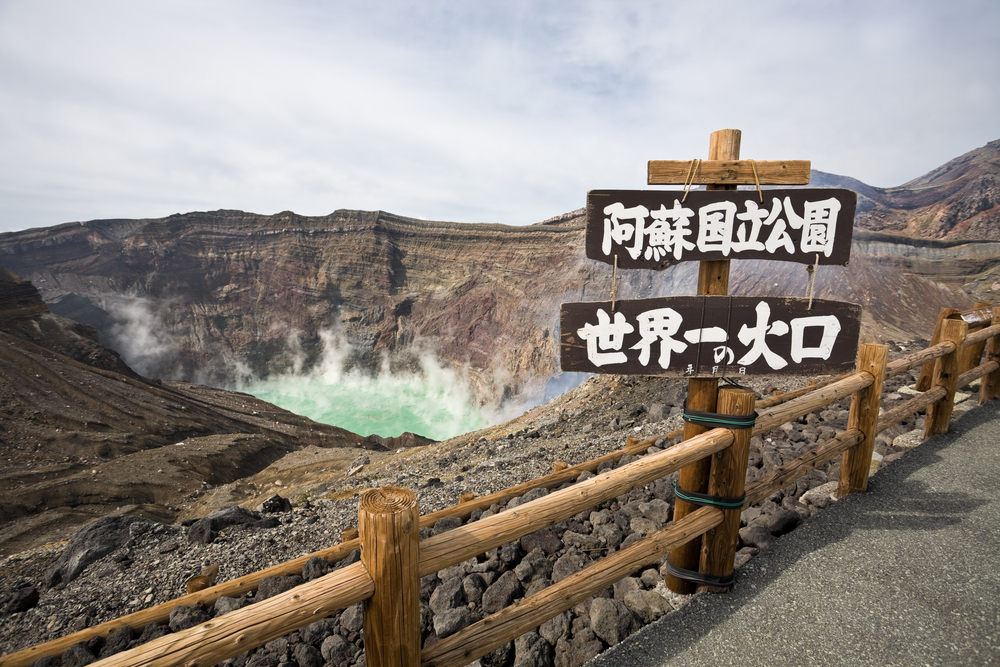
When it’s quiet, you can drive up to Nakadake’s summit. (Image: ymgerman/Shutterstock)
Nakadake is often referred to as Mount Aso. It draws a lot of public attention with its almost constant eruptions, usually in a dramatic but fairly gentle Strombolian way. (GSJ; JMA; Huang et al.)
Occasionally, though, Nakadake gets mean.
This 2021 eruption was scary but harmed no one. However, Nakadake’s rare explosions have damaged structures, injured people, and claimed lives in the past.
Aso (the big hole in Kyushu) has other attractions, too.
These include hot springs, mud pots, and a volcano observatory (autotranslated) as well as features that most of us don’t usually associate with active supervolcanoes, including:

Aso City is down there. Everything you see in this image is part of the caldera. (Image: Kai Keisuke/Shutterstock)
- A city plus six towns and villages, two railway lines, a national highway, several other roads, and a scenic gorge — all in all, there are around 50,000 permanent residents and millions of tourists who visit Aso-san each year (GSJ; Japanese Wikipedia)
- Extensive grasslands north and south of the Five Mountains that not only farmers and stockbreeders care about — the United Nations has designated Aso a Globally Important Agricultural Heritage System (Chakraborty)
- Headwaters of multiple rivers and hundreds of cold springs
- Buddhist ruins dating back to the 1100’s
- Rodan (okay, that one is not entirely unexpected).
Rodan takes off from a for-realsies Mount Nakadake.
This is a national park and, because of its volcanic landscapes as well as the grasslands, it’s also a UNESCO Global Geopark. (Chakraborty)

Shades of Yellowstone!
(Image: Tanya Jones/Shutterstock)
In 2010, more than 18 million people visited Aso-san and the park. They came to feed Rodan to do some sightseeing and/or climbing. (JMA)
An Obon festival is held in late summer here, and autumn leaf-peeking tours of colorful forests on the Five Mountains — especially Mount Nekodake — are very popular.
Wait. Are we still talking about an active, hazardous supervolcano here?
Yes, we are. Most definitely.
What is Aso?
It takes either a satellite or a geologist’s eye to see Aso Caldera whole.

Geologic map of Aso Caldera. (Image:
AIST/GSJ)
The caldera rim has eroded back a bit (Kaneko et al.), but Aso-san excavated most of this hole into Kyushu with a series of four explosive ash-flow eruptions over the last 300,000 years. (Chakraborty; GSJ; JMA)
The giant blasts occurred roughly 270,000 (Aso-1), 140,000 (Aso-2), 120,000 (Aso-3), and 90,000 years ago. (GSJ; Kaneko et al.; Miyabuchi).
To compare that to something we’re a little more familiar with, Yellowstone’s most recent supereruption happened 631,000 years ago, and its famous Huckleberry Ridge blowout occurred 2.1 million years ago. (USGS)

Geological map of the Five Mountains from AIST/GSJ.
In between cataclysms at Aso-san there seems to have been relatively low-level volcanism, probably similar to activity that built the incredibly beautiful caldera landscapes of today. (GSJ; Hoshizumi et al.; Kaneko et al.; Keller et al., 2023)
In fact, the leaf-peekers’ favorite, Mount Neko, goes back to times before Aso-3! (GSJ)
Somehow it survived both the Aso-3 and Aso-4 caldera-forming eruptions.
That’s no small accomplishment, even for a mountain, because Aso-3 was a punchy VEI 7, sending pyroclastic flows careening 30 to 40 miles east and west across Kyushu (LaMEVE; Takarada and Hoshizumi), and Aso-4, 90,000 years ago, was the biggest blast of them all.
Just how big was it?
Aso-4 was long considered a powerful VEI 7, somewhat stronger than its predecessor Aso-3.
Then, in 2020, Takarada and Hoshizumi (see source list at end of post) reported the results of a more detailed and in-depth analysis, showing that Aso-4 vented anywhere from 465 to 962 km3 of magma.
Not only is this solidly in the supereruption class, but if the higher figure is close (DeSilva and Self report a magma volume of less than 592 km3), it also makes Aso-4 the world’s second largest eruption during the last 100,000 years. (Keller et al., 2021)
The largest eruption over that interval occurred at Toba, in Indonesia, as we will see next time. It was an order of magnitude greater than Aso-4. (Takarada and Hoshizumi)
This does not diminish the impact of Aso-4 on the islands of Japan as well as the mainland.

Yug/Pekachua via Wikimedia, CC BY-SA 3.0.
Archaeologists have yet to find evidence of paleolithic humans in Japan 90,000 years ago, but some individuals or small hunter/gatherer bands might have been around.
If so, they were out of luck no matter where they were in the archipelago when Aso went off.
This eruption on the southernmost main island left half a foot of ash way up in the north on what is now Hokkaido, almost a thousand miles away. (Nakada; Takarada and Hoshizumi)
Closer to the vent, its pyroclastic flows devastated an estimated 13,000 square miles, according to Takarada and Hochizumi.
Those deposits have since weathered into the rolling plateaus that now surround Aso in northern and central Kyushu, as well as parts of Yamaguchi Prefecture on Honshu, the next island up. (Japanese Wikipedia; Takarada and Hoshizumi)
The supereruption
Aso-san hides its secrets well and details of the Aso-4 eruption are hard to come by.
Geoscientists, however, are very clever as well as inquisitive.
Using some of the same geophysical techniques that now can locate petroleum and economic mineral deposits miles underground, Matsushima et al. looked for but did not find any underground structures related to caldera collapse at Aso-san.
Other research has identified a funnel-shaped structure in the bedrock underneath Aso Caldera, as well as various signals having to do with the plumbing system that feeds restless Nakadake and — good news! — no signs of a vast store of magma building up for a potential “Aso-5.” (Hata et al., 2016, 2018: Keller et al., 2023)
Yokoyama (2016, 2022) recognized three Tambora-sized calderas inside the much larger Aso Caldera but couldn’t say in what order they formed.
The Geological Survey of Japan (GSJ), on the other hand, suggests that a caldera formed during the Aso-1 eruption and widened into the present structure with each successive blast.
That’s all I was able to find about how Aso-san’s present caldera formed, but geochemistry studies have reinforced the idea that this supervolcano is not yet on the verge of another big one.
Relax. No bunsen burners and safety goggles are involved.
The winds are generally from the west here, and tephra fallout from Nakadake’s eruption plume tends to pile up on the area just beyond the eastern caldera rim. (Miyabuchi)
This has been the case over hundreds of millennia, so Hoshizumi et al. checked out tephra that landed here during the interval between Aso-3 and Aso-4.
They were looking for geochemical clues about how the magma under Aso-san evolved from “normal” Nakadake-style mafic eruption fodder into a very felsic fuel for supereruption.
What they discovered led Hochizumi et al. to describe events in the 30,000 years between Aso-3 and Aso-4 as five stages:
- VEI 3-4 eruptions of mafic lava soon after Aso-3 stopped.
- More frequent mafic eruptions, still VEI 3-4.
- A change to more felsic lava composition (a higher silica content and therefore a change also in scale of eruptions, which became more explosive).
- The most active stage, with many plinian (VEI 4-5) eruptions for about seven thousand years.
- Relative dormancy for some nine thousand years.
Then Aso-4 was unleashed — suddenly, it seems, because there aren’t any signs of preceding “normal”-sized preliminary eruptions. (Wilson et al.)
A quiet volcano is not always a safe one.
There probably were precursors before the supereruption, like ground deformation, seismic swarms, and changes in water and gas emission chemistry and temperature.
These signals would be picked up by today’s monitoring technology, but they leave no recognizable traces in the geological record.
Geoscientists would very much like to find precursor evidence, in order to learn whether impending supereruptions show unique signs that could indicate their unusual scale before it actually happens.
Anyway, 90,000 years ago enormous pyroclastic flows sped away from Aso in all directions. Most traveled 60 to 90 miles, but some went more than 100 miles — among the longest pyroclastic runouts ever recorded. (Takarada and Hoshizumi)
Coignimbrite plumes above the huge pyroclastic flows — much larger than anything Mount St. Helens produced in 1980 — darkened the skies over Japan and parts of mainland Asia, eventually dropping thick ash deposits, including that half-foot on Hokkaido.
There may have been some brief breaks in between fiery death clouds (Wilson et al.), but the regional disaster continued long after the supereruption ended.
This part of the world gets a lot of rain which, along with wind, reworked and redistributed all those loose deposits over and over again.
This, but supersized.
As for wind effects, it might not have mattered much back in 88,000 BC, but today our global air traffic system would face aircraft damage and major schedule disruptions from wind-blown clouds of post-eruption loose ash that would be with us for centuries or longer.
A supereruption might not extinguish us (more on this next time), but it would certainly reboot our advanced technological civilization.
🌋🌋🌋

Lyn Topinka/USGS via Forest Atlas, public domain
Eventually things stabilized in the lands and seas affected by the Aso-4 eruption.
Ordinary volcanism started in the area of today’s Five Volcanoes and elsewhere in and around Aso Caldera, from a different, mafic type of magma (Miyoshi et al., 2011, 2013), and here we are today with ongoing eruptions at Nakadake but, according to Hoshizumi et al., no sign yet of any transition to felsic, more explosive material.
Keller et al. (2023) note that Aso-san is probably still recovering from the last supereruption.
That’s good news. We likely won’t have to face another supereruption here during our lifetimes.
“Probably.”
But there is still so much about supervolcanoes and supereruptions that earth scientists, assorted public officials, hazard management specialists, and the rest of us don’t know yet.
Points to ponder
First and foremost is an open-ended question: What exactly could Japan do if monitoring did show an oncoming supereruption at Aso?
My own guess is that they would need to evacuate Kyushu and adjacent parts of Honshu because pyroclastic flows are not survivable. Ashfall is, per Nakada, as long as shelters are equipped with food and water.
Vast quantities of remobilized ash are another matter, as everyone near Mount Pinatubo in the 1990s discovered.
But where would the millions of refugees go? And what about the infrastructure and technology?
🌋🌋🌋
Studies of the Aso-4 ignimbrite (pyroclastic flow) deposits show a composition change similar to what Hoshizumi et al. found in tephra that piled up east of the caldera between Aso-3 and Aso-4, only in reverse order: felsic (high silica) magma came out first, then a felsic-mafic mix, then mostly mafic (basaltic) magma toward the end. (Kaneko et al.)
As you might expect, volcanologists are on this like white on rice, since the geochemical evidence gives them important clues about what goes on underground as a supervolcano fills up, but thus far they haven’t reached a consensus. (Kaneko et al.; Keller et al., 2021)
🌋🌋🌋
Like other fire mountains, every supervolcano is different, but it’s interesting to note what Aso-san (subduction-zone volcano) and Yellowstone (hotspot volcano, probably) have in common.
Besides being national parks and loved by the people around them, both Aso and Yellowstone have extensive hydrothermal systems near the surface, evidenced by fumaroles and hot springs; too, both have had multiple big eruptions.
So why has Aso produced four big blasts in just half the time that has passed since Yellowstone’s Lava Creek eruption 631,000 years ago?
It could be individual differences, but other factors come into play over such a long time span.
There is a hypothesis that supervolcanoes have cycles.
Bouvet de Maisonneuve et al. and Keller et al. (2023) describe it this way:
- Incubation: The first step is to warm up the surrounding crust with frequent “normal” eruptions. Hot bedrock can move a bit, allowing a supersized magma chamber to grow.
- Maturation: All the multiple small sills and other magma reservoirs start to coalesce rather than feed eruptions. Things quiet down some at the surface.
- Fermentation: This step’s name always makes me laugh, but it makes sense because things get gassy. Dissolved gases start coming out of the magma, and this fuels runaway growth of the magma chamber.
- Caldera formation. Internal or external factors can destabilize the system, causing a VEI 7 to 8 eruption: (1) Too much gas pressure inside the chamber; and (2) External events of some sort, such as tectonic shifts of the region’s stress field or, say, removal of heavy weight from the crust by melting a glacier.
- After the caldera-forming eruption, recovery OR death of the system, depending on whether or not there is continued magma resupply coming up from the Earth’s mantle.
Aso is in recovery. (Keller et al., 2021)
And Yellowstone?
There was a respectable outpouring of lava flows after the Lava Creek supereruption and then — quiet.
And all this time, plate tectonics has been moving the cold North American crustal plate over that hotspot.
Are Yellowstone’s inner fires still melting that crust, slowly building up to another supereruption at this location?
Or is the North American crust snuffing it out?
Well, hotspots aren’t snuffable, but as we’ll see at the end of this series, geoscientists have differing views about Yellowstone’s status, with some of them even suggesting that Yellowstone — at least as as we know it — might be dying out!
🌋🌋🌋
Featured image: A_kiri/Shutterstock
Sources:
Abe, Y.; Ohkura, T.; Shibutani, T.; Hirahara, K.; and others. 2017. Low‐velocity zones in the crust beneath Aso caldera, Kyushu, Japan, derived from receiver function analyses. Journal of Geophysical Research: Solid Earth, 122(3): 2013-2033.
Acocella, V.; Di Lorenzo, R.; Newhall, C.; and Scandone, R. 2015. An overview of recent (1988 to 2014) caldera unrest: Knowledge and perspectives. Reviews of Geophysics, 53(3): 896-955.
Bouvet de Maisonneuve, C. B.; Forni, F.; and Bachmann, O. 2021. Magma reservoir evolution during the build up to and recovery from caldera-forming eruptions–a generalizable model?. Earth-Science Reviews, 218: 103684.
Chakraborty, S. 2018. The Interface of Geology, Ecology, and Society: The Case of Aso Volcanic Landscape. Natural Heritage of Japan: Geological, Geomorphological, and Ecological Aspects, Springer, 117-130.
DeSilva, S. and Self, S. 2022. Capturing the extreme in volcanology: the case for the term “supervolcano”. Frontiers in Earth Science, 10: 859237.
Geological Survey of Japan (GSJ). n.d. Aso. Via Google Translate. https://gbank.gsj.jp/volcano/Act_Vol/aso/text/eng/exp04-1e.html
Geshi, N 2020. Volcanological challenges to understanding explosive large-scale eruptions. Earth, Planets and Space, 72: 1-10.
Geshi, N.; Miyagi, I.; Saito, G.; and Conway, C. E. 2023. Caldera collapse thresholds correlate with magma chamber dimensions. Scientific Reports, 13(1): 7463.
Hata, M.; Munekane, H.; Utada, H.; and Kagiyama, T. 2020. Three‐dimensional electrical resistivity structure beneath a volcanically and seismically active island, Kyushu, Southwest Japan Arc. Journal of Geophysical Research: Solid Earth, 125: e2019JB017485.
Hata, M.; Matsushima, N.; Takakura, S.; Utsugi, M.; and others. 2018. Three-dimensional electrical resistivity modeling to elucidate the crustal magma supply system beneath Aso caldera, Japan. Journal of Geophysical Research: Solid Earth, 123: 6334–6346.
Hata, M.; Takakura, S.; Matsushima, N.; Hashimoto, T.; and Utsugi, M. 2016. Crustal magma pathway beneath Aso caldera inferred from three‐dimensional electrical resistivity structure. Geophysical Research Letters, 43(10): 720–10, 727.
Hoshizumi, H.; Miyabuchi, Y.; Miyagi, I.; Geshi, N.; and Takarada, S. 2022. Tephrostratigraphy and eruptive history of Aso-4/3 tephra group, Aso volcano: preparatory process for Aso-4 ignimbrite eruption. Bulletin of the Volcanological Society of Japan, 67(1): 91-112. Via onlinedoctranslator.com.
Huang, Y. C.; Ohkura, T.; Kagiyama, T.; Yoshikawa, S.; and Inoue, H 2018. Shallow volcanic reservoirs and pathways beneath Aso caldera revealed using ambient seismic noise tomography. Earth, Planets and Space, 70: 1-21.
Japan Meteorological Agency (JMA). n.d. Volcanoes of Japan: Aso. https://www.data.jma.go.jp/vois/data/filing/souran_eng/menu.htm
Kaneko, K.; Kamata, H.; Koyaguchi, T.; Yoshikawa, M.; and Furukawa, K. 2007. Repeated large-scale eruptions from a single compositionally stratified magma chamber: An example from Aso volcano, Southwest Japan. Journal of Volcanology and Geothermal Research, 167(1-4): 160-180.
Keller, F.; Guillong, M.; Geshi, N.; Miyakawa, A.; and Bachmann, O. 2023. Tracking caldera cycles in the Aso magmatic system–Applications of magnetite composition as a proxy for differentiation. Journal of Volcanology and Geothermal Research, 436: 107789.
Keller, F.; Bachmann, O.; Geshi, N.; and Miyakawa, A. 2021. The role of crystal accumulation and cumulate remobilization in the formation of large zoned ignimbrites: insights from the Aso-4 caldera-forming eruption, Kyushu, Japan. Frontiers in Earth Science: 8, 614267.
Large Magnitude Explosive Volcanic Eruptions (LaMEVE). n.d. Aso. https://vogripa.org/searchVOGRIPA.cfc?method=search&ymax=&xmin=&xmax=&ymin=&volcanoName=Asosan&alternateVolcanoName=&volcanoType=any&dateType=dateTypeBP&eruptionDate1=&eruptionDateDay1=dd&eruptionDateMth1=mm&eruptionDateYr1=yyyy&eruptionDate2=&eruptionDateDay2=dd&eruptionDateMth2=mm&eruptionDateYr2=yyyy®ion=any&subRegion=any&MagnitudeType=magnitude&magnitudeFrom=&magnitudeTo=&composition=any&bulkVolumeFrom=&bulkVolumeTo=&dreVolumeFrom=&dreVolumeTo=&columnHeightFrom=&columnHeightTo=&airTephraVolumeFrom=&airTephraVolumeTo=&submitButton=Search
Matsushima, N.; Utsugi, M.; Takakura, S.; Yamasaki, T.; and others. 2020. Magmatic–hydrothermal system of Aso Volcano, Japan, inferred from electrical resistivity structures. Earth, Planets and Space, 72: 1-20.
Miyabuchi, Y. 2011. Post-caldera explosive activity inferred from improved 67–30 ka tephrostratigraphy at Aso Volcano, Japan. Journal of Volcanology and Geothermal Research, 205(3-4): 94-113. Snippets only)
Miyoshi, M.; Shibata, T.; Yoshikawa, M.; Sano, T.; and others. 2011. Genetic relationship between post-caldera and caldera-forming magmas from Aso volcano, SW Japan: Constraints from Sr isotope and trace element compositions. Journal of Mineralogical and Petrological Sciences, 106(2): 114-119.
Miyoshi, M.; Shinmura, T.; Sumino, H.; Sano, T.; and others. 2013. Lateral magma intrusion from a caldera-forming magma chamber: Constraints from geochronology and geochemistry of volcanic products from lateral cones around the Aso caldera, SW Japan. Chemical Geology, 352: 202-210.
Nakada, S. 2018. Volcanic archipelago: volcanism as a geoheritage characteristic of Japan. Natural Heritage of Japan: Geological, Geomorphological, and Ecological Aspects, Springer, 19-28.
Saiga, A.; Matsumoto, S.; Uehira, K.; Matsushima, T.; and Shimizu, H. 2010. Velocity structure in the crust beneath the Kyushu area. Earth, Planets and Space, 62: 449-462.
Saito, H.; Uchiyama, S.; Hayakawa, Y. S.; and Obanawa, H. 2018. Landslides triggered by an earthquake and heavy rainfalls at Aso volcano, Japan, detected by UAS and SfM-MVS photogrammetry. Progress in Earth and Planetary Science, 5: 1-10.
Takarada, S., and Hoshizumi, H. 2020. Distribution and eruptive volume of Aso-4 pyroclastic density current and tephra fall deposits, Japan: A M8 super-eruption. Frontiers in Earth Science, 8: 170.
Townsend, M.; Huber, C.; Degruyter, W.; and Bachmann, O. 2019. Magma chamber growth during intercaldera periods: Insights from thermo‐mechanical modeling with applications to Laguna del Maule, Campi Flegrei, Santorini, and Aso. Geochemistry, Geophysics, Geosystems, 20(3): 1574-1591.
Wikipedia. 2024. Mount Aso. Last accessed 1/17/2025. https://en.m.wikipedia.org/wiki/Mount_Aso
___. 2024. Aso Caldera. Last accessed 1/17/2025. https://en.m.wikipedia.org/wiki/Aso_Caldera
Wikipedia (Japanese). 2025. Mount Aso. Last accessed 1/17/2025. Via Google Translate. https://ja.m.wikipedia.org/wiki/%E9%98%BF%E8%98%87%E5%B1%B1
___. 2024. Aso Caldera. Last accessed 1/17/2025. Via Google Translate. https://ja-m-wikipedia-org.translate.goog/wiki/%E9%98%BF%E8%98%87%E3%82%AB%E3%83%AB%E3%83%87%E3%83%A9?_x_tr_sl=auto&_x_tr_tl=en&_x_tr_hl=en-US&_x_tr_pto=wapp
Wilson, C. J.; Cooper, G. F.; Chamberlain, K. J.; Barker, S. J.; and others. 2021. No single model for supersized eruptions and their magma bodies. Nature Reviews Earth & Environment, 2(9): 610-627.
Yagi, Y.; Okuwaki, R.; Enescu, B.; Kasahara, A.; and others. 2016. Rupture process of the 2016 Kumamoto earthquake in relation to the thermal structure around Aso volcano. Earth, Planets and Space, 68: 1-6.
Yokoyama, I. 2016. Origin of calderas: discriminating between collapses and explosions. Annals of Geophysics, 59(6): S0650-S0650.
___. 2022. The 1815 Tambora eruption: Its significance to the understanding of large-explosion caldera formations. Geofísica Internacional, 61(1): 5-19.
 Flight To Wonder