VEI 8: Supereruption.
When we hear that super word, most of us immediately think of Yellowstone even though there are other active supervolcanoes out there.
Wilson et al. (2021) point out that this group of nine potential troublemakers is quite diverse. (Counts vary by researcher; I follow DeSilva and Self)
Some of them — eastern California’s Long Valley Caldera, for instance — are smaller than Yellowstone Caldera while others, like Toba on the island of Sumatra in Indonesia, are bigger.
Let’s start off by talking about the one most of us know as a supervolcano — and also as a very popular national park.
It was in 1949 that a geologist first recognized the leftover deposits from Yellowstone’s huge prehistoric eruptions for what they are. (Miller and Wark)
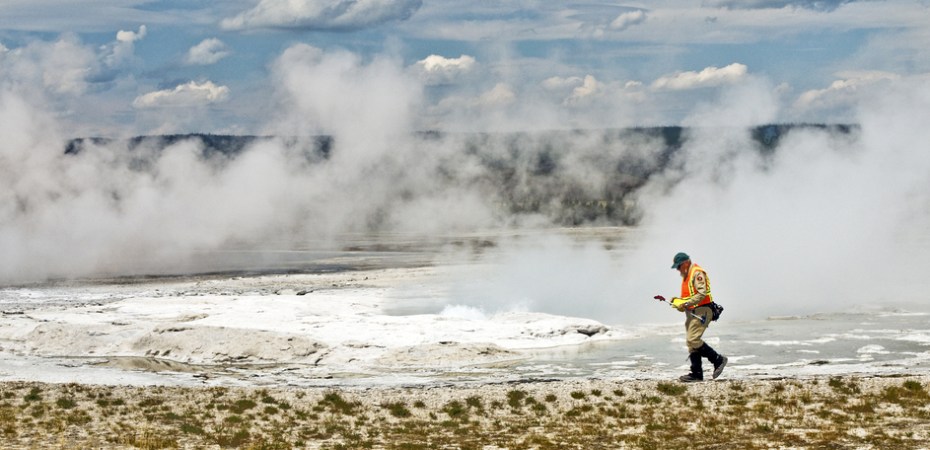
Yellowstone Supervolcano’s mild-mannered public face is very nonthreatening; this paper, on the other hand, while heavy on jargon in the text, clearly reveals the true “super” nature of that picnic area’s tan-colored ground in Figures 1 and 2. (Also, the video came up on a search, and I know nothing about the company that made it.)
The public didn’t start getting excited about such things until 2000.
That’s when the BBC introduced us all to the word “supervolcano,” which has a surprisingly long history. (Miller and Wark)
A jointly produced BBC docudrama about the occurrence of another Huckleberry Ridge-sized Yellowstone eruption, titled Supervolcano, soon followed —

They were not subtle.
— and the super hype (most of it not as realistic) has increased ever since.
Fortunately, so has funding for scientific research into the real thing.
Earth scientists now know more about Yellowstone and other large caldera systems that have had one or more VEI 8 eruptions — that’s one technical definition of “supervolcano” (Miller and Wark) — thanks in part to progress driven by the topic’s popularity and even more so by the concern of many stakeholders about how such a blast could affect our world.
Short answer: It would be bad. (Donovan and Oppenheimer; Self, 2015)
🌋🌋🌋
The longer answer to questions about supervolcanoes and their impacts on our globally interconnected world is like a road under construction, strewn with jargon and blocked in several places by barriers to knowledge that still puzzle some of the best minds on the planet.
For the most part, we laypeople don’t think about it much, other than to watch the occasional disaster movie or indulge in a clickbait headline or two about Yellowstone being overdue or some other sensational fallacy.
Supervolcanoes don’t need that hype. They really are sensational and sometimes we can’t help but wonder what they’re like and wish that we had the background to understand what’s going on with them better.
There is anxiety, too, since experts tell us that supereruptions do happen. How often, we wonder, and where?
And also this —
What’s a real supereruption like?
No one can be sure — it hasn’t happened yet in recorded history.
Given the stakes, as well as the availability of supercomputers, volcanologists have worked out indirect ways to model a possible supereruption despite having very little data (Bachman and Huber; Cashman and Sparks), but this only gives them a very general and not necessarily an accurate picture. (Mason et al.)
Among issues hindering the boffins’ progress toward a perfectly reliable computer model is the fact that they can’t get to the action, deep underground, where supervolcanoes stew and grow.
In addition to this lack of observational data, human lifespans and the comparatively short length of our recorded history get in their way, too.
It takes tens to hundreds of thousands of years or more for vast quantities of magma to form before the big blast.
Time out for a quick reality check.
Typically sized magma chamber:
One section of a supersized magma “chamber”:
As the National Park Service explains it, Yosemite is part of what once was a very large underground magma collection, called a batholith, that formed while there was a subduction zone here. Then the batholith froze in place millions of years ago.
All that granite we see now at Yosemite and elsewhere in the region stayed underground. It did not erupt.
Erosion and plate tectonics have exposed it to our view — including the part that we call the Sierra Nevada mountain range.
That’s the scale we’re talking about with supervolcanoes.
Most batholiths don’t ever reach the surface (Bachman and Huber). In fact, a major unanswered research question is why a very few do, resulting in a supereruption. (Yellowstone is an exception, because it’s the only known supervolcano associated with a hotspot.)
A supereruption certainly leaves its mark on things, but that mark is made out of ash, not lava, and apart from some welded ignimbrites, it isn’t very durable.
These cataclysms are rare, which is good news for us but also means that supereruptions which did leave traces in the geological record happened a long time ago.
The youngest one identified thus far, in New Zealand, is about 26,000 years old. Older ones can go back millions of years
As deep time passes, much of the evidence about past supereruptions erodes away or gets buried under more recent geologic deposits.
It’s not available for computer models, whose accuracy depends on having sufficient amounts of data.
Common sense, though, tells us that the effects of a supereruption will be both short term — ashfall and pyroclastic flows — and long term, such as remobilization of ash far worse than what occurred after Pinatubo’s VEI 6 eruption in 1991, as well as likely climate effects from sulfur aerosols. (Donovan and Oppenheimer; Self, 2006)
Let’s follow some widely cited papers and explore this layperson’s idea of what an actual supereruption might be like, based on her understanding (which of course is limited) of some very technical reading.
Of primary importance is the great “what if” — and since the BBC got us all into this, it’s only proper to tell it in a way that is also a small homage to Douglas Adams.
Just remember that volcanoes are not Vogons, and above all else —

Image by Pete Linforth from Pixabay
What if..?
Suppose one sunny weekend morning there you are, in your bathrobe, brushing your teeth, when you hear reliable news that a supereruption is underway in Florida, midway between Tampa and Orlando.
“Strange,” you think, “I didn’t know that there are volcanoes in Florida” — and there aren’t any in real life, although that resilient US state is no stranger to some other kinds of natural disaster.
The Florida setting is just a way to get you thinking about a real supereruption instead of anything you’ve seen in tabloid hype or disaster movie scenes.
Very conveniently for all of us without PhD’s in geology, it also avoids having to bring in the complex geological context, very different from Florida’s, that actually leads to one of these explosive fireholes.
Finally, it’s obviously fantasy and so is not as scary as a real setting would be.
Again: The following account is fictional — no one in the southeastern US stands a chance of actually having these experiences because there are no volcanoes there, let alone supervolcanoes.
Someone at similar distances from an actual supereruption will, though.
And the central US is expected to see ash, if another Huckleberry Ridge-sized eruption ever happens at Yellowstone.
If…
More on how big that “if” might be in Part 3. Now let’s look at how things might possibly play out.
🌋🌋🌋
After hearing the news, what you do next will depend upon both your location and the type of supereruption it is.
Yes, geoscientists have discovered over the past twenty-plus years that there is more than one kind of supereruption.
The ashy hurricane can happen all at once (for example, Long Valley’s Bishop Tuff) or with some pauses, as in Earth’s most recent supereruption, at Taupo in New Zealand about twenty-six millennia ago (Barker et al.; Wilson et al., 2021):
Quite a leisurely pace, isn’t it — at least until the magma chamber roof gives way. After that, the whole North Island gets devastated, according to Barker et al. and other references listed at post’s end. It’s worth pointing out here that Taupo is very active and, as with all supervolcanoes, most of its eruptions are not supersized.
Your supereruption is not like that one.
It begins the way we all imagine one starts, the way the Bishop Tuff supereruption that made Long Valley Caldera did start almost 800,000 years ago, per Wilson and Hildreth: suddenly, with a plinian outburst that is quickly joined by multiple other columns — sort of like the eruption sequence they showed in that BBC docudrama — more and more columns, as curved fractures in the ground gape open and the bedrock above a roughly 7.5 x 14-mile-wide magma chamber (Hildreth, 2004) takes five or six days to drop down a mile or more (2-3 km), forming a new caldera. (Hildreth, 2004)
In your supereruption, over the next ninety hours at least 150 cubic miles of magma (600-625 km3) will blow out of the ground through those widening cracks, quickly expanding and freezing into pumice — hardened rock foam.
Besides soaring into the air, that pumice and other tephra (volcanic glass, chunks of bedrock broken off and caught up in the eruptive violence, etc.) feeds the ashy hurricane that consists of enormous pyroclastic flows whose deposits eventually will pile up almost 700 feet (~200 m) thick near the vent. The flows move very fast and can travel 60 to 100 miles (100-150 km). Meanwhile, above it all, the plinian columns rise high into the stratosphere, overshoot at first, and then subside into a vast umbrella cloud. (Hildreth, 2004; Mastin et al.; Wilson and Hildreth; Wilson et al., 2021)
I told you supervolcanoes are sensational!
But you might not see it that way if you’re in —
Miami, Florida, 11 a.m. Eastern
In between the episodes of shaking from those massive earthquakes that accompany caldera formation 200 miles north of you, it’s very, very quiet.
Ash deadens sound.
It is very, very dark, too. As Oppenheimer describes the experience under even a regular-sized ash cloud:
Probably the first sensation for anyone caught in such fallout will be the disorientation and terror of being plunged into complete darkness. Even the darkest nights do not compare: in a dense fall of ash, there is no glimmer of light from Sun, sky, Moon or stars, and the chances are that power lines will have been cut, so no response from light switches…
Volcanic ash can short-circuit power lines and other electrical equipment. It also interferes with satellite communications and clogs water/sewer lines and air intakes in things like motor vehicles, aircraft, marine engines, and air conditioners. (Donovan and Oppenheimer; Self, 2006)
It also burns your eyes, throat, and sinuses, even with the use of your leftover COVID-era face mask and some safety goggles that happened to be around.
The ash gets in everywhere, though putting wet towels along the door and at the windows helps some.
You’d like to leave.
They did call an evacuation. But you can’t drive or get a ride — the intense rain of ash killed your car before you could get two blocks, and no planes, trains, or automobiles can operate.
As for ship rescue, not even US Navy vessels with engines protected from ash — if there are such things — can break through the thickening and widening pumice rafts that make all of South Florida inaccessible by water.
Out in the street, when you last checked, ash was almost a foot deep and still falling. While out there, you saw some acquaintances pass by close to you. They seemed to be pushing and/or pulling a small boat in the direction of the road that goes down to the harbor. [BBC docudrama parallel: Rick’s “walk for life.”]
You thought about joining them but doubt that it will work.
Maybe they’ll make it. Maybe you will.
All you know is that it’s very quiet, very dark. The power, water, and sewers are all gone and you can’t get out.
Birmingham, Alabama, 10 a.m., Central
The volcanic cloud overhead hasn’t quite chased away all the sunlight yet, but it sure is dark now. The birds are silent, and ashfall started soon after it first moved in overhead.
Now the ash is over an inch thick on the sidewalk.
That dark sky looks a lot like severe weather — there is some lightning, too! — but this cloud doesn’t move with the wind. (Mastin et al.) The Coriolis force spreads it (Oppenheimer), some talking head on the news said — farther and farther, so thick, bringing twilight and maybe even darkness soon, here more than 500 miles away from the eruption.
There are no planes. Grounded all over the country, someone said, and up in Canada, too. The ash makes jet engines stop and just generally makes it impossible to fly.
They say on the news that ash could get several inches deep here, and everybody should try sweeping it off their roof before too much accumulates. It is rock, after all, and in South Alabama some roofs already have collapsed under the weight.
There’s no word at all yet from northern Florida.
Don’t use water to wash it off, the announcers say. That just makes ash heavier.
Your nephew and his wife call. Do you want to come out to their house in the suburbs? If so, you’d better hurry: traffic is heavy and forget about stocking up on groceries and gas in town — there aren’t lines at stores and gas stations so much as demolition derbies and crowds of very unhappy people.
The nephew says they were able to get out early on and have laid in a good supply of food and other necessities. They get their water from a well, though he’s not sure how they’ll get the water out of that well if the power goes down. He’ll think of something.
But come now, if you’re coming, while the gettin’s good. Or at least possible. It doesn’t matter if you’re not dressed. Just get in the car and…
The conversation stops. Your house lights flicker once and, even though they stay on, it suddenly hits you that this isn’t just a severe squall line coming, or a hurricane.
You’re not sure what it will be like, and for the first time ever, you’re touched by an existential fear.
How long is this going to last?
[Months to years, for the post-eruption physical effects; in terms of social, economic, and political impacts, it’s a changed world, all this from common sense and also according to Donovan and Oppenheimer, generally speaking.]
You go indoors, round up the cats and a few items you and they will need, round up the cats again and put them in carriers, grab your bugout bag on the way out, get in the car (in your bathrobe) and leave.
Ten hours later, just before the whole transportation system shuts down because of traffic overload, accidents caused by treacherous conditions from slippery ash (including a hazardous chemical spill on I-59 after a trailer truck went off the road), power outages, looting, and gas shortages, and amid rumors that martial law is going to be declared, you reach your nephew’s place, 15 miles away. They’re glad to see you. The house is lit with kerosene lamps and candles (of which they have a good supply), and you’ll be staying with them for quite a while.
The monument to North America’s geographical center, at Rugby, North Dakota, almost 2,000 miles away from the Florida vents, 10 a.m., Central.
I’m going to cheat here , in the interests of brevity, and refer you to the London scene in that BBC docudrama — fine weather, no sign of trouble in the sky, but there’s a rush on stores that have already shut their doors because the supereruption is or soon will be affecting global supply lines and everyone needs to make whatever they’ve got right now last as long as possible.
The movie, which Miller and Wark call plausible, shows the spread of a Yellowstone Huckleberry Ridge hypothetical umbrella cloud over the United States, accompanied by power outages and other crises.
Long Valley’s Bishop Tuff supereruption, which I’m using as the factual basis of this little tale, was smaller — its ash has “only” been found on land throughout the Southwest. In our imaginary Florida scenario, the Southeast would see a cloud and ash, but the central plains probably wouldn’t.
I don’t know anything about Rugby, North Dakota, but it sounds like it’s a rural area, which may bring some advantages, but whatever the supereruption’s size, it’s still going to be a tough row for them to hoe as 21st-century US society comes to a halt and overseas international connections are severed.
McMurdo Station, Antarctica
All the people rushing around ignore you, not even stopping to ask who you are and why you’re in your bathrobe.
Some of them are still preparing and/or deploying instruments to measure the eventual sulfur and possibly ash fallout here, a year or more from now.
Others are packing up their personal stuff.
Everyone is trying to beat the deadline when the last aircraft and ship leave Antarctica, several hours from now, just before global communication, aviation, and marine networks shut down completely.
Soon you’re all alone there, sputtering in indignation, “This is terrible! Why didn’t they see this coming?”
🌋🌋🌋
It wasn’t for lack of trying, but it wasn’t easy, either, because of the issues mentioned earlier.
Next time: Can supereruptions be forecast? Also, the nine active supervolcanoes that DeSilva and Self listed, and finally, the PLUTONS Project.
Featured image: Daniel-Alvarez/Shutterstock
Sources:
I should probably repost the “Don’t Panic” image. What happened is that I collated all the references first (below) and then realized that more than one post would be needed — and actually, the posts can only hit a few high points. I’m going to do an eBook.
Below are ALL the references, not just those used in this post. Explore and enjoy; there’s much fascinating information about supervolcanoes today!
GENERAL
Acocella, V.; Di Lorenzo, R.; Newhall, C.; and Scandone, R. 2015. An overview of recent (1988 to 2014) caldera unrest: Knowledge and perspectives. Reviews of Geophysics, 53(3): 896-955.
Bachmann, O., and Huber, C. 2016. Silicic magma reservoirs in the Earth’s crust. American Mineralogist, 101(11): 2377-2404.
Barker, S. J.; Wilson, C. J.; Illsley-Kemp, F.: Leonard, G. S.; and others. 2021. Taupō: an overview of New Zealand’s youngest supervolcano. New Zealand Journal of Geology and Geophysics, 64(2-3): 320-346.
Brown, S. K.; Crosweller, H. S.; Sparks, R. S. J.; Cottrell, E.; and others. 2014. Characterisation of the Quaternary eruption record: analysis of the Large Magnitude Explosive Volcanic Eruptions (LaMEVE) database. Journal of Applied Volcanology, 3: 1-22.
Caricchi, L.; Annen, C.; Blundy, J.; Simpson, G.; and Pinel, V. 2014. Frequency and magnitude of volcanic eruptions controlled by magma injection and buoyancy. Nature Geoscience, 7(2): 126-130.
Cashman, K. V., and Sparks, R. S. J. 2013. How volcanoes work: A 25-year perspective. Bulletin, 125(5-6): 664-690.
Crosweller, H. S.; Arora, B.; Brown, S. K.; Cottrell, E.; and others.
2012. Global database on large magnitude explosive volcanic eruptions (LaMEVE). Journal of Applied Volcanology, 1: 1-13.
Deligne, N. I.; Coles, S. G.; and Sparks, R. S. J. 2010. Recurrence rates of large explosive volcanic eruptions. Journal of Geophysical Research: Solid Earth, 115(B6).
DeSilva, S. and Self, S. 2022. Capturing the extreme in volcanology: the case for the term “supervolcano”. Frontiers in Earth Science, 10: 859237.
Donovan, A., and Oppenheimer, C.
2018. Imagining the unimaginable: communicating extreme volcanic risk. Observing the Volcano World: Volcano Crisis Communication, 149-163.
Gelman, S. E.; Gutiérrez, F. J.; & Bachmann, O. 2013. On the longevity of large upper crustal silicic magma reservoirs. Geology, 41(7): 759-762.
Giordano, G., and Caricchi, L. 2022. Determining the state of activity of transcrustal magmatic systems and their volcanoes. Annual Review of Earth and Planetary Sciences, 50(1): 231-259.
Harmon, L. J.; Gualda, G. A.; Gravley, D. M.; Smithies, S. L.; and Deering, C. D. 2024. The Whakamaru magmatic system (Taupō Volcanic Zone, New Zealand), part 1: Evidence from tephra deposits for the eruption of multiple magma types through time. Journal of Volcanology and Geothermal Research, 445, 107966.
Harmon, L. J.; Smithies, S. L.; Gualda, G. A.; and Gravley, D. M.
2024. The Whakamaru magmatic system (Taupō Volcanic Zone, New Zealand), part 2: Evidence from ignimbrite deposits for the pre-eruptive distribution of melt-dominated magma and magma mush. Journal of Volcanology and Geothermal Research, 447, 108013.
Jellinek, A. M., and DePaolo, D. J. 2003. A model for the origin of large silicic magma chambers: precursors of caldera-forming eruptions. Bulletin of Volcanology, 65: 363-381.
John, D. A. 2008. Supervolcanoes and metallic ore deposits. Elements, 4(1): 22-22.
Mason, B. G.; Pyle, D. M.; and Oppenheimer, C. 2004. The size and frequency of the largest explosive eruptions on Earth. Bulletin of Volcanology, 66(8): 735-748.
Miller, C. F. and Wark, D. A. 2008. Supervolcanoes and their explosive supereruptions. Elements, 4(1): 11-15.
New Mexico Bureau of Geology and Mineral Resources. Valles Caldera: New Mexico’s Supervolcano (PDF)
Oppenheimer, C. 2011. Eruptions That Shook the World. Cambridge: Cambridge University Press. Retrieved from https://play.google.com/store/books/details?id=qW1UNwhuhnUC
Poland, M. 2020. Caldera Chronicles: Caldera Systems — A World-Wide Family That Is More Than Just Yellowstone.
Pyle, D. M. 2018. What can we learn from records of past eruptions to better prepare for the future?. Observing the Volcano World: Volcano Crisis Communication, 445-462.
Saunders, K. E.; Morgan, D. J.; Baker, J. A.; and Wysoczanski, R. J. 2010. The magmatic evolution of the Whakamaru supereruption, New Zealand, constrained by a microanalytical study of plagioclase and quartz. Journal of Petrology, 51(12): 2465-2488.
Self, S. 2006. The effects and consequences of very large explosive volcanic eruptions. Philosophical Transactions of the Royal Society A: Mathematical, Physical and Engineering Sciences, 364(1845): 2073-2097.
Self, S. 2015. Explosive super-eruptions and potential global impacts. In Volcanic Hazards, Risks and Disasters (pp. 399-418). Elsevier.
U. S. Geological Survey (USGS) 2024 Questions About Supervolcanoes
Wikipedia. 2024. Taupo Volcano. Last accessed November 27, 2024.
Wilson, C. J., ; Blake, S.; Charlier, B. L. A.; ans Sutton, A. N. 2006. The 26· 5 ka Oruanui eruption, Taupo volcano, New Zealand: development, characteristics and evacuation of a large rhyolitic magma body. Journal of Petrology, 47(1): 35-69.
Wilson, C. J.; Gravley, D. M.; Leonard, G. S.: and Rowland, J. V. 2009. Volcanism in the central Taupo Volcanic Zone, New Zealand: tempo, styles and controls. Studies in volcanology: the legacy of George Walker. Special Publications of IAVCEI, 2, 225-247.
Wilson, C. J.; Cooper, G. F.; Chamberlain, K. J.; Barker, S. J.; and others. 2021. No single model for supersized eruptions and their magma bodies. Nature Reviews Earth & Environment, 2(9): 610-627.
YELLOWSTONE:
Christiansen, R. L.; Lowenstern, J. B.; Smith, R. B.; Heasler, H.; and others. 2007. Preliminary assessment of volcanic and hydrothermal hazards in Yellowstone National Park and vicinity. U. S. Geological Survey. (PDF)
Foulger, G. R.; Christiansen, R. L.; and Anderson, D. L. 2015. The Yellowstone “hot spot” track results from migrating basin-range extension. The Interdisciplinary Earth: A Volume in Honor of Don L. Anderson: Geological Society of America Special Paper, 514: 215-238.
Lowenstern, J. B., and Hurwitz, S. 2008. Monitoring a supervolcano in repose: Heat and volatile flux at the Yellowstone Caldera. Elements, 4(1): 35-40.
Lowenstern, J. B.; Smith, R. B.; and Hill, D. P. 2006. Monitoring super-volcanoes: geophysical and geochemical signals at Yellowstone and other large caldera systems. Philosophical Transactions of the Royal Society A: Mathematical, Physical and Engineering Sciences, 364(1845): 2055-2072.
Mastin, L. G.; Van Eaton, A. R.; and Lowenstern, J. B. 2014. Modeling ash fall distribution from a Yellowstone supereruption. Geochemistry, Geophysics, Geosystems, 15(8): 3459-3475.
Matthews, N. E.: Vazquez, J. A.; and Calvert, A. T. 2015. Age of the Lava Creek supereruption and magma chamber assembly at Yellowstone based on 40 Ar/39 Ar and U‐Pb dating of sanidine and zircon crystals. Geochemistry, Geophysics, Geosystems, 16(8): 2508-2528.
Myers, M. L.; Wallace, P. J.; Wilson, C. J.; Morter, B. K.; and Swallow, E. J. 2016. Prolonged ascent and episodic venting of discrete magma batches at the onset of the Huckleberry Ridge supereruption, Yellowstone. Earth and Planetary Science Letters, 451: 285-297.
Poland, M. 2024 Caldera Chronicles — McDermitt Caldera: An Early Caldera of the Yellowstone Hotspot.
Stelten, M. 2024. Caldera Chronicles: So, When Will The Next Eruption At Yellowstone Happen?
Sulpizio, R.; Dellino, P.; Doronzo, D. M.; and Sarocchi, D. 2014. Pyroclastic density currents: state of the art and perspectives. Journal of Volcanology and Geothermal Research, 283: 36-65.
Watts, K. E.; Bindeman, I. N.; and Schmitt, A. K. 2012. Crystal scale anatomy of a dying supervolcano: an isotope and geochronology study of individual phenocrysts from voluminous rhyolites of the Yellowstone caldera. Contributions to Mineralogy and Petrology, 164: 45-67.
Wotzlaw, J. F.; Bindeman, I. N.; Stern, R. A.; D’Abzac, F. X.; and Schaltegger, U. 2015. Rapid heterogeneous assembly of multiple magma reservoirs prior to Yellowstone supereruptions. Scientific reports, 5(1): 14026.
Yellowstone Volcano Observatory (YVO) website.
LONG VALLEY:
Biondi, E.; Zhu, W.; Li, J.; Williams, E. F.; and Zhan, Z. 2023. An upper-crust lid over the Long Valley magma chamber. Science Advances, 9(42): eadi9878.
Busby, C. J. 2013. Birth of a plate boundary at ca. 12 Ma in the Ancestral Cascades arc, Walker Lane belt of California and Nevada. Geosphere, 9(5): 1147-1160.
Flinders, A. F.; Shelly, D. R.; Dawson, P. B.; Hill, D. P.; Tripoli, B.; and Shen, Y. 2018. Seismic evidence for significant melt beneath the Long Valley Caldera, California, USA. Geology, 46(9): 799-802.
Hildreth, W. 2004. Volcanological perspectives on Long Valley, Mammoth Mountain, and Mono Craters: several contiguous but discrete systems. Journal of Volcanology and Geothermal Research, 136(3-4): 169-198.
Hildreth, W. 2017. Fluid-driven uplift at Long Valley Caldera, California: geologic perspectives. Journal of Volcanology and Geothermal Research, 341: 269-286.
Hildreth, W. 2021. Comparative rhyolite systems: Inferences from vent patterns and eruptive episodicities: Eastern California and Laguna del Maule. Journal of Geophysical Research: Solid Earth, 126(7): e2020JB020879.
Hildreth, W., and Fierstein, J.
2017. Geologic field-trip guide to Long Valley Caldera, California (No. 2017-5022-L). US Geological Survey.
Montgomery‐Brown, E. K.; Wicks, C. W.; Cervelli, P. F.; Langbein, J. O.; and others. 2015. Renewed inflation of Long Valley caldera, California (2011 to 2014). Geophysical Research Letters, 42(13): 5250-5257.
Riley, P.; Tikoff, B.; and Hildreth, W</b<. 2012. Transtensional deformation and structural control of contiguous but independent magmatic systems: Mono-Inyo Craters, Mammoth Mountain, and Long Valley Caldera, California. Geosphere, 8(4): 740-751.
Wilson, C. J., and Hildreth, W.
1997. The Bishop Tuff: new insights from eruptive stratigraphy. The Journal of Geology, 105(4): 407-440.
UTURUNCU/PLUTONS PROJECT
Gottsmann, J.;, Blundy, J.; Henderson, S.; Pritchard, M. E.; and Sparks, R. S. J. 2017. Thermomechanical modeling of the Altiplano-Puna deformation anomaly: Multiparameter insights into magma mush reorganization. Geosphere, 13 (4): 1042–1065.
Hudson, T. S.; Kendall, M.; Pritchard, M.; Blundy, J. D., and Gottsmann, J. H. 2022. From slab to surface: Earthquake evidence for fluid migration at Uturuncu volcano. Authorea Preprints.
Hudson, T. S.; Kendall, J. M.; Blundy, J. D.; Pritchard, M. E.; and others. 2023. Hydrothermal fluids and where to find them: Using seismic attenuation and anisotropy to map fluids beneath Uturuncu volcano, Bolivia. Geophysical Research Letters, 50(5): e2022GL100974.
Pritchard, M. E.; De Silva, S. L.; Michelfelder, G.; Zandt, G.; and others. 2018. Synthesis: PLUTONS: Investigating the relationship between pluton growth and volcanism in the Central Andes. Geosphere, 14(3): 954-982.
Salisbury, M. J.; Jicha, B. R.; DeSilva, S. L.; Singer, B. S.; and others. 2011. 40Ar/39Ar chronostratigraphy of Altiplano-Puna volcanic complex ignimbrites reveals the development of a major magmatic province. Bulletin, 123(5-6): 821-840.
Sparks, R. S. J.; Folkes, C. B.; Humphreys, M. C.; Barfod, D. N.; and others. 2008. Uturuncu volcano, Bolivia: Volcanic unrest due to mid-crustal magma intrusion. American Journal of Science, 308(6): 727-769.
Unsworth, M.; Comeau, M. J.; Diaz, D.; Brasse, H.; and others. 2023. Crustal structure of the Lazufre volcanic complex and the Southern Puna from 3-D inversion of magnetotelluric data: Implications for surface uplift and evidence for melt storage and hydrothermal fluids. Geosphere, 19(5): 1210-1230.
 Flight To Wonder