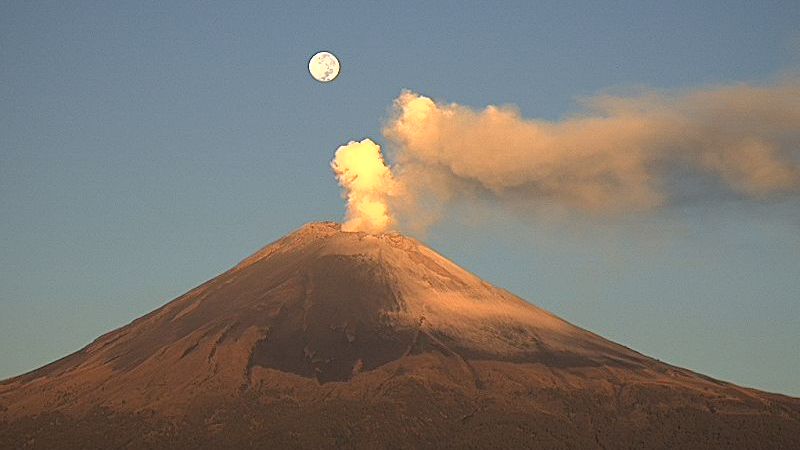
- Status: Yellow, Phase 2.
- Most recent blog post (June 6, 2023)
- National Autonomous University of Mexico (UNAM) article (autotranslated) marking this eruption’s 30th year.
This gigantic stratovolcano, situated between Mexico City to the west and Puebla to the east, in close proximity to over 20 million people, has not had any more flare-ups since 2023, when things got strombolian up there and authorities had to raise the alert one level.
Popo generally has been cooking right along since then, cycling up and down a bit but always staying within the more usual Level 2 guidelines that have characterized its lengthy eruption (thirty years this month and counting).
However, its activity recently got a little more intense and has stayed that way.
Notably, the increase started within minutes — that can happen, and without precursors, at an open-conduit volcano like this.
There’s no indication that anything more than the usual ashfall hassles for its human neighbors is on the way, but given how fast changes can occur here, and out of great respect for its history of plinian eruptions or extensive lava flows from time to time, we should have a post ready for 2024/2025 news from this beloved but dangerous icon of Mexico.
- Webcams de Mexico has live webcams, which are free but not embeddable (Spanish).
- Diegoxx’s Live Cam Popocatepetl YouTube channel (Spanish).
- Current CENAPRED report (Spanish).
- Hazard map (Spanish)
- Washington VAAC page.
- Puebla Civil Protection (X, Spanish).
- Mexico’s Civil Protection page (Spanish).
- GVP page.
Updates
December 23, 2025, 7:30 a.m., Pacific: This is not a major change and the alert status of Yellow, Phase 2, is not affected, but the volcano had a temporary increase in activity —
— and I thought this cool video would also be a good example of the challenges involved in monitoring open-conduit volcanoes. Popo is usually active at a low intensity but it seems to effortlessly move into intense activity without warning now and then (and it does have a history of eruptions up to VEI 6, though not in the scientific era, which means that no precursors for these major events, if any, have been documented).
This current uptick isn’t as intense as the spectacular activity was in 2023, when they did go to Yellow, Phase 3 for a while. It is a reminder, though, that 31 years — from December 21, 1994 — are not even a blink of time to volcanoes, and yet this is a span of time long enough for people to get used to the typical lower level of activity.
Don’t go up into the exclusion zone, no matter how placid the volcano seems. No one can see what is actually happening inside that conduit any more than they can see what’s happening inside a pressure cooker that is about to explode.
December 12, 2025, 3:13 p.m., Pacific: Per the Global Volcanism Program:
Most Recent Weekly Report: 3 December-9 December 2025
The Centro Nacional de Prevención de Desastres (CENAPRED) reported that eruptive activity continued at Popocatépetl during 2-9 December. The seismic network recorded 3-70 long-period events per day, accompanied by steam-and-gas emissions with occasional minor ash content that drifted in various directions. In addition, the seismic network recorded 96 minutes of low-amplitude tremor during 7-8 December and 201 minutes of low-amplitude tremor consisting of 78 minutes of high-frequency tremor and 123 minutes of harmonic tremor during 8-9 December. According to the Washington Volcanic Ash Advisory Center (VAAC) ash plumes visible in webcam and satellite images on 3, 5, 7, and 9 December rose 5.6-6.1 km (18,500-20,000 ft) a.s.l. (about 400 m above the crater rim) and drifted in multiple directions. The Alert Level remained at Yellow, Phase Two (the middle level on a three-color scale) and the public was warned to stay 12 km away from the crater.
Popo has been erupting since December 1994.
Featured image: Webcams de México Tianguismanalco screenshot.

