
Sajedul Islam Alif/Shutterstock
Cosmopolitan, with human-like pupils, and, depending on the species, capable of either a roar OR a purr.
Panthera — the big-cat group — is full of surprises!
82. Big cats today are native to every continent except Antarctica and Australia.
The origins of Family Felidae aren’t fully understood, but cats definitely evolved in the Northern Hemisphere, starting in the late Oligocene to early Miocene, almost thirty million years after the nonavian dinosaurs (and other animals and plants) had died off. (Werdelin et al.)

People call the Miocene “the start of today’s world.” It was that. These Miocene continents, for example, look fairly familiar but there are important differences from today’s arrangement. And cats can’t swim very far. (Image: Wikipedia, CC BY-SA 4.0)
It had to have happened up north.
Cats, their ancestors, and other placental mammals could not reach Australia and South America, which were surrounded by water back then and full of marsupial mammals like wombats and opossums, respectively.
Fossils suggest that marsupials also had inhabited Antarctica, long ago when that continent was ice-free.
Today we associate many big cats with Africa. This continent certainly has played a role in the development of both cats and sabercats, although I’ve read differing views on whether the ancestors of today’s iconic African cats evolved there or whether they walked in when a land bridge opened between Africa and Eurasia about 19 million years ago.
Eurasia and North America occasionally had bridges, too — across what’s now the Bering Strait and possibly also a Greenland-Iceland-Scotland route — when sea level dropped and the climate favored ice-free conditions at those latitudes for at least a few months each year.
This allowed migration of various species and the occurrence of all sorts of interesting evolution as geological epochs passed.
Then, just a few million years ago, plate tectonics hooked up North and South America, leading to a feline (and sabercat) invasion southward, but Australia remained dog- and cat-free right up until humans brought in their domesticated companions.
So which big cats are native to which continents today?
JAGUARS (Panthera onca): Americas
The only big cat native to the Americas ranges from southern Arizona down through Mexico and Central America into South America as far as northern Argentina, including the Amazon Basin.
Interestingly, dirk-toothed Smilodon also was a native here, while the other ice-age sabercat, scimitar-toothed Homotherium, had a surprisingly broad range not only across Eurasia and America but also north-south from equatorial regions up almost to the Arctic Circle.
Getting back to living cats, today’s other Panthera species are in the Old World, but not always where you might expect —
LIONS (Panthera leo): Africa and India
Look for Leo in sub-Saharan Africa, of course, but also in one small part of northwestern India: Gir National Park and Wildlife Sanctuary.
Today’s pride lands include more than Serengeti-style wooded grasslands and plains. Lions like fairly open country but they can find this in other environments, too — for example, moist and dry forest (Gir Forest is dry), scrublands, desert regions like the Kalahari, and even on a Namibian beach!
LEOPARDS (Panthera pardus): Africa, Asia
This big cat owns the record for widest range, living not only in Africa but also through much of the Middle East, across southern Asia, north through China and up into the Russian Far East, as well as southeastward to the Indonesian island of Java.
As you might guess from that broad distribution, leopards are generalists and can live in most forests, wetlands, arid places, coastal scrub, high mountain slopes, deserts, and even swamps — anywhere they can find prey (including small to large mammals mostly, but pretty much any other animal they come across while hungry).
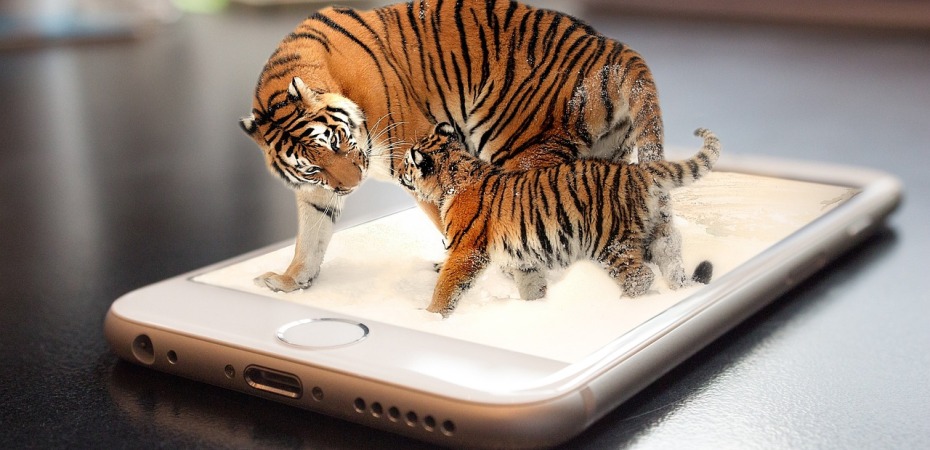
TIGERS (Panthera tigris): Asia.
Although they apparently never made it to Africa, tigers once prowled through Asia from Turkey and the Caspian Sea east through India and Southeast Asia to Manchuria and Siberia in the north and the Indonesian archipelago in the south.
They were hunted almost to extinction.
Now only small tiger populations exist, mostly on preserves, in Bangladesh, Bhutan, China, India, Indonesia, Malaysia, Myanmar, Nepal, Russia, and Thailand.
This is another feline generalist, though not quite as versatile as the leopard. Tigers thrive in habitats as different as tropical mangroves and Siberian oak forests!
All they need are dense cover, water, and a reliable supply of large plant-eating prey animals.
Western Thailand.
SNOW LEOPARD (Panthera uncia): Central Asia
There are no surprises about this big cat’s ‘hood — it apparently always has lived in the high country of central Asia and still does today.
According to Sunquist and Sunquist, “…snow leopards are really rock specialists, and they are usually found in rugged areas where the terrain is broken by cliffs, ridges, and ravines.”
CLOUDED LEOPARDS (Neofelis nebulosa): Asia
These unusual-looking “little big cats” — possibly bridging the gap between Panthera and other cats — are native to China, Southeast Asia, Taiwan, Sumatra, and Borneo.
They are tree specialists, most often found in uncut tropical forest, but the Cat Specialist Group notes that clouded leopards also have been seen in secondary and logged stands, and even in grassland and scrub.
This agile tree cat does hunt ground animals like boar and deer, as well as monkeys, squirrels, and other animals up in the forest canopy.
Footage of them in the wild is rare; it’s good to see a family!
83. No one knows why big cats have round pupils.
There is something almost human-like in the snow leopard’s round head, flattish face, and friendly looking eyes.
It takes a little while to sink in that those eyes aren’t like Fluffy’s — snow leopards and all other big cats except the clouded leopard have rounded pupils just like us.

“I understand; sit down, have some tea, and tell me all about it. Also, if you could just slather yourself with this butter and apply a little salt and pepper…” (Image: Ondrej Chvatal/Shutterstock)
For that matter, so do cats in a completely different lineage (mountain lions, cheetahs, and jaguarundis). The totally unrelated little Pallas cat is also a member of this round-pupils group.
Why not the usual vertical-slit pupil that sometimes makes Fluffy look quite alien?
No one knows for sure.
An answer might be possible if we could ask a lion or tiger what it saw and then compare that to what Fluffy told us.
But today the lion whispering and cat talk is strictly one way. Leo, Tigger, and Fluffy won’t ever tell us their secret.
Instead, biologists — who are even more curious about this than we are — turn to anatomical studies, computer simulations, and phylogenetic analyses.
Banks et al., for instance, studied the matter in several different animals besides cats (including sheep, which have horizontal pupils).
They found that ambush predators are likely to have vertical-slit pupils because these allow them to gauge distances, while prey are more likely to have horizontal-slit pupils for panoramic predator detection and better forward movement.
That’s good as far as it goes, but it doesn’t really help us with our question about the big cats.
Werdelin et al. note that there is no consensus on the matter.
They suggest, very tentatively, that it might have something to do with habitat, since eye pupils let in light and round ones seem to occur in cats that live in open environments, such as lions, or in a wide variety of environments, say, tigers and leopards.
If you are young and thinking about a career in science, this might make a good research topic — plus enough money to retire on in your twenties or thirties, if you can get the cats to speak up and tell us what’s going on!
84. Big cats are not necessarily roaring cats.
Molecular biology is what identifies a cat as Panthera, a member of the group that we call “big cats.”
Those test results show that these clouded leopards are very closely related to Panthera, yet they do not roar:
Neither does this genetically identified member of Panthera (which doesn’t purr, either, although the snow leopard is obviously very happy):
Until such studies came along, members of Family Felidae long were considered as either “roaring cats” (the big cats) or “purring cats” (all the rest).
This was based on the arrangement of certain bones in their throat that were thought to vibrate and produce the roar.
But then biologists did more in-depth anatomical work and discovered that it wasn’t those bones vibrating at all.
It was the big cat’s vocal chords – technically, “vocal folds” — that vibrated and produced the roar.
These vocal structures are shaped differently in some big cats and are made out of somewhat different tissue. That plus the big animal’s long larynx work together to produce a roar.
Then acousticians who had been using sonograms in an attempt to define “roar” spoke up.
Of the big cats that roar, they found that only lions produce the full call series, one version of which goes like this:
These experts reported that jaguars and leopards produce part of the series —
— while tigers only use the main call and grunt.
It makes sense that only the larger pantherines roar, since their larger internal ear structures are better able to pick up low-frequency sounds at a distance.
Why would snow leopards need to roar?
Up in the high country, it would echo off rocky cliffs, confusing every listener.
And in the clouded leopard’s arboreal realm, vegetation would muffle sound, preventing a roar from traveling very far.
The closer we look at any cat, the more we realize how unique each species is and how well adapted it is to its environment.
If you are enjoying the “Fangly Facts” series, tips are welcome via the secure Stripe donation link. I won’t be saving your email for marketing or other spam, so here’s a big thank you in advance!
Sources include:
Banks, M. S.: Sprague, W. W.; Schmoll, J.; Parnell, J. A.; and Love, G. D. 2015. Why do animal eyes have pupils of different shapes?. Science advances, 1(7): e1500391.
Britannica.com . 2023. Australia. https://www.britannica.com/place/Australia Last accessed December 11, 2023.
Cat Specialist Group. 2023. Clouded leopard. http://www.catsg.org/index.php?id=116 All last accessed December 11, 2023.
___. 2023. Jaguar. http://www.catsg.org/index.php?id=95
___. 2023. Lion (African). http://www.catsg.org/index.php?id=108
___. 2023. Lion (Asiatic). http://www.catsg.org/index.php?id=113
___. 2023. Leopard. http://www.catsg.org/index.php?id=110
___. 2023. Snow leopard. http://www.catsg.org/index.php?id=100
___. 2023. Tiger. http://www.catsg.org/index.php?id=124
Johnson, W. E.; Eizirik, E.; Pecon-Slattery, J.; Murphy, W. J.; and others. 2006. The Late Miocene Radiation of Modern Felidae: A Genetic Assessment. Science, 311:73-77.
Kitchener, A. C.; Van Valkenburgh, B.; and Yamaguchi, N. 2010. Felid form and function, in Biology and Conservation of Wild Felids, ed. Macdonald, D. W., and Loveridge, A. J., 83-106. Oxford: Oxford University Press.
Kitchener, A. C.; Breitenmoser-Würsten, C.; Eizirik, E.; Gentry, A.; and others. 2017. A revised taxonomy of the Felidae: The final report of the Cat Classification Task Force of the IUCN Cat Specialist Group. https://repository.si.edu/bitstream/handle/10088/32616/A_revised_Felidae_Taxonomy_CatNews.pdf
Macdonald, D. W.; Loveridge, A. J.; and Nowell, K. 2010. Dramatis personae: An introduction to the wild felids, in Biology and Conservation of Wild Felids, eds. Macdonald, D. W., and Loveridge, A. J., 3-58. Oxford: Oxford University Press.
Science Alert. 2023. Important News: Scientists think they’ve finally figured out how cats purr. https://www.sciencealert.com/important-news-scientists-think-theyve-finally-figured-out-how-cats-purr
Sunquist, M. and Sunquist, F. 2002. Wild Cats of the World. Chicago and London: University of Chicago Press. Retrieved from https://play.google.com/store/books/details?id=IF8nDwAAQBAJ
University of Utah. 2023. Born to roar. https://archive.unews.utah.edu/news_releases/born-to-roar/
Werdelin, L.; Yamaguchi, N.; Johnson, W. E.; and O’Brien, S. J. 2010. Phylogeny and evolution of cats (Felidae), in Biology and Conservation of Wild Felids, eds. Macdonald, D. W., and Loveridge, A. J., 59-82. Oxford: Oxford University Press.
Wikipedia. 2023. Australia (continent). https://en.wikipedia.org/wiki/Australia_(continent) Last accessed December 11, 2023.
 Flight To Wonder