These are some very fangly facts, indeed!
Curious?
If someone says “saber-toothed tiger,” you have a general idea of what they mean: a large, muscular cat, not necessarily striped, with long curved fangs extending below the jawline.
That’s good as far as it goes, except for the “tiger” part (which these Kansas paleontologists explain).
But it doesn’t go very far.
67. Misconception: Smilodon was THE saber-toothed cat.
Reality: Paleontologists are identifying more and more groups, going back all the way to the Miocene epoch as they try to understand how saber-toothed cats evolved and why they eventually went extinct.
There used to be many types of Machairodontinae (the formal name for cats with saberteeth) — here is just one of the well-cited research papers on them (jargon alert) — but very few made it past the Miocene toll bridge.
By the time polar ice caps were periodically expanding into temperate latitudes and then melting back again during the Pleistocene, there were only two basic kinds of sabercat around.
Yes, two.
Smilodon and Homotherium
The Pleistocene fossil record shows that Smilodon — Greek for “knife tooth” — prowled through the Americas from Patagonia all the way up into southern Canada or even farther.
We laypeople recognize Smilodon, its bony face, framed by long, knife-like fangs, atop the cat’s imposing skeleton in museum displays like this one at California’s La Brea Tar Pits.

However, a completely different Ice Age sabercat existed in both the New World AND the Old:
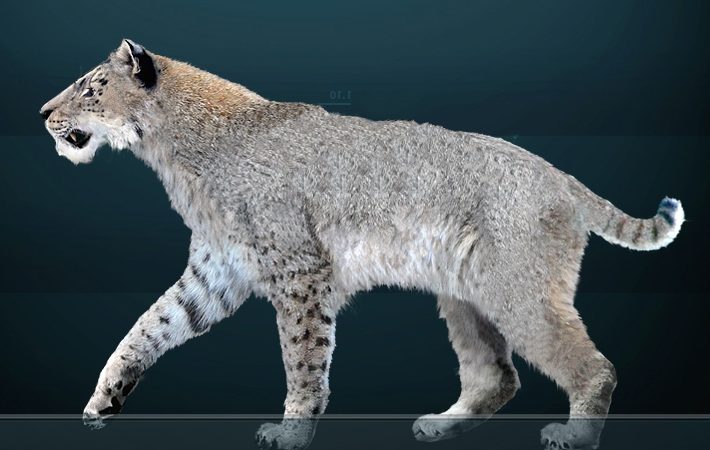
Homotherium roamed the Old World as well as the New.
(Image: Sergiodlarosa via Wikimedia, CC BY-SA 3.0)
Scientists are aware of how clunky scientific names sound to laypeople, so during the twentieth century they tried out some ordinary sounding names for each sabercat:
- Smilodon became “the dirk-toothed cat” because of those long, blade-like upper canines.
- Homotherium had somewhat smaller, broader saberteeth and was rebranded as “the scimitar-toothed cat.”
While no one knows for sure how sabercats used their fangs, the dirk- and scimitar-teeth differences probably are a reflection of each sabercat’s unique hunting style.
Smilodon most likely was an ambush hunter, a method that would require cover; however, even with that powerhouse build Smilodon could run short distances before wrestling its prey to the ground.
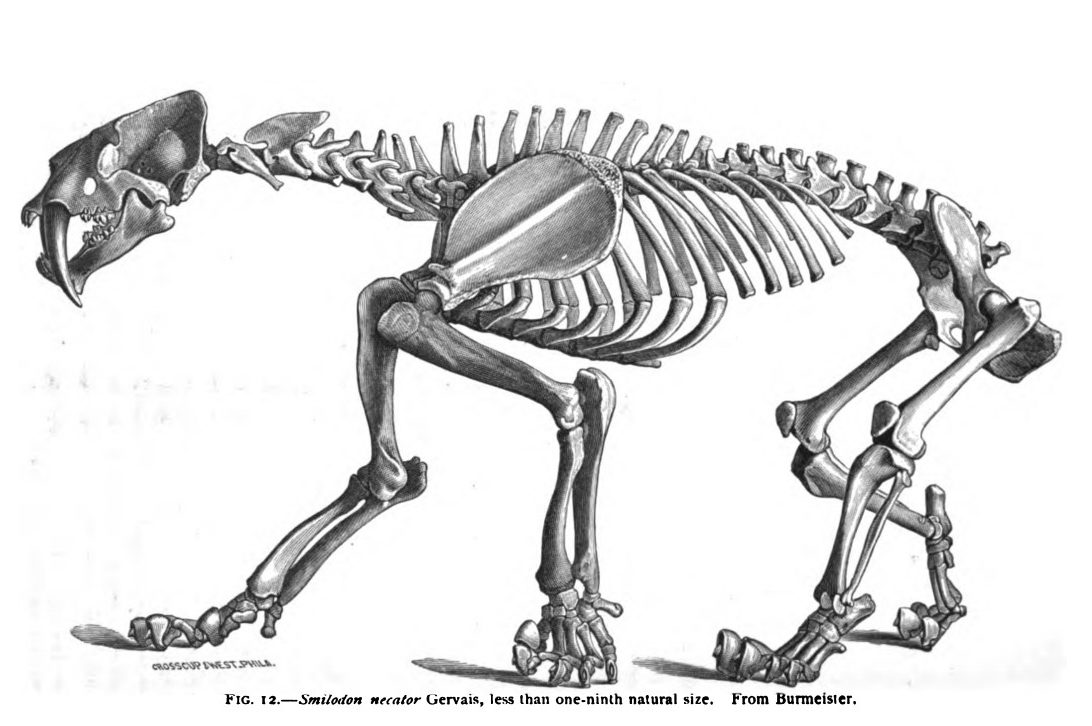
Even the US National Football League might consider “Smilodon populator’s” bulk a bit much! (Image: E. D. Cope, public domain.)
Homotherium had the typical sabertooth well-developed neck and front end musculature, but overall it looked more like a cross between a big cat and a hyena; its hind limbs were shorter than the front ones, giving this sabercat a sloped back, and its legs were long enough for speedy running.
Hyenas can gallop long distances today, and so it has been suggested that Homotherium, unlike Smilodon, might have been more of a pursuit predator.
It’s only speculation, but carrying the idea further, perhaps Homotherium had social groups of some sort and lived in open spaces, not competing at all with Smilodon in the Americas (Smilodon never made it to Eurasia or Africa).
Xenosmilus
Of course, there is a complication to every picture-perfect story.
In terms of ice-age sabercats, that complication is named Xenosmilus, a Pleistocene cat that was discovered in Florida. It had physical traits of both scimitar- and dirk-toothed cats!
In sum, paleontologists are starting to see just how diverse the sabercats really were.
Smilodon was not alone.
That lovable California state fossil is just the tip of a huge iceberg made up of all the cats with saberteeth that have ever lived — an iceberg that finally ran up against the great ship Extinction some ten to twelve thousand years ago and sank without a trace.
Okay. My metaphors are confused, but when it comes to sabercats Science is learning new details all the time by very, very carefully organizing and studying all the fragments it can find.
We laypeople, though, have a simple question: Are today’s cats and the sabercats related?
Believe it or not, there’s an answer, even though sabercats have been extinct for well over 10,000 years!
68. Misconception: Sabercats were the ancestors of today’s cats.
Reality: DNA testing shows that they were part of Family Felidae, but sabercats belonged to a different subfamily, one that no longer exists.
We do have a little DNA from both Smilodon and Homotherium; the idea of “Pleistocene rewilding” has its supporters, too; but no one is about to go all Jurassic Park on extinct sabercats just yet.
Instead, experts in ancient life are using that precious genetic material and doing other microbiological studies to explore what sabercats might have been like and to establish their ancestral connection to modern cats.
What were they like?
In papers listed at the end of this episode, scientists explain things in detail, but I am going to skip the jargon and simply call their methods “Scientific Magic.”
Experts who understand it, of course, call the results reasonable even when sometimes disagreeing about their interpretation.
In any event, the findings often astonish everyone.
For example, Barnett et al. (2020) use Scientific Magic in “7x nuclear genome and a 38x exome from H. latidens using shotgun and target-capture sequencing” — yawn — to show that Homotherium:
- Might have hunted during the day.
- Had certain genes, associated with cardiopulmonary fitness and strong bones, that back up other proposals (based on fossil evidence) that it was probably a runner, not a pouncer like Smilodon.
- Could have been capable of lion-like coordinated behavior and social interactions, though this is very speculative.
There are some suggestive findings about this sabercat and its habits from other lab techniques, too:
Sabercats and living cats
Most importantly, Barnett et al. confirm what other DNA tests have shown: the sabercat lineage was part of Family Felidae and it diverged long ago from the line that eventually led to modern cats.
Another team, Westbury et al., studied Smilodon’s DNA and report that sabertooths were sort of cousins to living cats rather than ancestors.
They find that:
- The cat family first appeared in the rocky record some 27 to 30 million years ago.
- Around 22 million years ago, ancestral Felinae (the group that includes modern cats) and Machairodontinae (sabercats) split up and padded down separate evolutionary paths.
- Around 11 million years ago, Smilodon and Homotherium evolved, as did the first modern cats (Panthera, the big cats).
The oldest known living cat species today has very long canines but no true sabertooth attributes like unusually small lower canines or an outward arch of massive incisors. The cats, however, are adorable.
Modern cats evolved quite quickly into the species we know and love today, but their fangly cousins didn’t survive the Ice Age’s end for reasons that no one can be sure of.
Maybe they just couldn’t handle the new age? Well —
69. Misconception: Sabercats were losers, doomed to fail.
Reality: Sabercats were the most highly evolved cats ever!
It takes a lot of evolution to change an animal’s original shape as much as sabercats changed the basic cat shape.
This included not only the teeth (and associated skull modifications) but also the body, with sabercats having a whole complex of anatomical characteristics that included, depending on the species, unusually long necks and very powerful chests/shoulders, shorter backs, (oddly enough) stubby tails, and other things.
Sabercats were very highly developed animals!
We don’t yet know why these evolutionary changes took place, but they did work out well down through geologic time, since saberteeth have appeared repeatedly over geologic time.
Since the end of the nonavian dinosaurs, sabertoothed mammals (all extinct) have included at least two placental mammals unrelated to cats, one marsupial, and the barbourofelids — placental mammals that vanished in the Miocene and might have been either cats or a sister group to Family Felidae.
All of these groups were successful for millions of years, too, so renowned paleontologist E. D. Cope was not correct when he wrote in 1880, about the extinction of sabercats (“the Smilodons,” but including other sabertoothed beasts), that: “…the length of these teeth became an inconvenience and a hindrance to their possessors. I think there can be no doubt that the huge canines in the Smilodons must have prevented the biting off of flesh from large pieces, so as to greatly interfere with feeding, and to keep the animals in poor condition…Even when it opens…there would appear to be some risk of the latter’s becoming caught on the point of one or the other canine, and forced to remain open, causing early starvation.”
More discoveries have been made since then; the genetic basis of evolution is now understood: and Paleontology’s view of sabercats today is much different.
While no one is certain how Smilodon and other sabercats used their dental hardware and complex build, the features obviously served them well.
All sabertooths are gone now, leaving us with more questions than answers, but as the geologic record suggests, at some point down the road, another predator will rediscover the advantages of very fangly teeth and a new chapter in the Sabertooth Saga will begin.
And then we’ll have to renegotiate that whole “Do not eat me” thing.
If you are enjoying the “Fangly Facts” series, tips are welcome via the secure Stripe donation link. I won’t be saving your email for marketing or other spam, so here’s a big thank you in advance!
Sources include:
Antón, M. 2014. 2013. Sabertooth. Bloomington: Indiana University Press.
Antón, M.; Salesa, M. J.; Turner, A.; Galobart, Á.; and Pastor, J. F. 2009. Soft tissue reconstruction of Homotherium latidens (Mammalia, Carnivora, Felidae). Implications for the possibility of representations in Palaeolithic art. Geobios, 42(5): 541-551.
Antón, M.; Salesa, M. J.; Galobart, A.; and Tseng, Z. J. 2014. The Plio-Pleistocene scimitar-toothed felid genus Homotherium Fabrini, 1890 (Machairodontinae, Homotherini): diversity, palaeogeography and taxonomic implications. Quaternary Science Reviews, 96: 259-268.
Antón, M.; Siliceo, G.; Pastor, J. F.; Morales, J.; Salesa, M. J. 2020. The early evolution of the sabre-toothed felid killing bite: the significance of the cervical morphology of Machairodus aphanistus (Carnivora: Felidae: Machairodontinae). Zoological Journal of the Linnean Society, 188(1): 319-342.
Barnett, R.; Barnes, I.; Phillips, M. J.; Martin, L. D.; and others. 2005. Evolution of the extinct Sabretooths and the American cheetah-like cat. Current Biology, 15(15): R589-R590.
Barnett, R.; Westbury, M. V.; Sandoval-Velasco, M.; Vieira, F. G.; and others. 2020. Genomic adaptations and evolutionary history of the extinct scimitar-toothed cat, Homotherium latidens. Current Biology, 30(24): 5018-5025.
Cope, E. D. 1880. On the extinct cats of America. The American Naturalist, 14(12): 833-858. https://www.journals.uchicago.edu/doi/pdf/10.1086/272672
Dictionary.com. 2023. Smilodon. https://www.dictionary.com/browse/smilodon
Figueirido, B.; Lautenschlager, S.; Pérez-Ramos, A.; and Van Valkenburgh, B. 2018. Distinct predatory behaviors in scimitar-and dirk-toothed sabertooth cats. Current Biology, 28(20): 3260-3266.
Haaramo, M. 2019. Felidae: Machairodontinae — saber-toothed cats. https://www.mv.helsinki.fi/home/mhaaramo/metazoa/deuterostoma/chordata/synapsida/eutheria/carnivora/aeluroidea/machairodontinae.html Last accessed September 12, 2020.
Janczewski, D. N.; Yuhki, N.; Gilbert, D. A.; Jefferson, G. T.; and O’Brien, S. J. 1992. Molecular phylogenetic inference from saber-toothed cat fossils of Rancho La Brea. Proceedings of the National Academy of Sciences, 89(20): 9769-9773.
Jiangzuo, Q.; Werdelin, L; and Sun, Y. 2022. A dwarf sabertooth cat (Felidae: Machairodontinae) from Shanxi, China, and the phylogeny of the sabertooth tribe Machairodontini. Quaternary Science Reviews, 284: 107517.
Jiangzuo, Q.; Werdelin, L.; Sanisidro, O.; Yang, R.; and others. 2023. Origin of adaptations to open environments and social behaviour in sabretoothed cats from the northeastern border of the Tibetan Plateau. Proceedings of the Royal Society B, 290(1997): 20230019.
Lautenschlager, S.; Figueirido, B.; Cashmore, D. D.; Bendel, E. M.; and Stubbs, T. L. 2020. Morphological convergence obscures functional diversity in sabre-toothed carnivores. Proceedings of the Royal Society B, 287(1935): 20201818.
Lindsey, E. L., and Seymour, K. L. 2015. “Tar Pits” of the western Neotropics: Paleoecology, taphonomy, and mammalian biogeography. Natural History Museum of Los Angeles County Science Series, 42: 111-123.
Martin, L. D. 1980. Paper 287: Functional Morphology and the Evolution of Cats. Transactions of the Nebraska Academy of Sciences and Affiliated Societies. VIII:141154
Martin, L. D.; Babiarz, J. P.; Naples, V. L.; and Hearst, J. 2000. Three ways to be a saber-toothed cat. Naturwissenschaften, 87(1): 41-44.
Meachen-Samuels, J. A. 2012. Morphological convergence of the prey-killing arsenal of sabertooth predators. Paleobiology, 38(1): 1-14.
Prothero, D. R. 2006. After the Dinosaurs: The Age of Mammals. Bloomington and Indianapolis : Indiana University Press.
Slater, G. J., and Van Valkenburgh, B. 2008. Long in the tooth: evolution of sabertooth cat cranial shape. Paleobiology, 34(3): 403-419.
Turner, A., and M. Antón. 1997. The Big Cats and Their Fossil Relatives: An Illustrated Guide to Their Evolution and Natural History. New York: Columbia University Press.
Werdelin, L., and Turner, A. 1996. Turnover in the guild of larger carnivores in Eurasia across the Miocene-Pliocene boundary. Acta zoologica cracoviensia. 39(1):585-592.
Werdelin, L.; Yamaguchi, N.; Johnson, W. E.; and O’Brien, S. J. 2010. Phylogeny and evolution of cats (Felidae), in Biology and Conservation of Wild Felids, eds. Macdonald, D. W., and Loveridge, A. J., 59-82. Oxford: Oxford University Press.
Westbury, M. V.; Barnett, R.; Sandoval-Velasco, M.; Gowe, G.; and others. 2021. A genomic exploration of the early evolution of extant cats and their sabre-toothed relatives [version 2; peer review: 2 approved]. Open Research Europe, 1, 25.
Wroe, S.; Lowry, M. B.; and Anton, M. 2008. How to build a mammalian super-predator. Zoology, 111(3): 196-203.
 Flight To Wonder