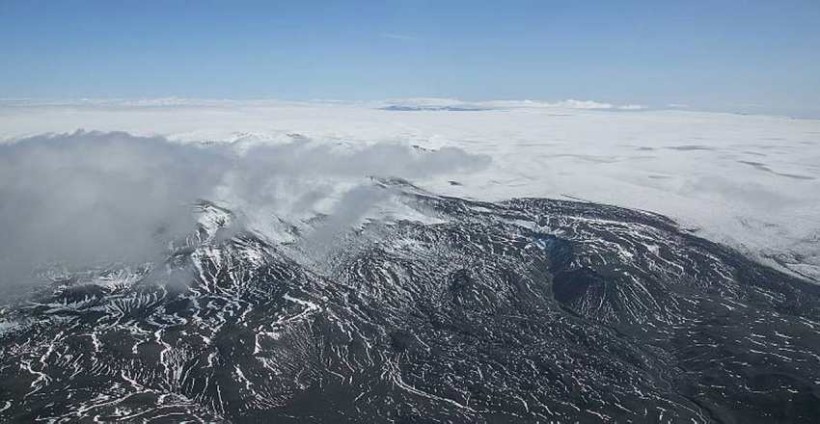
That image is from south central Iceland and trust me — rather, trust the official Catalogue of Icelandic Volcanoes (quoted below) — there are two volcanoes in that massive mixture of basalt rock and glacier. The big one, Bardarbunga, is waking up again after its last eruption ended nine years ago:
Both Bárðarbunga and Hamarinn central volcanoes have extensive ice cover. The 2000 m high Bárðarbunga central volcano lies at the NW edge of the ice cap, with only its NW slopes ice free. It is dominated by a 65 km2 and up to 700 m deep ice-filled caldera. Bedrock rises to 1850 m in the northwest caldera rim and is lowest in a narrow gap on the east rim where minimum elevation is 1350 m…
…
…Bárðarbunga is monitored by the Icelandic Meteorological Office with seismic and GPS networks. The present threshold for earthquake detection is about M 1.
Over the last seven years seismic activity has been gradually increasing in Bárðarbunga and the northern part of the fissure swarm. This activity dropped again after the Grímsvötn eruption in May 2011, but it soon began to increase gradually again. A large fissure eruption on the ice-free northern part of the fissure swarm (Holuhraun area) took place —
It was this one, four years after the explosiveness of a subglacial eruption at another volcano (Eyjafjallajokull) disrupted North Atlantic air traffic in 2010.
— between August 2014 and February 2015. It was accompanied by a significant collapse of the Bárðarbunga caldera. Seismicity is still somewhat elevated after the eruption.
That 2014-2015 eruption was effusive, not explosive, because magma stayed below the surface while under the glacier:
That was an exceptionally long dike and it got quite close to Askja but did not reach it before surfacing.
The ice-covered parts of Bardarbunga do sometimes erupt, and that is explosive.
There’s also an active fissure system — Veidivotn — extending to the southwest of this glacier.
As you can probably guess, Bardarbunga is a rather complex volcanic system and different from the volcanic fissural systems that we’ve been following on the Reykjanes Peninsula.
I can’t get into it deeply right now — the Catalogue has lots of information on Bardarbunga and is remarkably clear and jargon-free.
Too, here are some more links, if you like:
- The Icelandic Met Office (IMO) Bardarbunga-Holuhraun 2014-2015 overview page.
This article explores, among other things, what effects this, Eyjafjallajokull (2010), and Grimsvotn (2011) had on Icelandic volcano monitoring.
- IMO’s Bardarbunga information and monitoring page.
- Wikipedia: Bardarbunga and its beautiful associate Trolladyngja shield volcano:
And a BIG serving of lagniappe!
Featured image: Sparkle Motion, CC BY 2.0.

