
Catalogue of Icelandic Volcanoes pages for:
- Askja
- Bardarbunga
- Eyjafjallajokull
- Grimsvotn
- Hekla is not restless at time of writing (September 7, 2024) but tends to wake up suddenly and in a plinian-style mood, per Icelandic volcanologists.
- Hofsjokull
- Katla
- Ljosufjoll
The focus in this post is on the “big guns” in southern and central Iceland, separately from the Reykjanes Peninsula activity which includes not only the current series of eruptions but also some seismic restlessness in adjacent volcanic systems. If and when volcanologists report magmatic movements in those systems, I will include them here in each volcano’s individual post.
Updates
January 28, 2025, 8:18 p.m., Pacific: No overall changes in Ljosufjoll status, but some blog updates.
January 9, 2025, 5:05 a.m., Pacific: Per IMO today:
In light of increased activity and indications of magma intrusion at depth, the Icelandic Meteorological Office has raised the monitoring level in Ljósufjöll. A new monitoring plan for the area is being developed.
With magma still very deep and with no sign of ground deformation, they haven’t issued a VONA yet.
December 29, 2024, 5:38 p.m., Pacific: The Southern Volcanoes group posted an earthquake summary, too.
December 27, 2024, 5:02 a m., Pacific: The University of Iceland’s Southern Volcanoes group has summarized 2024 jokulhlaups (glacial outburst floods) in this Facebook post.
December 20, 2024, 9:50 a m., Pacific: Today, the IMO did an update (autotranslated) on unrest in the Ljosufjoll volcanic system, a little ways north of the Reykjanes Peninsula.
Nothing eruptive appears imminent, they report, but magma is probably moving around at depth. If and when an eruption comes, it likely will be small — see the Catalog of Icelandic Volcanoes link above for details.
It is worth noting that, back in the ice age, Ljosufjoll, while not one of the “big guns,” did have some rhyolite eruptions — explosive because of magma composition rather than the typical phreatic explosions we associate with most Icelandic volcanoes in modern times, and therefore potentially somewhat higher on the VEI scale than those magma-water contact blasts, which I believe are all classified as VEI 1 (though something like Eyjafjallajokull’s subglacial eruption in 2010 would be higher).
Several Icelandic volcanoes have produced rhyolite — a very sticky, high-silica melt that tends to hold in gases until it blows up — and apparently no one knows for sure why. It requires a silica source, i.e., continental crust, which is not found on mid-ocean ridges or hotspots.
Rhyolite is usually found in settings like subduction zones and continental rifting.
Well, the boffins see that Ljosufjoll has only produced runny red lava eruptions since the last ice age ended, and so they note that another small lava flow is the most likely outcome here, whenever the system gets around to it in months, years, decades, or more.
December 4, 2024, 12:36 p.m., Pacific: That Katla jokulhlaup back in September was not a major issue, and currently Katla is not in the online news that I routinely check.
Neither is Bardarbunga, but it has been swarming now and then and Jon Frimann did a post about it that makes a lot of sense to this layperson.
However, on the current vafri.is graphic is a swarm of somewhat stronger quakes — though still not very strong compared to the M5-range temblor a couple months ago:
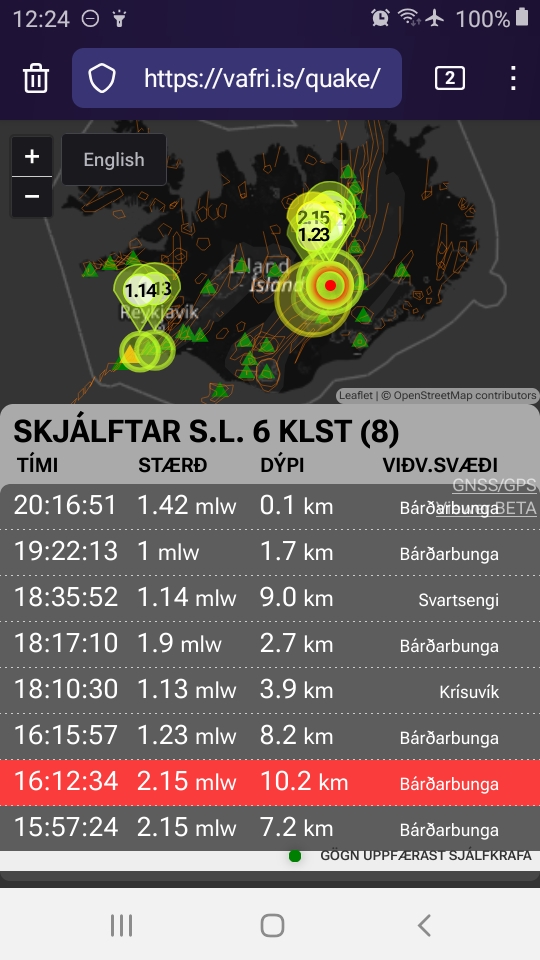
— and I guess we should keep an eye out for the possibility that Bardarbunga might not wait decades for its next round of activity.
Note that its alert level is not elevated and, as mentioned, even the media is not focusing on it now.
It’s just interesting, plus I have gained a lot of respect for Icelandic volcanoes since the November 10, 2023, plate boundary movement on Reykjanes Peninsula got this layperson watching Iceland’s geology more closely.
September 28, 2024, 11:37 p.m., Pacific: IMO just reported another Skalm River jokulhaup is in progress.
September 10, 2024, 6:45 a.m., Pacific: Today’s IMO update via Google Translate (this is definitely from Katla, so I’ll copy this to that post, too):
Jökulhlaup in Skálm in winter
The second smaller event following the glacier run on July 27
10.9.2024The glacier run that has been going on in Skálm for the past 24 hours is in progress. Electrical conductivity and water level in the river were increasing from Saturday, September 7th until yesterday when measurements started to decrease again. Increased electrical conductivity is a sign of geothermal water in the river. The geothermal water comes from Mýrdalsjökull. Since yesterday afternoon, the electrical conductivity has returned to normal values, and this run is therefore in decline.
At the end of July this year, there was a significant glacier run in Skálm and the river flooded over highway 1 in a section. During that run, a considerable amount of ice turbulence was measured on seismometers around Mýrdalsjökull, but similar ice turbulence has not been detected in recent days. This is the second smaller event to follow that run, but another small run occurred in the river around August 10th.
Náttúruvárvakt VÍ continues to monitor the run, but directs tourists in the area to be careful at the source of the river and near the riverbed, as there could still be gas pollution in the area.
September 9, 2024, 3:34 p.m., Pacific: There is a small jokulhlaup reported (autotranslated) again on the Skalm River.
They don’t mention Katla, which was the source of July’s strong outburst flood. Most likely Katla is at it again, but Eyjafjallajokull (which is much smaller) sits more or less on Katla’s “shoulder,” and though it has its own glacier and presumably its own jokulhlaup channels — they were bad in 2010! — there was that recent swarm that appeared on vafri.is to be at Eyjaf, so let’s wait for more information about the flood’s source.
September 7, 1:36 p.m., Pacific: There is a small swarm ongoing at Eyjafjallajokull — no alerts are up, not even any comment about it found on a quick online media check.
It’s just restlessness, but I will include Eyjaf here and also, at the top of the page, list links to the Catalogue of Icelandic Volcanoes page for all the volcanoes mentioned here.
September 4, 9:30 a.m., Pacific: The Icelandic Met Office (IMO) did a thorough update on Askja yesterday, and I have updated the Askja post.
In other news, no more floods from Katla yet, but it continues to have a moderate quake or two every now and then.
Bardarbunga just had another 5-pointer — two, so far this year — but IMO takes it in stride as part of this system’s wakeup, per news reports.
Grimsvotn and Hofsjokull shake a bit but no alerts have been raised.
Hekla is not restive, but it tends to wake up quickly and powerfully, per volcanologists, so a link to its Catalogue of Icelandic Volcanoes page is a good idea.
August 7, 2024, 1:06 p.m., Pacific: Well, I posted this in May and never returned to it until today, when the need for an update became obvious — not an extensive one, though.
The main news is that Katla jokulhlaup in July, which briefly took out part of the Ring Road. See the Katla post, too, which is still pinned. There are still questions about Katla’s activity and this volcano is being watched very closely now.
In a news story that, unfortunately, I can’t find again, Armann Hoskuldsson was quoted recently as speculating that either Katla or Askja will eventually erupt next. It’s just his opinion, but interesting. Will keep an eye out for that link.
In June, Pall Einarsson brought everyone up to date on “lazy” but potentially dangerous Hofsjokull, in central Iceland, which is rumbling.
Grimsvotn, Bardarbunga, and Askja rumble, too, and last week I noticed that Katla’s little friend, Eyjafjallajokull, shook a bit, too.
However, it all is low-level activity, and as far as I know, not a notable change anywhere from baseline except at Katla, which appears to be more of a puzzle than an eruption event just now.
We’ll see how things go.
Original post:
May 27, 2024, 8:47 a.m., Pacific: As you can see from this screenshot —
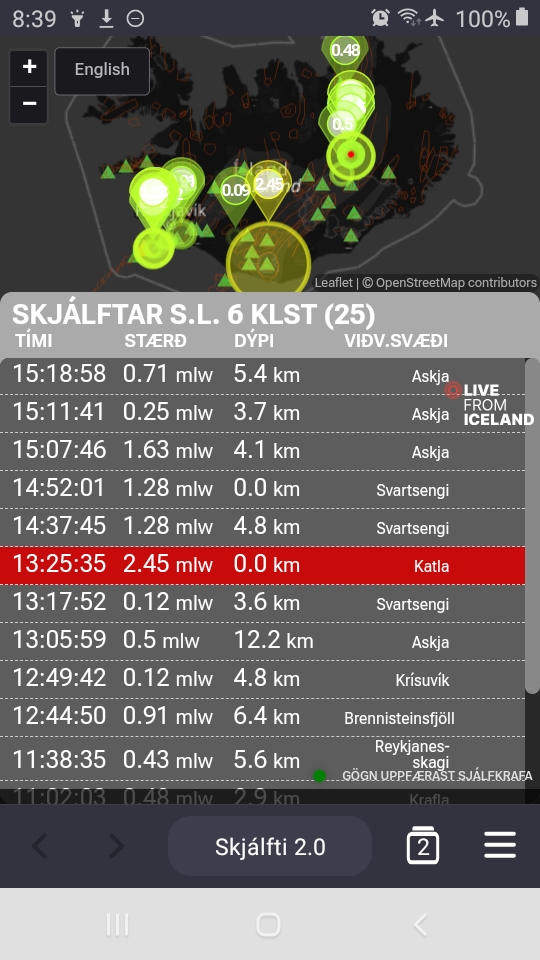
— both Askja and Katla are heard from this morning.
The IMO has also noted signs that Bardarbunga might be waking up for the first time since 2015, and of course, there is Grimsvotn to keep an eye on.
Alert levels have not been raised at any of these volcanoes, and to save space here, I’m going to include news of all Icelandic volcanoes except those Reykjanes systems here, with a dedicated pinned post only when the volcano’s status is changed to Aviation Code Orange or Red.
Featured image: GRID-Arendal, CC BY-NC-SA 2.0.
 Flight To Wonder