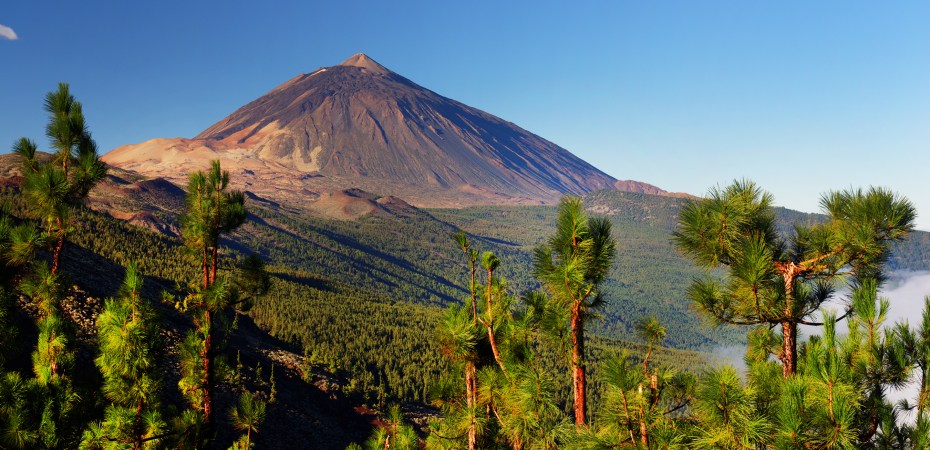
Broad-based Teide, on Tenerife in the Canary Islands, towers more than 12,200 feet above the subtropical Atlantic Ocean and would be a perfect cone, in this image by Mikadun/Shutterstock, if not for that slight bump in its outline near the summit.
Add in another 10,000-plus feet of volcanic rock hidden beneath the waves, and Teide becomes the third tallest active fire mountain on Earth (after Mauna Kea and the Decade Volcano Mauna Loa in Hawaii)! (NASA)
However, height wasn’t one of the Decade/European Laboratory Volcano criteria.
Reduction of risk and loss of life was the main focus. (Potter et al.)
Volcanic risk in the Canary Islands
It is true that scientists would have wanted to study Canary Island volcanoes even without the Decade Volcano program.
Like Mount Etna, these oceanic volcanic structures, just off the northwest coast of Africa, are difficult to explain.
There are issues with every hypothesis that has been offered as a reason for their existence. Even the most popular idea — that the Canaries formed over a Hawaiian-style hotspot — is problematical for some experts. (Belay et al.; Viñuela)
But, academic details aside, volcanic hazard is high throughout the Canary Islands, and at the start of the International Decade, this called for some attention.
Per PEVOLCA (we’ll see what that is in the next section), “These active volcanoes have been causing crises for more than half a century.”
Space is limited on the islands, and more than two million people live here; in addition, millions of tourists visit the Canaries each year.
A volcano emergency could have important consequences for Canarians, their property, and the environment. (We saw some of those consequences in 2021, when Cumbre Vieja, on the island of La Palma, erupted.)
And then there is that landmark volcano, Teide: a tourist magnet, surrounded by about a million year-round neighbors on the beautiful island of Tenerife.
A typical Canary Island eruption has lava flows and fountaining (Carracedo et al., 2022), but in addition to that Teide sometimes has some explosive eruptions, most recently the VEI 4 Montaña Blanca event around 80 BC. (Dominguez Cerdeña et al.; GVP)
But that’s not the only concern at this Decade Volcano.
When seen from space, Teide is dwarfed by its setting — a 6 x 10-mile-wide hole in Tenerife called Las Cañadas Caldera.
Las Cañadas is a very complex structure that geoscientists continue to puzzle over today.
To oversimplify and make a long story short — and for this reason, following only suggestions by Hunt et al. (2013, 2018), although, as the GVP notes, there are other ideas out there — at least four big volcanoes have stood here during the last million years or so. Three of them are no longer around.
They disappeared in a series of huge landslides about 1 million, 600,000, and 170,000 years ago, respectively.
Each collapse was accompanied by a large eruption that covered the island of Tenerife with thick layers of ash.
According to the Hunt et al. papers, as I understand them, Teide and its smaller companion, Pico Viejo (probably a flank vent, per Carracedo et al., 2018), represent Las Cañadas Volcano Number Four.
This insight comes with the help of thirty years of research since the Decade Volcano program began.
But even in the 1990s, volcanologists could look at Las Cañadas and be reminded of the much smaller but still devastating Mount St. Helens landslide/eruption in 1980.
This called for urgent investigation, particularly since Teide sits where the north wall of Las Cañadas used to be. Could the third tallest volcano on our planet suddenly collapse?
Fortunately, a 21st-century perspective suggests that Teide is unlikely to slip away from us any time soon. (Pinto)
However, offshore sonar studies done during the International Decade did find the underwater debris field left by that Las Cañadas Volcano Number Three collapse 170,000 years ago. The rocky wreckage covers a parcel of seafloor up to 12 miles wide and 65 miles long. (Carracedo et al., 2007; Paris et al.; Teide Park Guide)
Whatever happened here was a big event!
There also is evidence of tsunamis, although — contrary to disaster lore — the debris avalanche apparently played out as a series of large rock blocks slipping down over several days, not all at once (which would have caused a megatsunami). Still, parts of Tenerife were flooded when Volcano Number Three fell down. (Hunt et al., 2013, 2018)
Earth scientists are still trying to work out the details of Las Cañadas Caldera’s history, in order to reach a consensus that will help them better understand just what to expect from Teide over the long term.
As for its explosive eruptions, experts continue to keep a close watch on the huge volcano, collecting geophysical and chemical data to learn more about what goes on inside and underneath Teide and Tenerife — the mountain and island are often described as a single volcanic unit — and trying to identify signals that might give them the earliest possible warning of an impending eruption. (Pinto)
What would they do if an eruption was on the way?
They have a plan: PEVOLCA, an acronym for the Spanish “Volcanic Emergencies Plan for the Canaries.”
This was not the case during the 1990s and 2000s. If Teide or some other Canarian volcano had gone off back then, everyone would have had to improvise, reacting to eruption events instead of anticipating the fire mountain’s next move and getting island residents out of harm’s way ahead of time.
A formal volcano emergency plan was a long time coming, even though legislation requesting one was passed during the International Decade. (Newhall, 1996; Perez; PEVOLCA)
Other accomplishments during the Decade Volcano program, per SVE: “Teide became the site for a Post-Graduate International Course on Volcanology, sponsored by UNESCO, IAVCEI, and other organizations…GIS methods were used to assess and portray hazards and risks.”
As we’ll see in the Mauna Loa chapter, geographic information system (GIS) software can build very helpful volcanic hazard maps, though I think this technique might have been fairly new in the 1990s.
As for the emergency plan PEVOLCA, it had been enshrined in law but practical steps weren’t taken on it until 2004-2005, when Teide — apparently asleep since a rift eruption in 1909 — had an earthquake swarm (luckily, this didn’t escalate into an eruption).
It wasn’t that no one cared. The problem was that, up until then, Canary Island eruptions didn’t happen very often, so everyone’s priorities, until Teide woke up and badly scared them, were the more frequent Canary Island natural hazards, like severe weather, flooding, and wildfires. (Carracedo et al., 2006; PEVOLCA; Solana et al.)
According to Solana et al., government funding for monitoring equipment and trained personnel initially was limited, even while Teide quivered in 2004:
…the only initiative to produce an open and inclusive research group on the islands…had instead to be created as a commercial entity.
I believe this was INVOLCAN, the Volcanological Institute of the Canaries, which developed between 2005 and 2009.
In 2008, the detailed PEVOLCA plan was first proposed, and it was approved in July 2010 — just in time for a submarine eruption off the sparsely populated westernmost Canary Island, El Hierro.
After more than two centuries of quiet in this area, INVOLCAN noted an uptick in earthquakes, starting in July 2011. The activity progressed into a small eruption that began in October and continued into 2012.
It was El Hierro’s first recorded activity; the first eruption in the Canaries for forty years; and the first activation of the emergency plan, which worked fairly well, although some problems did become apparent. (Solana et al.)
These were addressed, and a revised PEVOLCA went into effect in 2018, three years before the next test came: an eruption at Cumbre Vieja on La Palma island.
According to Marti et al., 2022, Tenerife and Cumbre Vieja have been the most active volcanic zones in the Canaries over the last six centuries.
The Cumbre Vieja eruption on La Palma in 2021 was relatively small, in scientific terms, (Carracedo et al., 2022), but it was a major disaster for people because it happened in a heavily populated area that also had valuable agricultural resources.
PEVOLCA proved its worth here. While seismic activity had been observed since 2017, eruption precursors appeared only a week before lava broke through the top of a ridge and fountained high into the air.
Seven days don’t allow much time for a coordinated disaster response and civil defense measures (Carracedo et al., 2022), especially on an island. However, the plan was invoked; scientists, political leaders and Civil Protection personnel followed the guidelines; and ultimately some eight thousand residents were evacuated safely.
While lava flows destroyed their property and wiped out entire towns, the eruption’s direct effects killed no one and there was only one indirect death. (Carracedo et al., 2022)
Now, a year later, they are cleaning up the mess at Cumbre Vieja. PEVOLCA is not in effect at the moment, although Teide shakes a little bit from time to time and other seismic swarms happen nearby.
The gorgeous Canaries are always a happening place, and not just in a tourism sense.
There will be another eruption someday, at Teide or on another island.
Canarians can face it with confidence now. They have a plan, a good one that has stood up well under fire — twice.
Stats
Location:
28.271° N, 16.641° W, in Santa Cruz de Tenerife Province, Canary Islands, Spain. The GVP lists this volcano as “Tenerife” and gives it a Volcano Number of 383030.
Nearby Population:
Per Global Volcanism Program (and not counting tourists):
- Within 5 km (3 miles): 0.
- Within 10 km (6 miles): 156.
- Within 30 km (19 miles): 337,660.
- Within 100 km (62 miles): 766,276.
CURRENT STATUS:
Teide stirred briefly in 2004 (Global Volcanism Program, 2006), but there was no eruption and seismologists report that things are presently quiet (through July 2023).
Biggest recorded event:
It’s difficult for a layperson to be sure, given the geological complexity and amount of research papers on this.
I understand from the reading that Teide’s largest historic explosive eruption happened at a vent on its eastern flank about two thousand years ago, building Montaña Blanca and leaving 3-foot-deep light-colored ignimbrite deposits on the volcano’s flanks.
The site of this ancient VEI 4 catastrophe is very scenic today.
Most recent eruption:
The 1909 basaltic eruption at Teide’s Chinyero vent was Tenerife’s last eruption.
Monitoring:
Spain’s National Geographic Institute (Spanish) monitors all Canary Island volcanoes.
In addition, they just completed a multi-year study (Spanish) at Teide in December 2019.
Finally, Toulouse VAAC keeps an eye on Teide and other Canary Island volcanoes.
Edited, February 21, 2026
Sources:
- Ablay, G. J., and Marti, J. 2000. Stratigraphy, structure a d volcanic evolution of the Pico Teide-Pico Viejo formation, Tenerife, Canary Islands. (Abstract only.) Journal of Volcanology and Geothermal Research, 103(1-4): 175-179, 183-208.
- Ancochea, E.; Huertas, M. J.; Cantagrel, J. M.; Coello, J.; and others. 1999. Evolution of the Cañadas edifice and its implications for the origin of the Cañadas Caldera (Tenerife, Canary Islands). Journal of Volcanology and Geothermal Research, 88(3): 177-199.
- Anguita, F., and Hernán, F. 2000. The Canary Islands origin: a unifying model. (Abstract only) Journal of Volcanology and Geothermal Research, 103(1-4): 1-26.
- Belay, I. G.; Tanaka, R.; Kitagawa, H.; Kobayashi, K.; and Nakamura, E. 2019. Origin of ocean island basalts in the West African passive margin without mantle plume involvement. Nature Communications, 10(1): 3022.
- Brown, S.K.; Jenkins, S.F.; Sparks, R.S.J.; Odbert, H.; and Auker, M. R. 2017. Volcanic fatalities database: analysis of volcanic threat with distance and victim classification. Journal of Applied Volcanology, 6: 15.
- Carracedo, J. C.; Troll, V. R.; Pérez, F. J.; Badiola, E. R.; and others.
- Carracedo, J. C.; Badiola, E. R.; Guillou, H.; Paterne, M.; and others. 2007. Eruptive and structural history of Teide Volcano and rift zones of Tenerife, Canary Islands. Geological Society of America Bulletin, 119(9-10): 1027-1051.
- Carracedo, J. C., and Troll, V. R. 2013. Structural and Geological Elements of Teide Volcanic Complex: Rift Zones and Gravitational Collapses, section 4.5, retrieved from Google Books at https://tinyurl.com/y7r856du
- Carracedo, J. C.; Troll, V. R.; Day, J. M.; Geiger, H.; and others. 2022. The 2021 eruption of the Cumbre Vieja volcanic ridge on la palma, canary islands. Geology Today, 38(3): 94-107.
- Dominguez Cerdeña, I.; del Fresno, C.; and Rivera, L. 2011. New insight on the increasing seismicity during Tenerife’s 2004 volcanic reactivation. Journal of Volcanology and Geothermal Research, 206(1-2): 15-29.
- Garcia, A.: Vila, J.; Ortiz, R.; Macia, R.; and others. 2006. Monitoring the reawakening of Canary Islands’ Teide Volcano: EOS Transactions, American Geophysical Union, v. 87, no. 6, p. 61, 65.
- Global Volcanism Program (GVP). 2006. Report on Tenerife (Spain) (Wunderman, R., ed.). Bulletin of the Global Volcanism Network, 31:2. Smithsonian Institution. https://volcano.si.edu/showreport.cfm?doi=10.5479/si.GVP.BGVN200602-383030.
- Hunt, J. E.; Wynn, R. B.; Talling, P. J.; and Masson, D. G. 2013. Multistage collapse of eight western Canary Island landslides in the last 1.5 Ma: Sedimentological and geochemical evidence from subunits in submarine flow deposits. Geochemistry, Geophysics, Geosystems, 14(7): 2159-2181.
- Hunt, J. E.; Cassidy, M.; and Talling, P. J. 2018. Multi-stage volcanic island flank collapse with coeval explosive caldera-forming eruptions. Nature Scientific Reports, 8:1146.
- National Geographic Institute of Spain (IGN, CNIG). 2020. Project MultiTeide. https://facebook.com/IGNSpain/videos/600870047164204/ Last accessed June 24, 2020.
- Martí, J.; Geyer, A.; Andujar, J.; Teixidó, F.; and Costa, F. 2008. Assessing the potential for future explosive activity from Teide–Pico Viejo stratovolcanoes (Tenerife, Canary Islands). (Abstract only) Journal of Volcanology and Geothermal Research, 178(3): 529-542.
- Martí, J.; Aspinall, W. P.; Sobradelo, R.; Felpeto, A.; and others. 2008a. A long-term volcanic hazard event tree for Teide-Pico Viejo stratovolcanoes (Tenerife, Canary Islands). Journal of Volcanology and Geothermal Research, 178(3): 543-552.
- Martí, J.; Becerril, L.; and Rodríguez, A. 2022. How long-term hazard assessment may help to anticipate volcanic eruptions: The case of La Palma eruption 2021 (Canary Islands). Journal of Volcanology and Geothermal Research, 431: 107669.
- Masson, D. G.; Watts, A. B.; Gee, M. J. R.; Urgeles, R.; and others. 2002. Slope failures on the flanks of the western Canary Islands. Earth-Science Reviews, 57(1-2): 1-35.
- MultiTeide. 2016. New scientific study of the Chinyero eruption (Tenerife). https://web.archive.org/web/20200815141638/http://www.multiteide.es/2016/11/chinyero/ Last accessed June 17, 2020.
- NASA Earth Observatory. 2016. Tenerife, Canary Islands. https://earthobservatory.nasa.gov/images/88659/tenerife-canary-islands Last accessed December 11, 2020.
- Newhall, C. 1996. IAVCEI/International Council of Scientific Union’s Decade Volcano projects: Reducing volcanic disaster. status report. US Geological Survey, Washington, DC. Retrieved from https://web.archive.org/web/20041115133227/http://www.iavcei.org/decade.htm
- ___. 1999. IAVCEI’s Primary IDNDR Project: Decade Volcanoes. IAVCEI News 1999. 2:8-9. https://tinyurl.com/ycxtsu4h (PDF)
- Paris, R.; Bravo, J. J. C.; González, M. E. M.; Kelfoun, K.; and Nauret, F. 2017. Explosive eruption, flank collapse and megatsunami at Tenerife ca. 170 ka. Nature Communications, 8: 15246.
- Perez, V. 2020. Tenerife lacks a plan to act in the face of a volcanic emergency. https://planetacanario.com/tenerife-carece-de-un-plan-de-actuacion-ante-una-emergencia-volcanica-aun-en-elaboracion/ Last accessed June 17, 2020.
- PEVOLCA. 2018. https://www.gobiernodecanarias.org/infovolcanlapalma/pevolca/ (Spanish)
- Pinto, T. 2016. Teide: 100 years waiting for an eruption. https://www.elespanol.com/ciencia/medio-ambiente/20161007/161234726_0.html Last accessed June 17, 2020.
- Potter, S. H.; Scott, B. J.; Fearnley, C. J.; Leonard, G. S.; and Gregg, C. E. 2018: Challenges and benefits of standardising early warning systems: A case study of New Zealand’s Volcanic Alert Level System. in Observing the Volcano World: Volcanic Crisis Communication, C. J. Fearnley et al., Eds., Springer, 601–620.
- Solana, M. C.; Calvari, S.; Kilburn, C. R. J.; Gutierrez, H.; and others. 2018. Supporting the development of procedures for communications during volcanic emergencies: Lessons learnt from the Canary Islands (Spain) and Etna and Stromboli (Italy). Observing the Volcano World: Volcano Crisis Communication, 289-305. https://link.springer.com/book/10.1007/978-3-319-44097-2
- Teide National Park Geological Guide. n. d. Government Institute of National Parks (OAPN) and Geological Survey of Spain (IGME). http://www.igme.es/LibrosE/GuiasGeo/teide_ing/ Last accessed December 12, 2020.
- Viñuela, J. M. 2007. The Canary Islands hot-spot. http://www.mantleplumes.org/Canary.html
- Wikipedia. 2020. Teide. https://en.wikipedia.org/wiki/Teide Last accessed June 17, 2020.
- Wikipedia (Spanish). 2020. Teide. https://es.wikipedia.org/wiki/Teide Last accessed June 17, 2020.
- World Organization of Volcano Observatories (WOVO). 2008. Canary Island Volcano Monitoring Program. https://wovo.bo.ingv.it/1803.html Last accessed December 11, 2020.
2006. Recent unrest at Canary Islands’ Teide Volcano?. Eos, Transactions American Geophysical Union, 87(43): 462-465.
 Flight To Wonder