In Pleistocene times, some 630,000 years ago, Yellowstone had its (thus far) last supereruption.
That formed the present Yellowstone Caldera, which you can see as a dotted white line on this map, which isn’t open access but does also label many features plainly.
Down through hundreds of millennia, many (though not all) of Yellowstone’s geysers and hot springs have formed in the topographic low spots of those great ring faults that formed during the caldera collapse. (Christiansen et al.)
Today we are looking at just two areas: the Firehole River and the West Thumb Geyser basins (and a brief buffalo jam).
The Firehole River Basins
Here’s an overview —
— and here is the Upper Geyser Basin, in all its glory!
Some travel tips. (For all such links/embeds in the post, there is no implied endorsement; these sites simply came up in a search and looked interesting.)
Meanwhile, farther down the Firehole River…Midway Basin!
Here is the National Park Service page.
And finally, Lower Geyser Basin (and a small buffalo jam):
- The National Park Service on bison
- The US Geological Survey on Lower Geyser Basin
The Yellowstone Lake Area
Here is a nice walk through West Thumb Geyser Basin on a sunny day —
The National Park Service page.
— and a dip into the lake’s depths with the Woods Hole boffins’ subsurface explorer:
🎣🐟🎣
For lagniappe:
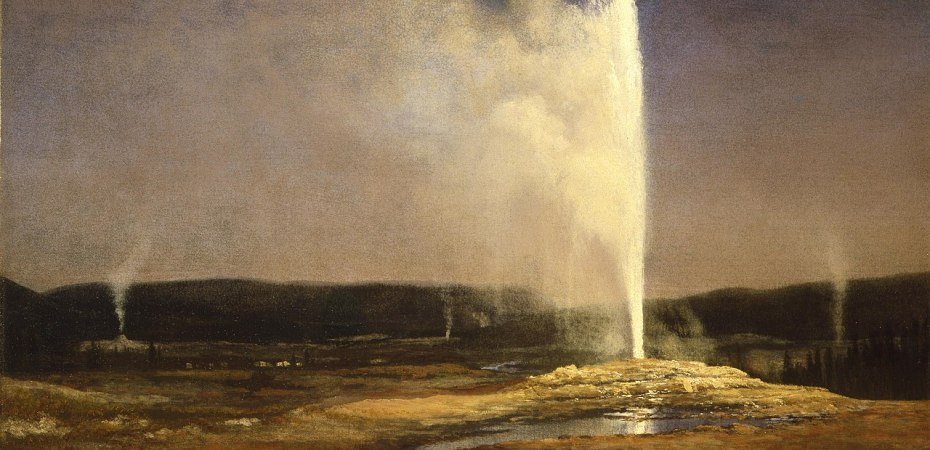
Featured image: Albert Bietstadt via Wikipedia, public domain.
Sources:
Christiansen, R. L.; Lowenstern, J. B.; Smith, R. B.; Heasler, H.; and others. 2007. Preliminary assessment of volcanic and hydrothermal hazards in Yellowstone National Park and vicinity. U. S. Geological Survey.
Wikipedia. 2026. Geothermal areas of Yellowstone. https://en.wikipedia.org/wiki/Geothermal_areas_of_Yellowstone (Last accessed April 6, 2026.)
___. Yellowstone National Park. https://en.wikipedia.org/wiki/Yellowstone_National_Park (Last accessed March 28, 2026.)
 Flight To Wonder