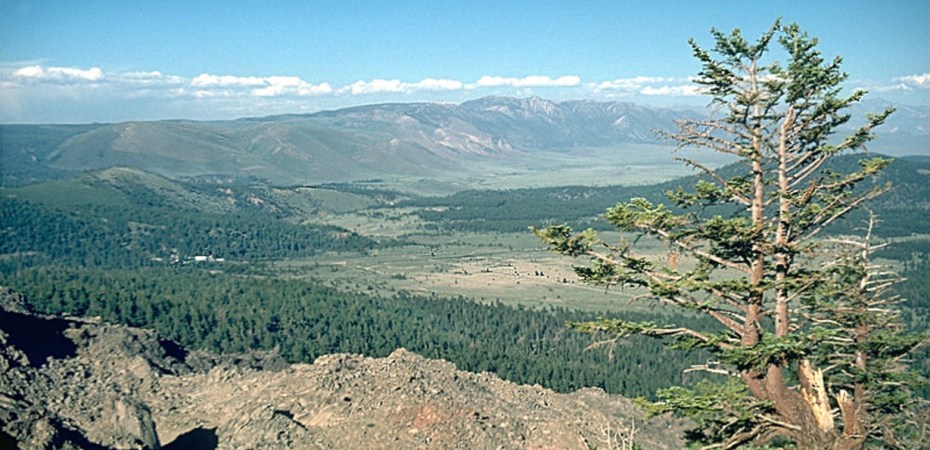
Reading up on Long Valley Caldera has given me a very Dante’s Peak feeling.
In case you haven’t seen it, here are some clips and the movie’s Wikipedia page. Never try to drive through hot lava unless you are: (a) on a Hollywood sound stage; (b) have James Bond and Sarah Connor in the front seat; and (c) you are plot-armored with small children AND a dog.
Granted, Long Valley is in east central California, and the fictional but very Mount St. Helens-ish Dante’s Peak is in the rural part of some unnamed Pacific Northwest state.
Also, Long Valley is a supervolcano, while Dante’s Peak is “just” a Mount St. Helens-ish stratovolcano.
Seriously, the film makers even did exterior shots of the Mount St. Helens summit crater, doubling as Dante’s Peak — gorgeous! Ahem. Where was I? Oh yes…
BUT…
- Both restless volcanoes are inconveniently close to prospering or (in the movie) hoping-to-prosper small towns.
In the real world, that prosperous small town is Mammoth Lakes, California — lovely and a world-renowned tourist destination:
There are tectonic reasons why Yosemite and the rest of the Sierra Nevada are close to Long Valley Caldera. As this layperson understands her reading, these places actually are indirectly responsible for Long Valley’s being there!
Some “normal”-sized volcanism is going on here, too.
It includes the town’s biggest tourist attraction — Mammoth Mountain, which is a huge pile of lava domes that sits on Long Valley’s caldera rim and also is California’s largest ski resort:
This is in 2014, twenty-two years after the ongoing unrest began.
— and as well, there is the 25-mile-long Mono-Inyo Crater Chain that extends from the west central caldera to Mono Lake — this has hosted about twenty small but explosive eruptions over the last five millennia and it’s the most likely site of the next Long Valley area eruption (CalVO, 2023; Hill, 2006):
The Craters are fed by dikes, not by a big magma chamber, and they are made out of a type of lava that is very different from Mammoth Mountain, which has its own set of dikes.
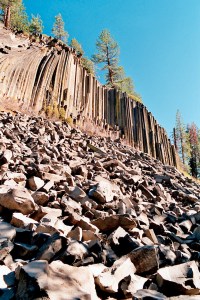
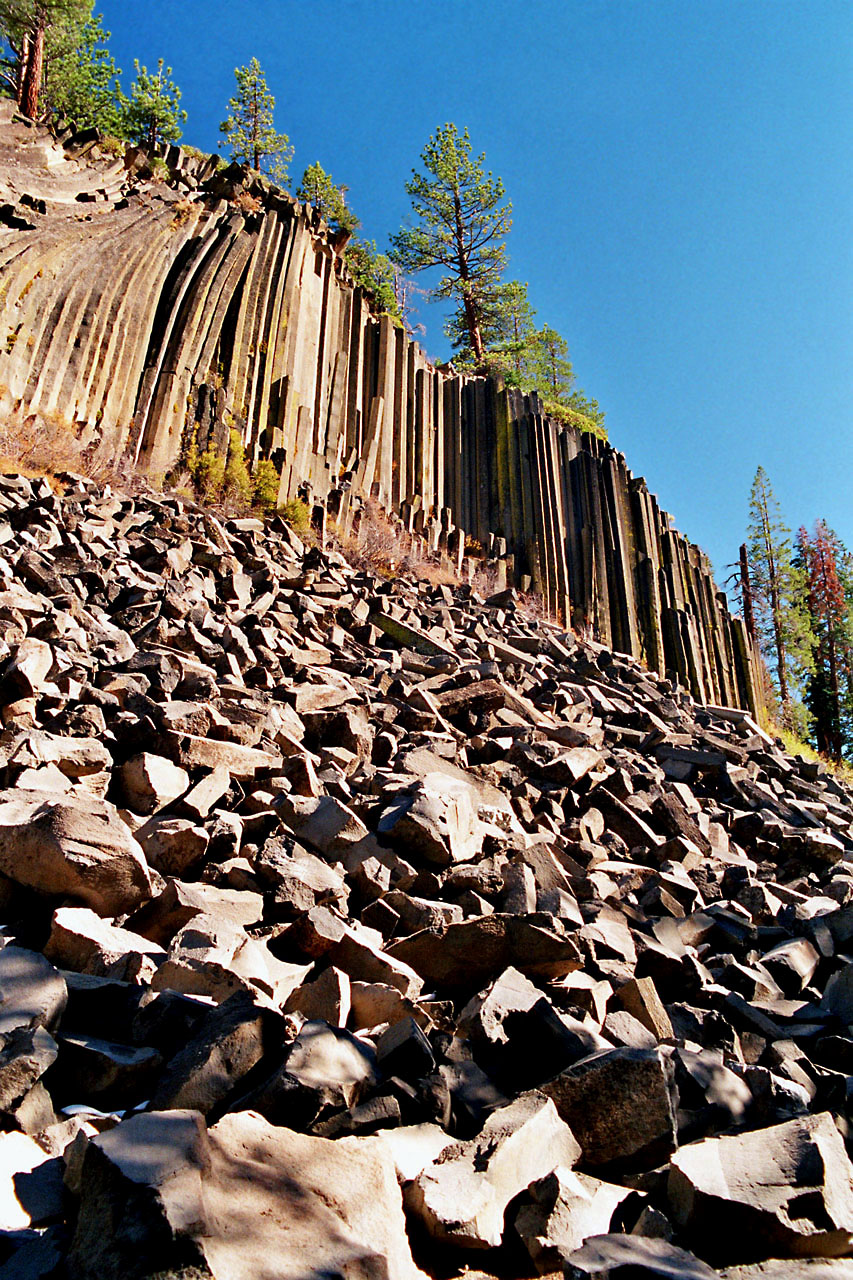
The Devil’s Postpile (Image: Cooper via Wikipedia, CC BY-SA 3.0)
The mountain’s underground network of basaltic dikes and sills is located some 6 to 17 miles below both Mammoth Mountain and the Devil’s Postpile, which is a 100,000-year-old lava flow that now shows impressive columnar jointing. (Hill, 2006)
Mammoth Mountain’s eruptions were Hawaiian-style lava fountains and flows; the Mono-Inyo domes all erupted explosively. (Hill, 2006)
Although Mono-Inyo’s plumbing is separate from the Long Valley system, just as Mammoth Mountain’s is separate, the chain’s rhyolitic lava does have some geochemical similarities to Long Valley’s rhyolite. (Hildreth et al., 2004, 2017; Riley et al.)
But this has nothing to do with supersizing.
Glass Mountain (Image: Eekster via Wikipedia, CC BY-SA 3.0)
Supereruptions don’t happen because the magma is uncommon; they happen because a LOT of magma accumulates in one place, for not yet well understood reasons, as it did under Long Valley 765,000 years ago, when this area was just another beautiful Sierran slope near a volcanic complex that today is extinct and called Glass Mountain. (Hildreth, 2004; Hildreth et al., 2023; Miller and Wark)
Before moving on, let’s briefly look at the lake in the background of that Craters video — Mono Lake.
It’s volcanic, though not in the caldera: Mono Lake hosted the Long Valley area’s most recent volcanic activity 250 to 300 years ago (CalVO; Hill, 2006):
Terrifying. Not. Those weird-looking towers formed underwater as hydrothermal vents.
Yes, altogether this an amazing place, better even than anything Hollywood might dream up!
Getting back to the Dante’s Peak comparison, though…
- Both Long Valley and Dante’s Peak have hot springs that can injure or kill unwary swimmers with sudden superheated blasts.
That awful scene has happened a few times in real life.
In fact, they had to close Long Valley’s Hot Creek swimming hole in 2006 because the blasts — not the human casualties — became frequent. There has even been some geysering!
- In the movie, development of volcanic unrest hurts the local economy (just as it did in real-life Mammoth Lakes in the 1980s).
As a result, Dante Peak’s Mayor Rachel faces political blowback for listening to USGS warnings.
In Mammoth Lakes, the official who had a road put in, on his own initiative, to give townspeople a second evacuation route in case of an eruption was voted out of office! (Hill et al., 2018)
🎥🌋🌋🎦
I enjoy Dante’s Peak a lot, but I like the dramatic real-world story even better (although it certainly wasn’t fun for anyone who experienced it).
First off, it was a stressful double-whammy for volcanologists. We laypeople don’t realize this because only one of the volcanoes went off.
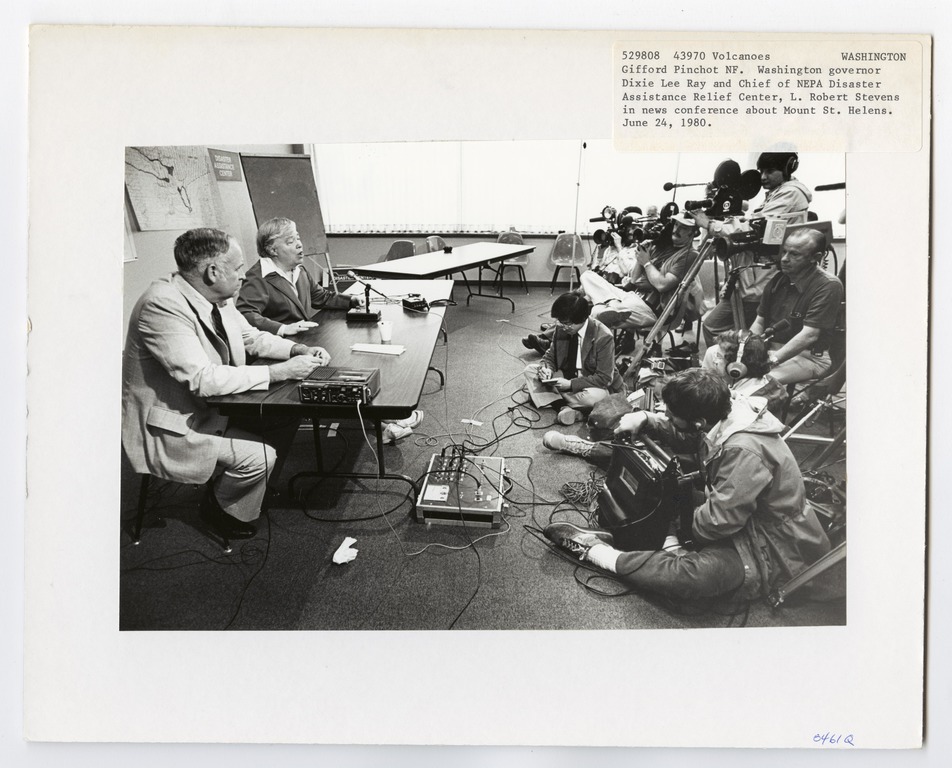
This is actually two politicians, but it gives you some idea of the intensity of public interest — it was to an extent scientists had never dealt with before. (Image: NARA, public domain)
The Long Valley unrest started in earnest not long after Mount St. Helens blew on May 18, 1980 (see the book Volcano Cowboys for a very unofficial but fascinating account of that eruption, which was the first and thus far only major blast in the Lower 48 during the mass-media era, and the subsequent stress of being, for the first time ever, in a nation-wide goldfish bowl while monitoring a major US geologic disaster).
Secondly, while the term “supervolcano,” as we understand it today, wouldn’t be used for another twenty years, volcanologists knew that Long Valley had had a really big eruption in the geologically recent past.
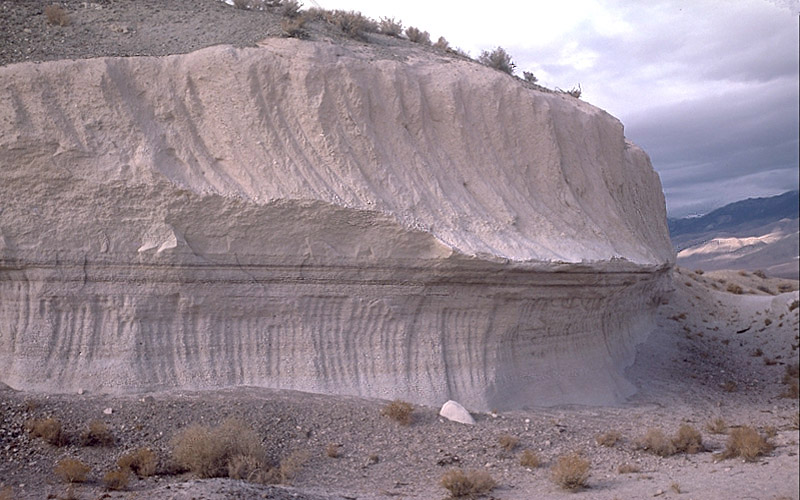
A clue. (Image: Wikimedia, public domain)
They knew that Long Valley had not erupted in a hundred thousand years, also that it had been quiet during the era of modern seismology. (This area does get a lot of earthquakes, but for other reasons relating to the Sierra Nevada, the adjacent Basin and Range Province, and so forth — nothing that could routinely be attributed to the movement of magma and/or magmatic fluids under Long Valley Caldera.)
They knew that the Mammoth Mountain area had not erupted in about fifty thousand years.
They knew that Mono-Inyo lava domes had last erupted a few centuries earlier at Mono Lake.
All was sweetness, peace, and light.
Then, on October 4, 1978, a M5.8 earthquake in the Sierras occurred nine miles southeast of Long Valley Caldera. This isn’t extraordinarily large for east central California, but for some reason, after that, seismic activity picked up in the adjacent Sierra Nevada, Long Valley Caldera, and Mammoth Mountain. (Hill, 2006)
Also, Long Valley’s resurgent dome rose almost ten inches between autumn 1979 and summer 1980. (Hill, 2006)
(The dome is now nearly three feet higher than it was prior to the onset of unrest, report Crozier and Hotovec-Ellis.)
On May 25, 1980, just a week after Mount St. Helens erupted, three M6-ish earthquakes shook Long Valley’s south caldera rim, followed by a fourth on May 27th (about an hour after the USGS had issued a formal statement that another strong one might occur). (Hill, 2006)
As Hill et al. (2018) put it, between these strong temblors and the dome uplift…
…With fresh images of Mount St. Helens in mind, it required no great leap to recognize a volcanic signature in this combination of strong earthquake swarm activity and ground deformation. Still, if the activity had died away as with most aftershock sequences, attention would have soon focused elsewhere.
Earthquake activity continued, however, with frequent swarms that included locally felt earthquakes (M ~3–5 events), rapid-fire bursts of small earthquakes (spasmodic bursts), which are often associated with active volcanoes, and evidence that focal depths appeared to be getting shallower with time…
More than two decades later, with no eruption yet from Long Valley or Mammoth Mountain, it sounds like something from a movie, but it really happened.
How would you have liked to be a decision-maker at the time?
- No one could really tell whether Long Valley was about to let loose, and if it did, how big that eruption would be. While no one expected another Bishop Tuff, something five to ten times the size of Mount St. Helens’ 1980 eruption seemed possible, based upon available data at the time. (Hill, 2006)
- Rising magma often stalls out before reaching the surface, and even today it’s still impossible to tell beforehand how big an eruption will be.
In the 1980s, if they took action based on the worst-case Long Valley scenario, authorities and scientists would lose credibility, and therefore public trust and future cooperation, by evacuating large parts of eastern California, etc., only to have no eruption or only a small one occur — and just how large would that evacuation need to be, anyway?
- If they prepared for a small eruption, and Long Valley did unleash another big one, the casualties would be horrific and it would all be because of the scientists and officials.
And so many laypeople see science as boring…
Well, the experts steered a middle ground and that proved to be the right choice.
But as boffins, the feds, and the state worked things out through channels that were in existence back then, local residents first learned about the USGS concerns — and in some cases, even the fact that Long Valley was a volcano! — from a newspaper article that was published one day before the official word came down. (Hill et al., 2018)
These signs were not there in 1982, and this long valley is not a pointy stratocone. As well, it’s way too big to be a volcano…right?
Local residents were not happy.
They were even less happy as the news spread, the inevitable rumor mills got going, and tourists stopped coming to Mammoth Lakes.
Emotions were so strong, early in the crisis, that “Geologists not welcome” signs sprouted on local motel and restaurant windows.
Fortunately, time brings healing, and there were patient people of good will on both “sides.”
As the years have passed, everybody has worked through it. (Hill, 2006; Hill et al., 2018)
For example, today the ski resort offers a very popular “Top of the Mountain” geology program. (Hill, 2006; Hill et al., 2018)
And, as a result of the initial public communications failure, along with suggestions from the public, officials, and other stakeholders, both the current USGS volcano alert level system and the CalVO agency have come into being out of that crisis (the California Volcano Observatory monitors Long Valley and other volcanoes in the state). (Hill et al., 2018)
That’s a happy ending! Quick! Somebody make a movie about it before the inevitable next (probably “normal”-sized) eruption happens!
What is Long Valley Caldera?
Its name describes its shape, and here is an interpretive video about the Long Valley that covers all of the essential points that I have read about.
Now for some details.
According to Gualda et al. and Montgomery-Brown et al., the Bishop Tuff supereruption began as a very powerful plinian eruption from a single vent location on what is now the southern side of the caldera. More vents opened up in a process that some volcanologists describe as “unzipping,” and massive pyroclastic flows poured out.
As the enormous magma reservoir emptied, the ground above it began to collapse into what soon became a mile-deep hole in the Sierra Nevada, much of which was quickly filled in by whatever eruption products — ashfall, pyroclastic flow material — had not yet already been blasted across most of what is now the US Southwest and western Great Plains.
The whole process took anywhere from ninety hours to six days, depending on which authority you consult. (Cashman and Sparks; Flinders et al.; Wilson and Hildreth; Wilson et al., 2021)
Erosion has since widened the upper circumference of that hole into the Long Valley Caldera that we see today.
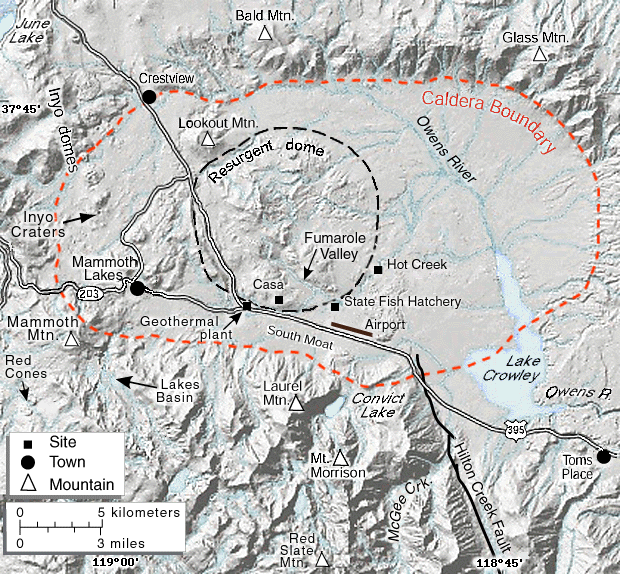
USGS via Wikipedia, public domain.
As often happens at such large calderas, the center domed up, soon after the main event, because some magma was oozing back into the old and broken underground chamber. (Flinders et al.; Hill, 2006)
By AD 1980, when concern about Long Valley’s status was very high, volcanologists worried that a sizable pool of melt might be sitting down there. (Hill, 2006)
After the Bishop Tuff supereruption (when more than 650 km3 of magma blew out of the ground), Long Valley Caldera has had some “normal”-sized rhyolite eruptions. These have occurred about every two hundred thousand years; the last one was a hundred thousand years ago. (Flinders et al.; Hill, 2006)
Long Valley’s most recent nap lasted, for all we know, until late 1978/early 1979.
We don’t actually know because seismology and volcanology are very recent human inventions. Too, the geologic record wouldn’t preserve evidence of any periods of low-level restlessness in between the caldera’s periodic rhyolite eruptions.
What the rocky archives do show is that basaltic lavas began to erupt west and southwest of the big caldera about 160 ka (thousand years ago). Between 110 and 56 ka, they built several structures, most notably, Mammoth Mountain.
Rhyolite eruptions, from about 40 ka on, constructed the Mono-Inyo crater chain with a series of twenty or more small to moderate explosive eruptions.
Then, 250 to 300 years ago, magma intruded underneath Mono Lake, lifting up Poaha Island and causing a small andesite eruption on the island”s north side. (Hill, 2006)
And here we are today.
I don’t know the reason for all those different types of lava — perhaps some mad petrologist has their secret lair down there.
A more serious question…
Is Long Valley moribund or waking up?
That’s the question experts are working on now.
There is an estimated 6,400 km3 of magma down there (Biondi et al.) — GAH!
No. Wait. Such mind-boggling numbers are typical for supervolcanoes.
The context is what really matters.
And, happily no large collections of melt have been identified near the surface here or at any known supervolcano, no matter how closely the boffins have looked. (Biondi et al.; CalVO, 2023; Hill, 2006; Wilson et al., 2021)
(Unrecognized supervolcanoes are another matter and one that goes far beyond the scope of this post.)
In fact, most of Long Valley’s magma is probably crystallized, i.e., frozen. (Biondi et al.; Flinders et al.; Hildreth, 2004; Hildreth et al., 2017)
This is the fate of all supersized magma bodies.
Very few of them ever erupt. Buoyancy takes all that molten material up near the relatively frigid surface, where it cools down quickly and hardens into rock. (Carrichi et al.; Jellinek and De Paolo)
This is how the Sierra Nevada formed.
Those mountains (including Yosemite) were once a huge pool of granitic melt, formed as part of the San Andreas Subduction Zone back in the day.
The pool froze in place after complicated changes in plate tectonics turned the subduction zone into another type of plate boundary: the San Andreas transform fault that we all know and respect today.
Since then, over some 85 million years (Salisbury et al.), that big block of granite has been uplifted; it is weathering into some of the planet’s most beautiful scenery — Yosemite and the Sierra Nevada mountain range.
Guess who went hiking in Yosemite: our silent guide from New Zealand’s Southern Alps in the first post on Taupo!
While this was going on, the hot bottom of that chilled mass of igneous rock dropped off — volcanologists call it “delamination.”
That chunk of lithosphere is still sinking into the molten depths, stirring up some very hot material from below and setting off an ongoing round of volcanism all along the the Sierra Nevada’s eastern front. (Riley et al.)
Long Valley is one of these areas, though not the only one.
However, the volume of erupted material here — from the earliest days of obsidian flows at Glass Mountain right on through the formation of Mono Lake’s Poaha Island almost three centuries ago — is unusually large, orders of magnitude more than what other volcanic centers in this region have produced. (Hildreth et al., 2023; Riley et al.)
The reasons why are still under discussion.
One possibility is rather cool.
Some geoscientists suggest that the Sierra Nevada range has become a microplate that is slowly rotating. There are additional intricate geological forces in operation here, manifesting in such features as Basin and Range, the Eastern California Shear Zone, and Walker Lane, but all that, while intriguing, is way too complex for this post.
All of this, they say, particularly the geologically nimble Sierra Nevada, has led to a gap in Earth’s crust that is located exactly where there is so much volcanism in and around Long Valley today. (Hill, 2006; Riley et al.; Wilson et al., 2021)
There are other suggestions, too, of course, and debate continues.
What does appear as fact to some volcanologists is that Long Valley area volcanism started out basaltic (Hawaiian or Icelandic style runny red lava eruptions) and then moved its focus westward a little bit, becoming silicic (explosive gray lava eruptions) along the way. (Flinders et al.; Hildreth et al., 2023)
Now, according to this Moribund argument, the volcanism focus is transitioning back into basaltic eruptions again (with the Mammoth Mountain area activity) and the old rhyolite centers are cooling down and freezing up (Hildreth, 2004), just as the Sierra Nevada froze up.
Odd as it seems to us laypeople, that could explain Long Valley’s unrest — unrest that might mean this supervolcano is almost dead. (Don’t worry — there is a “Miracle Max” viewpoint, too.)
A process called “second boiling” happens just as silicic magma crystals give up their last bit of heat. This releases their remaining gases and fluids, which would then rise toward the surface in precisely the way that seismic signals, detected by stations set up to monitor Long Valley unrest, do show fluids of some sort to be rising underneath parts of the caldera. (Bachman and Huber; Biondi et al.; Hildreth et al., 2017)
So the Long Valley Caldera system is moribund, according to this school of thought, and some already call it a pluton (the Sierra Nevada, along with Yosemite, being bigger, gets the name of “batholith“). (Hildreth et al., 2023; Salisbury et al.)
But there are other points of view. Let’s think of them as the Miracle Max School.
For instance, Acocella et al. describe a possible magmatic source down there — possibly a mixture of hydrothermal fluids anď partial melt.
Hill et al (2020) argue that Long Valley’s deeper magmatic system is active and say that future eruptions here of any sort are unlikely but can’t be completely ruled out.
It’s too bad that no one, including either the Moribund or the Miracle Max supporters, has yet been able to get a definitive look at Long Valley’s plumbing. (Giordano and Carrichi; Hill, 2006)
However, the boffins can do clever things with geophysical data and computer modeling.
In 2023, Biondi et al. published a study that supported the “moribund supervolcano” idea.
Other studies (Miracle Max!) have recognized possible magmatic activity.
To quote just one (Flinders et al.), there might be a sizable reservoir of melt, located about halfway between the surface and our planet’s mantle some 6 to 11 miles underneath Long Valley Caldera.
But Flinders et al. emphasize that this in no way means that the melt can be erupted. As Hill et al (2020) point out, it might just be scattered in small pockets among vast walls of already crystallized melt.
The status of what Hill (2006) and Acocella et al. call the Long Valley-Mono Craters Volcanic Field, is still an open question.
Fortunately for us all, it is no longer as urgent a question as it was in the 1980s. Everyone now understands this supervolcano much better than they did back then.
Many studies suggest that there is some sort of a compact inflation source in the center of the caldera, three to four miles below the resurgent dome, as well as a lesser inflation source somewhere underneath part of a “shaky” little seismic zone in the southern caldera. (Hill, 2006)
Those studies cannot show whether these sources have a magmatic origin (Miracle Max) or are a result of a regional tectonic disturbance in Long Valley’s longstanding hydrothermal system (consistent with either school of thought). (Crozier and Hotovec-Ellis)
Of note, Long Valley has become quieter since 2000, and the boffins do not see this as “the quiet before the storm”; rather, the caldera might be “breathing” (from heating of geothermal fluids) just as Yellowstone and Italy’s Campi Flegrei “breathe” (Hill, 2006; Hotovec-Ellis and Crozier; Crozier and Hotovec-Ellis) — though in a more laidback fashion (this is California, after all).
Nonetheless, in terms of general threat assessment, Long Valley is currently considered a very high threat but not because of any supereruption.
Future eruptions, according to both Hill (2006) and a 2023 report from CalVO, are more likely to take place from the Mono-Inyo chain than from the caldera (which probably would have steam-driven, small to moderate explosive activity, at the resurgent dome or in its southern part. if it ever does erupt on a human-relevant time scale).
The Craters are rather remote, but of course ashfall from these explosive events would affect the whole region, including Mammoth Lakes, air traffic corridors, and key transportation routes.
Mammoth Mountain, with its separate plumbing and different eruption style, has its own CalVO page and is considered a moderate threat.
These would be lava fountains and Hawaiian-style flows (CalVO) that certainly would be devastating over the short-term to Mammoth Lakes, but would not have such a widespread impact as any rhyolitic eruptions along the crater chain.
Mammoth Mountain actually has been fairly quiet.
Its shallow magma reservoirs have probably crystallized, but there is a deep network of dikes and sills that host a seismic swarm now and then. (Hill, 2006)
Nevertheless, volcanic hazard is present here.
In 1990, experts detected carbon dioxide coming up through Mammoth Mountain soil after an inferred deep intrusion of magma during 1989. (Hill, 2006; Hill et al., 2018)
The outgassing continues, at about 300 tonnes/day. (Hill, 2006; CalVO)
This gas is invisible, odorless, and it collects in low places or closed-in areas like snow caves.
There have been four CO2-related deaths at Mammoth Mountain thus far, three of which occurred in 2006, when members of a ski patrol who were erecting warning signs around a fumarole fell into a snow cave that was almost completely filled with carbon dioxide.
🌋🌋🌋
Overall, everyone in the Long Valley area is much more volcano savvy these days.
And the volcano?
Surprisingly, its seismicity has quieted down over the last half-decade. In January 2026, CalVO reported that the resurgent dome is subsiding. (Crozier and Hotovec-Ellis)@
They call this the most significant subsidence measured since monitoring began in 1980!
What does it mean?
This layperson suspects that it is too early to tell.
- Is Long Valley “breathing,” as Yellowstone and some other large calderas do? That is, is it still alive?
- Or are we witnessing a dying supervolcano’s last breath?
Earth is a very slow actor, and we may not live long enough to see how this plot ultimately plays out.
But the “movie” is an excellent adventure/drama, unfolding in a beautiful setting!
Featured image: S. R. Brantley, public domain.
Sources:
- Acocella, V.; Di Lorenzo, R.; Newhall, C.; and Scandone, R. 2015. An overview of recent (1988 to 2014) caldera unrest: Knowledge and perspectives. Reviews of Geophysics, 53(3): 896-955.
- Bachmann, O., and Huber, C. 2016. Silicic magma reservoirs in the Earth’s crust. American Mineralogist, 101(11): 2377-2404.
- Biondi, E.; Zhu, W.; Li, J.; Williams, E. F.; and Zhan, Z. 2023. An upper-crust lid over the Long Valley magma chamber. Science Advances, 9(42): eadi9878.
- Busby, C. J. 2013. Birth of a plate boundary at ca. 12 Ma in the Ancestral Cascades arc, Walker Lane belt of California and Nevada. Geosphere, 9(5): 1147-1160.
- California Volcano Observatory (CalVO). 2023. Long-term outlook for volcanic activity in Long Valley Caldera. https://www.usgs.gov/volcanoes/long-valley-caldera/science/long-term-outlook-volcanic-activity-long-valley-caldera
- ___. 2026. Long Valley. https://www.usgs.gov/volcanoes/long-valley-caldera Accessed March 22, 2026.
- ___. 2026. Mammoth Mountain. https://www.usgs.gov/volcanoes/mammoth-mountain Accessed March 22, 2026.
- Caricchi, L.; Annen, C.; Blundy, J.; Simpson, G.; and Pinel, V. 2014. Frequency and magnitude of volcanic eruptions controlled by magma injection and buoyancy. Nature Geoscience, 7(2): 126-130.
- Cashman, K. V., and Sparks, R. S. J. 2013. How volcanoes work: A 25-year perspective. Bulletin, 125(5-6): 664-690.
- Crozier, J. A., and Hotovec-Ellis, A. J. 2026. A quiet exhalation at Long Valley. https://www.usgs.gov/observatories/calvo/news/a-quiet-exhalation-long-valley
- Flinders, A. F.; Shelly, D. R.; Dawson, P. B.; Hill, D. P.; Tripoli, B.; and Shen, Y. 2018. Seismic evidence for significant melt beneath the Long Valley Caldera, California, USA. Geology, 46(9): 799-802.
- Gelman, S. E.; Gutiérrez, F. J.; & Bachmann, O. 2013. On the longevity of large upper crustal silicic magma reservoirs. Geology, 41(7): 759-762.
- Giordano, G., and Caricchi, L. 2022. Determining the state of activity of transcrustal magmatic systems and their volcanoes. Annual Review of Earth and Planetary Sciences, 50(1): 231-259.
- Global Volcanism Program. 2026. Long Valley. Accessed March 12, 2026. https://volcano.si.edu/volcano.cfm?vn=323822
- Gola, G.; Barone, A.; Castaldo, R.; Chiodini, G.; and others. 2021. A novel multidisciplinary approach for the thermo‐rheological study of volcanic areas: The case study of Long Valley Caldera. Journal of Geophysical Research: Solid Earth, 126(2): e2020JB020331.
- Gualda, G. A.,; Ghiorso, M. S.; Hurst, A. A.; Allen, M. C.; and Bradshaw, R. W. 2022. A complex patchwork of magma bodies that fed the bishop tuff supereruption (Long Valley caldera, CA, United States): evidence from matrix glass major and trace-element compositions. Frontiers in Earth Science, 10: 798387.
- Hildreth, W. 2004. Volcanological perspectives on Long Valley, Mammoth Mountain, and Mono Craters: several contiguous but discrete systems. Journal of Volcanology and Geothermal Research, 136(3-4): 169-198.
- Hildreth, W. 2017. Fluid-driven uplift at Long Valley Caldera, California: geologic perspectives. Journal of Volcanology and Geothermal Research, 341: 269-286.
- Hildreth, W. 2021. Comparative rhyolite systems: Inferences from vent patterns and eruptive episodicities: Eastern California and Laguna del Maule. Journal of Geophysical Research: Solid Earth, 126(7): e2020JB020879.
- Hildreth, W.; Fierstein, J.; and Calvert, A. T. 2023. Precaldera mafic magmatism at Long Valley, California: Magma-tectonic siting and incubation of the Great Rhyolite System. Journal of Volcanology and Geothermal Research, 433: 107726.
- Hill, D. P. 2006. Unrest in Long Valley Caldera, California, 1978–2004. https://volcanoes.usgs.gov/vsc/file_mngr/file-31/LVC_unrest-dphill_reprint.pdf
- Hill, D. P.; Mangan, M. T.; and McNutt, S. R. 2018. Volcanic unrest and hazard communication in Long Valley volcanic region, California. In Observing the Volcano World (pp. 171-187). Springer, Cham. https://link.springer.com/chapter/10.1007/11157_2016_32
- Hill, D. P.; Montgomery-Brown, E. K.; Shelly, D. R.; Flinders, A. F.; and Prejean, S. 2020. Post-1978 tumescence at Long Valley caldera, California: a geophysical perspective. Journal of Volcanology and Geothermal Research, 400: 106900.
- Hotovec-Ellis, A. J., and Crozier, J. A. 2026. Is it just me or is it a seismically uneventful year at Long Valley? https://www.usgs.gov/observatories/calvo/news/it-just-me-or-it-quiet-a-seismically-uneventful-year-long-valley
- Jellinek, A. M., and DePaolo, D. J. 2003. A model for the origin of large silicic magma chambers: precursors of caldera-forming eruptions. Bulletin of Volcanology, 65: 363-381.
- Miller, C. F. and Wark, D. A. 2008. Supervolcanoes and their explosive supereruptions. Elements, 4(1): 11-15.
- Montgomery‐Brown, E. K.; Wicks, C. W.; Cervelli, P. F.; Langbein, J. O.; and others. 2015. Renewed inflation of Long Valley caldera, California (2011 to 2014). Geophysical Research Letters, 42(13): 5250-5257.
- Poland, M. 2020. Caldera Chronicles: Caldera Systems — A World-Wide Family That Is More Than Just Yellowstone.
- Riley, P.; Tikoff, B.; and Hildreth, W 2012. Transtensional deformation and structural control of contiguous but independent magmatic systems: Mono-Inyo Craters, Mammoth Mountain, and Long Valley Caldera, California. Geosphere, 8(4): 740-751.
- Self, S. 2006. The effects and consequences of very large explosive volcanic eruptions. Philosophical Transactions of the Royal Society A: Mathematical, Physical and Engineering Sciences, 364(1845): 2073-2097.
- Shelly, D. R.; Ellsworth, W. L.; and Hill, D. P. 2016. Fluid‐faulting evolution in high definition: Connecting fault structure and frequency‐magnitude variations during the 2014 Long Valley Caldera, California, earthquake swarm. Journal of Geophysical Research: Solid Earth, 121(3): 1776-1795.
- U. S. Geological Survey (USGS). 2023. Long Valley field guide. https://www.usgs.gov/volcanoes/long-valley-caldera/science/long-valley-caldera-field-guide
- Wikipedia. 2026. Long Valley Caldera. https://en.wikipedia.org/wiki/Long_Valley_Caldera# Accessed March 13, 2026.
- Wilson, C. J., and Hildreth, W.
1997. The Bishop Tuff: new insights from eruptive stratigraphy. The Journal of Geology, 105(4): 407-440. - Wilson, C. J.; Cooper, G. F.; Chamberlain, K. J.; Barker, S. J.; and others. 2021. No single model for supersized eruptions and their magma bodies. Nature Reviews Earth & Environment, 2(9): 610-627.
- Wolterbeek, M. 2020. How the burgeoning Walker Lane may split the American West. https://www.unr.edu/nevada-today/nevada-stories/walker-lane
 Flight To Wonder