This week’s Sunday Morning Volcano has arrived early.
Indonesian volcanologists report (autotranslated) that they have raised the alert level at Tambora to II on a four-point scale.
No VONA has been issued since January.
Volcano alert level II in the Indonesian system only requires local residents and officials to stay aware of the volcano’s status and to avoid dangerous areas.
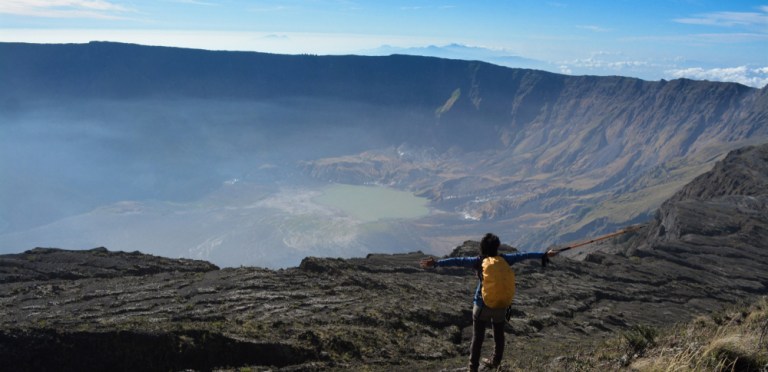
Yes, Tambora did have that VEI 7 eruption in 1815, but since then it has had only minor activity — lava flows and small dome or cone formation — in the caldera, most recently in the second half of the twentieth century. (GVP; Yokoyama)
Also, this is not the first alert raising. Tambora was restless in 2013, and in 2011 they actually went up to Level III for a while, which requires people to get ready to evacuate.
This layperson’s understanding (and it is also spelled out in the volcano notice linked above) is that Tambora, like other volcanoes with a history of large explosive eruptions, accumulates small volumes of magma at a time.
The big eruptions come after all those small batches collect together into one large reservoir.
According to Gertisser and Self, that took several thousand years for what eventually became the devastating 1815 eruption of Tambora.
[Layperson speculation]
It doesn’t sound as though anything really big is on the way now.
Probably this intrusion, like the earlier ones this century, will stall out.
If it does continue, an eventual eruption likely would be another small lava flow or dome-building episode on the caldera floor.
[/Layperson speculation]
Featured image: M. Rinander Tasya/Shutterstock
Sources
- Carn, S. A., and Oppenheimer, C. 2000. Remote monitoring of Indonesian volcanoes using satellite data from the Internet. International Journal of Remote Sensing, 21(5): 873-910.
- Gertisser, R., and S. Self. 2015. The great 1815 eruption of Tambora and future risks from large‐scale volcanism. Geology Today 31, no. 4 (2015): 132-136.
- Global Volcanism Program (GVP). 2026. Tambora. https://volcano.si.edu/volcano.cfm?vn=264040 Last accessed March 11, 2026.
- Oppenheimer, C. 2003. Climatic, environmental and human consequences of the largest known historic eruption: Tambora volcano (Indonesia) 1815. Progress in Physical Geography, 27(2): 230-259.
- Yokoyama, I. 2022. The 1815 Tambora eruption: Its significance to the understanding of large-explosion caldera formations. Geofísica internacional, 61(1): 5-19.
 Flight To Wonder