G’day, mate!
No. Wait. That’s Australia.
🦘🦘🦘
Scrolls through “Down-Under Meme Book”…Aha! Starts over.
🥝🥝🥝
An old man wearing a tent dress and carrying a long stick; two good-looking young men who don’t resemble their characters’ descriptions in the book whatsoever; a couple of aliens; and four short persons who are well dressed but barefoot — walking, walking, waaaaalkiiing…
The real New Zealand, and a real trek
Actual walking adventures in New Zealand are even more fun, as we’ll soon see, and they don’t require CGI, makeup, or a script, although you do need to dress appropriately and plan ahead.
Coming up is video of such a walk, taking us silently on a seven-day journey through New Zealand’s Southern Alps.
While I don’t remember Tolkien’s Fellowship of the Ring ever being harassed by cheeky parrots during their journey, it’s true that real-world weather, insects, and rugged terrain can be as deadly as an orc’s poisoned blade or a witch-king’s heavy mace (though our guide is very well prepared and — spoiler — has a physically challenging but wonder-filled week out there).
Of course, today’s post is about New Zealand’s active supervolcano, not its mountains or The Lord of the Rings, but there are two good reasons to ease gently into a discussion of this bad boy — Taupo, it’s called.

It’s a very bad boy, but relax. For our lay purposes, Taupo is not as complicated as this Figure 1 by Lamb et al. (CC BY-NC-ND-SA 4.0) looks. We’ll get to a couple of the image’s interesting points — the light blue dashed circles and the area of deepest water (darkest gray) — later in the post.
Image on right shows the location of Taupo (lake and volcano) in the central North Island of New Zealand; the triangles are other active volcanoes there. See how most of them line up? The dashed line around those outlines the Taupo Volcanic Zone.
1. The land
I can’t express the first reason for doing a slow introduction to Taupo adequately in words other than to say that it involves the land, which those of us outside the region might not be familiar with.
We should see that. It is GORGEOUS!
Also, seeing is believing.
The hiking video takes us through some physically grand effects of those ongoing slow but enormous earth forces at work here; tectonic forces that not only raise mountains in southern New Zealand but also influence the north’s eruptions, particularly at and around Taupo. (Allan et al., 2012; Wilson et al., 2021)
Why so forceful?
Well, New Zealand is an island nation at present, but it is not your ordinary South Pacific archipelago.

On this image, the continent of Zealandia is outlined in pink. (Image: Wikimedia, public domain)
New Zealand sits atop an active tectonic-plate boundary.
Also, it is really a continent, about half as big as Australia but mostly submerged right now, with only a few high points, like New Caledonia and what we call New Zealand’s two major islands currently rising above the ocean waves. (Trewick and Bland)
I don’t know why, and perhaps the boffins don’t know, either (Trewick and Bland), but Earth seems to play with Zealandia as if it was a plastic dough toy (my words, not the boffins’).
Gondwana formed the southern half of supercontinent Pangea back in the day and spawned all of our present southern continents, as well as some other land masses, as Pangea broke up. Too, J. R. R. Tolkien liked the name, which unintentionally but appropriately incorporated his made-up root word “gond” for “stone.”
One result of Terra’s playfulness with Zealandia is alpine mountains on South Island which we will soon be exploring in video.
Another result is many North Island volcanoes and supervolcanoes, past and present — this is the world’s most active and productive center of silicic (explosive) volcanism; and Taupo is the most active rhyolite volcano on Earth. (Barker et al., 2021; Potter et al., 2012; Wilson et al., 2009)
It’s not accurate to call rhyolite the ‘TNT of lavas,’ but that’s basically what it is: we are not talking runny red Hawaiian or Icelandic-style flows here. Also, rhyolitic eruptions are VERY rare occurrences in humanity’s short scientific era, which is why this 2011-2012 eruption of Puyehue-Cordón Caulle, a 2008 eruption of Chaitén, and dormant but restless Taupo are research magnets.
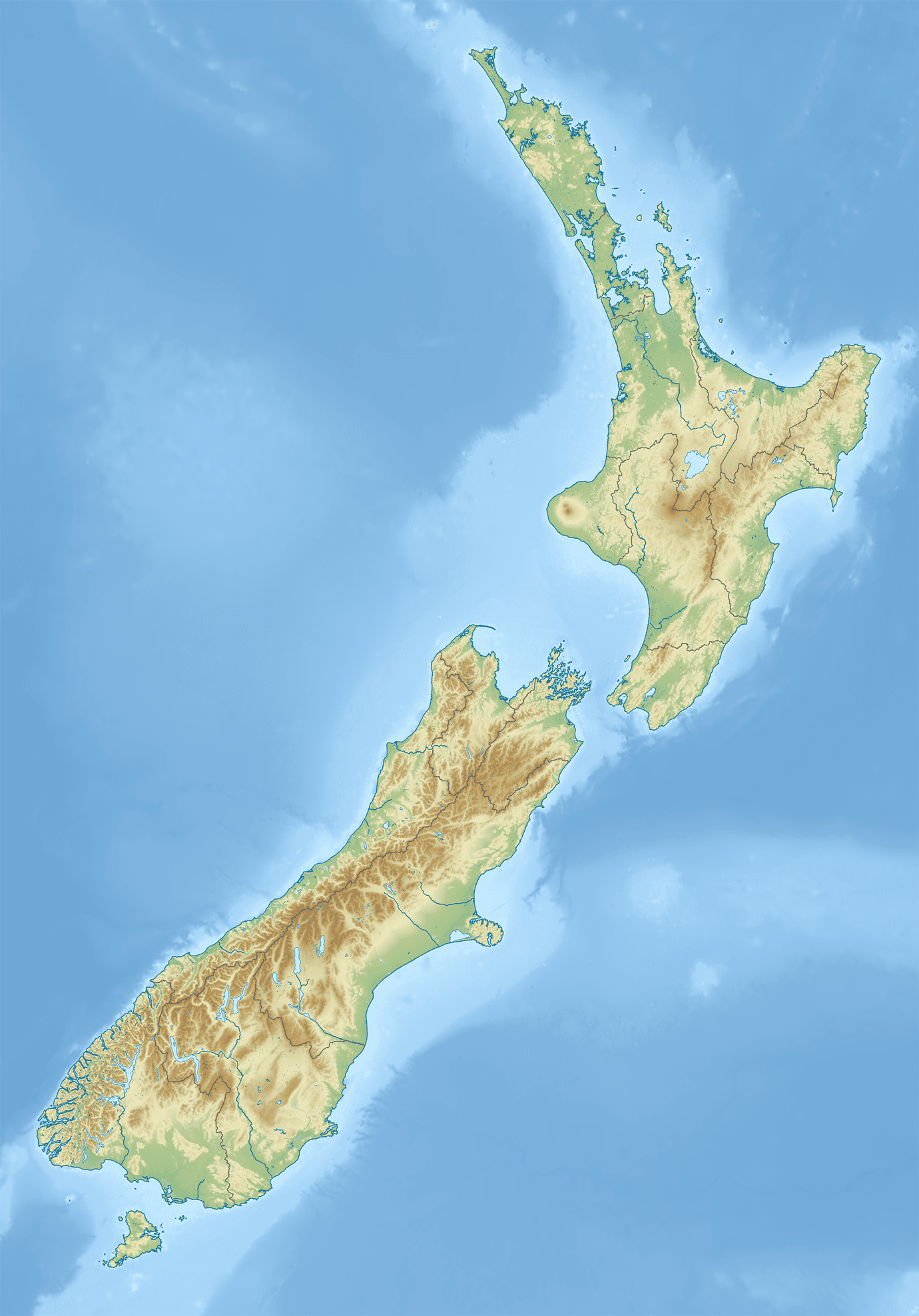
M. Bitton via Wikimedia, CC BY-SA 4.0
On South Island (the left one in this image), these tectonic forces clash in continental collision, building mighty mountains (Trewick and Bland) and causing mighty earthquakes along the Alpine Fault.
On New Zealand’s North Island, where Taupo sits, subduction-zone processes stretch and strain Zealandia’s crust out past its breaking point, leading to continental rifting and SO many volcanoes of various kinds — two of which, located just south of Taupo, provided background scenes for the Lord of the Rings movie.
🌋🌋🌋

Those two white dots in this low-orbit satellite view from the north (by NASA via Wikimedia, public domain) are the movie stars and, on the ground, they are part of Tongariro National Park.
That’s Tongariro in the foreground and, behind it, Ruapehu.
They are both active, but neither one erupted during the filming.
One of Tongariro’s cones played Mount Doom, while the stark volcanic landscape there and at Ruapehu provided a very Mordorish setting.
For this post, though, note the lack of mountains or valleys around Africa-shaped Lake Taupo, where Sauron, Morgoth, the supervolcano lurks, other than those two stratovolcanoes.
A couple of massive eruptions and a major tectonic collapse during the past 26,000 years are responsible for the lake’s unusual shape. (Barker et al., 2021; Lamb et al.; Potter et al., 2012)
Taupo itself wasn’t in the LOTR movies, but its history does sound like something that Hollywood might fabricate.
Yet it is not fiction.
Neither Peter Jackson nor J. R. R. Tolkien himself could have believably invented the geological reason for that smoothed-out landscape centered on Lake Taupo and extending fifty miles on every side.
No human could.
It is indeed fortunate that no human beings probably were closer to Taupo than New Caledonia Island on that really bad day, in or around 230 AD, when the smoothing out happened.
Late one summer to early fall afternoon, according to Lowe and Pittari, during a powerful eruption at Taupo, a massive (30 km3, by some estimates), extremely hot cloud of pyroclastic material suddenly surged outward from the vent at supersonic speeds.
Almost frictionless because it traveled on a bed of heated air, and with irresistible momentum from its mass and velocity, the cloud sped fifty miles or so in every direction regardless of terrain — filling in valleys, knocking down forests, and even burying Tongariro and the Kaimanawa Mountains, although it couldn’t quite overtop tall Ruapehu.
Some 7 to 15 minutes after it began, the surge ran out of material.
In that short time, it had changed the landscape of central North Island forever.
Trees grew back after a couple of centuries, but if you map them by species now, you will see a partial bull’s-eye pattern centered on Lake Taupo.
And that was not the supereruption.
I told you Taupo was a bad boy!
Granted, this eruption some 1,800 years ago — known variously as the “Taupo,” “Hatepe,” or “Y” eruption — was much bigger than the 26 other explosive eruptions that Taupo has had since its Oruanui supereruption about 26,000 years ago. (Potter et al., 2012)
Yes. Twenty-seven explosive eruptions, plus one known lava eruption (after the Y eruption, forming lava domes on the eastern lake bed), in a relatively short span of geological time — AFTER a superuption.
Most supervolcanoes take much longer to reaccumulate magma after a big one.
And Taupo’s Oruanui supereruption occurred only about three millennia — not even a blink of geologic time — after a big, but not supersized, eruption at a nearby volcanic system (the Northeast Dome complex) just a few miles away; this complex also participated a little bit in the supereruption and today controls some geothermal fields at Taupo. (Allan et al., 2012; Barker et al., 2021; Scott et al.; Wilson et al., 2021)
Taupo is a challenging and very active place!
🌋🌋🌋
2. People
Along with its big badness, there is a second reason for easing into the topic of Taupo supervolcano with a hiking video.
This involves people and the different ways that H. sapiens can view Nature.
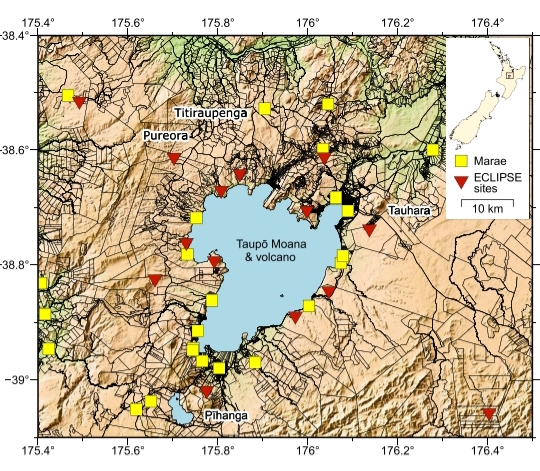
Figure 1 from Mestel et al. (2025a, CC BY-NC-ND-SA 4.0) shows signs of two cultures living and working around Taupo Lake (“Moana”) and Volcano. Yellow squares are Maori (Polynesian) meeting houses; black lines and red triangles mark the infrastructure and seismic stations, respectively, of European-related New Zealanders and geoscientists (whose team worked closely with the Maori to get permission to set up that temporary study network around sacred Lake Taupo.
The issue at Taupo is this: Can two human societies with totally different world concepts — one of them European, technological, and based on Western science; the other Polynesian (Maori), traditionally animist, and in legal custodianship of Lake Taupo after 34 generations of residence along its shores (during which time Taupo has not erupted) — can these two cultures unite and constructively face major volcanic hazard together?
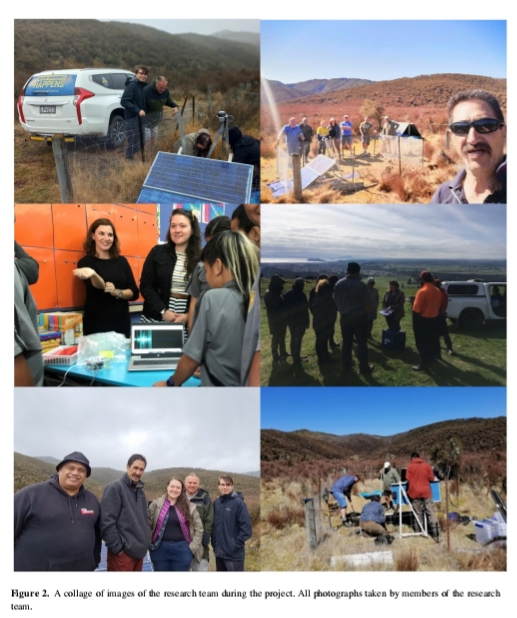
Spoiler: A guarded “Yes!” (Image: Figure 2, Mestel et al., 2025a, CC BY-NC-ND-SA 4.0
The question goes far beyond New Zealand circumstances, of course, but this is a good place to stop and think about it for a moment.
Watch the video below and imagine how Europeans, from the nineteenth century on, must have felt: admiring that land and measuring themselves against it, determined to sensibly tackle and overcome every challenge it presents. (Today this approach includes a no-nonsense practical sourcebook (PDF) on restive Taupo for scientists, the public, and officials.)
Then treat yourself to another viewing and try to imagine how you would experience this amazing Aotearoa if you were a thirteenth- or fourteenth-century, genealogy-minded Polynesian setting foot on it for the first time.
It might feel as though you had come home to Heaven; and that, in return for your spiritual land ancestor’s protection and many natural gifts, your role now is to guard it against all outside interference and to venerate it forever.
🥾🥾🥾
- Totally irrelevant but applicable near the end of the video: “What do they eat when they can’t get hobbit?” — Sam Gamgee.
Pro tip: Set aside forty minutes or so to watch this. Pulling yourself away early is very, very difficult once it grabs you.
🥾🥾🥾
That’s the South Island and its Alps.
Now, what is going on with the North Island and its Taupo Volcanic Zone (TVZ)?
To be continued… (on Sunday, I hope)
Edited January 16, 2026
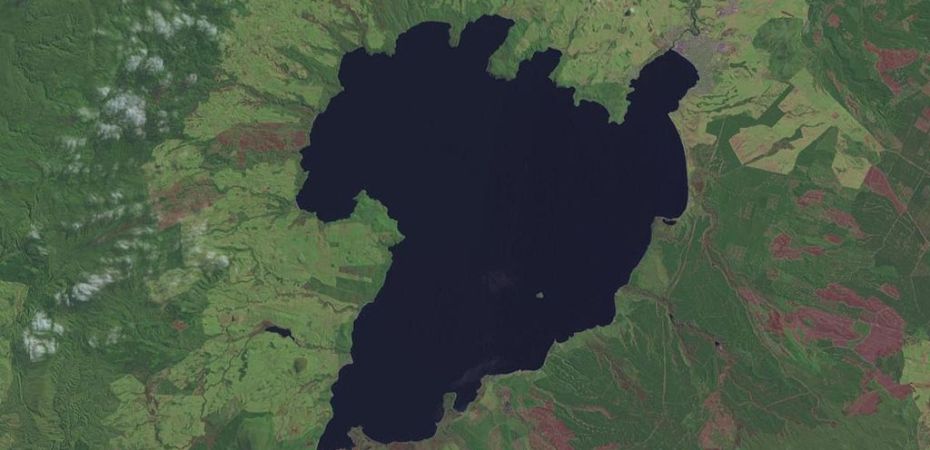
Feature image: Landsat via Lake Scientist, public domain.
Sources:
- Allan, A. S.; Wilson, C. J.; Millet, M. A.; and Wysoczanski, R. J. 2012. The invisible hand: Tectonic triggering and modulation of a rhyolitic supereruption. Geology, 40(6): 563-566.
- Allan, A. S.; Morgan, D. J.; Wilson, C. J.; and Millet, M. A. 2013. From mush to eruption in centuries: assembly of the super-sized Oruanui magma body. Contributions to Mineralogy and Petrology, 166(1): 143-164.
- Allan, A. S.; Barker, S. J.; Millet, M. A.; Morgan, D. J.; and others. 2017). A cascade of magmatic events during the assembly and eruption of a super-sized magma body. Contributions to Mineralogy and Petrology, 172(7): 49.
- Bachmann, O., and Huber, C. 2016. Silicic magma reservoirs in the Earth’s crust. American Mineralogist, 101(11): 2377-2404.
- Barker, S. J.; Van Eaton, A. R.; Mastin, L. G.; Wilson, C. J.; and others. 2019). Modeling ash dispersal from future eruptions of Taupo supervolcano. Geochemistry, Geophysics, Geosystems, 20(7): 3375-3401.
- Barker, S. J.; Wilson, C. J.; Illsley-Kemp, F.: Leonard, G. S.; and others. 2021. Taupō: an overview of New Zealand’s youngest supervolcano. New Zealand Journal of Geology and Geophysics, 64(2-3): 320-346.
- Cashman, K. V., and Sparks, R. S. J. 2013. How volcanoes work: A 25-year perspective. Bulletin, 125(5-6): 664-690.
- Corella Santa Cruz, C. R. 2023). Subduction cycling and its controls on hyperactive volcanism in the Taupo Volcanic Zone, New Zealand: a thesis presented in partial fulfilment of the requirements for the degree of Doctor of Philosophy in Earth Science at Massey University, Palmerston North, New Zealand (Doctoral dissertation, Massey University).
- Crosweller, H. S.; Arora, B.; Brown, S. K.; Cottrell, E.; and others. 2012. Global database on large magnitude explosive volcanic eruptions (LaMEVE). Journal of Applied Volcanology, 1: 1-13.
s - Ellis, S.; Barker, S. J.; Wilson, C. J.; Hamling, I.; and others. (2023). Taupōinflate: illustrating detection limits of magmatic inflation below Lake Taupō. New Zealand Journal of Geology and Geophysics, 66(4): 571-588.
- GNS Science. 2025. Kermadec Arc and the Taupo Volcanic Zone. https://www.gns.cri.nz/our-science/land-and-marine-geoscience/earth-dynamics/kermadec-arc-and-taupo-volcanic-zone/ Last accessed December 17, 2025.
- GeoNet. 2025. About Taupo. https://www.geonet.org.nz/about/volcano/taupo Last accessed December 17, 2025.
- Harmon, L. J.; Gualda, G. A.; Gravley, D. M.; Smithies, S. L.; and Deering, C. D. 2024. The Whakamaru magmatic system (Taupō Volcanic Zone, New Zealand), part 1: Evidence from tephra deposits for the eruption of multiple magma types through time. Journal of Volcanology and Geothermal Research, 445, 107966.
- Harmon, L. J.; Smithies, S. L.; Gualda, G. A.; and Gravley, D. M. 2024. The Whakamaru magmatic system (Taupō Volcanic Zone, New Zealand), part 2: Evidence from ignimbrite deposits for the pre-eruptive distribution of melt-dominated magma and magma mush. Journal of Volcanology and Geothermal Research, 447, 108013.
- Illsley‐Kemp, F.; Barker, S. J.; Wilson, C. J.; Chamberlain, C. J.; and others. 2021. Volcanic unrest at Taupō volcano in 2019: Causes, mechanisms and implications. Geochemistry, Geophysics, Geosystems, 22(6): e2021GC009803.
- Jellinek, A. M., and DePaolo, D. J. 2003. A model for the origin of large silicic magma chambers: precursors of caldera-forming eruptions. Bulletin of Volcanology, 65: 363-381.
- Lamb, O.; Bannister, S.; Ristau, J.; Miller, C.; and others. 2024. Seismic characteristics of the 2022-2023 unrest episode at Taupō volcano, Aotearoa New Zealand. Seismica, 3(2).
- Lowe, D. J., and Pittari, A. 2021. The Taupō eruption sequence of AD 232+-10 in Aotearoa New Zealand: a retrospection
- Mestel, E. R.; Illsley‐Kemp, F.; Savage, M. K.; Wilson, C. J.; and others. 2025. Seismicity from modern magmatic activity beneath Taupō volcano, Aotearoa New Zealand. Journal of Geophysical Research: Solid Earth, 130(9): e2025JB031644
- Mestel, E. R.; Smith, B.; Tapuke, K.; Illsley‐Kemp, F.; and others. 2025a. Mahi Tahi‐Rū Whenua: Tangata Whenua & Kairangahau Pūtaiao. Reflective learnings on partnering with Indigenous Māori communities in field‐based scientific research. Community Science, 4(2): e2023CSJ000066.
- Miller, C. F. and Wark, D. A. 2008. Supervolcanoes and their explosive supereruptions. Elements, 4(1): 11-15.
- Muirhead, J. D.; Illsley-Kemp, F.; Barker, S. J.; Villamor, P.; and others. 2022. Stretching, shaking, inflating: volcanic-tectonic interactions at a rifting silicic caldera. Frontiers in Earth Science, 10: 835841.
- Oppenheimer, C. 2011. Eruptions That Shook the World. Cambridge: Cambridge University Press. Retrieved from https://play.google.com/store/books/details?id=qW1UNwhuhnUC
- Poland, M. 2020. Caldera Chronicles: Caldera Systems — A World-Wide Family That Is More Than Just Yellowstone.
- Potter, S. H.,; Scott, B. J.; and Jolly, G. 2012. Caldera unrest management sourcebook. GNS Science, Wairakei Research Centre.
- Potter, S. H.; Scott, B. J.; Jolly, G. E.; Neall, V. E.; and Johnston, D. M. 2015. Introducing the Volcanic Unrest Index (VUI): a tool to quantify and communicate the intensity of volcanic unrest. Bulletin of Volcanology, 77(9): 77.
- Potter, S. H.; Scott, B. J.; Jolly, G. E.; Johnston, D. M.; and Neall, V. E. 2015. A catalogue of caldera unrest at Taupo Volcanic Centre, New Zealand, using the volcanic unrest index (VUI). Bulletin of Volcanology, 77(9); 78. (Abstract only)
- Pyle, D. M. 2018. What can we learn from records of past eruptions to better prepare for the future?. Observing the Volcano World: Volcano Crisis Communication, 445-462.
- Scott, E.; Bebbington, M.; Wilson, T.; Kennedy, B.; and Leonard, G. 2022. Development of a Bayesian event tree for short-term eruption onset forecasting at Taupō volcano. Journal of Volcanology and Geothermal Research, 432: 107687.
- Self, S. 2006. The effects and consequences of very large explosive volcanic eruptions. Philosophical Transactions of the Royal Society A: Mathematical, Physical and Engineering Sciences, 364(1845): 2073-2097.
- Trewick, S. A., and Bland, K. J. 2012. Fire and slice: palaeogeography for biogeography at New Zealand’s North Island/South Island juncture. Journal of the Royal Society of New Zealand, 42(3): 153-183.
- Wikipedia. 2026 Lake Taupo. https://en.wikipedia.org/wiki/Lake_Taup%C5%8D Last accessed January 14, 2026
- ___. 2025. New Zealand. https://en.wikipedia.org/wiki/New_Zealand . Last accessed December 18, 2025.
- ___. 2026. North Island. https://en.wikipedia.org/wiki/North_Island Last accessed January 14, 2026.
- ___. 2025. Taupo Volcano. https://en.wikipedia.org/wiki/Taup%C5%8D_Volcano Last accessed December 18, 2025.
- Wilson, C. J. N., and Walker, G. P. L. 1985. The Taupo eruption, New Zealand I. General aspects. Philosophical Transactions of the Royal Society of London. Series A, Mathematical and Physical Sciences, 314(1529): 199-228.
- Wilson, C. J.,; Blake, S.; Charlier, B. L. A.; and Sutton, A. N. 2006. The 26·5 ka Oruanui eruption, Taupo volcano, New Zealand: development, characteristics and evacuation of a large rhyolitic magma body. Journal of Petrology, 47(1): 35-69.
- Wilson, C. J.; Gravley, D. M.; Leonard, G. S.: and Rowland, J. V. 2009. Volcanism in the central Taupo Volcanic Zone, New Zealand: tempo, styles and controls. Studies in volcanology: the legacy of George Walker. Special Publications of IAVCEI, 2, 225-247.
- Wilson, C. J.; Cooper, G. F.; Chamberlain, K. J.; Barker, S. J.; and others. 2021. No single model for supersized eruptions and their magma bodies. Nature Reviews Earth & Environment, 2(9): 610-627.
 Flight To Wonder