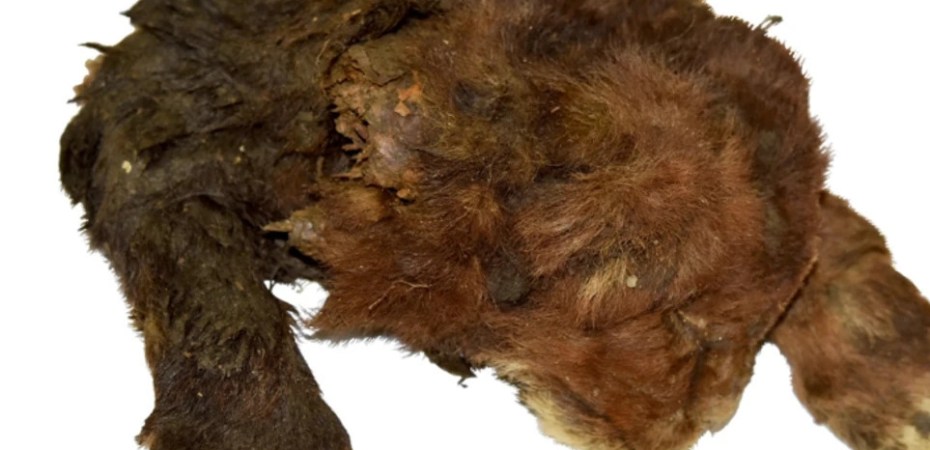
This is the first sabertooth that we have an actual picture of.
In fact, it’s the first time in history that paleontologists have had something other than bones and teeth to use in studying an extinct animal that left no living relatives! (Lopatin et al.)
That is the mummy of a partially preserved Homotherium cub, discovered in Siberian permafrost in 2020.
It is about three weeks old, Lopatin et al. report, judging by its baby teeth as compared to those of a lion cub of that age.
Careful examination of its anatomy confirms the muscle-based reconstructions that paleoartists like Mauricio Antón have made of sabercats. (Lopatin et al.)
Examples of how Antón reconstructs sabercats are plentiful in Sabertooth, the inspiration and guide for this post series.
The sabercat cub’s neck is longer and much more muscular than the lion cub’s, even at this young age.
Indeed, from what the experts can see (only the front part of the body was preserved), all the features that would be expected in an adult Homotherium, based on those reconstructions, are already present.
Some perishable details that would never fossilize are seen, too — most notably that adorable soft brown fur.
Lopatin et al. report that it is around an inch long, longest on the neck and back, with a fringe at the mouth.
Since Arctic predators are often white, the dark color probably surprised everyone except the people who set up this museum exhibit, shown in 3D for maximum impact:

Wim Hoppenbrouwers, CC BY-NC-ND 2.0.
Adult Homotheriums were not so cute!
The Siberian cub has a double row of whiskers, and its front paws are broader than the lion cub’s, with big square pads instead of the typical oval ones — “snowshoes,” in other words and insulation to keep the sabercat’s feet warm in Arctic conditions. (Lopatin et al.)
Cubby (my nickname for it) also has unusually small ears — a good way to avoid frostbite!
There is no mention in the paper of how this little Homotherium might have died. It was found encased in ice in a northeast Siberian layer of permafrosted loamy loess that also has yielded many mammoth bones.
Radiocarbon dating showed the researchers that Cubby is 35,500 to 37,000 years old.
This is much older than the youngest known Homotherium, an ~11,000-year-old adult found in a resting position near a pool inside Friesenhahn Cave in Texas. (Antón, 2013; Werdelin et al.)
The remains of two cubs were also found in that cave.
Life in the wild is hard on the very young!
It isn’t too surprising that we have these glimpses into Homotherium family life in regions as far apart as Texas and Siberia.
In its day, Homotherium was the most widespread sabercat ever found in the fossil record, ranging from South Africa to Yakutsk, from England to China and Java, and from Alaska and the Yukon down through the Lower Forty-Eight and points south as far as Venezuela, perhaps even to Uruguay. (Antón, 2013; Antón et al., 2014)
What was Homotherium?
It was a 4-million-year-old, lion-sized, moderately fanged sabercat that overall had a hyena-like build with loooong front legs, lion-sized hind legs, and a short back. (Agustí and Antón; Antón, 2013)

Mauricio Antón, “Sabertooth,” Figure 3.50, CC BY-NC-ND-SA 4.0
This is not how we laypeople tend to imagine sabercats, but it makes ecological sense for two reasons — keeping up with an abundant food source and beating the competition.
Food
Homotherium lived during the Pliocene era of widespread grasslands and also on the Plio-Pleistocene’s ice-age mammoth steppe (which is where Cubby lived and died).
Herbivores were plentiful on these plains. They probably covered long distances, too, although fossils can’t show animal behavior like annual migrations.
A carnivore that could easily lope over the same ground with them, maintaining enough energy in reserve to catch its dinner on the run, would have an advantage over other predators, which in those days included (but weren’t limited to) bears and wolves.
The bears could run fast but only for short distances. Wolves, we know, chased prey — they still do it today.
We can only guess that Homotherium was a pursuit predator, too, but it’s an educated guess based on the locomotion of a similarly-shaped but otherwise very different modern feliform:
So, did a horde of Homotheriums run down their hapless victims, as wolves and lions do now, out there on the open plains?
Some experts, including Antón, think it is possible, but again: this is behavior that leaves no direct evidence in the fossil record.
Would someone please invent that time machine so we can go find out?!!
Competition
Yes, there were other large cats — sabercats (first Megantereon and then, in the Pleistocene Americas, Smilodon), and also there were conetooths like lions, cougars, and cheetahs — some of them much larger than their descendants or relatives are today. (Agustí and Antón; Antón, 2013; Prothero)
Humans were also on the rise. A wooden spear might not always be an adequate defense, but with it and other simple weapons, our ancestors could and probably did take the same prey as Homotherium and sometimes drive it off its kills. (Antón, 2013)
They did so at great risk, but Homotherium might be more evenly matched against Smilodon or the large conetooths, or perhaps even at a slight disadvantage given its relatively light build.
No doubt big Homotherium could hold its own in a fight, but it was probably much easier on all the cats for them to just do some niche partitioning, that is, develop ways to both avoid each other while earning a living.
One way to do that is by going after different prey.
Another way is to use different hunting styles. Today we see that in cheetahs.
Time out for a cheetah run! Actual comment: “The cheetah ran into the future and waited for its prey come to him.”
Cheetahs also hunt during the day when lions are most likely to be inactive. Their niche partition includes, among other things, both locomotion and time shifting.
Leopards bring in size difference, as well as adding a wrinkle to the locomotion partition.
They are smaller than lions or tigers and are also very good at climbing, both as an escape method and as a way to hang on to a meal by dragging it out of the reach of scavengers.
Leopards also hunt in trees — something you will not see lions or tigers doing, and the leopard is big enough to deal with any smaller cats they might encounter up there.
That’s just a brief look at a few of the many ways cats manage to coexist with each other and other groups like scavengers today. The ecology of living cats is amazing.
It was undoubtedly amazing back in Homotherium’s time, too, but we can’t see it clearly because of the fossil record’s limitations. (Antón, 2013; Antón et al., 2014)
However Homotherium might have used its hyena-like shape, this probably in some way kept it from competing with Smilodon in the sabercat niche (which isn’t well understood because they are all gone now).
Homotherium didn’t crunch bones, though, as both hyenas and lions do today.
It had huge and very sharp carnassial cheek teeth, the better to slice up and chow down a kill before scavengers arrived.
Supporters of the group-living hypothesis, by the way, use the presence of speed-eating cheek teeth as indirect evidence that a successful hunting horde of Homotheriums needed to eat voraciously, as lions do, after a kill (grisly video coming up):
Unlike solitary cats, lion prides can keep scavengers at a distance until the lions have had their fill. For reference, per Wikipedia Homotherium was between about 5 and 6-1/2 feet long, between 3 and 4 feet high at the shoulder, and could weigh up to 440 pounds.
Speaking of teeth…
Scimitar-tooth and dirk-tooth
You might have encountered these terms before.
To define them visually, Homotherium was a scimitar-tooth —
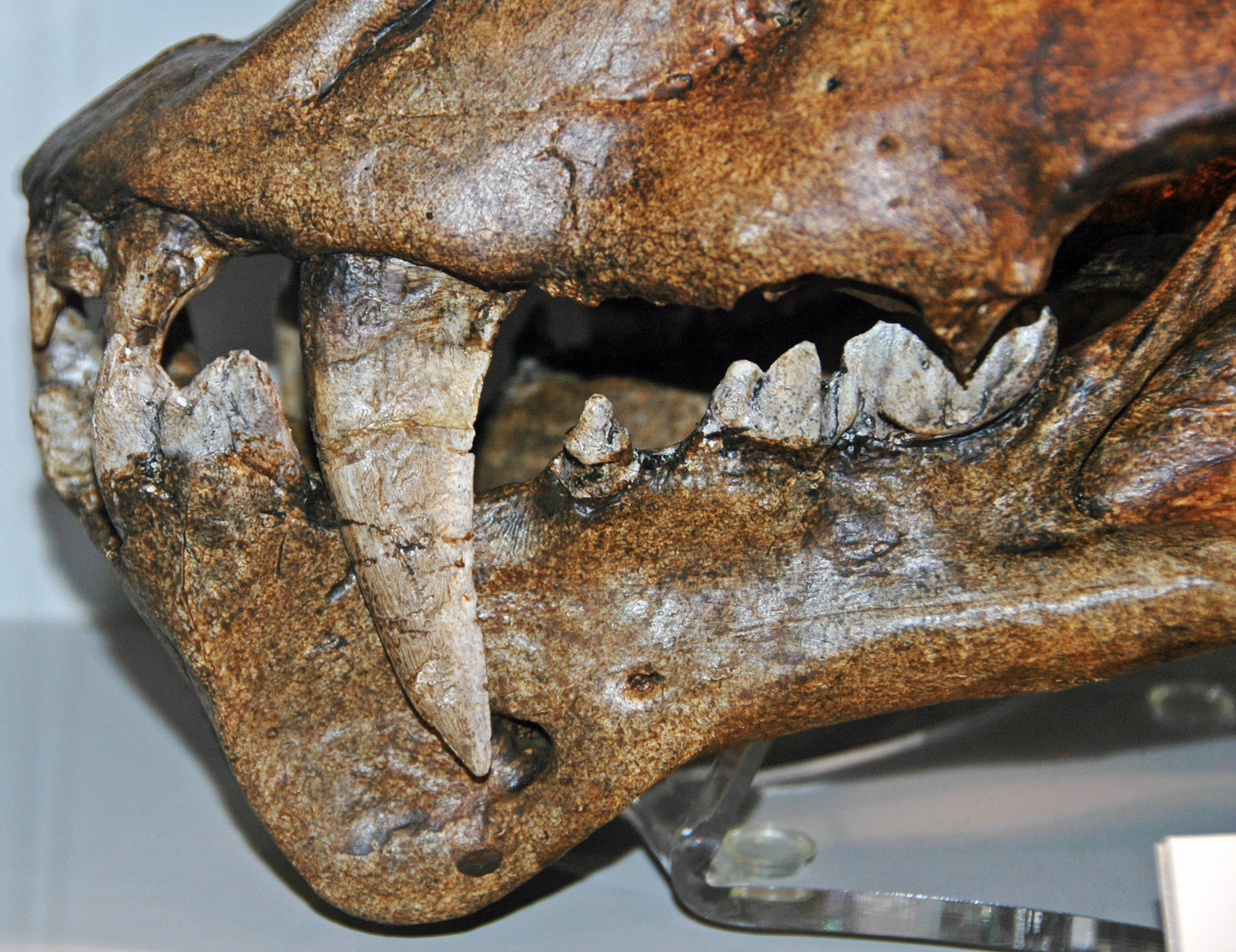
The upper canine is the sabertooth — flat, broad, and comparatively short. (Image: James St. John, CC BY 2.0)
— and Smilodon was a dirk-tooth (and could open its mouth REAL wide):
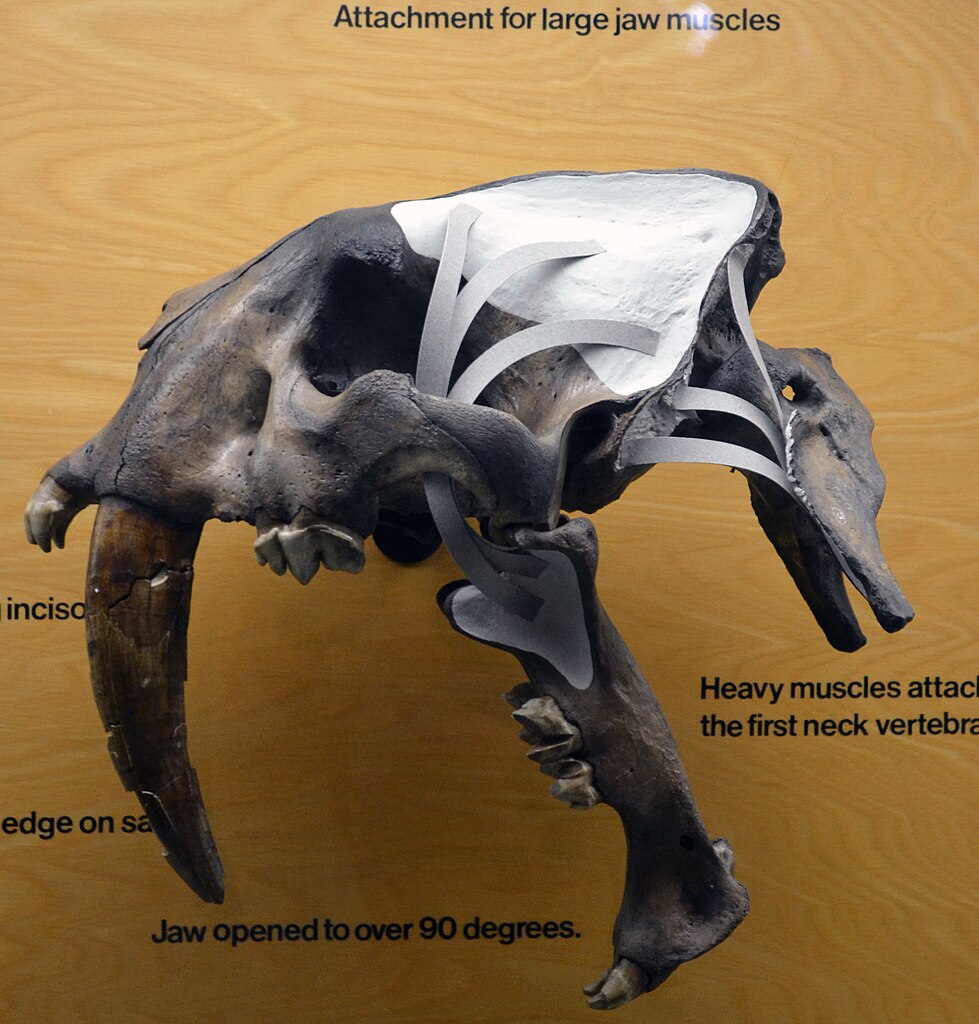
Kniiiiiives…(Image: Joe Blowe, CC BY-SA 2.0)
Since the terms were first introduced almost a century ago, multiple discoveries and new insights have shown that cats and cat-like predators actually had all sorts of sabertooth shapes:
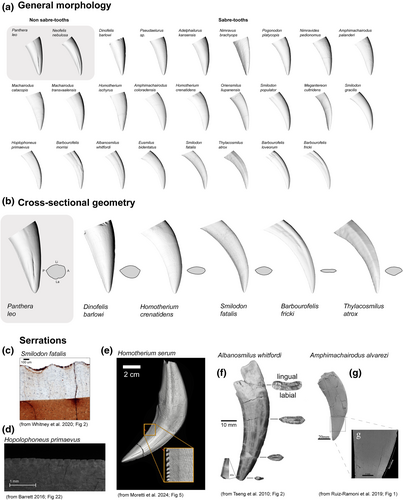
Pollock and Anderson Figure 1, CC BY-ND-NC-SA 4.0
“Scimitar-tooth” and “dirk-tooth” best fit Homotherium and Smilodon, respectively, and that’s all. (Turner et al.)
What is not so widely accepted now is the ecomorph model that developed from these dental differences. (Turner et al.)
Physical differences were also involved.
Homotherium was lightly built, seemingly to have speed as well as strength, while Smilodon’s burly body and shorter legs apparently made it a power player that only needed brief bursts of speed to catch up to and muscle down a prey animal into immobility before using its killing bite.
Scimitar-toothed Homotherium appeared to be adapted to open habitats while dirk-toothed Smilodon, the ambusher, would prefer cover and closed habitats.
And that is likely to have been true of each one. (Antón, 2013)
The ecomorph model extended this to include all sabertooths, regardless of taxon: scimitar-tooths = open habitats; dirk-tooths = more closed and wooded habitats.
That worked for a while, until Xenosmilus was discovered: a scimitar-toothed cat (probably related somehow to Homotherium) with a robust Smilodon-like frame. (Antón, 2013; Turner et al.)
Leave it to cats to mess up the most carefully thought-out plans of professional paleo-cat herders!
Too, as mentioned, we now know that, over millions of years, saberteeth have taken many forms, from the spike-like fangs of Nimravus to the scythes of Barbourofelis; from the feline-like sabers of Dinofelis through Machairodus and Pogy all the way to the last such cats (for now, anyway) — a scimitar-tooth and a dirk-tooth.
And what we understand of it all is meager, compared to all that we still need to find out.
🐆🐾🐅
It is well to end this series on an open note, leaving this and other fundamental questions of how to sort out sabertooths unanswered, just as they are in Academia.
There are plenty of proposed answers, as well as many good questions about sabertooths raised by some of the best minds on the planet.
After all, Academia and museums and paleoart and mass media are where the sabertooths live on and on and on.
I hope I have accomplished the goal of this little introductory series of posts, showing my fellow laypeople that there is much more to sabertooths than Smilodon.
Not that there is anything wrong with Smilodon.
There are many other avenues of entrance into the wonderful world of sabertooths, and I hope that you feel like exploring them now that you have some names and (reconstructed) faces to work with.
Each post in the series also has references at the end not only to show my sources but also to guide the curious reader into the more complex discussions ongoing about such things as species, how Homotherium evolved, and so forth.
The names of fossil sabertooths and current understanding of their interrelationships and other details will probably change with time.
But you don’t need to know all that to enjoy and to be astonished by the shock of going out your door one day and having your daily routine interrupted by this sight.
Featured image: Figure 1A, Lopatin et al. CC BY-NC-ND 4.0.
Disclosure: I am just a fan of paleoartist Mauricio Antón and have no personal, financial, or business connection with him. I just think that readers of my blog should know about his 2013 book Sabertooth and his blog.
Sources:
- Agustí, J., and Antón, M. 2002. Mammoths, sabertooths, and hominids: 65 million years of mammalian evolution in Europe. New York and Chichester: Columbia University Press. Retrieved from https://play.google.com/store/books/details?id=O17Kw8L2dAgC
- Antón, M. 2013. Sabertooth. Bloomington: Indiana University Press. Retrieved from https://play.google.com/store/books/details?id=dVcqAAAAQBAJ
- Antón, M.; Salesa, M. J.; Galobart, A.; and Tseng, Z. J. 2014. The Plio-Pleistocene scimitar-toothed felid genus Homotherium Fabrini, 1890 (Machairodontinae, Homotherini): diversity, palaeogeography and taxonomic implications. Quaternary Science Reviews, 96: 259-268.
- Chatar, N.; Fischer, V.; and Tseng, Z. J. 2022. Many-to-one function of cat-like mandibles highlights a continuum of sabre-tooth adaptations. Proceedings of the Royal Society B, 289(1988), 20221627.
- Chatar, N.; Michaud, M.; Tamagnini, D.; and Fischer, V. 2024. Evolutionary patterns of cat-like carnivorans unveil drivers of the sabertooth morphology. Current Biology, 34(11): 2460-2473.
- Cope, E. D. 1880. On the extinct cats of America. The American Naturalist, 14(12), 833-858.
- ___. 1882. The Tertiary formations of the central region of the United States. The American Naturalist, 16(3): 177-195.
- Figueirido, B.; Janis, C. M.; Pérez-Claros, J. A.; De Renzi, M.; and Palmqvist, P. 2012. Cenozoic climate change influences mammalian evolutionary dynamics. Proceedings of the National Academy of Sciences, 109(3): 722-727.
- Lopatin, A. V.; Sotnikova, M. V.; Klimovsky, A. I.,; Lavrov, A. V.; and others. 2024. Mummy of a juvenile sabre-toothed cat Homotherium latidens from the Upper Pleistocene of Siberia. Scientific Reports, 14(1): 28016.
- Meachen-Samuels, J. A. 2012. Morphological convergence of the prey-killing arsenal of sabertooth predators. Paleobiology, 38(1): 1-14.
- Pollock, T., and Anderson, P. S. 2025. Sharpening our understanding of saber‐tooth biomechanics. The Anatomical Record. https://anatomypubs.onlinelibrary.wiley.com/doi/10.1002/ar.25690
- Prothero, D. R. 2006. After the Dinosaurs: The Age of Mammals. Bloomington and Indianapolis: Indiana University Press. Retrieved from https://play.google.com/store/books/details?id=Qh82IW-HHWAC.
- Slater, G. J., and Van Valkenburgh, B. 2008. Long in the tooth: evolution of sabertooth cat cranial shape. Paleobiology, 34(3): 403-419.
- Turner, A.,; Antón, M.; Salesa, M. J.; and Morales, J. 2011). Changing ideas about the evolution and functional morphology of Machairodontine felids. Estudios Geológicos, 67(2): 255-276.</li.
- Van Valkenburgh, B. 1988. Trophic diversity in past and present guilds of large predatory mammals. Paleobiology, 14(2): 155-173.
- ___. 2007. Déjà vu: the evolution of feeding morphologies in the Carnivora. Integrative and comparative biology, 47(1), 147-163.
- Werdelin, L. 2024. Hypercanines: Not just for sabertooths. The Anatomical Record. https://anatomypubs.onlinelibrary.wiley.com/doi/10.1002/ar.25510
- Werdelin, L.; Yamaguchi, N.; Johnson, W. E.; and O’Brien, S. J. 2010. Phylogeny and evolution of cats (Felidae), in Biology and Conservation of Wild Felids, eds. Macdonald, D. W., and Loveridge, A. J., 59-82. Oxford: Oxford University Press.
- Wikipedia. 2025. Homotherium. https://en.wikipedia.org/wiki/HomotheriumLast accessed November 14, 2025.
 Flight To Wonder