Boo!
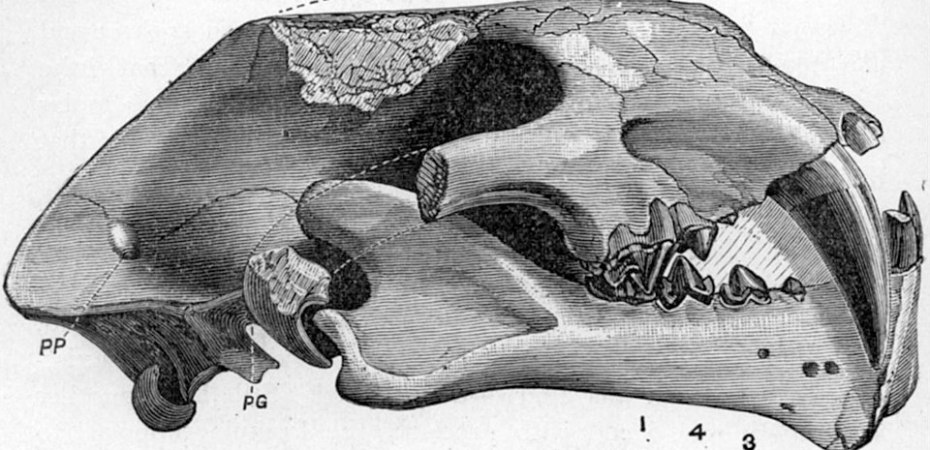
On any other day but Halloween this would just be another old-timey scientific drawing (Figure 9, in Cope, 1880).
Why bother with it when we can look it up online —

Nobu Tamura, via Wikimedia, CC BY-SA 4.0
— go to a museum, or, if we have a spare $75,000 to $161,000 or so, set up a real scare for trick-or-treaters with a “magnificent combination of fossilization and very talented preparation skills” (Source)?
Authenticity, I don’t know about. No doubt those linked reconstructions are as authentic as possible, but I couldn’t find any scientific papers describing even a partial skeleton of this nimravid Pogonodon.

He did not neglect the beast, though. (Image: Mauricio Antón, Figure 3.13 in “Sabertooth,” CC BY-NC-ND-SA 4.0)
Nor does Antón show a full-body Pogonodon in Sabertooth or on his blog.
It lived and died in what is now the John Day geologic formation of central and eastern Oregon — a region much bigger than the famous John Day Fossil Beds National Monument, where Pogonodon also is found.
Not all of the abundant John Day fossils are rigorously documented or officially archived when found. Without such quantitative information, boffins can’t do a reconstruction that would be scientifically useful.
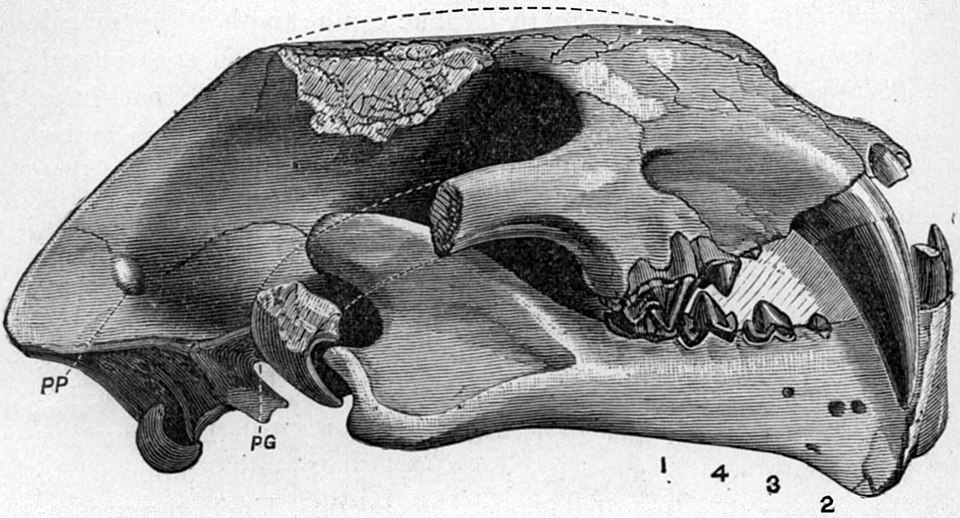
Here it is again. (Image: Figure 9, Cope, 1880)
Today is Halloween, however, so let’s remember that in real life some people not only ran towards this skull, which per Cope (1880) is about one-sixth less the size of a tiger skull (i.e., about the size a very large jaguar), they also risked life and limb for it.
Ahem.
As Cope (1880) tells it:
Science has hitherto had little knowledge of this species, and owes what is here recorded to a fortunate chance. The exploring party which I had sent into the John Day River valley under the direction of Mr. Jacob L. Wortman, in i879, examined the bad-lands in the locality known as The Cove. In passing the bluffs on one occasion, a member of the, party saw on the summit of a pinnacle of the crag what appeared to be a skull. The large shining objects supposed to be teeth attracted his attention, and he resolved to obtain the specimen. He, however, was unable to climb the cliff, and returning to camp narrated the circumstance. The other men of the party successively attempted to reach the object, but were compelled to descend without it, and in one case, at least, the return was made at considerable peril. A later attempt, made by Leander S. Davis, of the party, an experienced collector, was more successful. By cutting notches with a pick, in the face of the rock, he scaled the pinnacle and brought down the skull, but at considerable risk to limb and life.
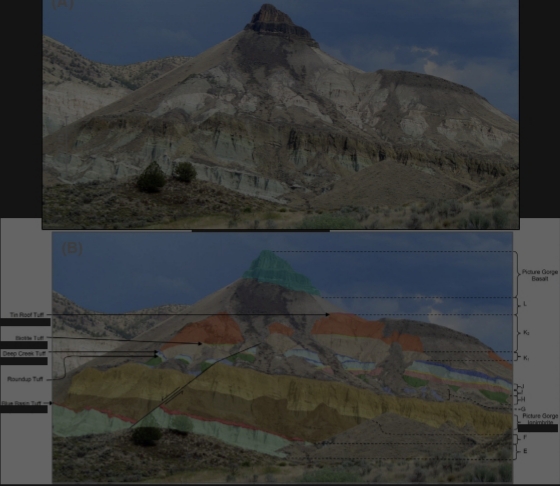
This is Sheep Rock, not The Cove, and those are not the exact pinnacles that doughty Leander S. Davis scaled in 1879, but all of the Turtle Cove rocks look something like this, with the exception of the dark Miocene basalt that, according to McClaughry et al., caps Sheep Rock. (Image: Mohr et al., Figure 2, A and B, CC BY-NC-ND-SA 4.0)
How cool is that?
Cope used this skull as the type species for genus Pogonodon.
What is Pogonodon?
Cope rather colorfully calls it “a station on the line connecting Dinictis with the higher sabertooths.”
I guess in those days evolution could be compared to a train and “higher” meant “more extreme.”
Things are very different now, but that’s a whole ‘nother topic.
Antón notes that Pogonodon was closely related to Dinictis. It probably was fairly large, at least the size of a small female leopard, but Pogonodon had more impressive teeth than Dinictis did and longer sabers, too, although not quite as long as the saberteeth of Hoplophoneus. (Meachen-Samuels)
Perhaps, besides having a skull the size of a large jaguar, Pogonodon also had a similar wrestler-style build.
We don’t know what nimravid family life was like, either, but they probably had their mellow moments.
Anyway, Pogonodon’s foreleg long bones are among the identified fossils from this Oligocene critter and they are more robust than those of any other known nimravid (Meachen-Samuels), meaning that those bones must have supported very powerful muscles.
Again, though, we’re talking nimravids here, not the moving cat mountain that was Smilodon populator.
The National Park Service uses imagination in its downloadable Pogonodon maze for kids, giving the cat nimravid a small, lion-like mane — which for all we know, nimravids had; manes and other external features wouldn’t fossilize — and huge tiger-like paws, which are very unlikely.
Pogonodon’s feet were smaller than those of today’s cats (Cope, 1880), and like probably all nimravids, Pogondon was rather flat-footed just as the NPS shows it — built for ambush, not pursuit. (Antón, 2013)

“RAWR!!!”
🐾🐾🐾
Time: From around 32 Ma (million years ago), which was at the start of the Whitneyan land mammal age to around 28 Ma, the early Arikareean (late Oligocene). (Antón, 2013; Barrett, 2016)
Setting: Pogondon came along after the Eocene forests had vanished as Earth began to cool and to dry out. It even missed the very early Oligocene wooded grasslands and gallery forests of North America described by Prothero.
Pogonodon’s world was mostly open grassy land, with a few trees along waterways — not that there was much water, at least seasonally. Estimated annual rainfall at the time was only slightly more than that measured in today’s deserts. (Prothero; Van Valkenburgh, 1988)
However, chemical alteration observed in Turtle Cove rocks suggests that some of the many preserved pyroclastic flows in the John Day region entered shallow lakes (Mohr et al.), which is where herbivores and carnivores of those times would have congregated and perished.
Just so many pyroclastic flows!
The John Day Formation has an abundance of Oligocene fossils for the same sad reason that the White River Group we explored last time does: an ignimbrite flare-up was underway. (This far north and west, there might have been other reasons for volcanism, too.) (Best et al., 2013, 2016; McClaughry et al.)
One of those eruptions would cover huge areas, annihilating plants and animals but frequently preserving their fossilized remains in volcanic sediments.
Life would gradually come back and thrive for hundreds of thousands of years or more until there was another eruption, more suffocating ashfall, and more fiery death clouds.
Repeat this cycle again and again.
As the Oligocene went on, though, the older White River Fauna lineages began to falter, as all long-lived groups eventually do.
At the top of the late Oligocene food chain, hyaenodonts were fading away, bear-dogs were few, and the going was tougher for nimravids, too, although they would keep on, as a group, into the very early Miocene. (Chabrol et al.; Prothero; Van Valkenburgh, 1988)
Prothero describes Pogonodon and Nimravus (who we will meet next time) as among the last of North America’s nimravids.
I prefer another colorful description from Cope (1880) to remember Pogonodon by: “[It] doubtless held the field in Oregon against all rivals.”
Featured image: Figure 9, Cope (1880), public domain.
Disclosure: I am just a fan of this paleoartist and have no personal, financial, or business connection with Mauricio Antón. I just think that readers of my blog should know about his book Sabertooth and his blog.
Sources:
- Agustí, J., and Antón, M. 2002. Mammoths, sabertooths, and hominids: 65 million years of mammalian evolution in Europe. New York and Chichester: Columbia University Press. Retrieved from https://play.google.com/store/books/details?id=O17Kw8L2dAgC
- Antón, M. 2013. Sabertooth. Bloomington: Indiana University Press. Retrieved from https://play.google.com/store/books/details?id=dVcqAAAAQBAJ
- ___. 2017. A glimpse into an Eocene lost world. https://chasingsabretooths.wordpress.com/2017/01/18/a-glimpse-into-an-eocene-lost-world/
- Averianov, A.; Obraztsova, E.; Danilov, I.; Skutschas, P.; and Jin, J. 2016. First nimravid skull from Asia. Scientific Reports, 6(1): 25812.
- Barrett, P. Z. 2016. Taxonomic and systematic revisions to the North American Nimravidae (Mammalia, Carnivora). PeerJ, 4: e1658.
- ___. 2021. The largest hoplophonine and a complex new hypothesis of nimravid evolution. Scientific Reports, 11(1): 21078.
- Best, M. G.; Christiansen, E. H.; and Gromme, S. 2013. Introduction: The 36–18 Ma southern Great Basin, USA, ignimbrite province and flareup: Swarms of subduction-related supervolcanoes. Geosphere, 9(2): 260-274.
- Best, M. G.; Christiansen, E. H.; de Silva, S.; and Lipman, P. W. 2016. Slab-rollback ignimbrite flareups in the southern Great Basin and other Cenozoic American arcs: A distinct style of arc volcanism. Geosphere, 12(4): 1097-1135.
- Bryant, H. N. 1991. Phylogenetic relationships and systematics of the Nimravidae (Carnivora). Journal of Mammalogy, 72(1), 56-78.
- Chabrol, N.; Morlon, H.; and Barido-Sottani, J. 2025. The Fossilized Birth Death Process with heterogeneous diversification rates unravels the link between diversification and specialisation to a carnivorous diet in Nimravidae (Carnivoraformes). bioRxiv, 2025-07.
- Chatar, N.; Fischer, V.; and Tseng, Z. J. 2022. Many-to-one function of cat-like mandibles highlights a continuum of sabre-tooth adaptations. Proceedings of the Royal Society B, 289(1988), 20221627.
- Chatar, N.; Michaud, M.; Tamagnini, D.; and Fischer, V. 2024. Evolutionary patterns of cat-like carnivorans unveil drivers of the sabertooth morphology. Current Biology, 34(11): 2460-2473.
- Cope, E. D. 1880. On the extinct cats of America. The American Naturalist, 14(12), 833-858.
- ___. 1882. The Tertiary formations of the central region of the United States. The American Naturalist, 16(3): 177-195.
- Figueirido, B.; Janis, C. M.; Pérez-Claros, J. A.; De Renzi, M.; and Palmqvist, P. 2012. Cenozoic climate change influences mammalian evolutionary dynamics. Proceedings of the National Academy of Sciences, 109(3): 722-727.
- Jicha, B. R.; Scholl, D. W.; and Rea, D. K. 2009. Circum-Pacific arc flare-ups and global cooling near the Eocene-Oligocene boundary. Geology, 37(4), 303-306.
- Larson, E. E., and Evanoff, E. 1998. Tephrostratigraphy and source of the tuffs of the White River sequence.
- McClaughry, J. D.; Ferns, M. L.: Streck, M. J.; Patridge, K. A.; and Gordon, C. L. 2009. Paleogene calderas of central and eastern Oregon: Eruptive sources of widespread tuffs in the John Day and Clarno Formations. https://pubs.geoscienceworld.org/gsa/books/edited-volume/885/chapter-abstract/3930413/Paleogene-calderas-of-central-and-eastern?redirectedFrom=fulltext.
- Meachen-Samuels, J. A. 2012. Morphological convergence of the prey-killing arsenal of sabertooth predators. Paleobiology, 38(1): 1-14.
- Mohr, M. T.; Famoso, N. A.; Samuels, J. X.; Laib, A. C.; and Schmitz, M. D. 2025. U-Pb zircon geochronology and chronostratigraphy of the Eocene–Miocene John Day Formation of central and eastern Oregon. Geosphere.
- Poust, A. W.; Barrett, P. Z.; and Tomiya, S. 2022. An early nimravid from California and the rise of hypercarnivorous mammals after the middle Eocene climatic optimum. Biology Letters, 18(10): 20220291.
- Prothero, D. R. 2006. After the Dinosaurs: The Age of Mammals. Bloomington and Indianapolis: Indiana University Press. Retrieved from https://play.google.com/store/books/details?id=Qh82IW-HHWAC.
- Rose, K. D. 2006. The Beginning of the Age of Mammals. JHU Press.
- Slater, G. J., and Van Valkenburgh, B. 2008. Long in the tooth: evolution of sabertooth cat cranial shape. Paleobiology, 34(3): 403-419.
- Van Valkenburgh, B. 1988. Trophic diversity in past and present guilds of large predatory mammals. Paleobiology, 14(2): 155-173.
- ___. 2007. Déjà vu: the evolution of feeding morphologies in the Carnivora. Integrative and comparative biology, 47(1), 147-163.
- Welsh, E. (2014, January). The first record of Osbornodon (Carnivora: Canidae) from the Orellan of South Dakota. In Proceedings of the South Dakota Academy of Science (Vol. 93, pp. 43-53).
- Werdelin, L. 2024. Hypercanines: Not just for sabertooths. The Anatomical Record. https://anatomypubs.onlinelibrary.wiley.com/doi/10.1002/ar.25510
- Werdelin, L.; Yamaguchi, N.; Johnson, W. E.; and O’Brien, S. J. 2010. Phylogeny and evolution of cats (Felidae), in Biology and Conservation of Wild Felids, eds. Macdonald, D. W., and Loveridge, A. J., 59-82. Oxford: Oxford University Press.
- Wikipedia. 2025. Hoplophoneus. https://en.wikipedia.org/wiki/Hoplophoneus Last accessed October 10, 2025.
- Zack, S. P.; Poust, A. W.; and Wagner, H. 2022. Diegoaelurus, a new machaeroidine (Oxyaenidae) from the Santiago Formation (late Uintan) of southern California and the relationships of Machaeroidinae, the oldest group of sabertooth mammals. PeerJ, 10: e13032.
 Flight To Wonder