
This looks like an ideal pet for someone who can’t decide whether they want a cat or a dog and who also might be looking for deterrence because they live in a rough neighborhood.
That’s actually a beautiful reconstruction portrait by Mauricio Antón, of course (Figure 3.26 in Sabertooth, CC BY-ND-NC-SA 4.0), but not of a cat.
Meet Barbourofelis morrisi, from Late Miocene Nebraska!
It has come a long evolutionary way from Middle Miocene Europe’s plush-toy-lookalike Sansanosmilus, but even morrisi will be overshadowed by the species that comes after it: the last barbourofelid, and by far the largest. (Antón, 2013)
🐾🐾🐾

Image: Antón, Figure 4.12 in “Sabertooth,” CC BY-ND-NC-SA 4.0
Their blades are extreme, and Antón reports that these Barbourofelis fricki sabertooths are 3 feet (90 cm) tall at the shoulder — about Smilodon populator size — with the mass of an African lion distributed over a bony frame that is much more powerfully built than anything seen in big cats today.
How the ground must have shaken during such battles!
Not shown: wusses. But also not present: extreme saberteeth.
Somehow, both Nimravides and Amphimachairodus (or Machairodus coloradensis, as some call it) managed to get along with B. fricki for millions of years, but it’s obvious who must have ruled the roost.
🐾🐾🐾
Last time, we met the very first known barbourofelids (along with a considerable amount of associated uncertainty) in Africa.
Now for the later ones. (Note: The uncertainties are fewer but have not gone away.)
Exactly what cats barbourofelids are we talking about here?
All of those outside of Africa — the ones that some paleontologists suggest were more advanced than the original group.
At least that is how I’m going to present barbourofelids.
There are other valid ways to look at these cat-like Miocene sabertooths, and, with one exception related to Wikipedia, I will completely ignore them all.
They draw us laypeople too deeply into the whirlpool of unanswered questions about barbourofelids and the older group that they resemble in many (but not necessarily all) ways: the nimravids.
We’ll meet our first nimravid next time.

This character. (Image: Mauricio Antón, Figure 3.20 in “Sabertooth,” CC BY-ND-NC-SA 4.0.
For now, just to keep the post both simple and accurate, let’s follow Sabertooth (although Antón’s own view of barbourofelids has probably done some evolving of its own over the intervening twelve years).
According to his 2013 book, barbourofelids have their own family but are more closely related to cats than to nimravids (the group at the bottom of these family trees):
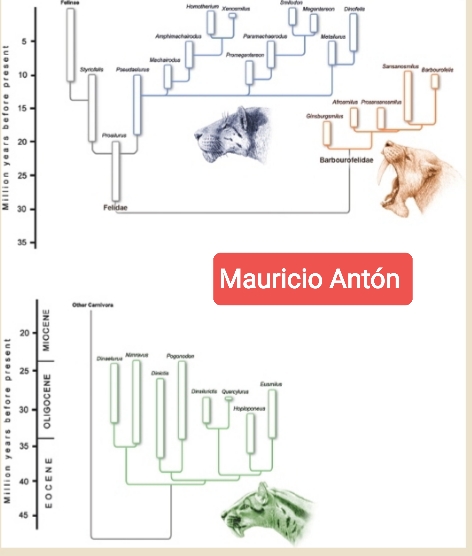
All such graphics should have Antón sabertooths on them! (Image: Figure 1.8, in “Sabertooth,” CC BY-ND-NC-SA 4.0)
That may or may not be the current view among paleontologists.
But any view of barbourofelids is likely to change over time.
This book-based approach gives us a basic handle on a little-known group of sabertooths that once roamed the Northern Hemisphere as well as Africa — beautiful, mysterious, and more than a little frightening — whose existence some of us might never have even suspected until now.
What follows is based solely on Sabertooth with added links from Wikipedia to get you started on your own explorations; dates are from Werdelin et al.
We can’t entirely avoid uncertainty, though.
Whoever wrote the current Wikipedia articles on the two starred critter groups (genera) listed below has yet to discover Werdelin’s comments on Afrosmilini and nimravids in his 2024 hypercanines paper.
I’ll get into that briefly after we meet our toothy new friends.
Sansanosmilus
Time: About 17 to 9.5 Ma (million years ago).

Figure 3.23 in Antón’s book Sabertooth, CC BY-NC-ND-SA 4.0.
Here’s our plush-toy-lookalike!
In real life, powerful Sansanosmilus, the size of a modern leopard, must have been feared wherever it lived — to date, its fossils have been identified in France and in the Himalayan Siwaliks foothiils. (Antón, 2013; Jasinski et al.)
Although its saberteeth were only moderately long, they were more developed than anything seen thus far in the African species, plus its skull had multiple bony adaptations typical of sabertoothed predators.
Sansanosmilus had almost completely flat (semi-plantigrade) feet and shorter legs, but it was about the same overall size as toe-walking (digitigrade) P-Quad (my nickname for the biggest cat in those times: Pseudaelurus quadridentatus).
Albanosmilus**
Dates: Same as Sansanosmilus, because the Werdelin et al. paper is from 2010.
Until 2013, this Eurasian barbourofelid was considered to be a Sansanosmilus, but enough differences were recognized in 2013 to give the cat-like predator its own genus.
Antón (2013) only mentions the Spanish Albanosmilus. As you can see at Wikipedia, much more has been said about this genus since then, and it has been recognized in North America as well as Eurasia (Antón did mention similarities between the Eurasian and North American specimens).
According to some paleontologists, Albanosmilus might even be the ancestor of…
Barbourofelis**
Dates: About 12 to 9.8 Ma.
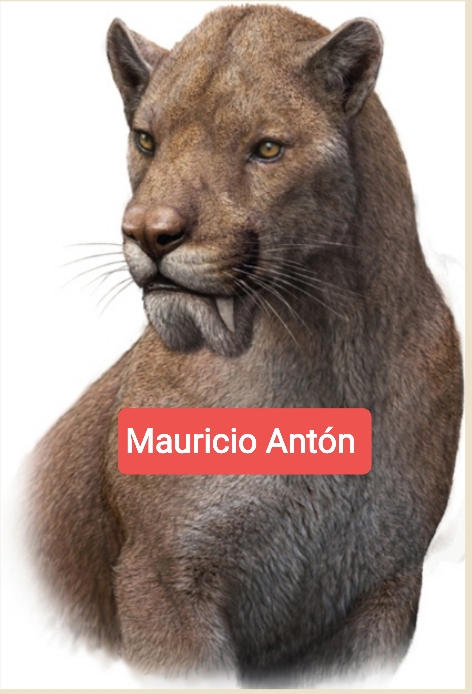
North America’s Barbourofelis morrisi was about the size of a large leopard, and as you can see, it was a very muscular beast.
Antón considers morrisi an intermediate form between the relatively primitive Eurasian barbourofelids mentioned above and the extreme sabertooths that followed it.
Here is the Wikipedia page on Barbourofelis.
Two notable barbourofelids described by Antón were loveorum and fricki.
🐾🐾🐾
B. loveorum was down in Florida, along with Galiani’s cat, a Nimravides species.
Somehow the two coexisted for quite a while, as did other sabercats and barbourofelids elsewhere in North America and in Eurasia. (Agustí and Antón; Jiangzuo et al.; Prothero)
Here is loveorum not showing any kindness at all towards a hapless herbivore:

This is what Florida’s Love Bone Bed might have looked like back in the day. (Image: Mauricio Antón, Figure 2.14 in “Sabertooth,” CC BY-NC-ND-SA 4.0)
Note the somewhat flat-footed stance and stubby tail. Also, it takes a strong back to stand on your haunches like that and pull down an ancestral rhino of some sort with your front legs and your chest, shoulder, and neck musculature.
Antón apparently agrees with paleontologists who argue that Barbourofelis might have hunted in social groups.
Behavior doesn’t fossilize, but as I understand it, some experts suggest that cubs took so long to grow their adult sabers, they couldn’t have hunted independently for years. Meanwhile, though, older cubs could help Mom with their weight and muscle power.
It sounds reasonable, but until someone invents a time machine, this can only be speculative.
🐾🐾🐾
The last, largest, and most spectacular barbourofelid was B. fricki:
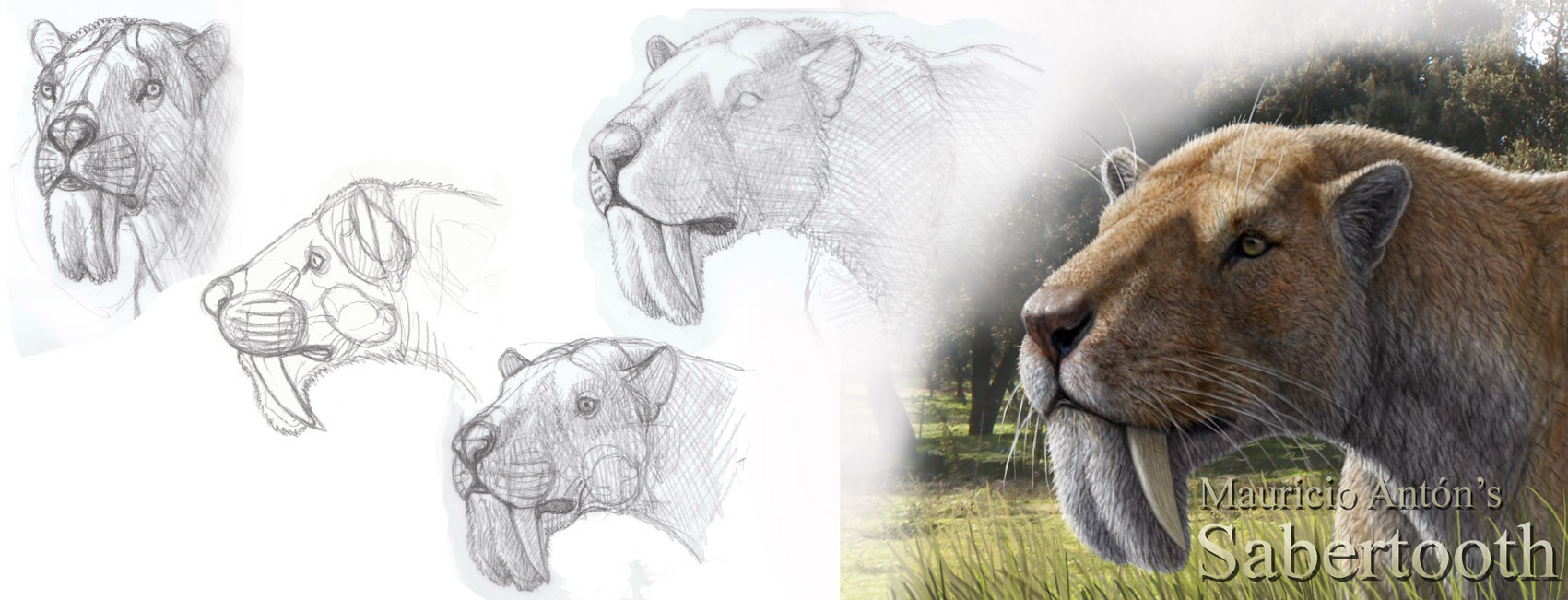
“Smilodon who?” — B. fricki. (Image: Mauricio Antón, CC BY-ND-NC-SA 4.0)
For all its size and enormous muscles, fricki, like most barbourofelids, had short legs and a short, stiff back that was probably used as Antón has drawn it in loveorum, as an aid to pulling down and immobilizing prey for the killing bite.
My reading shows that the stiff barbourofelid backs could flex vertically, enabling a gallop.
However, those short, muscle-bound legs were not built for speed, and as mentioned in the Amphimachairodus post, both Nimravides and fricki probably ran out of luck in the late Miocene when their prey developed long legs in response to an advance in plant evolution that led to the tall-grass prairies that we can still see in a few places on North America’s plains today. (Jiangzuo et al.)
**Werdelin’s comment
In the 2024 paper on hypercanines, Dr. Werdelin, of course, was responding to the papers that reclassified barbourofelids as nimravids from 2013 on, not to the Wikipedia articles on Albanosmilus and Barbourofelis that reference those papers.
It’s actually an arcane and ongoing debate in Academia.
Since we haven’t even met nimravids yet, let’s just say that Werdelin notes two basic problems with the idea:
- A geologically long span of time passed between nimravids and barbourofelids.
This is unusual in closely related groups — there should be some intermediate forms to connect them, just as all those prehistoric cats, with and without saberteeth, connect today’s Fluffy & Co. with the Dawn Cat Proailurus almost 30 million years ago.
- The Afrosmilini are very primitive, not only compared to later barbourofelids but also when compared to the nimravids that they supposedly evolved from.
This suggests to Werdelin the possibility that saberteeth developed twice independently — okay, three times, if we count Family Felidae, although Werdelin is strictly focused on the two cat-like predator groups.
No matter what status you give the barbourofelids, saberteeth seem to have developed once in nimravids and then again in the Afrosmilini (you see, Africa was geographically isolated in nimravid times, with its own unique animals and plants and with archaic hyaenodonts — not hyenas and not members of the Order Carnivora — as the only predators up until the Early to Middle Miocene when cats/cat-like predators are first recorded there.
Werdelin goes into more detail about this, but we don’t really need to.
Now that we know Smilodon wasn’t THE sabercat, but only one of the most recent sabercats, we can appreciate every new idea about barbourofelids and other sabertooths that comes along.
What we actually need right now, given where we’re headed next time, is a weather report and satellite check.
Nimravids lived in a very different world from that experienced by the Miocene cats and barbourofelids we have been visiting with for so long.
Let’s take one last look at the Miocene, as well as a quick glance at the times that came before it as they relate to our sabertooths.
Satellite view:
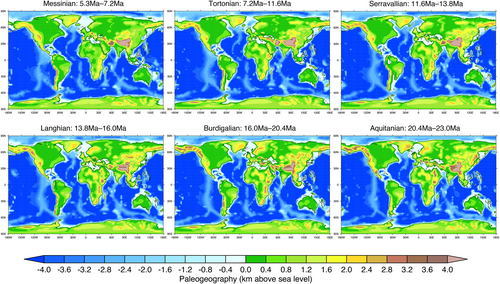
Figure 3, Steinthorsdottir et al., CC BY-NC-ND-SA 4.0
Weather report and Setting:
Steinthorsdottir et al. sum this up better than I ever could:
During the Miocene time period (∼23–5 million years ago), Planet Earth looked similar to today, with some important differences: the climate was generally warmer and highly variable, while atmospheric CO2 was not much higher. Continental-sized ice sheets were only present on Antarctica, but not in the northern hemisphere. The continents drifted to near their modernday positions, and plants and animals evolved into the many (near) modern species. Scientists study the Miocene because present-day and projected future CO2 levels are in the same range as those reconstructed for the Miocene. Therefore, if we can understand climate changes and their biotic responses from the Miocene past, we are able to better predict current and future global changes…
The barbourofelids and Family Felidae were just part of a big and intricate picture that is still not well understood.
One interesting and topical thing I’ve learned from reading is that cats and cat-like predators — including nimravids — first appeared as the world began to cool down and then thrived as the big chill continued.
🌎🌍🌏
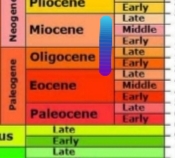
The blue-spectrum line is pointing at the total time that nimravids and barbourofelids spent on Earth (there was a gap between the two from late in the Oligocene to earliest Miocene). Until the Miocene, this was also a time of major climate change. (Source, public domain)
Believe it or not, during the hothouse early Eocene, Earth was still a global forest, much of it a rainforest, with subtropical to temperate woods at the poles (along with alligators and other warmth-loving animals within the Arctic Circle!) — this, according to Prothero.
Then the planet entered a cooling phase, some 40 million years ago, for complex and still not totally understood reasons. (Westerhold et al.)
Cool air holds less water vapor than warm air does, so the global cooldown led, in intricate ways, to drying and the world wide woods began to open up. (Prothero)
And, at some point in the late Eocene between 35 and 40 million years ago, cat-like nimravids appeared in the fossil record. (Werdelin, 2024)
🐈🐅🐆
In a series of stuttering stops and starts, interspersed with just a few warm spells, the world continued to cool down and dry out during the Oligocene, which is probably when barbourofelids as well as true cats first showed up. (Prothero; Werdelin, 2024; Werdelin et al.)
We can never know about the barbourofelids and nimravids, but today’s cats are certainly a flexible bunch, inhabiting environments as different as the Sahara (sand cat), the Himalayas (snow leopard and lynx), and rainforest (jaguar, leopard, and a variety of smaller cats).
No one knows where the feline shape shared by felid, barbourofelid, and nimravid comes from, but it likely developed from a very flexible carnivoran who subsequently refined it as Earth’s transitioned, per Westerhold et al., among others, from greenhouse to icehouse (our current planetary setting) over some 40 million years.
Most of those cats and cat-like predators, up until around 13,000 years or so years ago, had saberteeth, too.
This, of courses, raises the interesting question of what’s the secret of conetooth success, but I haven’t read anything about that yet.
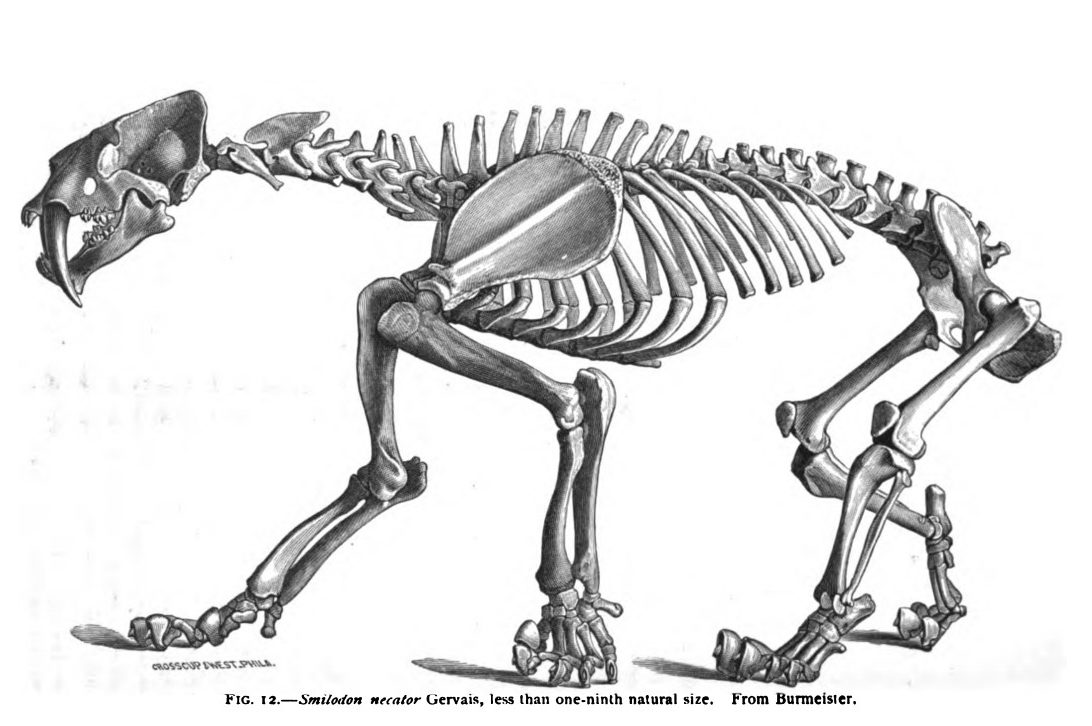
Much more charismatic, for scientists as well as us laypeople. (Image: E. D. Cope, public domain)
The Steinthorsdottir et al. paper, except for that “simple language” section contains much jargon but it thoroughly reviews the Miocene from every possible angle.
They can’t cover the great turnover in carnivores at epoch’s end, when all sabercats vanished other than Megantereon and Homotherium (this series’ closing bookend to the opening Smilodon post).
Was it climate change? Competition from conetoothed big cats like the lions? Something else?
More unanswered questions, and we must leave them up there and move on, into the Oligocene, to track down Eusmilus…
Featured image: Figure 3.26 in Antón’s book Sabertooth, CC BY-NC-ND-SA 4.0. I watermarked it, as he does with images on his blog, and hope that it might encourage you to purchase his book, with all its wonderful artwork and detailed information on sabertooths from Permian times on down to yesterday, some 12,000 years ago.
Disclosure: I am just a fan of this paleoartist and have no personal, financial, or business connection with Mauricio Antón. I just think that readers of my blog should know about Sabertooth.
Sources:
- Agustí, J., and Antón, M. 2002. Mammoths, sabertooths, and hominids: 65 million years of mammalian evolution in Europe. New York and Chichester: Columbia University Press. Retrieved from https://play.google.com/store/books/details?id=O17Kw8L2dAgC
- Anton, M. 2003. Reconstructing fossil mammals from Arrisdrift (17-17.5 Ma), Namibia, in Memoir 19, Geology and Palaeobiology of the Central and Southern Namib, Vol. 2, Palaeontology of the Orange River Valley, Pickford, M., and Senut, B., eds. Geological Survey of Namibia. https://the-eis.com/elibrary/sites/default/files/downloads/literature/Reconstructing%20fossil%20mammals%20from%20Arrisdrift.pdf (PDF) (Reader note: Check this out, if you’re interested in paleoart — Antón goes into vivid detail on how he reconstructs fossil animals in general!)
- ___. 2013. Sabertooth. Bloomington: Indiana University Press. Retrieved from https://play.google.com/store/books/details?id=dVcqAAAAQBAJ
- Chatar, N.; Fischer, V.; and Tseng, Z. J. 2022. Many-to-one function of cat-like mandibles highlights a continuum of sabre-tooth adaptations. Proceedings of the Royal Society B, 289(1988), 20221627.
- Chatar, N.; Michaud, M.; Tamagnini, D.; and Fischer, V. 2024. Evolutionary patterns of cat-like carnivorans unveil drivers of the sabertooth morphology. Current Biology, 34(11): 2460-2473.
- Jiangzuo, Q.; Li, S.; and Deng, T. 2022. Parallelism and lineage replacement of the late Miocene scimitar-toothed cats from the old and New World. Iscience, 25(12).
- Johnson, W.E.; Eizirik, E.; Pecon-Slattery, J.; Murphy, W.J.; and others. 2006. The Late Miocene radiation of modern Felidae: a genetic assessment. Science, 311: 73-77.
- Juhn, M. S.; Balisi, M. A.; Doughty, E. M.; Friscia, A. R.; and others. 2024. Cenozoic climate change and the evolution of North American mammalian predator ecomorphology. Paleobiology, 50(3): 452-461.
- Lyras, G. A.; Giannakopoulou, A.; and Werdelin, L. 2019. The brain anatomy of an early Miocene felid from Ginn Quarry (Nebraska, USA). PalZ, 93(2): 345-355.
- Morales, J.; Salesa, M. J.; Pickford, M.; and Soria, D. 2001. A new tribe, new genus and two new species of Barbourofelinae (Felidae, Carnivora, Mammalia) from the Early Miocene of East Africa and Spain. Earth and Environmental Science Transactions of the Royal Society of Edinburgh, 92(1): 97-102.
- Morales, J., and Pickford, M. 2018. A new barbourofelid mandible (Carnivora, Mammalia) from the early Miocene of Grillental-6, Sperrgebiet, Namibia. Communications of the Geological Survey of Namibia, 18, 113-123.
- Ormsby, C. 2021. Morphology and Paleoecology of Nimravides galiani (Felidae) and Barbourofelis loveorum (Barbourofelidae) from the Late Miocene of Florida. Electronic Theses and Dissertations, Paper 3902 https://dc.etsu.edu/etd/3902
- Prothero, D. R. 2006. After the Dinosaurs: The Age of Mammals. Bloomington and Indianapolis: Indiana University Press. Retrieved from https://play.google.com/store/books/details?id=Qh82IW-HHWAC.
- Rothwell, T. P. 2001. Phylogenetic systematics of North American Pseudaelurus (Carnivora: Felidae). Columbia University.
- ___. 2004. New felid material from the Ulaan Tologoi locality, Loh Formation (early Miocene) of Mongolia. Bulletin of the American Museum of Natural History, 2004(285): 157-165.
- Salesa, M. J.; Anton, M.: Turner, A.; Alcala, L.; and others. 2010. Systematic revision of the Late Miocene sabre‐toothed felid Paramachaerodus in Spain. Palaeontology, 53(6): 1369-1391.
- Salesa, M. J.; Antón, M.; Morales, J.; and Peigné, S. 2012. Systematics and phylogeny of the small felines (Carnivora, Felidae) from the Late Miocene of Europe: a new species of Felinae from the Vallesian of Batallones (MN 10, Madrid, Spain). Journal of Systematic Palaeontology, 10(1): 87-102.
- Shelbourne, C. D., and Lautenschlager, S. 2024. Morphological diversity of saber‐tooth upper canines and its functional implications. The Anatomical Record.
- Slater, G. J., and Van Valkenburgh, B. 2008. Long in the tooth: evolution of sabertooth cat cranial shape. Paleobiology, 34(3): 403-419.
- Steinthorsdottir, M.; Coxall, H. K.; De Boer, A. M.; Huber, M.; and others. 2021). The Miocene: The future of the past. Paleoceanography and Paleoclimatology, 36(4): e2020PA004037.
- Turner, A., and Antón, M. 1997. The big cats and their fossil relatives: an illustrated guide to their evolution and natural history. Columbia University Press.
- Turner, A.; Antón, M.; Salesa, M. J.; and Morales, J. 2011. Changing ideas about the evolution and functional morphology of Machairodontine felids. Estudios Geológicos, 67(2): 255-276.
- Van Valkenburgh, B. 2007. Déjà vu: the evolution of feeding morphologies in the Carnivora. Integrative and Comparative Biology, 47(1): 147-163.
- Wang, X.; Carranza-Castañeda, O.; and Tseng, Z. J. 2023. Fast spread followed by anagenetic evolution in Eurasian and North American Amphimachairodus. Historical Biology, 35(5): 780-798.
- Werdelin, L. 2012. A new genus and species of Felidae (Mammalia) from Rusinga Island, Kenya, with notes on early Felidae of Africa. Estudios Geológicos, 67: 217-222.
- ___. 2022. African Barbourofelinae (Mammalia, Nimravidae): a critical review. Historical Biology, 34(8): 1347-1355. (Abstract only)
- ___. 2024. Hypercanines: Not just for sabertooths. The Anatomical Record. https://anatomypubs.onlinelibrary.wiley.com/doi/10.1002/ar.25510
- Werdelin, L.; Yamaguchi, N.; Johnson, W. E.; and O’Brien, S. J. 2010. Phylogeny and evolution of cats (Felidae), in Biology and Conservation of Wild Felids, eds. Macdonald, D. W., and Loveridge, A. J., 59-82. Oxford: Oxford University Press.
- Westerhold, T.; Marwan, N.; Drury, A. J.; Liebrand, D.; and others. 2020. An astronomically dated record of Earth’s climate and its predictability over the last 66 million years. science, 369(6509): 1383-1387. (Abstract only)
 Flight To Wonder