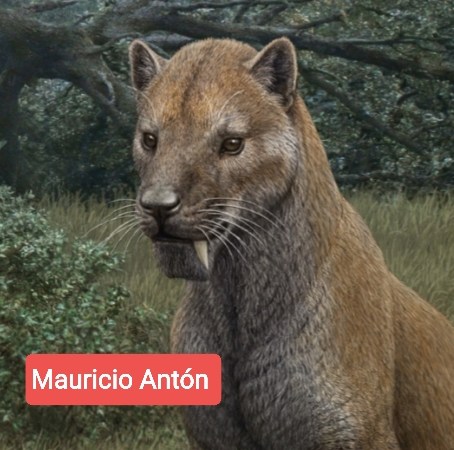
What is that thing? A plush toy? It’s got saberteeth — is it a cat? It’s a very primitive cat, isn’t it? Wait, there are some major anatomical differences; maybe it’s not a cat? But there are cat-like features, too — does it belong to the cat family’s cousins sister-group? No, it’s a nimravid, right?
🎊🎈🐾🐾🐾🎈🎉
There, in a layperson nutshell, is the summary of Paleontology’s centuries-long and ongoing debate about this prehistoric animal and its relatives –including all the question marks (but not the plush-toy hypothesis; also, nimravids are coming, a couple of posts from now, so they and any connections they might have to this group will keep).
Back in Middle Miocene Europe, puma-sized P-Quad (a/k/a Pseudaelurus quadridentatus) — our long-toothed, square-chinned feline friend from last time — probably saw this button-eyed furball, which was about the same size, as serious competition.
This, even though their two groups not only coexisted overall but also thrived together in western Eurasia and, eventually, in North America for millions of years. (Agustí and Antón; Jiangzuo et al.; Ormsby; Prothero)
In 1929, long after its rivalries with cats like P-Quad were over, humans christened that weird-looking critter Sansanosmilus palmidens.
“-smilus” is for the knife-teeth, although this particular species didn’t yet have the impressive chompers that some of its later relatives would develop.
Sansan, in France, is where its fossils were first found.
Mauricio Antón drew it, as Figure 3.23 in Sabertooth (CC BY-ND-NC-SA 4.0), so Sansanosmilus probably did look a lot like that, aside from Antón’s educated guesses about things that don’t fossilize, such as the coat and eyes.
But what was it?
Sansanosmilus was a barbourofelid, and in this post, I’m not going to add a link to more information about that group.

“Mommy, why is that cat wearing pajamas?” “That’s not a cat, honey. It’s a barbourofelid, or maybe a nimravid. I can’t tell at this distance.” (Image: It’s a nimravid — Eusmilus by name — and is Figure 3.20 in Mauricio Antón’s “Sabertooth” (CC BY-ND-NC-SA 4.0). It left some tracks (JODA 283, 251).
I’ve got links and references galore — enough to tell me that any one thing written about the barbourofelids can sound deceptively authoritative.
Everything said about them needs to be set in the context of all those question marks above.
So instead, let’s look at Africa: the context, or setting, in which barbourofelids (probably) and cats (possibly, per Lyras et al. and Werdelin, 2012) first evolved.
Afrosmilini: The Old Ones
Sansanosmilus was European and fairly well advanced along the sabertooth path, compared to the more primitive, i.e., Model T pseudaelurine build of older barbourofelids (if that’s what they all were; Werdelin, 2022, has doubts about some of them).
Morales and Pickford suggest that Sansanosmilus marks a transition in barbourofelids to Ferraris more markedly sabertoothed ones that would soon spread across Eurasia and North America, late in the Miocene epoch.
Some species of the Old Ones, whatever that African group of predators was exactly, did have a few sabertooth characteristics, but these weren’t as advanced as in Sansanosmilus, although the animals seemed to moving in that direction, culminating in Prosansanosmilus — “Before Sansanosmilus.” (Morales et al.; Morales and Pickford)
In 2001, Morales et al. grouped and labeled those early barbourofelids (if that’s what they were) separately as Afrosmilini because:
- They felt that an Afrosmilus species was most representative of the entire African group of what, at that point, seemed most likely to be either cats or else close relatives of Family Felidae (this concept of what barbourofelids might have been has undergone some changes since 2001, but the tribe Afrosmilini still stands, even though some experts list its members differently).
- The Old Ones all stayed in Africa, as far as the scanty fossil record shows, except for that one time, according to Morales et al. when an advanced Afrosmilus (or perhaps a primitive Prosansanosmilus) wandered up into Spain. If that little jaunt is ever confirmed, this would be the only known barbourofelid (if that’s what it truly was) identified in both Africa and Eurasia. (Werdelin, 2012)
That’s how great a gap there is between the Old Ones and those that came after plush-toy-lookalike Sansanosmilus.
Or is it a gap in knowledge about the African branches of this group of cat-like predators?

Perhaps lynx-sized Afrosmilus, the small “cat” shown here, needed an Iberian vacation break from its daily round of terror in East Africa: left to right, a large hyaenodont (not hyenas, rather, a whole ‘nother and VERY successful order of mammalian meat-eaters, now long extinct); a beardog; and a smaller species of hyaenodont. (Image: Mauricio Antón via Wikimedia, CC BY-SA 4.0)
As if there weren’t enough “ifs” already, the Afrosmilini, particularly Afrosmilus, had some traits in common with Early to Middle Miocene critters that looked a lot like cats, and in at least one case — Asilifelis — probably do belong in Felidae. (Morales and Pickford; Werdelin, 2012)
In turn, some of these apparent felines had several barbourofelid characteristics. (Werdelin, 2012)
It really makes me wonder what kind of parties they were throwing back then during the long African night!
And it doesn’t help that Afrosmilini, as defined by Morales et al., disappear from Africa’s known fossil-bearing rocks throughout the entire Middle Miocene run during which the cats (if that’s what they were) had their earthly existence. (Morales and Pickford)
It’s unclear why that Afrosmilini fadeout happened on this continent while barbourofelids were doing well in Eurasia.
Werdelin (2022), who sees the group as a combination of Afrosmilini and nimravids, notes that there was a complete turnover of nimravids between 14.7 and 13.7 Ma.
He mentions that this coincides with the Middle Miocene global cooling and aridification episode but cannot definitely say that the turnover and the change in climate were related.
If there was such a connection, then share and share alike: the Middle Miocene cats would show it, too. However, showing that would take more fossils of these carnivores than researchers have identified to date.
Diamantofelis and Namafelis

From Figure 6, Antón, 2003 (PDF download), CC BY-NC-ND-SA 4.0
Here is Antón’s reconstruction of Diamantofelis — its fossils were found in a diamond field, but if you want to imagine a sparkly collar or ear ring, go right ahead!
The setting here is along a intermittently flowing river loop in what is now Arrisdrift, Namibia, some 17½ million years ago.
In the paper that figure comes from, Antón explains the limits of that reconstruction.
However, based on the few fragments available, he notes that Diamantofelis and its presumably close relative Namafelis probably were built like Eurasia’s pseudaelurine cats — unlike Asilifelis, in Kenya, which apparently was 1 to 2 million years older than them and was already evolving from Pseudaelurus to Felis grade. (Werdelin, 2012)
It looks to me as though Asifelis has made boffins everywhere take another look at their ideas about how cats evolved.
Despite their resemblance to the Pseudaelurus feline complex — and given the presence of barbourofelids in Africa — it is not yet absolutely clear that Diamantofelis and Namafelis were true cats. (Werdelin, 2012
After all, some very primitive Afrosmilini had a pseudaelurine build, as well as several cat-like anatomical features, but they also have barbourofelid anatomy.
Diamantofelis and Namafelis likely had a pseudaelurine build, but they also had some barbourofelid features.
Werdelin (2012) suggests that this leaves open the possibility, unusual though it would be, that they both were cone-toothed barbourofelids.
Agh!
Where do you draw the line between these two groups, and how were they related — if they were related at all and not some atypical case of convergent evolution?
Clearly something important in the evolution of saberteeth and the evolution of Family Felidae happened in Africa as the Miocene epoch opened and progressed.
By the Late Miocene, it had resulted in a delightful diversity of both sabercats and barbourofelids.
Maybe someday paleontologists will figure out what that Something was.
Next time on this blog, we will meet the more fangly barbourofelids, including the last and most spectacular one of them all — North America’s Barbourofelis fricki.
Featured image: Figure 3.23 in Antón’s book Sabertooth, CC BY-NC-ND-SA 4.0. I watermarked it, as he does with images on his blog, and hope that it might encourage you to purchase his book, with all its wonderful artwork and detailed information on sabertooths from Permian times on down to yesterday, some 12,000 years ago.
Disclosure: I am just a fan of this paleoartist and have no personal, financial, or business connection with Mauricio Antón. I just think that readers of my blog should know about his work.
Sources:
- Agustí, J., and Antón, M. 2002. Mammoths, sabertooths, and hominids: 65 million years of mammalian evolution in Europe. New York and Chichester: Columbia University Press. Retrieved from https://play.google.com/store/books/details?id=O17Kw8L2dAgC
- Anton, M. 2003. Reconstructing fossil mammals from Arrisdrift (17-17.5 Ma), Namibia, in Memoir 19, Geology and Palaeobiology of the Central and Southern Namib, Vol. 2, Palaeontology of the Orange River Valley, Pickford, M., and Senut, B., eds. Geological Survey of Namibia. https://the-eis.com/elibrary/sites/default/files/downloads/literature/Reconstructing%20fossil%20mammals%20from%20Arrisdrift.pdf (PDF) (Reader note: Check this out, if you’re interested in paleoart — Antón goes into vivid detail on how he reconstructs fossil animals in general!)
- ___. 2013. Sabertooth. Bloomington: Indiana University Press. Retrieved from https://play.google.com/store/books/details?id=dVcqAAAAQBAJ
- Chatar, N.; Fischer, V.; and Tseng, Z. J. 2022. Many-to-one function of cat-like mandibles highlights a continuum of sabre-tooth adaptations. Proceedings of the Royal Society B, 289(1988), 20221627.
- Chatar, N.; Michaud, M.; Tamagnini, D.; and Fischer, V. 2024. Evolutionary patterns of cat-like carnivorans unveil drivers of the sabertooth morphology. Current Biology, 34(11): 2460-2473.
- Jiangzuo, Q.; Li, S.; and Deng, T. 2022. Parallelism and lineage replacement of the late Miocene scimitar-toothed cats from the old and New World. Iscience, 25(12).
- Johnson, W.E.; Eizirik, E.; Pecon-Slattery, J.; Murphy, W.J.; and others. 2006. The Late Miocene radiation of modern Felidae: a genetic assessment. Science, 311: 73-77.
- Juhn, M. S.; Balisi, M. A.; Doughty, E. M.; Friscia, A. R.; and others. 2024. Cenozoic climate change and the evolution of North American mammalian predator ecomorphology. Paleobiology, 50(3): 452-461.
- Lyras, G. A.; Giannakopoulou, A.; and Werdelin, L. 2019. The brain anatomy of an early Miocene felid from Ginn Quarry (Nebraska, USA). PalZ, 93(2): 345-355.
- Morales, J.; Salesa, M. J.; Pickford, M.; and Soria, D. 2001. A new tribe, new genus and two new species of Barbourofelinae (Felidae, Carnivora, Mammalia) from the Early Miocene of East Africa and Spain. Earth and Environmental Science Transactions of the Royal Society of Edinburgh, 92(1): 97-102.
- Morales, J., and Pickford, M. 2018. A new barbourofelid mandible (Carnivora, Mammalia) from the early Miocene of Grillental-6, Sperrgebiet, Namibia. Communications of the Geological Survey of Namibia, 18, 113-123.
- Ormsby, C. 2021. Morphology and Paleoecology of Nimravides galiani (Felidae) and Barbourofelis loveorum (Barbourofelidae) from the Late Miocene of Florida. Electronic Theses and Dissertations, Paper 3902 https://dc.etsu.edu/etd/3902
- Prothero, D. R. 2006. After the Dinosaurs: The Age of Mammals. Bloomington and Indianapolis: Indiana University Press. Retrieved from https://play.google.com/store/books/details?id=Qh82IW-HHWAC.
- Rothwell, T. P. 2001. Phylogenetic systematics of North American Pseudaelurus (Carnivora: Felidae). Columbia University.
- ___. 2004. New felid material from the Ulaan Tologoi locality, Loh Formation (early Miocene) of Mongolia. Bulletin of the American Museum of Natural History, 2004(285): 157-165.
- Salesa, M. J.; Anton, M.: Turner, A.; Alcala, L.; and others. 2010. Systematic revision of the Late Miocene sabre‐toothed felid Paramachaerodus in Spain. Palaeontology, 53(6): 1369-1391.
- Salesa, M. J.; Antón, M.; Morales, J.; and Peigné, S. 2012. Systematics and phylogeny of the small felines (Carnivora, Felidae) from the Late Miocene of Europe: a new species of Felinae from the Vallesian of Batallones (MN 10, Madrid, Spain). Journal of Systematic Palaeontology, 10(1): 87-102.
- Shelbourne, C. D., and Lautenschlager, S. 2024. Morphological diversity of saber‐tooth upper canines and its functional implications. The Anatomical Record.
- Slater, G. J., and Van Valkenburgh, B. 2008. Long in the tooth: evolution of sabertooth cat cranial shape. Paleobiology, 34(3): 403-419.
- Turner, A., and Antón, M. 1997. The big cats and their fossil relatives: an illustrated guide to their evolution and natural history. Columbia University Press.
- Turner, A.; Antón, M.; Salesa, M. J.; and Morales, J. 2011. Changing ideas about the evolution and functional morphology of Machairodontine felids. Estudios Geológicos, 67(2): 255-276.
- Van Valkenburgh, B. 2007. Déjà vu: the evolution of feeding morphologies in the Carnivora. Integrative and Comparative Biology, 47(1): 147-163.
- Wang, X.; Carranza-Castañeda, O.; and Tseng, Z. J. 2023. Fast spread followed by anagenetic evolution in Eurasian and North American Amphimachairodus. Historical Biology, 35(5): 780-798.
- Werdelin, L. 2012. A new genus and species of Felidae (Mammalia) from Rusinga Island, Kenya, with notes on early Felidae of Africa. Estudios Geológicos, 67: 217-222.
- ___. 2022. African Barbourofelinae (Mammalia, Nimravidae): a critical review. Historical Biology, 34(8): 1347-1355. (Abstract only)
- ___. 2024. Hypercanines: Not just for sabertooths. The Anatomical Record. https://anatomypubs.onlinelibrary.wiley.com/doi/10.1002/ar.25510
- Werdelin, L.; Yamaguchi, N.; Johnson, W. E.; and O’Brien, S. J. 2010. Phylogeny and evolution of cats (Felidae), in Biology and Conservation of Wild Felids, eds. Macdonald, D. W., and Loveridge, A. J., 59-82. Oxford: Oxford University Press.
- Wikipedia. 2025. Asilifelis. https://en.m.wikipedia.org/wiki/Asilifelis Last accessed September 18, 2025.
- ___. 2025. Diamantofelis. https://en.m.wikipedia.org/wiki/Diamantofelis Last accessed September 18, 2025.
- ___. 2025. Katifelis. https://en.m.wikipedia.org/wiki/Katifelis Last accessed September 18, 2025.
- ___. 2025. Namafelis. https://en.m.wikipedia.org/wiki/Namafelis Last accessed September 18, 2025.
 Flight To Wonder