
That’s Dinofelis, the metailurine sabercat, in an illustration (and Figure 3.2) from Turner and Antón.
The skull is from Pliocene China. Mauricio Antón fleshed out his drawing of it for that 1997 book’s cover:

Beautiful cat! But note the saberteeth.
While some experts question the status of metailurines like Yoshi and Metailurus, fellow metailurine Dinofelis is generally accepted as a member of Machairodontinae, the sabercats. (Werdelin et al.)
This, even though some Dinofelis species were very big-cat-like! (Werdelin and Lewis, 2001)
🐾🐾🐾
Disclosure: Once again, I don’t have any connection, business, social, or otherwise, with paleoartist Mauricio Antón and am not hyping his work. I just think that it’s really good and that readers who are interested in these blog posts should know about it so they can explore that and the many additional works of other authors and artists on fossil cats, if it interests them. There’s a lot out there.
Too, the book “Sabertooth” is the inspiration and basis for this series (along with other facts that I have looked up independently).
However, Turner and Antón’s “The Big Cats and their Fossil Relatives,” which I came across in a university library back in 2014, is what first got me interested in cat evolution, both because of Antón’s illustrations of extant and fossil cats — his best work, in my opinion — that explode off the pages at you in profusion and also because the text is simple and clear while still being factual enough to make the book a highly cited scientific reference. As far as I know, it’s not available as an eBook.
🐾🐾🐾
Wikipedia approaches deinos–felis — “Terrible cat” — the proper way: pedantically.
Let’s go the fun route instead.

The blue-spectrum line is pointing at a LONG run by Dinofelis! (Image source, public domain)
After all, every cat is a natural-born terror, unless you’re Tweetie Pie, and Dinofelis was not especially terrible at catting — it was actually quite good at it all over the Northern Hemisphere and in Africa, where it originated some 8 million years ago (Ma), in a life span that extended from the late Miocene (probably), throughout the Pliocene, and into the early Pleistocene.
As far as this layperson knows, no other sabercat had such a widespread and lengthy time on Earth.
Yet who knows about it, outside the halls of Academia?
The Dinofelis story would be much better known if it were novelized or made into a movie.
That I cannot do, but here are vignettes of a few of its many species — basically, just the really notable ones like the Lothagam cat or species that can be accompanied by graphics.
These little stories are fictional in the sense that it’s just this layperson’s understanding of the sources listed at post’s end — too numerous and interconnected in my head to reference in the usual way — but it all follows those sources as closely as possible. Let me know in the comments if you spot discrepancies or have a question.
Once upon a time, in the Miocene to very early Pliocene…
Lothagam, Kenya
Some 4½ to 5 million years ago, a big, meandering river ran through what is now the western shore area of Lake Turkana in Kenya’s part of the East African Rift.
Because of that African rifting, massive eruptions were frequent here at the time. These provided a casing of hardened volcanic ash to protect fossilized remains of the diverse animal and plant communities that thrived here during the late Miocene – a casing that tectonic forces later lifted up as the Lothagam Block for paleontologists to view.
To view and to reconstruct —
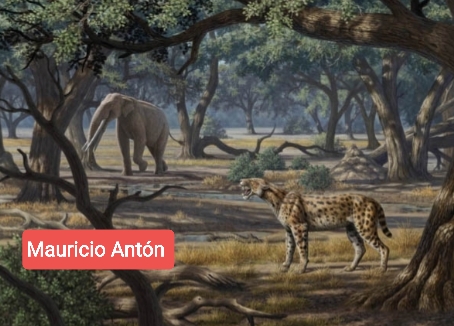
Mauricio Anton, Figure 2.15, in “Sabertooth,” CC BY-NC-ND-SA 4.0
That’s our old friend Lokotunjailurus, tall as a modern lioness, calling. Other sabercats lurked in ambush among Lothagam’s riverine gallery forests and, farther from the riverbanks, along edges of grassy open patches and in thorny scrublands.
Megantereon was at Lothagam, and so was another sabercat.
Although this mysterious cat was about the size of a large Metailurus and had other similarities to that Miocene metailurine, the fragments of it discovered thus far at Lothagam have been interpreted by Werdelin and Lewis (2001) as belonging most likely to a very early member of the genus Dinofelis (for comparison, Panthera is the genus we use today for all big cats, past and present; the two groups, cone-tooth and saber-tooth, did coexist for a while but, unfortunately, there are no Dinofelis cats present now).
Metailurus, as far as is known, did not survive past the Miocene.
But the metailurine Dinofelis group, if that’s what the Lothagam cat belonged to, was only getting started.
D. werdelini, ~5 Ma (million years ago)
Sabercats galore hunted through a coastal mosaic of marshes, grasslands, riverine gallery forests, and tidal zones at around the same time as Lothagam’s cat, but much farther south and to the west –along the very tip of Africa at a place that’s now called Langebaanweg, South Africa.
The South Atlantic coast here was a good place for herbivores, too, as well as for many different kinds of predator.
Among the cats — sabertooths all, I believe; cone-tooths definitely were part of Earth’s wildlife back then but were not yet common in the known sabercat fossil record — Yoshi roamed here, along with huge Amphimachairodus (or a close relative that some experts call Adeilosmilus).
But the most common cat at Langebaanweg was one built much like the Lothagam cat and just as fragmented, in terms of fossils.
Those fossils are more numerous, though. Enough fragments are available to tell knowledgeable cat fossil herders that this was a Dinofelis and that it was around the size of a large modern jaguar.
They could not put a species name on it until 2023, when Jiangzuo et al. recognized it as D. werdelini (named to honor the Swedish paleontologist who also has a prominent place in these cat post references!).
This is currently the oldest defined Dinofelis species.
Once upon a time in the Pliocene…
D. diastemata, ~4 Ma
Exciting geological events had been happening far to the north of these two Dinofelis hunting grounds.
Most dramatic of all was the evaporation of the Mediterranean over a few hundred thousand years after tectonic and climatic changes temporarily cut it off from the Atlantic Ocean. (At this latitude, evaporation removes water from the sea faster than rivers can pour it in.)
That dry spell ended some 5½ million years ago, according to Clauzon et al., when more tectonic and climatic changes reopened the Atlantic spigot.
While some geoscientists believe that this reappearance of the Mediterranean Sea happened gradually, others, including Clauzon et al., suggest that great floods of Atlantic water poured into the Mediterranean basin and quickly refilled it, based in part upon their interpretation of geological evidence found in a much smaller basin.
The Roussillon Basin, in southern France near the Pyrenees — which were young and rising mountains at the time of the great drying and rewetting — has formed, like the mountains did, because Africa is slowly plowing into Eurasia in a big continental plate collision.
In the Roussillon area are signs of the entire Mediterranean saga, as well as of the subsequent shift back into erosion and deposition of sandy deltas and alluvial fans as the Pyrenees have continued both to rise and, a little more slowly, to weather down over time.
Back in the Pliocene, a network of rivers cut into what was then new soil, and lakes formed here, too.
The early Pliocene was also a warm, humid time, so evergreen forests spread, as did floodplains and wetlands.
A host of animals gathered in this rich land, of course — prey and predators. Among them, according to fossils found in the Roussillon basin, was Dinofelis diastemata.

“Open wide.” (Image: Mauricio Antón, Figure 3.36, in “Sabertooth,” CC BY-NC-ND-SA 4.0)
A diastema is something only a paleontologist or a veterinarian would know about.
It’s the gap between a cat’s front canine tooth and the molars farther back along the jaw and it was unusually long in this Dinofelis species for some reason.
Fur color isn’t preserved in bony fossils, but the melanistic sabercat Antón drew could have existed in those European rainforests — just as there are melanistic cone-tooths in such places today:
D. diastemata was fairly large — jaguar-sized, perhaps — and built much like old D. werdelini down in South Africa.
As far as scholars know, there was no connection between those two, and they have looked hard.
Dinofelis, with its many forms and constant presence over a respectable amount of geologic time, is a research magnet for felinologists.
Just for the record, and also because of its beauty, here is a non-melanistic D. diastemata, in Turner and Antón’s Plate 3:

It looks a LOT like a big cat, and so does…
D. cristata, 4½ to ~3 Ma
This is the species shown on the cover of The Big Cats and Their Fossil Relatives:
Here it is again.
D. cristata, found in the Siwalik Hills of India and Pakistan, as well as in China, was very similar to France’s D. diastemata, only bigger.
It is, in fact, the largest Dinofelis found so far — as big as a small lion or tiger.
That might not sound as impressive as, say, the enormous bulk of Amphimachairodus or Smilodon, but we have to remember that Dinofelis faced different challenges.
Places like the Siwaliks — which are Himalayan foothills — might be badlands today, but in the Pliocene they hosted great rivers that drained the mountains, while the region kept its mild climate for quite a while after other parts of the world had begun to cool down and dry out as the global icehouse came on.
As a result, an incredible variety of wildlife thrived here and competition among carnivores must have been intense.
Predators often coexist just as lions and leopards do today: by being different sizes and using different hunting techniques.
That comparatively small size, as well as that unique combo of feline and machairodont features, somehow gave Dinofelis — the last of the metailurines — an advantage over other more toothy and “macho” machairodonts like Homotherium and Megantereon.
It could have helped Dinofelis stay out of their way, just as leopards avoid lions nowadays by being smaller and hunting in a different style, and thus would have given this Pliocene metailurine the ability to coexist with them as well as with any other large carnivores that might be in the neighborhood.
This is just one of the avenues of research that paleontologists are following as they study Dinofelis.
Certainly the sabercat features in D. cristata are invisible to layperson eyes. Its upper canines were almost identical to a lion’s or tiger’s fangs!
But saberteeth alone do not a sabercat make.
Other dental details — in particular, very small lower canines — are also diagnostic sabertooth features, and D. cristata had those.
By the way, there was another cat in the youngest fossil-bearing Siwalik formations: Felis.
Ancestors of wildcats and other members of the domestic-cat lineage were on the scene now, although Dinofelis probably wouldn’t see them as competition.
Other lineages, with larger cats, that were appearing in various places, like Panthera, lynxes, and the puma group?
That might be different, but thus far all cone-tooths were few and far between, at least in the fossil record.
D. barlowi, ~3½ to 2 Ma
I am tempted to just include this reconstruction and move on to our next and final Dinofelis species:

Mauricio Antón, CC BY-NC-ND-SA 4.0
But you should know about the baboons, so let’s just recall that leopards also use trees as secure nap sites in a dangerous and unpredictable world.

Anna-Carina Nagel/Shutterstock
The South African sabercat D. barlowi was large, almost the size of D. cristata, and like that species, it closely resembled our modern big cats.
Its sabers were only mildly flattened and just slightly curved.
Still, both of these are sabercat traits, and D. barlowi also was very robust, with powerful forelegs: another sabercat feature.
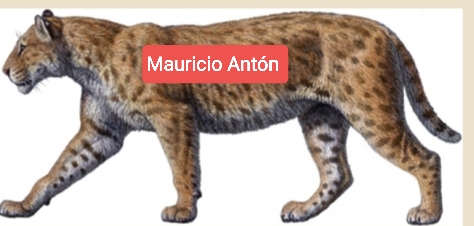
Note the shortened tail, too, although it wasn’t yet the typical sabertooth (and lynx-like) stub. (Image: Mauricio Antón, Figure 3.34 in “Sabertooth”)
That front-end power and sharp teeth must have been bad news for the baboons that fell into a cave trap with a live Dinofelis in it.
The remains of three of these sabercats and about a dozen baboons have been found at Bolt’s Farm, South Africa.
Back in Pliocene times, that was a roofless cave, steep and deep — unlike the Florida fissure where our two peccary epicures were found, once in, no animal could get out of it.
Today, male baboons are big and feisty enough to fight off leopards —
— but as Turner and Antón note, “…the extra size and strength of Dinofelis may have made it a specialist in killing large primates, including our own relatives and ancestors.”
It’s too bad about the baboons, but a question comes to mind: Could an association with early hominids be why the boffins gave this sabercat the “Terrible cat” name?
After all, Bolt’s Farm, along with the other two sites where many Dinofelis fossils have been found, are part of the Cradle of Humankind — the world’s largest known concentration of our ancestral remains.
But no one has yet found a cave that trapped Dinofelis together with Australopithecus, Paranthropus, or early Homo.
Smilodon. Why is it always Smilodon?
Once upon a time in the late Pliocene to early Pleistocene…
D. piveteaui: youngest and most machairodont of all
Here is another beautiful cat portrait, like Yoshi’s:

Mauricio Antón, CC BY-NC-ND-SA 4.0
Antón notes in the accompanying text that, even though it had remarkable (though primitive) sabercat dentition, “…the life appearance of the head of D. piveteaui would also be quite cat-like, especially when seen from the front. When relaxed, its warm and fuzzy look would barely let us imagine what a killing machine we had in front of us.”
Other Dinofelis cats might have hunted in much the same way that big cats do today (Werdelin and Lewis (2001)), but Antón notes that this last known Dinofelis species had all of the typical sabercat dental features.
Although its sabers were not as long or as advanced as those of Machairodus, D. piveteaui probably hunted like a sabercat, perhaps slashing a victim’s throat to cause massive bleeding and a quick death instead of the more typical cone-tooth attack, in this case (predation scene), a surgically accurate nape bite that separates cervical vertebrae and severs the spinal cord, instantly killing its hapless victim:
They chased off the leopard but could not save their friend.
That kind of killing bite would be impossible with saberteeth.
Dinofelis piveteaui lived in South Africa’s Cradle of Humankind region, as well as in an area of modern-day Ethiopia that also was occupied at around the same time by Australopithecus and Home erectus.
But there is no evidence of interactions between it and our ancestors or relatives. Indeed, according to Wikipedia, isotope studies suggest that Megantereon had more of a preference for hominids than the “Terrible cat” did.
The End
The last well-dated fossils of D. piveteaui, the last known species in the last known metailurine genus, are from about 1½ Ma in Africa, but some studies suggest that it was still around just under a million years ago, also in Africa.
Indeed, it might have lingered longer than even that, but we will never know because the relevant rock formation suddenly ends in an unconformity.
There is so much that we can never know about prehistory, generally, and Dinofelis in particular.
If I started writing down the questions about this group of sabercats, this post might become twice as long as it is now, so let’s just close for now this introduction and later on, maybe tonight, dream about a group of half-cats/half-sabertooths, roaming the Earth for geological epochs, thriving, spreading across an entire hemisphere and beyond, and then becoming less numerous, less widespread, finally down to just one species that eventually followed rock and water and wind down into silence forever.
Once, only academics knew about them. Now you do, too.
Some lagniappe:
This is the best movie reconstruction of Smilodon I’ve seen — my only criticism is that it’s larger than life, which makes great drama, and the tail is a bit too long. (That cat in “Alpha” was a cave lion: compare it to the Chauvet drawings. In the campfire scene, they showed the right Smilodon size.)
Sources/Further reading:
- Agustí, J., and Antón, M. 2002. Mammoths, sabertooths, and hominids: 65 million years of mammalian evolution in Europe. New York and Chichester: Columbia University Press. Retrieved from https://play.google.com/store/books/details?id=O17Kw8L2dAgC
- Antón, M. 2013. Sabertooth. Bloomington: Indiana University Press. Retrieved from https://play.google.com/store/books/details?id=dVcqAAAAQBAJ
- Badgley, C.; Barry, J.; Behrensmeyer, A. K.; Cerling, T.; and others. 2025. Fifty Years in the Foothills: Ecosystem Evolution in the Neogene Siwalik Record of Pakistan. Annual Review of Earth and Planetary Sciences, 53(1): 479-509.
- Beyene, Y.; Suwa, G.; Sano, K.; Asfaw, B.; and Katoh, S. 2023. Konso-Gardula, Ethiopia. In Handbook of Pleistocene Archaeology of Africa: Hominin behavior, geography, and chronology (pp. 421-430). Cham: Springer International Publishing. (Abstract only)
- Britannica. 2025. Swartkrans. https://www.britannica.com/place/Swartkrans Last accessed September 10, 2025.
- Clauzon, G.; Le Strat, P.; Duvail, C.; Do Couto, D.; and others. 2015. The Roussillon Basin (S. France): A case-study to distinguish local and regional events between 6 and 3 Ma. Marine and Petroleum Geology, 66: 18-40.
- Feibel, C. S. 2003. Stratigraphy and depositional setting of the Pliocene Kanapoi Formation, lower Kerio valley, Kenya. Natural History Museum of Los Angeles County, Contributions in Science, 498: 9-20.
- Jiangzuo, Q.; Rabe, C.; Abella, J.; Govender, R.; and Valenciano, A. 2023. Langebaanweg’s sabertooth guild reveals an African Pliocene evolutionary hotspot for sabertooths (Carnivora; Felidae). Iscience, 26(8).
- Katoh, S.; Suwa, G.; Nakaya, H.; and Beyene, Y. n.d. Stratigraphic and Chronologic Context of the Konso Formation Paleontological Collection. KONSO-GARDULA RESEARCH PROJECT, 11.
- Manthi, F. K.; Plavcan, J. M.; and Ward, C. V. 2020. Introduction to special issue Kanapoi: Paleobiology of a Pliocene site in Kenya. Journal of Human Evolution, 140, 102718. (Abstract and snippets only)
- Nanda, A. C. 2002. Upper Siwalik mammalian faunas of India and associated events. Journal of Asian Earth Sciences, 21(1): 47-58.
- Nanda, A. C. 2013. Upper Siwalik mammalian faunas of the Himalayan foothills. Journal of the Palaeontological Society of India, 58(1): 75-86.
- Prothero, D. R. 2006. After the Dinosaurs: The Age of Mammals. Bloomington and Indianapolis: Indiana University Press. Retrieved from https://play.google.com/store/books/details?id=Qh82IW-HHWAC.
- Quinn, R. L., and Lepre, C. J. 2020. Revisiting the pedogenic carbonate isotopes and paleoenvironmental interpretation of Kanapoi. Journal of human evolution, 140: 102549./li>
- Turner, A., and Antón, M. 1997. The big cats and their fossil relatives: an illustrated guide to their evolution and natural history. Columbia University Press.
- van den Hoek Ostende, L. W.; Morlo, M.; and Nagel, D. 2006. Fossils explained 52. Geology Today, 22(4).
- Werdelin, L., and Lewis, M. E. 2001. A revision of the genus Dinofelis (Mammalia, Felidae). Zoological Journal of the Linnean Society, 132(2): 147-258.
- ___. 2020. A contextual review of the Carnivora of Kanapoi. Journal of Human Evolution, 140: 102334.
- Werdelin, L., and Sardella, R. 2006. The” Homotherium” from Langenbaanweg, South Africa and the origin of Homotherium. Palaeontographica Abteilung A Paläozoologie, Stratigraphie, 277(1-6): 123-130
- Werdelin, L.; Yamaguchi, N.; Johnson, W. E.; and O’Brien, S. J. 2010. Phylogeny and evolution of cats (Felidae), in Biology and Conservation of Wild Felids, eds. Macdonald, D. W., and Loveridge, A. J., 59-82. Oxford: Oxford University Press.
- Wikipedia. 2025. Dinofelis. https://en.m.wikipedia.org/wiki/Dinofelis Last accessed September 4, 2025.
- Wynn, J. G. 2000. Paleosols, stable carbon isotopes, and paleoenvironmental interpretation of Kanapoi, Northern Kenya. Journal of Human Evolution, 39(4): 411-432.
 Flight To Wonder