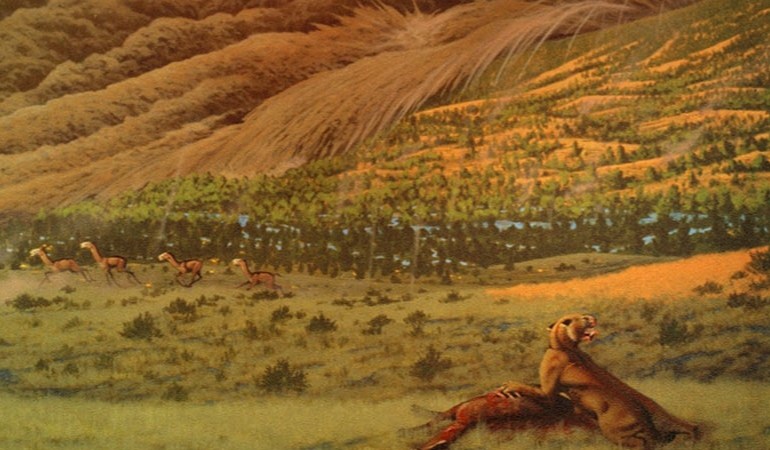
We’re looking at Nimravides — called “Machairodus” by the US National Park Service in text accompanying that image (which is only partially shown here).
The sabercat has just made a kill but is about to have its day ruined, and a few of its remains fossilized, by pyroclastic flows of the Rattlesnake Tuff eruption that occurred 7 million years ago in what is now eastern Oregon’s John Day Country.
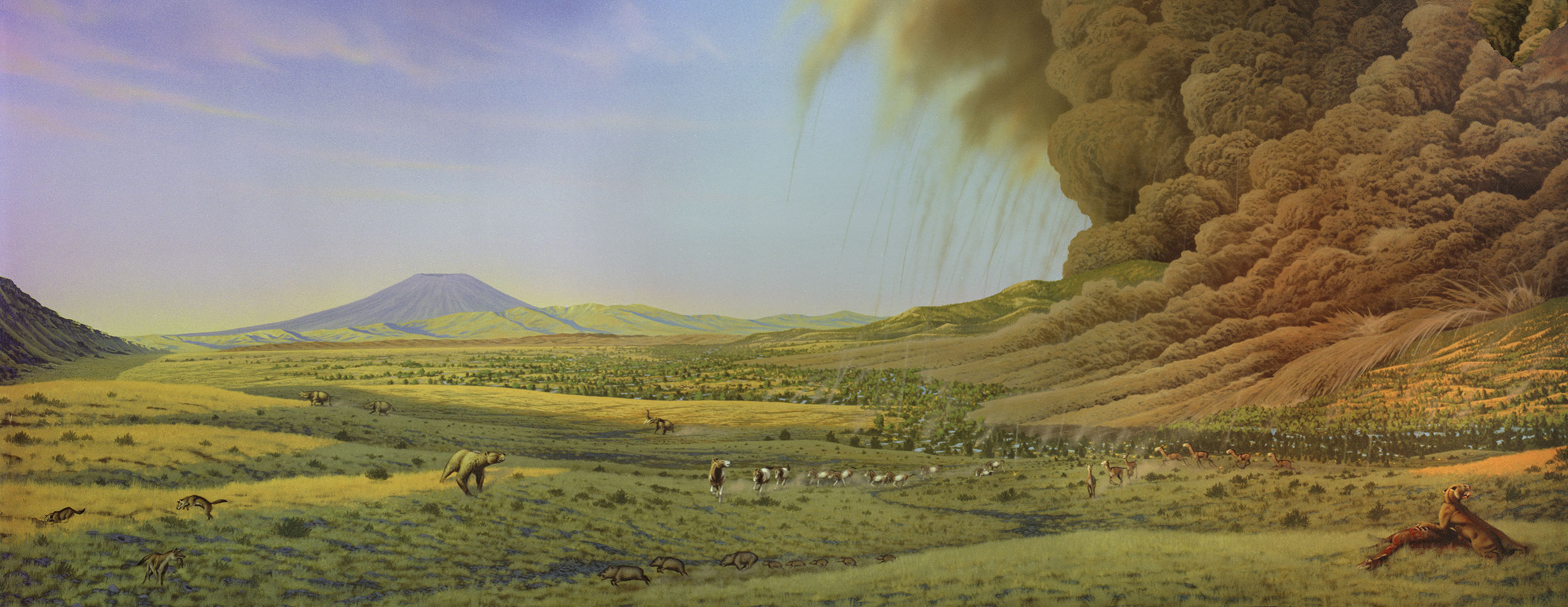
Here’s the whole image by Roger Witter/NPS, public domain.
I’m not sure if the NPS went with “Machairodus” because of 19th-century paleontologist E. D. Cope’s first describing (pages 1019-1020) this “saber tooth tiger” under that name or because 21st-century Mauricio Antón (who is a paleontologist as well as a paleoartist) and others decided in 2013 that North America’s Miocene Nimravides is really our old friend Machairodus in disguise.
Yet in 2013 Antón also gave us this beautiful reconstruction of the cat and called it Nimravides:
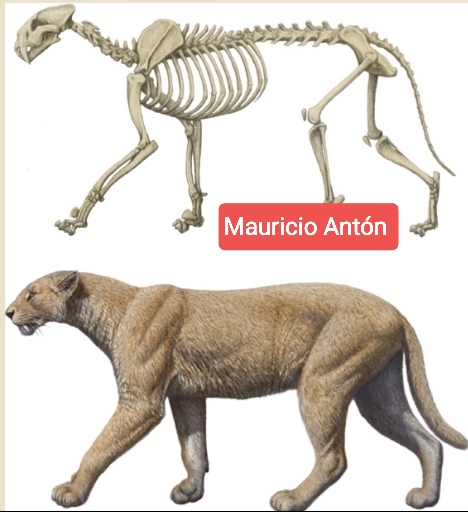
Figure 3.39, in “Sabertooth.” Disclosure: I am just a fan of this paleoartist and have no personal, financial, or business connection with Mauricio Antón. I just think that readers of my blog should know about this book and Antón’s blog.
What gives?
Stop the presses! (Not)
The E. D. Cope thing is understandable: all sabertoothed cat fossils were called Machairodus in his time. (See Wikipedia for the rest of this sabercat’s nomenclature history.)
Antón himself explains the “Nimravides/Machairodus” mixup in a 2013 blog post.
He notes that, at some point shortly after finishing Sabertooth and sending it to press, he was in New York, exploring the collection of undescribed cat fossils at the American Museum of Natural History.
Under a label of “Nimravides catacopis” (the magnificent scientific name of this species at that time), Antón recognized fossils that he would categorize without hesitation as Machairodus aphanistus back in Spain at the Cerro de los Batallones Miocene carnivore traps.
Machairodus dominated that ecosystem back in the day and left thousands of bones at Batallones, including articulated skeletons.
So paleontologists know a lot about that sabercat (and also about Pogy, which actually outnumbers Machairodus and was the “leopard” to Machairodus’ “lion” there).
After more intensive study, Antón’s research group officially renamed N. catacopis as Machairodus catacopis — a decision that many, though not all, experts agree with.
The general idea, as I understand it, is that, rather than evolving on its own in North America as had been assumed for Nimravides, this sabercat — either Machairodus itself or one of its ancestors (which are not at all well understood) (Wang et al.; Werdelin et al.) — crossed over the Bering land bridge from Eurasia (just as Amphimachairodus would do, a little later in the Miocene, to become the North American Miocene sabercat known, among other names, as A. coloradensis).
Returning to Mauricio Antón’s initial observation, it was too late for him to redo the “Nimravides” chapter in Sabertooth, so Antón explained this discrepancy on his blog instead.
And with the book as reference, unaware of the issue at the time, I planned for a Nimravides post for this series.
Why is “Nimravides” still in this post’s title?
That’s partly because it’s still valid. There are other species besides catacopis that unquestionably belong under “Nimravides.”

Jaguar-like but lion-sized “N. galiani” in Florida, for example. (Baskin) (Image: Geekgecko via Wikimedia, CC BY-SA 4.0.
However, the main reason is a 2022 paper by Jiangzou et al. that I came across while reading up for this post.
In it, they make a detailed and convincing-sounding argument for keeping the original Nimravides catacopis scientific name.
Now, as far as we’re concerned, this kerfuffle is just another arcane matter for the boffins to sort out — I’m not qualified to come down in favor of either side. Antón’s case sounds convincing, too.
But it is an excellent example of this fossil cat’s special feature in terms of the ongoing blog series.
Human uncertainty
This is really tricky for a layperson to write about, but it needs to be at least mentioned so that we don’t forget how complex paleontology is in practice.
We like to read about definite things, written in black and white. Science, on the other hand, is all about inference and shades of gray.
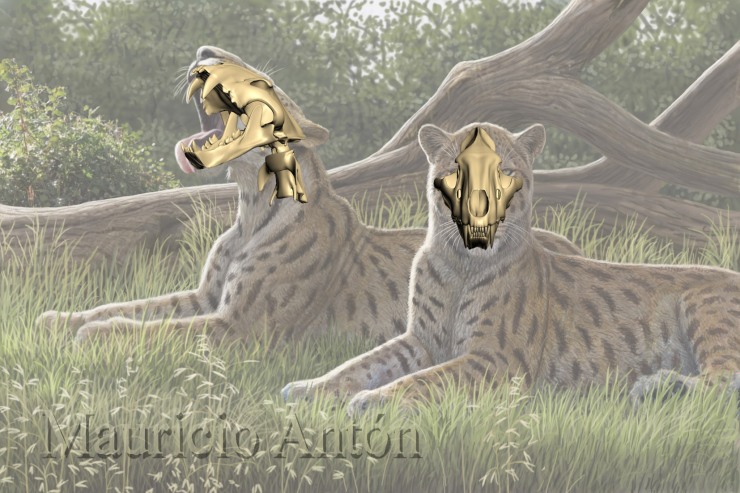
Remember this? (Image: Mauricio Antón, CC BY-NC-ND-SA 4.0)
There are unavoidably broad areas of uncertainty about the details of life on Earth millions of years ago.
And very few hard bones come down to witness about those times.
As paleontologist Donald Prothero notes, in order to get a fossil —
Once an organism dies, its body must be buried quickly before decomposers break it down completely, or scavengers chew it up, or river or ocean currents roll it around and break it up. After it is buried, it can be transformed by chemicals in the groundwater, it can dissolve away completely, or it can be destroyed by the high heat and pressures that rocks experience with deep burial in the earth’s crust. If it survives all these ordeals, then the fossil needs the unusual good fortune of having been exposed again at the earth’s surface during the last few centuries, so that paleontologists can find it and collect it and preserve it in a museum. Consider the huge area of eroding rocks exposed on the earth today, with their fossils weathering out and being continuously destroyed; there are at most a few thousand paleontologists in the entire world to search these places and find the fossils before they are lost forever, after their millions of years of burial.
You can see how extraordinarily fortunate it is that we have any fossils at all, let alone that our fossil record is as good as it is.
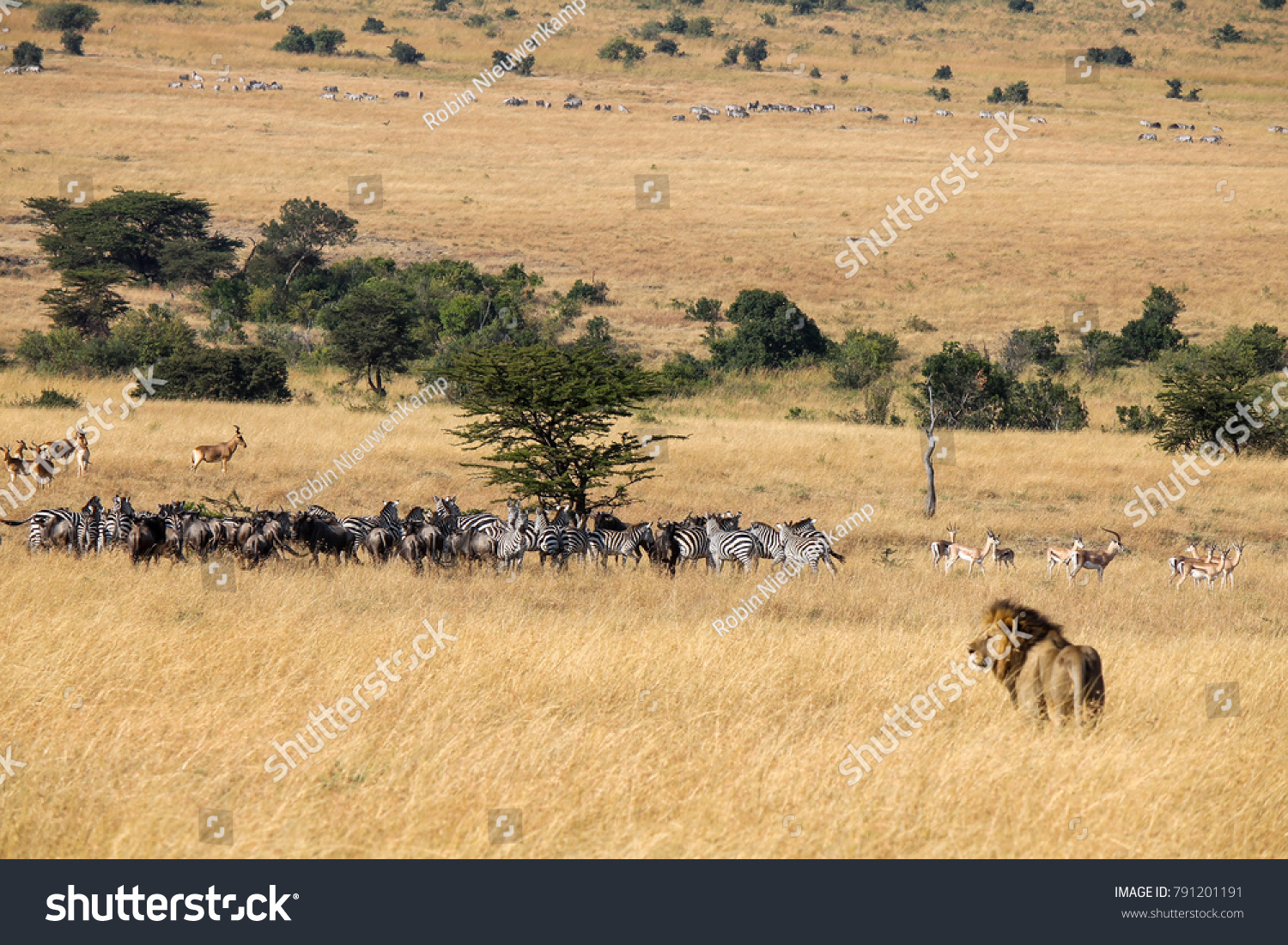
Robin Nieuwenkamp/Shutterstock
Carnivores are especially rare in the fossil record, even the big ones, because they are rare in real life. Today, for example, it can take a hundred zebras to support just three lions. (Van den Hoek Ostende et al.)
What are the chances of any of those three lions getting fossilized on a big area like the Serengeti plain and then turning up at a fossil dig 10 million years from now?
Multitudinous zebras, yes (though not their stripes), but the cats?
And even if some feline fossils did survive, what could future paleontologists ever really know about our lions?
We are privileged, as well as being their potential prey and competition. No one else in all time will ever hear this.
That’s why carnivore traps like La Brea (Pleistocene) and Batallones (Miocene) are so precious.
They give experts in ancient life plenty of material to study.
However, it’s sometimes not enough when cats are involved.
Cats, past and present, all have the same general body plan, making it very difficult for experts to tell different cat fossils apart. (Ormsby; Werdelin et al.)
There are experts who enjoy such challenges and who have helped everyone to better understand how cats evolved.
They sometimes disagree, and those controversies can be titanic, I learned while reading up on the cat family.
But relatively minor debates like the Nimravides/Machairodus catacopis classification, while confusing in detail to us laypeople, do give us a glimpse into the real world of fossil cats that experts deal with all the time.
For instance, let’s bring this whole section together by checking out Figure 4 in Jiangzuo et al.:

Figure 4, Jiangzuo et al., CC BY-NC-ND-SA 4.0
Can you spot the sabercat that they call Nimravides catacopis? (Cheat, per the figure’s caption: It’s A-C, and D is N. galiani.)
How about Machairodus? (E, with F and G being two species of Amphimachairodus that the authors recognize.)
All I can see is a couple of impressive saberteeth and many old and rather beaten-up bones.
Yet to the authors and their academic peers these illustrations are full of useful information and, in this case, apparently provides some of the evidence in support of their argument that Nimravides catacopis was a North American native cat.
So it goes in Academia.
The rest of us are lucky to live in times of museum dioramas, video documentaries (gruesome video warning) —
Even if the vast majority are on Smilodon
— and reconstructions like those from Mauricio Antón, the US National Park Service, and many other excellent sources.
All of these wonderful things give us a feel for life that once walked this same planet, but in very different times.
🐾🐾🐾
Location: This, of course, depends on where you stand in the Nimravides/Machairodus debate.
According to those who favor Machairodus catacopis, as Antón and some others do, the sabercat roamed most of the Northern Hemisphere.
Paleontologists who prefer Nimravides catacopis argue that it was a North American native.
Along with other species, particularly N. galiani and N. thinobates (other species have been named besides these two, but I’m not sure if there is consensus on those), Nimravides has been identified at Miocene sites that include (but aren’t limited to) Oregon, Kansas, Texas, and Florida.
Whatever the boffins choose to call it, it was a widespread and very successful North American sabercat.
Time: Uncertainty is a factor here, too.

The blue-spectrum line is pointing at Middle/Late Miocene. (Source, public domain)
I have stretched it a little bit into the Middle Miocene, which is when the first known sabercat — given the glorious moniker Miomachairodus pseudailuroides — appears in the fossil record (it’s only known from a few fragments in Turkey, per Werdelin et al.).
Antón (2013) includes Miomachairodus in the Machairodus genus; therefore, M. catacopis, waaaay over in North America, would be part of this venerable lineage.
The uncontroversial Nimravides species are close to that Middle/Late Miocene line, too, with N. thinobates appearing at around 11 Ma (million years ago) and N. galiani at around 11.6 Ma, per Werdelin et al.
And these experts definitely put the genus Nimravides in Middle Miocene times by estimating that it began about 14 million years ago — in North America (their study came out three years before Antón’s group renamed catacopis — which was the last known sabercat associated with that group).
Jiangzuo et al. date their N. catacopis to around 10.5 Ma and suggest that it might be a descendant of N. thinobates.
Confused yet?
Well, we’ve reached the earliest times for Machairodontinae, when the sabercats were new and still sorting themselves out.
All of this might become clearer in the future, after more research is done and additional fossil discoveries are made.
Satellite view:
Distant hominoid ancestors of the people who would invent that Holocene electric light, and cities, and satellites, and much more, were evolving in Africa as climate change brought their European experiment to a close. (Agustí and Antón; Prothero)
Tectonics-wise, all continents (dark at night, except for natural phenomena) were more or less in the same positions as they are today, still colliding in places and raising great mountain chains like the Alps and Himalayas.
At around 14-15 Ma, permanent ice fields started appearing in Antarctica, which also began to host ice ages, although the Arctic region remained ice-free, except for perhaps a few glaciers in Greenland. (Chorley; Chorley et al.; Prothero; Van Peer et al.)
The planet was cooling down, drying out. Global CO2 levels were dropping as Earth’s “greenhouse” era changed, for complex and not entirely understood reasons, into the present “icehouse.” (Prothero)
From space, you would have seen the evergreen tropical and subtropical forests in the middle latitudes opening up during the Middle to Late Miocene and, in places, being replaced by different tree species (which a botanist would have told you were more summer drought-tolerant).
One of these new open areas, in the geographic region that now includes Greece, Iran, and Turkey, served as a woodland/grassland hub for a corridor of open habitats that extended from northwestern Africa eastward across Arabia into Afghanistan, northward into eastern Europe, amd also northeast into northern China.
Agustí and Antón call that hub the Greek-Iranian Province and note that it set the pattern from which later African savannas would evolve.
In that early dry scrub/open woodland province evolved a number of large mammals, many of them ancestral to the animals we associate with the African plains today, and it is in that Greek-Iranian Province that the first sabercat fossils — Miomachairodus, spp. — appear in Earth’s rocky archives. (Agustí and Antón)
But a satellite view of Middle/Late Miocene Earth would not show the innovation plants were evolving that would soon doom some herbivores and their predators, likely including Nimravides.
Setting: At what is now Cerro de los Batallones, open, grassy patches were interspersed among wooded areas that provided cover for several different kinds of predator.

That’s Pogy up in the tree, apparently cussing out Magericyon, a beardog who is relaxing with a bone at the tree’s base, while two Machairodus cats on the right are murdering a Hipparion horse. See Antón’s caption of Figure 2.12 in “Sabertooth” for a full list of the animals in this beautiful Batallones reconstruction. The text explains why ground cracks like that one were so deadly to them all.
On the other side of the Atlantic, global cooling and various tectonic factors combined to cover much of North America with mixed grasslands and woodlands. (Prothero; Rothwell)
In what is now Alachua County, Florida, a stream flowed down to the nearby Gulf over limestone bedrock that had fissures and cavities in it that were great at accumulating fossils.
In nearby estuaries, grasslands, and nearby riverine woodlands, there were sabertoothed predators, including the cat-like Barbourofelis:
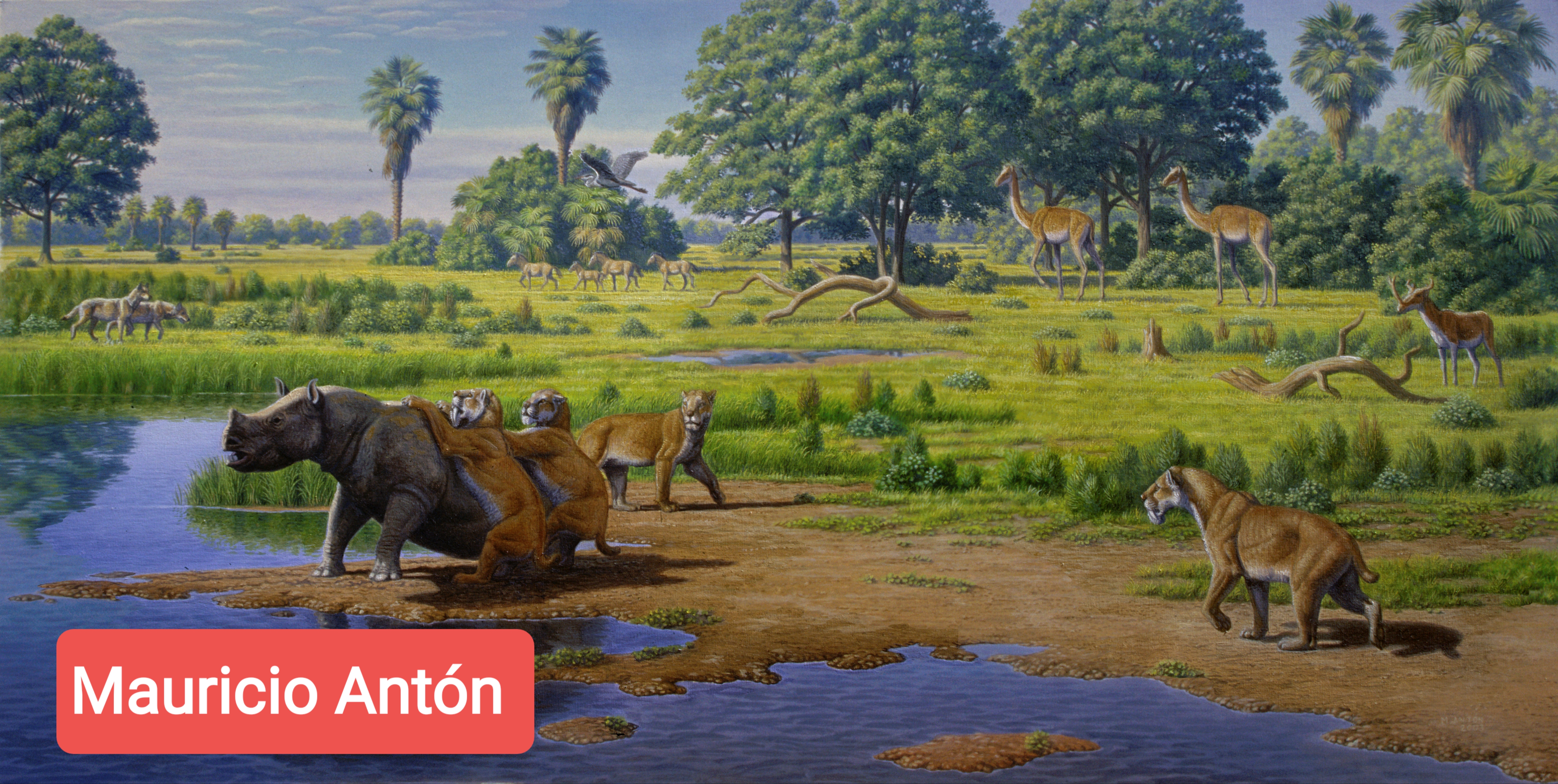
These are NOT saber-toothed cats. They are saber-toothed cat-like predators. (Image: Mauricio Antón, CC BY-NC-ND-SA 4.0)
Nimravides galiani was there, too — the size of a modern lion but built rather like a jaguar. (Baskin)
Ormsby suggests one way that the two sabertooths might have coexisted: Galiani’s cat, as it’s sometimes called, prowled the open spaces, while the more bulky barbourofelid might have been an opportunistic hunter and ambush predator.
Yet Antón shows Barbourofelis hunting in groups — more on this impressive sabertooth genus next month!
Machairodus/Nimravides catacopis gradually took over from Galiani’s cat and N. thinobates.
A million years or so later, Amphimachairodus wandered in from Asia across the Bering land bridge to become A. coloradensis. (Jiangzuo et al.; Werdelin et al.)
North America apparently was big enough for all three sabertooths — Nimravides/Machairodus, Amphimachairodus, and Barbourofelis.
But then, a few million years later, the grass got taller and thicker.
Tall-grass prairies like this preserve are a Late Miocene innovation — bison, however, would not reach North America from Eurasia until the Pleistocene. (Jiangzuo et al.; Prothero)
Plant-eaters developed longer legs and a preference for grazing the grasslands rather than standing in one place, browsing on leaves and shrubs.
In the changing global climate, plants that had worked out new ways to do photosynthesis spread far and wide. The effects of this shook up the Late Miocene food chain in many ways.
“No problem,” said Amphimachairodus, who already had long legs as well as a very efficient killing bite. (Jiangzou et al.)
“…” — Machairodus/Nimravides and Barbourofelis, who both vanished.
Ecomorph/Tribe: I had planned to get into Homotherini/Smilodontini origins, now that we have the list of potential ancestors for homotherins complete, but there isn’t room for it now.
It can wait for P-Quad (Pseudaelurus quadridentatus), likely founder of the sabercat line.
But first, we have a couple of metailurines to meet — cats that Antón (2013) lists as sabertooths, although some paleontologists deny the metailurines membership in that toothy club.
For lagniappe:
Featured image: Roger Witter/NPS, public domain.
Sources:
- Agustí, J., and Antón, M. 2002. Mammoths, sabertooths, and hominids: 65 million years of mammalian evolution in Europe. New York and Chichester: Columbia University Press. Retrieved from https://play.google.com/store/books/details?id=O17Kw8L2dAgC
- Antón, M. 2013. Sabertooth. Bloomington: Indiana University Press. Retrieved from https://play.google.com/store/books/details?id=dVcqAAAAQBAJ
- Baskin, J. A. 2005. Carnivora from the late Miocene Love bone bed of Florida. Bulletin of the Florida Museum of Natural History, 45(4), 413-434.
- Chorley, H. 2021. Antarctic ice sheet and climate evolution during the mid-Miocene (Doctoral dissertation, Open Access Te Herenga Waka-Victoria University of Wellington).
- Chorley, H.; Levy, R.; Naish, T.; Lewis, A.; and others. 2023. East Antarctic ice sheet variability during the middle Miocene climate transition captured in drill cores from the Friis Hills, transantarctic Mountains. Bulletin, 135(5-6), 1503-1529.
- Jiangzuo, Q.; Li, S.; and Deng, T. 2022. Parallelism and lineage replacement of the late Miocene scimitar-toothed cats from the Old and New world. Iscience, 25(12).
- Juhn, M. S.; Balisi, M. A.; Doughty, E. M.; Friscia, A. R.; and others. 2024. Cenozoic climate change and the evolution of North American mammalian predator ecomorphology. Paleobiology, 50(3): 452-461.
- Ormsby, C. 2021. Master’s thesis: Morphology and Paleoecology of Nimravides galiani (Felidae) and Barbourofelis loveorum (Barbourofelidae) from the Late Miocene of Florida.
- Prothero, D. R. 2006. After the Dinosaurs: The Age of Mammals. Bloomington and Indianapolis: Indiana University Press. Retrieved from https://play.google.com/store/books/details?id=Qh82IW-HHWAC.
- Rothwell, T. P. 2001. Phylogenetic systematics of North American Pseudaelurus (Carnivora: Felidae). Columbia University.
- Slater, G. J., and Van Valkenburgh, B. 2008. Long in the tooth: evolution of sabertooth cat cranial shape. Paleobiology, 34(3): 403-419.
- Stevens, M. S., and Stevens, J. B. 2003. Chapter 9: Carnivora (Mammalia, Felidae, Canidae, and Mustelidae) From the Earliest Hemphillian Screw Bean Local Fauna, Big Bend National Park, Brewster County, Texas. Bulletin of the American Museum of Natural History, 177-211.
- van den Hoek Ostende, L. W.; Morlo, M.; and Nagel, D. 2006. Fossils explained 52. Geology Today, 22(4).
- Van Peer, T. E.; Liebrand, D.; Taylor, V. E.,; Brzelinski, S.; and others. 2024. Eccentricity pacing and rapid termination of the early Antarctic ice ages. Nature Communications, 15(1), 10600.
- Van Valkenburgh, B. 1988. Trophic diversity in past and present guilds of large predatory mammals. Paleobiology, 14(2): 155-173.
- Wang, X.; Carranza-Castañeda, O.; and Tseng, Z. J. 2023. Fast spread followed by anagenetic evolution in Eurasian and North American Amphimachairodus. Historical Biology, 35(5): 780-798.
- Werdelin, L.; Yamaguchi, N.; Johnson, W. E.; and O’Brien, S. J. 2010. Phylogeny and evolution of cats (Felidae), in Biology and Conservation of Wild Felids, eds. Macdonald, D. W., and Loveridge, A. J., 59-82. Oxford: Oxford University Press.
 Flight To Wonder