
Just a couple of large spotted cats with saberteeth, taking it easy…
Gah!
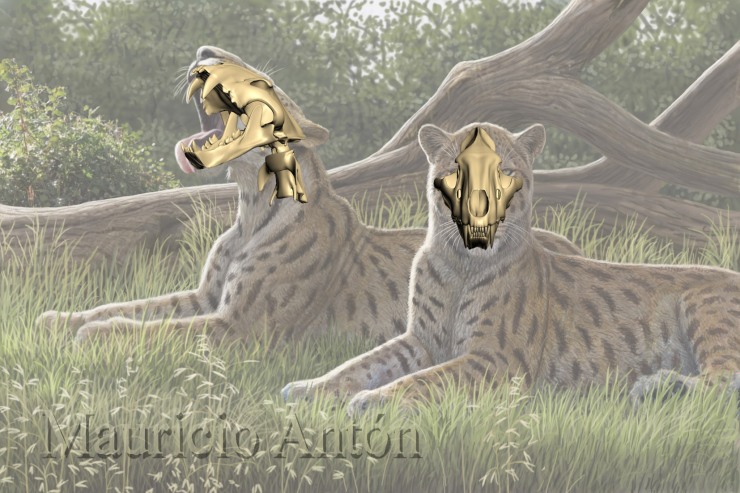
Mauricio Antón, CC BY-NC-ND-SA 4.0
Paleoartist Mauricio Antón strikes again!
Actually, that image isn’t meant to be scary. It’s just one of several in a post on Antón’s blog showing how he used his knowledge of feline anatomy to reconstruct the male/female pair of Machairodus sabercats.
Writing this post today on Machairodus is also a challenge.
We’re shifting focus from the glamour pusses, like Smilodon and Amphimachairodus, to the more primitive sabertoothed members of Family Felidae.
“Primitive” never means “boring,” of course, when talking about saber-toothed cats, but the background reading does get scholarly very quickly.
My overall impression from this reading is that, much like the spooky-looking Antón image, Science’s present understanding of sabercats has lots of gray areas and only a few hard bones.
This is especially true with the earliest known Miocene sabercats, whose fossilized remains are rare and, with few exceptions, in bits and pieces.
Cerro de los Batallones, which Machairodus dominated back in the day, is one of the exceptions. This video is in Spanish, but YouTube can autotranslate it through the Captions menu, and it is hosted by renowned paleontologist Dr. Jorge Morales. (Also, the cover image looks REAL familiar!)
It’s easy for a layperson to get lost in all that discussion, but if I get lost, then so will you — and that will never do!
So let’s take a different approach. The next few posts will be less detailed about each early sabercat.
Instead, starting today, we will explore some cool feature in each of the remaining groups for the cat-family part of this series, which I selected from Antón, 2013:
- Machairodus
- Nimravides (not a nimravid)
- Metailurus (ALL sabertoothed cats are metal!)
- Dinofelis (not a dinosaur)
I don’t know whether these groups are widely accepted by other professional cat-fossil herders (remember: “gray areas”), but we will stick with the series’ basic source — Mauricio Antón’s book Sabertooth — for consistency.
With Machairodus, the cool feature is a question: what are saberteeth good for?
Cats and cat-like critters had them for more than 30 million years. Why?
But first…
What is Machairodus?
The term “Machairodus” has a long and confusing history that Turner et al. and especially Wikipedia get into.
Today, “Machairodus” is simply a genus label: the first part of a binomial scientific name.
While multiple species names for this fossil cat are out there, some paleontologists, including Antón, use “Machairodus” for a single species now — Machairodus aphanistus, the sabercat that left thousands of its bones and even some fully articulated skeletons at what is now Cerro de los Batallones in Spain.
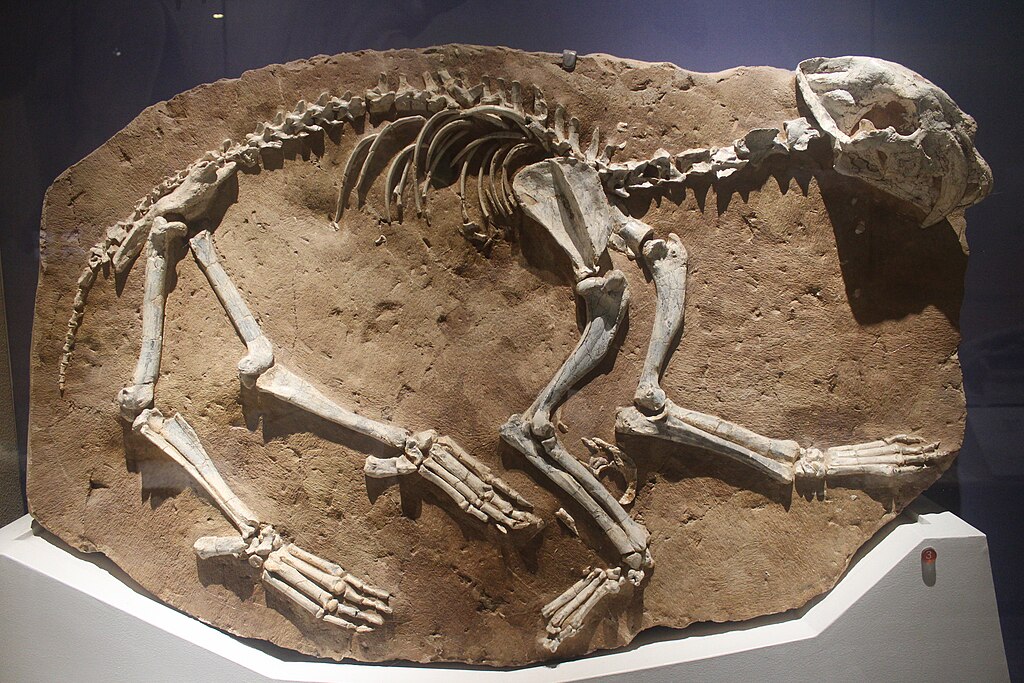
Jonathan Chen via Wikimedia, CC BY-SA 4.O
The sabercat Machairodus is Family Felidae’s first named Miocene cat and also the first known cat to reach the size of modern lions and tigers. (Turner et al.; Werdelin et al.)

“Whee!” — Machairodus. (Image: Figure 3.37 in “Sabertooth” CC BY-NC-ND-SA 4.0)
Weighing almost 500 pounds, Machairodus was also built like a tiger or other modern big cat.
Yet this roughly 10-million-year-old Miocene kitty had advanced saberteeth that wouldn’t look out of place in a 20,000-year-old Pleistocene fossil dig! (Antón, 2013; Agustí and Antón; Chatar et al., 2024)

“What?” (Image: Figure 3.38 in “Sabertooth” CC BY-NC-ND-SA 4.0)
Ferrari engine on a Model T chassis
As we’ve seen in previous posts, today’s cats are built much the same way as the first cats were, almost 30 million years ago, with a few differences, mostly subtle, that we don’t need to get into here. (Antón, 2013; Werdelin et al.)
If these conical-toothed cats, past and present, were automobiles, they would all be Model T’s.
The ice-age sabercats, though — Smilodon and Homotherium — were highly evolved: Ferraris, so to speak.
Machairodus was a Model T, but its saberteeth, which Antón (2013) notes were as advanced as Homotherium’s, gave it a Ferrari engine.
This analogy can be carried further.
Just as a Ferrari engine in a Model T would break the car, so did having advanced saberteeth in a basic-model cat’s body break a LOT of Machairodus sabers.
Saberteeth are rather flat — yes, knife-like — and therefore can’t take the multidirectional loads that modern big cats experience when they (gruesome video warning):
- Suffocate prey with a throat bite —
— or with a muzzle clamp:
No one really knows how sabercats hunted, but can you see Smilodon doing this for a living? Me neither.
(/gruesome video warning)
Those lions, that leopard, and all the other modern cats have cone-shaped teeth that are strong enough to handle stresses from multiple directions as prey struggles. (Pollock and Anderson)
The knife-like shape of saberteeth instead makes them ideal for unidirectional slicing. (Pollock and Anderson)
Did Machairodus bring a knife to a cone-tooth fight?
Unfortunately, we can’t go out, set up camera traps, and then wait to catch one in action to find out.
Machairodus did have a few other Ferrari physical sabertooth characteristics, including (Agustí and Antón; Antón, 2013):
- A somewhat longer and narrower skull than a lion has
- A square chin
- A very long and muscular neck, and hefty front-end muscles as well as flexible forelegs that could grasp and manipulate prey
All cats are good at pronating and supinating their front legs (Van Valkenburgh), but the sabertooths took this to a whole ‘nother level.
The body and skull of Machairodus were evolving in the right direction, but its saberteeth were several million years ahead of their time.
Antón (2013) calls this an example of mosaic evolution.
As a result, while some Ferraris Smilodons at La Brea (Pleistocene California) had broken sabers, at the Batallones carnivore traps (Miocene Spain) it was a regular epidemic with Model-T Machairodus (Antón, 2013)
And yet…
Machairodus and other early sabercats founded an entire subfamily in Felidae: Machairodontinae, the “Knife-tooths,” i.e., sabercats.
Knife-tooths, not Broken-tooths. That does raise a question.
What’s so great about saberteeth?
First off, saberteeth aren’t some sort of unique dental hardware.
They’re the same old upper canine teeth that all of us mammals have inherited genes for from our distant therapsid ancestors. (See Werdelin, 2024, for a mildly technical exploration of all the known ways that mammals, including deer and walruses, have developed and used their hypercanines.)
Saberteeth, found in some members of Carnivora and in the extinct Oxyaenodonta (not in this blog series, but see Werdelin, 2024), are long, flattened, curved, and occasionally serrated upper canines.
While trying to figure out just why saberteeth keep evolving over and over again — an ongoing research effort — many experts recognize two different kinds:
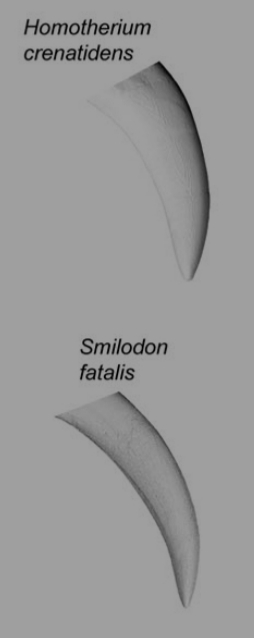
From Figure 1, Pollock and Anderson, CC BY-NC-ND-SA 4.0
- Scimitar-tooth — Relatively short and broad, very flat, coarsely serrated. Example Homotherium, top image
- Dirk-tooth — Very long, only a little flattened, extremely fine serrations or none at all. Example: Smilodon, lower image.
Since the fossil remains of Smilodon and Homotherium show two very differently built sabercats, some researchers extend this concept, suggesting that dirk-tooths like Smilodon were buff, with short, muscular legs, and they probably were solitary hunters who ambushed prey.
In this view, the long legs of Homotherium, a scimitar-tooth, were built for running and so this sabercat was a pursuit predator that possibly hunted in groups.
It’s a very appealing argument because it shows how the two ice-age sabercats might have been able to coexist through niche partitioning (here’s a modern example of that).
However, I’m not sure how much the dirk-tooth/scimitar-tooth two-step can be generalized beyond Smilodon and Homotherium. (See Antón’s discussion in Sabertooth.)
After more discoveries and with the development of more ways to analyze the sabertooth record, some studies don’t even find a dirk-tooth/scimitar-tooth difference (Anderson et al., for instance), while others continue to support it (including van den Hoek Ostende et al.)
Antón, in Sabertooth, stays on middle ground, writing that the dirk-/scimitar dichotomy “…may well reflect part of the truth but reality is likely to have been more complex.”
How much more complex?
This much, in terms of upper canine shape:
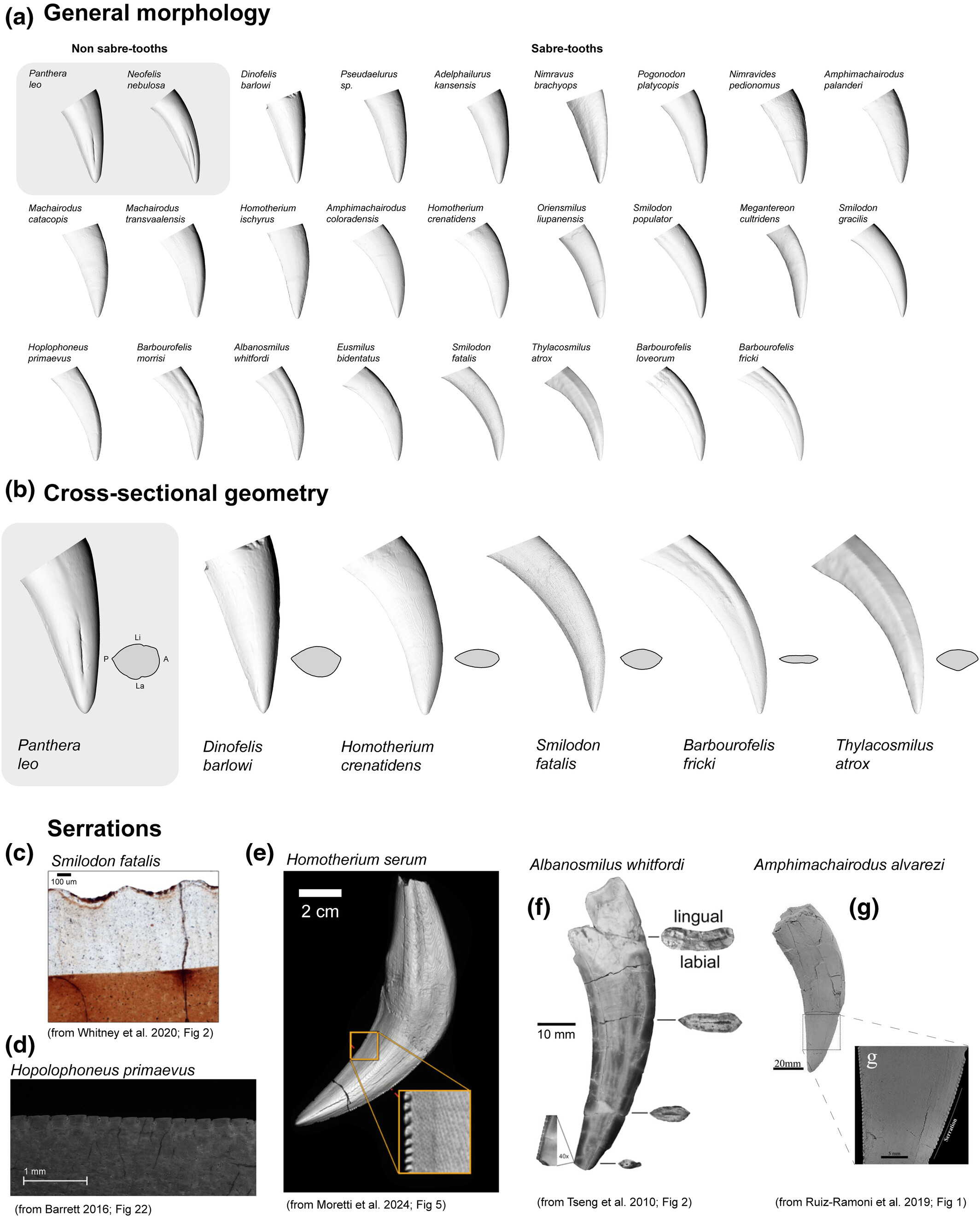
Pollock and Anderson’s Figure 1, covering (a) sabertooth shape, with two Machairodus species given; (b) a few selected cross-section views; and (c)-(g) serrations. CC BY-NC-ND-SA 4.0.
The Machairodus and Homotherium teeth in (a) are much more curved than the lion’s fang (Panthera leo), and they’re much flatter and broader than the clouded leopard’s fang (Neofelis nebulosa).
But how were these saberteeth used?
The variety of shapes suggests that there might have been a range of killing-bite styles. (Chatar et a., 2022; Pollock et al.)
Turner et al. go into various hypotheses about the sabertooth’s killing bite, which also takes the cat’s skull, neck, and front-end anatomy into account.
Stabbing seemed likely at first, but on further review a slicing bite was more logical, aimed perhaps at delivering a wound to the abdomen or throat that would cause massive bleedng and quickly send the prey into shock.
Both methods can easily injure the cat and/or break its teeth, though.
Turner et al. and Antón (2013) suggest instead a canine shear bite.
In this, the cat’s powerful neck, forelegs and chest muscles immobilize prey on the ground while saberteeth quickly slice through the unfortunate victim’s soft neck tissues, severing major blood vessels and also its windpipe.
Death is almost instantaneous — much faster than with a modern big cat’s clamp-and-hold bite (to the Cape buffalo’s throat, in the lion video earlier in this post, and over the impala’s muzzle in the leopard video).
Machairodus had some of the primitive anatomical features needed to pull off a successful canine shear bite, but not to the extent seen in Amphimachairodus and later sabercats. (Antón, 2013, 2014)
Given its mostly feline body structure, Machairodus probably used some sort of a blend of modern big-cat-style and basic canine-shear killing methods.
It might have experienced a few wild rides, as did the leopard in that video when it clamped onto the impala.
In any event, Machairodus often broke its saberteeth.
Here is a modern scenario in which having saberteeth could tip things in favor of the predator, but it requires a look at one more gruesome video.
This one is particularly horrible because the prey is still kicking, though I’m sure it was close to death and in too much shock to be aware of what was happening.
It’s important to note here that there were even more scavengers in Late Miocene Europe — Machairodus’ time — than there are out on today’s African savannas.
Life is brutal out there, competition is intense, and any new evolutionary development can become a lifeline.
This leopard lacks such a development.
It is killing an antelope by clamp-and-hold but has to let go when a wild dog arrives.
Precious moments are wasted fending off individual dogs, and then the leopard must abandon its meal to escape up a tree when the whole pack arrives (not that they have any more success, because hyenas are hungry, too).
If the leopard had swiftly killed its victim with saberteeth, multitasking (murder and self-defense) wouldn’t have been needed.
There was time for the single-purposed cat to carry that carcass up into the tree before the pack arrived.
Situations like this are among the reasons why many experts, including Anderson et al., Turner et al., and Van Valkenburgh, suggest that killing efficiency mighr be why saberteeth keep evolving in meat-eaters over and over again.
So why aren’t all cats sabertooths?
I don’t know. Two other groups that we’ll be meeting — nimravids and barbourofelids — were mostly all sabertooths, but Family Felidae took two paths.
The conical-toothed subfamily Felinae must have done something right, evolution-wise, because it is still around.
This question will be the special feature for the very conical-tooth-like sabercat Metailurus, coming in a couple of weeks.
For now, let’s end this lengthy post without getting into location, setting, tribe, etc.
We can visit those next time with Nimravides, which could be called “Machairodus North America” and is called Machairodus catocopis in the tooth graphic a few paragraphs back.
Some lagniappe:
Featured image: Mauricio Antón, CC BY-NC-ND-SA 4.0.
Disclosure: I am just a fan of this paleoartist and have no personal, financial, or business connection with Mauricio Antón. I just think that readers of my blog should know about Sabertooth and his blog and hope that it might encourage you to purchase his book, with all its wonderful artwork and detailed information on sabertooths from Permian times on down to yesterday, some 12,000 years ago.
Sources:
- Agustí, J., and Antón, M. 2002. Mammoths, sabertooths, and hominids: 65 million years of mammalian evolution in Europe. New York and Chichester: Columbia University Press. Retrieved from https://play.google.com/store/books/details?id=O17Kw8L2dAgC
- Andersson, K.; Norman, D.; and Werdelin, L. 2011. Sabretoothed carnivores and the killing of large prey. PLoS One, 6(10), e24971.
- Antón, M. 2013. Sabertooth. Bloomington: Indiana University Press. Retrieved from https://play.google.com/store/books/details?id=dVcqAAAAQBAJ
- Antón, M.; Salesa, M. J.; Galobart, A.; and Tseng, Z. J. 2014. The Plio-Pleistocene scimitar-toothed felid genus Homotherium Fabrini, 1890 (Machairodontinae, Homotherini): diversity, palaeogeography and taxonomic implications. Quaternary Science Reviews, 96, 259-268.
- Chatar, N.; Michaud, M.; Tamagnini, D.; and Fischer, V. 2024. Evolutionary patterns of cat-like carnivorans unveil drivers of the sabertooth morphology. Current Biology, 34(11): 2460-2473.
- Jiangzuo, Q.; Werdelin, L.; Sanisidro, O.; Yang, R.,; and others. 2023. Origin of adaptations to open environments and social behaviour in sabretoothed cats from the northeastern border of the Tibetan Plateau. Proceedings of the Royal Society B, 290(1997): 20230019.
- Pollock, T., and Anderson, P. S. 2025. Sharpening our understanding of saber‐tooth biomechanics. The Anatomical Record. https://anatomypubs.onlinelibrary.wiley.com/doi/10.1002/ar.25690
- Pollock, T. I.; Deakin, W. J.; Chatar, N.; Carmona, P. S. M.; and others. 2025. Functional optimality underpins the repeated evolution of the extreme “saber-tooth” morphology. Current Biology, 35(3): 455-467.
- Salesa, M. J.; Hernández, B.; Marín, P.; Siliceo, G.; and others. 2024. New insights on the ecology and behavior of Machairodus aphanistus (Carnivora, Felidae, Machairodontinae) through the paleopathological study of the fossil sample from the Late Miocene (Vallesian, MN 10) of Cerro de los Batallones (Torrejón de Velasco, Madrid, Spain). Journal of Mammalian Evolution, 31(2): 21.
- Slater, G. J., and Van Valkenburgh, B. 2008. Long in the tooth: evolution of sabertooth cat cranial shape. Paleobiology, 34(3): 403-419.
- Turner, A.; Antón, M.; Salesa, M. J.; and Morales, J. 2011. Changing ideas about the evolution and functional morphology of Machairodontine felids. Estudios Geológicos, 67(2): 255-276.
- Van Valkenburgh, B. 2007. Déjà vu: the evolution of feeding morphologies in the Carnivora. Integrative and Comparative Biology, 47(1), 147-163.
- van den Hoek Ostende, L. W.; Morlo, M.; and Nagel, D. 2006. Fossils explained 52. Geology Today, 22(4). https://www.academia.edu/18341301/Fossils_explained_52
- Werdelin, L.; Yamaguchi, N.; Johnson, W. E.; and O’Brien, S. J. 2010. Phylogeny and evolution of cats (Felidae), in Biology and Conservation of Wild Felids, eds. Macdonald, D. W., and Loveridge, A. J., 59-82. Oxford: Oxford University Press.
- Werdelin, L. 2024. Hypercanines: Not just for sabertooths. The Anatomical Record. https://anatomypubs.onlinelibrary.wiley.com/doi/10.1002/ar.25510
 Flight To Wonder