- Current Aviation Code: Orange
- Global Volcanism Program (GVP) page
- KVERT page (Note: Website is in Russia and not secure.)
- Tokyo VAAC advisories
December 16, 2025, 10:27 a.m., Pacific: I am updating all these posts. Krasheninnikov continues to erupt, sometimes strongly enough for VAAC advisories to be issued.
Here is the most recent GVP report:
Most Recent Weekly Report: 3 December-9 December 2025
The Kamchatkan Volcanic Eruption Response Team (KVERT) reported that the eruption at Krasheninnikov continued during 28 November-4 December. A large thermal anomaly over the volcano was identified in satellite images during 28 November-2 December. Gas-and-steam plumes drifted 60 km NW on 30 November and 1 December. Satellite images showed active lava and continuing advancement of flows on the ENE flank during 22 November-6 December. The Aviation Color Code remained at Orange (the second highest level on a four-color scale). Dates and times are provided in Coordinated Universal Time (UTC); specific events are indicated in local time where specified.
Original post
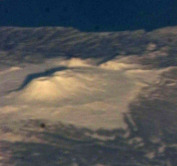
There’s a reason why that image is so small, which we’ll get to later on.
Here’s a view from closer to the ground, although this doesn’t show those unusual double-summit craters very well (that pointy volcano in the background is Kronotsky, which last erupted in the 1920s):

Игорь Шпиленок via Wikimedia, public domain
Some spectacular cracks have opened up in Krasheninnikov volcano today as it erupted for the first time in several centuries:
I see lava flowing down there, along with powerful phreatomagmatic (steam-explosion) plumes.
According to Pravda — the only official information source that I can find online (KVERT’s website doesn’t load for me; can you get it?) — Russian volcanologist Olga Girina reports that a lava dome is forming in the north summit crater. Very little information about the cracks was given.
Interesting sequence of events
EuroNews reports that Russian volcanologists suspect this eruption and a very strong temblor today might be related to the recent M8.8 megathrust quake.
It went like this:
1. July 29: The big one happened. Here are two informal looks at that, from Earthquake Insights and, less technically, from Wikipedia.
Note the USGS aftershock forecast, at that first link, of a 99% probability of aftershocks in the M6 range.
There was also an online surge of enthusiastic but not knowledgeable posts linking the quake to Klyuchevskoy’s eruption up in central Kamchatka. These did not take into account the fact the Klyuchevskoy has been erupting with that level of intensity for a while now.
CORRECTION: When I wrote that, I was unaware that activity at Klyuchevskoy and a couple of other regional volcanoes did increase: details here, along with any updates on Krasheninnikov that become available.
Volcanologists whose work I’ve read are almost unanimous in saying that earthquakes do not set off volcanoes except maybe, very occasionally, when the volcano was already primed for eruption.
I was more interested in possible effects on Avachinsky and Koryaksky, near Petropavlosk, but couldn’t get through to the KVERT site and eventually dropped it since there was no news about them.
2. August 3: At 1650 today, local time, Krasheninnikov erupted. (Kompas)
3. August 3: At 1737 today, local time, a M6.8 temblor sruck in the same general area as the big one, triggering a tsunami warning that was soon lifted.
That fascinating sequence is going to trigger quite a few papers and maybe even theses in coming years!
What is Krasheninnikov?
You might have seen, in some of the videos on that massive 8-pointer, that Kamchatka is part of a subduction zone, overriding the downgoing Pacific oceanic plate.
One of the results of this subduction is two volcanic belts, and associated fracture zones, running northeast-southwest down the peninsula. (Zelenin et al.)
Krasheninnikov is a subduction-zone volcano in the Eastern Volcanic Belt, close to the sea.
But it’s one of the rarer kinds of subduction-zone volcano that tend to erupt lava more often than blowing their tops over and over again, as Mount St. Helens (to name just one example) so frequently does.
Krasheninnikov knows how to be a drama queen, though.
Some of its prehistoric eruptions have a VEI 3 or 4 rating from the Global Volcanism Program and, some 30,000 years ago, according to a new study by Ponomareva et al., Krasheninnikov had a caldera-forming eruption in the VEI 6 range (magnitude 6.1).
This was one of many explosive eruptions in Kamchatka around that time, 25,000 to 30,000 years ago.
I don’t know why Kamchatka’s blasts were peaking back then or why Earth dialed back the volcanic violence a few notches to “Moderate” after that. (Ponomareva et al., 2021)
But that drop in intensity was a nice break.
At now mellower Krasheninnikov, starting around the end of the last ice age, lava flows built a stratovolcano. That took about 4,500 years, according to the GVP, and in the meantime another stratovolcano began rising just northeast of the first one some 6,500 years ago.
The two fire mountains were following the overall NE-SW line of the Eastern Volcanic Belt, and they grew together there in the middle of old Krasheninnikov Caldera, which is the vague oval shape around them in our feature image.
Here it is again:

Yes, that’s awfully small, but with a little tweaking, it shows the whole complex structure of this unusual volcano and the lighting is perfect.
It’s only part (lower left) of this larger view of the region from ISS:
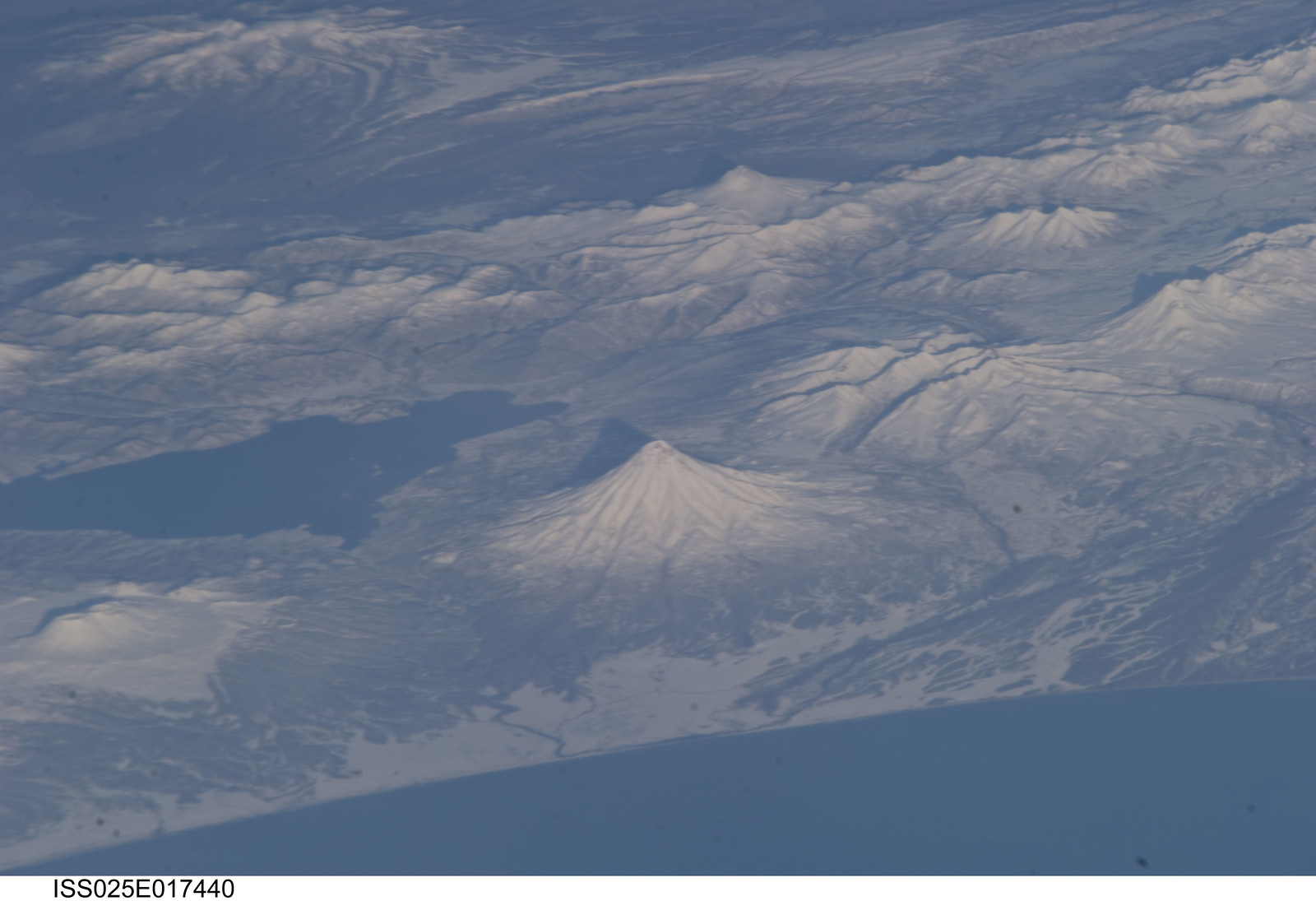
NASA#2007934, public domain
As you can see, this is a very remote area.
Nevertheless, the Global Volcanism Program reports on its website that almost 4,700 people live less than a hundred miles from Krasheninnikov.
There are also intercontinental air traffic corridors overhead, though I don’t know how busy they are at this moment of geopolitical tension. Tokyo VAAC monitors this airspace.
What distance and the snow hide in this space-station view are the NE-SW fissures and fractures in all that ground along the Eastern Volcanic Belt. (Zelenin et al. go into that in technical detail.)
As I understand it, they are there because of interactions between Kamchatka’s volcanism and its tectonics.
The fissured fracture zone controls the location of vents in the Eastern Volcanic Belt and it’s also why Krasheninnikov has flank eruptions as well as summit dome eruptions.
I know that cracks in an erupting volcano can be bad news, but my impression after reading up on Krasheninnikov is that these particular cracks are not a bug but a feature.
Hope I’m right.
Anyway, a new lava dome is forming in the north summit crater, where two others already exist. There is currently a VAAC advisory up, noting ash at 14,000 feet, but it doesn’t seem that the situation is escalating right now.
What the boffins do have is an eruption that really could have been seismically triggered. Wow!
As well, this is their first ever chance to directly observe a Krasheninnikov eruption.
For them, this is indeed a summertime Christmas!
Featured image: NASA, public domain; cropped and manipulated for better clarity
Sources:
Global Volcanism Program (GVP), last accessed August 3, 2025 https://volcano.si.edu/volcano.cfm?vn=300190
Ponomareva, V.; Pendea, I. F.; Zelenin, E.; Portnyagin, M.; and others. 2021. The first continuous late Pleistocene tephra record from Kamchatka Peninsula (NW Pacific) and its volcanological and paleogeographic implications. Quaternary Science Reviews, 257: 106838. (Abstract only)
Ponomareva, V. V.; Gorbach, N. V.; Zelenin, E. A.; Portnyagin, M. V.; and others. 2025. Krasheninnikov Caldera (Eastern Kamchatka: Age and Magnitude of Eruption. Russian Journal of Pacific Geology, 19(Suppl 1): S42-S45.
Wikipedia, last accessed at 1328 UTC, August 3, 2025 https://en.m.wikipedia.org/wiki/Krasheninnikov_(volcano)
Zelenin E.; Kozhurin, A.; Ponomareva, V.; and Portnyagin, M. 2019. Tephrochronological dating of paleoearthquakes in active volcanic arcs: A case of the Eastern Volcanic Front on the Kamchatka Peninsula (northwest Pacific). JOURNAL OF QUATERNARY SCIENCE, 1: 13.
 Flight To Wonder