
Okay, that’s not the sabercat’s scientific name, but “Promegantereon ogygia” is quite a toothy mouthful.
This official moniker has its own extensive history (Antón; Salesa et al., 2010a), but on looks alone, in that reconstruction Pogy seems a little different from the other sabertooths that we’ve met, doesn’t it?
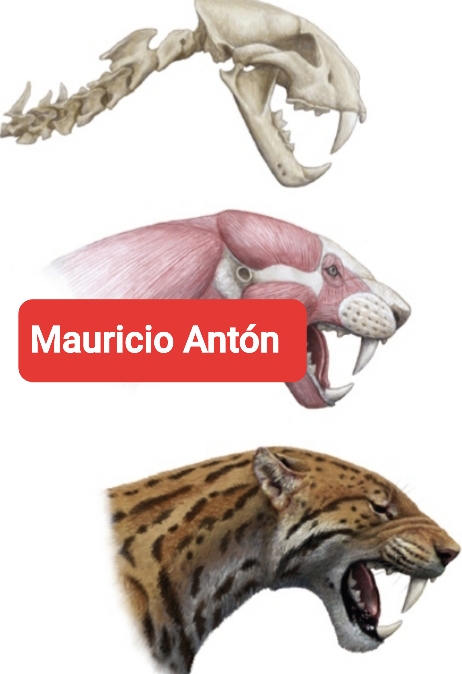
Here it is again. (Image: Figure 3.58, Anton, in “Sabertooth,” CC BY NC-ND-SA 4.0)
It could be a snarling leopard, except for the somewhat larger fangs, that long neck, and a few other, more subtle differences.
Yet Pogy is considered by some paleontologists, including Antón as well as Salesa et al. (2010, 2010a) to be the earliest known member of the Smilodon lineage, though this is controversial.
For some other paleontologists, Pogy has phylogenetic issues. They prefer to give the title of “First!” to Paramachaerodus for now, pending more research into the somewhat older P. ogygia and its evolution.
Primitive Promegantereon ogygia
Remember the description of sabercats, earlier in this series, as the Ferraris of cat-family evolution?
And then how conditions at the end of the last ice age instead somehow favored Family Felidae’s version of Model T’s? (Modern cats lack the evolutionary bells and whistles seen in sabertooths like Smilodon and Homotherium and have essentially the same basic body plan as the first cats, way back in the Early to Middle Miocene epoch 20-some million years ago.)
Because of this change in conditions about 12,000 years ago, which might have included but wasn’t limited to the presence and hunting skills of H. sapiens, the Pleistocene’s end was also the finish line for sabertoothed cat-like predators after a run of more than 30 million years. (Werdelin et a.)
But with Pogy and Paramachaerodus we’re now in the Miocene and much closer to Family Felidae’s starting line.
Yay!
For some unknown reason, Miocene conditions favored both “Model T’s” (the new cat family) AND sabertooths (the pre-existing barbourofelids, which were cat-like and extreme sabertooths, perhaps a sister group to Felidae, as Werdelin et al. note, or possibly nimravids of some sort; we’ll meet them in late September).
Since the barbourofelids already had been doing quite well for over 10 million years and were still thriving at that crucial moment in cat evolution, it’s not surprising that some of the Model Ts in this favorable world would start work on their own Ferrari makeover (as a layperson, I have no idea how to convey that evolutionary concept without metaphor).
But it was a slow process.
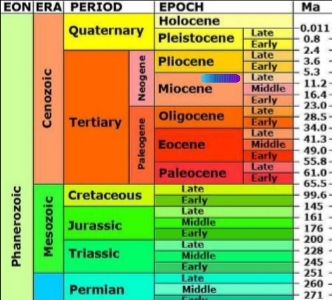
The blue-spectrum line is pointing at the Late Miocene. (Source, public domain>
For both Pogy and Paramachaerodus the time is Late Miocene, so Proailurus, the Dawn Cat, had already taken off early, followed in the Middle Miocene by its Model-T-like descendants Lorteti (probable ancestor of Felinae — today’s cats) and Quadridentatus, the most likely ancestor of Machairodontinae — the sabercats.
- Lorteti was leopard-sized, definitely a conical-toothed cat like today’s felids, per Werdelin et al.
- Quadridentatus resembled Lorteti but had what Antón calls “incipient sabertooth features.” (P-Quad is napping right now, waiting for its series post in early September.)
Our Pogy is a mix of primitive and early sabercat characteristics.
It has the Model-T anatomy of Quadridentatus (Agustí and Antón; Salesa et al., 2010a) but it also shows some undeniable signs of turning into a Ferrari (Salesa et al., 2010) — features that Paramachaerodus takes even farther.
Model T: Like a “normal” cat
Promegantereon’s head was almost puma-like but with a somewhat longer muzzle. (Salesa et al., 2010a)

The lower fangs were long, too, like those sported by today’s clouded leopard. That’s primitive, and even a little unusual.
In the fully developed sabertooth complex, notes Antón, lower canines actually shrink in size, becoming part of a protruding arch of lower incisors (which Pogy only showed a few hints of developing).
As for Pogy’s upper sabers, except for their size and (not visible from that reconstruction angle) the typical sideways flattening that all saberteeth have, to some extent — clouded leopard fangs are conical, like those of other modern cats — those upper fangs look a lot like those of a modern tiger or lion. (Agustí and Antón)
P. ogygia might have used those fangs the same way tigers, lions, and other modern members of the genus Panthera do, with a pantherine-like killing bite.
Or perhaps it had something in between that and the presumably more slashing and specialized bite used by Ferraris more evolved sabercats like Megantereon and Smilodon, whatever that was (jargon alert). (Chatar et al.; Wikipedia)
Pogy stood about 24 inches tall at the shoulder, with a build very much like that of a puma or a small leopard, but what Antón calls the “sabertooth complex” was starting to show.
Ferrari: Like a saber-toothed cat
Besides its long neck and lynx-like short tail, P. ogygia also had very powerful forelegs and a big, sharp dewclaw (Salesa et al., 2010) — features found in many sabertooths.
Yes, we’ve seen this superb video before, but did you notice the cat reaching out and hooking that unfortunate gazelle? Besides speed, they need a sharp dewclaw!
Dewclaws aren’t as well developed in today’s cats but they’re still very useful. Cheetahs use theirs at the end of a chase to bring down small prey.
Pogy also had the sabertooth ability to handle its prey with powerful forearms, and its elbows and shoulders were reinforced for stability. (Salesa et al., 2010)
Why?
Until someone invents a time machine and we can go back to observe sabercats at work, no one can be certain why they had such front-end power.
One very popular suggestion based on fossil evidence and various computer and mechanic modeling studies is that sabercats both protected their saberteeth from prey struggles and also speeded up the killing process to stay head of competition and scavengers by pinning the hapless victim against the ground, immobilizing it before applying the killing bite.
Here, some boffins explore how Smilodon might have killed its prey:
Powerful forelegs and rather light and flexible hindlegs also meant that medium-sized sabercats like Pogy and Paramachaerodus were agile, too, and could carry their meal up into a tree, where they might be able to eat in peace.

And then race around with the zoomies. (Image: Mauricio Antón via Wikimedia, CC BY-SA 3.0 nl)
🐾🐾🐾
Location: Eurasia.
Time: Late Miocene, roughly 11 to 7.5 million years ago.
Pogy disappeared from Europe’s fossil record a couple million years before its contemporary Paramachaerodus did.
See that post for some highlights of the environmental setting in which these two sabercats coexisted, one that they also shared with primitive homotherins and, briefly, with barbourofelids.
A lot of changes occurred during these times, and it will be easier to get a feel for them if we wait until all the interacting players are on board, namely, genus Machairodus (August 29) and genus Barbourofelis (September 19) — note: dates might change a little, depending on work circumstances, but that’s what I am aiming for.
Featured image: Figure 3.58 in Antón’s book Sabertooth. I watermarked it, as he does with images on his blog, and hope that it might encourage you to purchase his book, with all its wonderful artwork and detailed information on sabertooths from Permian times on down to yesterday, some 12,000 years ago.
Disclosure: I am just a fan of this paleoartist and have no personal, financial, or business connection with Mauricio Antón. I just think that readers of my blog should know about Sabertooth.
Sources:
- Agustí, J., and Antón, M. 2002. Mammoths, sabertooths, and hominids: 65 million years of mammalian evolution in Europe. New York and Chichester: Columbia University Press. Retrieved from https://play.google.com/store/books/details?id=O17Kw8L2dAgC
- Agustí, J.; Cabrera, L.; and Garcés, M. 2013. The Vallesian Mammal Turnover: A Late Miocene record of decoupled land-ocean evolution. Geobios, 46(1-2), 151-157.
- Antón, M. 2013. Sabertooth. Bloomington: Indiana University Press. Retrieved from https://play.google.com/store/books/details?id=dVcqAAAAQBAJ
- Casanovas-Vilar, I. 2014. The range and extent of the Vallesian Crisis (Late Miocene): new prospects based on the micromammal record from the Vallès-Penedès basin (Catalonia, Spain). Journal of Iberian Geology, 40(1), 29-48.
- Chatar, N.; Fischer, V.; and Tseng, Z. J. 2022. Many-to-one function of cat-like mandibles highlights a continuum of sabre-tooth adaptations. Proceedings of the Royal Society B, 289(1988):20221627.
- Prothero, D. R. 2006. After the Dinosaurs: The Age of Mammals. Bloomington and Indianapolis: Indiana University Press. Retrieved from https://play.google.com/store/books/details?id=Qh82IW-HHWAC.
- Salesa, M. J.; Anton, M.; Turner, A.; Alcala, L.; and others. 2010. Systematic revision of the Late Miocene sabre‐toothed felid Paramachaerodus in Spain. Palaeontology, 53(6): 1369-1391
- Salesa, M. J.; Anton, M.; Turner, A.; and Morales, J. 2010a. Functional anatomy of the forelimb in Promegantereon* ogygia (Felidae, Machairodontinae, Smilodontini) from the Late Miocene of Spain and the origins of the sabre‐toothed felid model. Journal of Anatomy, 216(3): 381-396.
- Shelbourne, C. D., and Lautenschlager, S. 2024. Morphological diversity of saber‐tooth upper canines and its functional implications. The Anatomical Record.
- Werdelin, L.; Yamaguchi, N.; Johnson, W. E.; and O’Brien, S. J. 2010. Phylogeny and evolution of cats (Felidae), in Biology and Conservation of Wild Felids, eds. Macdonald, D. W., and Loveridge, A. J., 59-82. Oxford: Oxford University Press.
- Wikipedia. 2025. Mammal Neogene zones. Last accessed July 8, 2025. https://en.m.wikipedia.org/wiki/Mammal_Neogene_zones
___. 2025. Promegantereon. Last accessed July 8, 2025. https://en.m.wikipedia.org/wiki/Promegantereon
 Flight To Wonder