- Hot Springs Research Institute (Japanese)
- Japan Meteorological Agency (JMA) Hakone Town page (Japanese)
- Tokyo VAAC page
- Global Volcanism Program (GVP) page
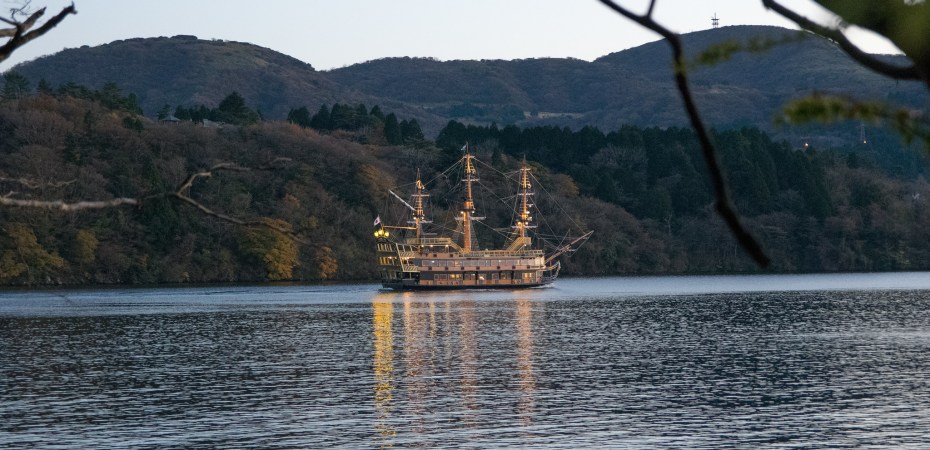
In case you were wondering where that ship in The Goonies was headed at the movie’s end…it sailed to Japan.
Actually that is a sightseeing cruise on beautiful Lake Ashi, which is part of a popular resort near Tokyo but also happens to fill part of the double-caldera summit of Mount Hakone, which is stirring:
【箱根山直下付近で地震、数日前から地震多発の場所】
21時49分頃、神奈川県西部(箱根山直下付近)を震源とするM3.7、震度2の地震がありました。付近では数日前から地震が頻発し始め、21日にはM3クラスの有感地震が発生していました。今後箱根山が噴火する可能性も否定できず、注意が必要です。 pic.twitter.com/wyfyPIZgua— 気象・防災チャンネル (@kisho_bousai) July 23, 2025
https://platform.twitter.com/widgets.js
X translation:
[Earthquake near the base of Mount Hakone, a location with frequent earthquakes in recent days]
Around 9:49 PM, an earthquake with a magnitude of 3.7 and an intensity of 2 occurred, with its epicenter in western Kanagawa Prefecture (near the base of Mount Hakone). The area has been experiencing frequent earthquakes in recent days, with a felt earthquake of magnitude 3 occurring on the 21st. The possibility of Mount Hakone erupting in the future cannot be ruled out, and caution is necessary.
I know nothing about this volcanic center. According to the GVP, “Hakoneyama volcano is truncated by two overlapping calderas, the largest of which is 10 x 11 km wide. The calderas were formed as a result of two major explosive eruptions about 180,000 and 49,000-60,000 years ago. Scenic Lake Ashi lies between the SW caldera wall and a half dozen post-caldera lava domes that were constructed along a NW-SE trend cutting through the center of the calderas. Dome growth occurred progressively to the NW, and the largest and youngest of these, Kamiyama, forms the high point. The calderas are breached to the east by the Hayakawa canyon. A phreatic explosion about 3000 years ago was followed by collapse of the NW side of Kamiyama, damming the Hayakawa valley and creating Lake Ashi. The latest magmatic eruptive activity about 2900 years ago produced a pyroclastic flow and a lava dome in the explosion crater, although phreatic eruptions took place as recently as the 12-13th centuries CE. Seismic swarms have occurred during the 20th century. Lake Ashi, along with the thermal areas in the caldera, is a popular resort destination SW of Tokyo.”
It’s interesting that they list a very brief VEI 1 eruption in 2015 and then nothing until as far back as ~1170 AD.
That’s just a blink of the eye to a volcano, but it does seem rather sluggish.
The quakes are centered in a small area — wonder if the fire mountain feels phreatic (steam-driven) or more like doing another lava dome?
Updates:
July 24, 2025, 7:10 a.m., Pacific: Well, this update (autotranslated) from the Kanagawa Hot Springs Research Institute is encouraging. There have been no changes noted in ground deformation or volcanic gases; no earthquakes have been located near the 2015 eruption site; and they think the seismicity looks more like that caused by tectonics than by volcanic activity.
I found that institute with help from a reader’s contextual note on the tweet included above in this post. Apparently “bousai” does not mean “official”!
That’s good to know, and they are unfollowed.
I will add the Institute to links. JMA reportedly (via NHK) continues to watch the volcano and its swarm closely, too.
May that beautiful golden ship continue to sail Lake Ashi unhindered for many years to come!
Featured image: pohjolanpoluilla, CC BY-SA 2.0
 Flight To Wonder