
This one you might not have heard of before.
Smilodon’s granddaddy, Paramachaerodus had much shorter upper-canine sabers.
In fact, this Late Miocene skull seems a little primitive for a sabercat (although it is still highly evolved when compared to today’s conical-toothed cats and their ancestors).
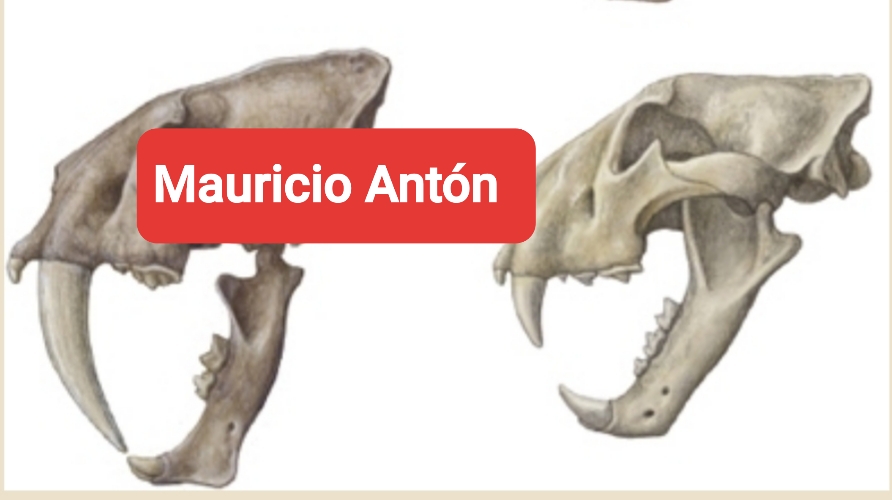
None of them is something you’d want to meet during a night at the museum. (From Figure 1.10, Antón, CC BY-NC-ND-SA 4.0).
That’s Smilodon fatalis on the left (a species found by the hundreds at La Brea), and on the right, a member of the modern big-cat genus Panthera.
What is Paramachaerodus?
The only Paramachaerodus species that seems to have consensus support among the boffins is Paramachaerodus orientalis, shown at the top of this post.
P. orientalis was about the size of a modern leopard and probably was a good climber, given its skeletal adaptations like those seen in cats today that inhabit forested habitats. (Antón; Wikipedia)
Today’s clouded leopard is also a forest-adapted cat with long upper and lower fangs, but for many reasons it is not a sabertoothed cat. Sabercats had shorter, lynx-like tails, and there is no evidence in ANY fossil cat of the amazing 180-degree ankle flexibility that clouded leopards and a few other modern cats have. (Antón; Werdelin et al.)
A highly technical debate over at least three other species continues, but let’s leave that to Wikipedia.
It’s just one of many unanswered questions about Genus Paramachaerodus.
Answers are few and far between because fossil cats of any sort are rare and also because of the passage of geological time — some 5 to 8 million years (Werdelin et al.) of erosion, burial, and decay since Promachaerodus roamed Eurasian and African woods and woodland savannas during the Late Miocene.
Indeed, very little is known about any of the saber-toothed apex predators that stalked Eurasia and Africa back then.
This is too bad because there was a wonderful assortment of them — and other impressive carnivores and herbivores besides.
Apparently just two kinds of sabertooth — Homotherium and Megantereon, descendant of Paramachaerodus — made it through the Miocene-Pliocene carnivore extinctions.
Therefore, the most recent and most complete fossil sabertooth record available to us, covering the last 2 million or so Plio-Pleistocene years, is dominated by just a couple of survivors.
It can only hint at the sabertoothed carnivore group’s glorious and multitudinous past, which you and I are now starting to explore on Fridays.
“E” vs. “I”
Of course scientists have risen to the challenge, but they make progress slowly and by means of argument and counterargument.
Then a new fossil is discovered, or an old one is reinterpreted in a novel but convincing way, and it’s back to Square One for everyone but the die-hards, who continue with the old arguments and very occasionally turn out to be right after all.
This complex process overall has advanced human understanding of past life on Earth, but it can be very confusing for outsiders like us laypeople — especially when it comes to sabercat names.
Early paleontologists went a little overboard with “machairo,” meaning “knife-like.” (Anton; Werdelin et al.)
It’s okay as the group’s name — “machairodontines,” cats with “knife-like teeth.”
But for a while there, almost every fossil sabercat was called “Machairodus” — in parallel, most living cats first were grouped in “Felis.”
These names have changed, sometimes a lot, down through the years as understanding of sabercats (and living cats) has improved. (Antón; Werdelin et al.)
The terminology still can make your head spin sometimes when you’re searching through scientific papers over the last century or so, but this “Machairodus” issue won’t mess up our blog series.
As we work our way back through the Miocene — a long epoch and the one in which Family Felidae appeared — sometimes a sabercat will be called “Machairodus” or have “Machairodus” as part of their name; sometimes not.
It’s no big deal. We are simply meeting a few sabercats (and eventually, a few sabertoothed cat-like barbourofelids and nimravids), not delving into evolutionary details and relationships.
That is, not beyond the point, for series post organization purposes, of grouping the cats as smilodontins (which we’re on now), homotherins (coming in August, with the final post, in November, being on Homotherium), and metailurins (September), as I understand Antón and Werdelin et al.
I wouldn’t even mention this “Machairodus” issue if it weren’t for the fact that today’s sabercat lost an “i” and gained an “e” — why they did this with Paramachaerodus, I have no idea.
🐾🐾🐾
Ecomorph/Tribe:
Dirktooth/Smilodontini (Antón); see Antón’s in-depth discussion of these two terms.
Location:
All of Eurasia, and in Africa, too.

The blue-spectrum line is pointing at the Late Miocene. (Source, public domain>
Time:
Late Miocene, 8 to 5.3 million years sgo. (Werdelin et al.)
Satellite view:
The Miocene comes near the end of this plate-tectonics reconstruction.
Watch for the Arabian Peninsula and Africa colliding with Europe, and India completing its docking with Asia. In the number countdown, roughly 23 to 5.3 is the Miocene.
Paramachaerodus actually came in at the very end of that epoch (8 to 5 million years ago, per Werdelin et al.).
There were some major Miocene changes in satellite view that the video doesn’t show very clearly.
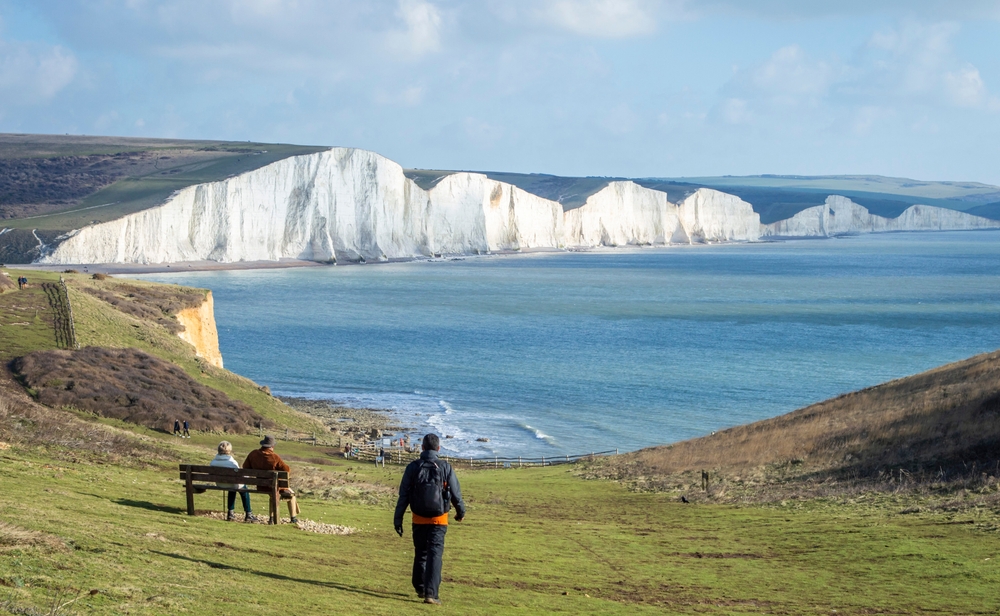
The Arabia, Africa, and India collisions with Eurasia cut off the warm east-west flow of the Tethys Sea, forming the Mediterranan. This also caused some major changes in global ocean circulation.
The video also doesn’t show glaciers forming on Antarctica in the early Miocene and then melting away, although the cool-temperate land there probably was not completely ice free during this epoch.
Permanent ice finally appeared there around 14 million years ago, first the East Antarctica Ice Sheet, and then, during the Late Miocene, the West Antarctica Ice Sheet, which was more unstable since part of it was and is over the ocean, not completely landbound.
Sea levels dropped as the ice cap formed, then rose again with fluctuations in Antarctic ice volume.
In northern polar regions, there might have been some glaciers here and there, but in Late Miocene times the Arctic Sea was open water and ice ages were not a thing yet. (Agustí et al.; Prothero)
Weather report:
Cooling and drying out of the temperate latitudes world-wide as ocean circulation changed and the the South Pole ice cap grew.
Extremely dry at times, on and off for about a million years, in the Mediterranean basin, starting around 6 million years ago!
Setting:
As you can see on the “satellite-view” video, today’s major mountain ranges were rising throughout the Miocene, including but definitely not limited to the Alps and Himalayas.
This created many kinds of landscapes and microhabitats for animals and plants to explore and adapt to.
Also, Prothero notes that today’s East Africa savanna is only a remnant of the Late Miocene grasslands that spread across most temperate and dry tropical regions.
There is plenty of cover today in East Africa for leopards to use as they hunt and coexist with lions, hyenas, and other competition.
This was probably true for leopard-sized Paramachaerodus, too — at least until the Mediterranean started going through drying cycles that severely affected the surrounding lands and their animals.
Competition:
Depending on location, these included a variety of (at least) lion-sized homotherins of the genus Machairodus — told you! — as well as leopard-sized or larger metailurins and the new Dinofelis cats (Antón counts both of these two cougar- to pantherine-like groups as sabertooths, but not all paleontologists agree).
For a while, Paramachaerodus also shared its habitat with another mid-sized sabercat: Pogy (Promegantereon ogygia), who we will meet next week.
By the late Miocene there were also plenty of hyenas around, as well as ancestral modern cats that moved into Africa from Eurasia over the land bridges that formed during continental collisions.
On the large caniform side, bears were present. However, I don’t think that Paramachaerodus had to contend with the members of Family Canidae who, along with several other species, had left North America for Eurasia, crossing over the Bering Land Bridge.
Canids hadn’t yet reached Europe, where they would eventually outcompete the hyenas (who would then just have Africa to call home).
Prey:
Ancestral elephants and their relatives, which include mammoths and mastodons, moved out of Africa on the new land bridges.
With luck, Paramachaerodus might have taken the young of such moving beast mountains, if the larger sabercats allowed it, but its more likely prey would have been some of the many rhino species, as well as various pigs, deer, horses, and ancestral cattle family and giraffe family members — anything that might wander into a wooded area to forage in peace, away from the many hazards of the open savanna.
Monkeys, apes, and hominids were probably on the menu, too.
Featured image: Figure 3.59 in Antón’s book Sabertooth, CC BY-NC-ND-SA 4.0. I watermarked it, as he does with images on his blog, and hope that it might encourage you to purchase his book, with all its wonderful artwork and detailed information on sabertooths from Permian times on down to yesterday, some 12,000 years ago.
Disclosure: I am just a fan of this paleoartist and have no personal, financial, or business connection with Mauricio Antón. I just think that readers of my blog should know about Sabertooth.
Sources:
- Agustí, J., and Antón, M. 2002. Mammoths, sabertooths, and hominids: 65 million years of mammalian evolution in Europe. New York and Chichester: Columbia University Press. Retrieved from https://play.google.com/store/books/details?id=O17Kw8L2dAgC
- Agustí, J.; Cabrera, L.; and Garcés, M. 2013. The Vallesian Mammal Turnover: A Late Miocene record of decoupled land-ocean evolution. Geobios, 46(1-2): 151-157.
- Antón, M. 2013. Sabertooth. Bloomington: Indiana University Press. Retrieved from https://play.google.com/store/books/details?id=dVcqAAAAQBAJ
- Prothero, D. R. 2006. After the Dinosaurs: The Age of Mammals. Bloomington and Indianapolis: Indiana University Press. Retrieved from https://play.google.com/store/books/details?id=Qh82IW-HHWAC.
- Werdelin, L.; Yamaguchi, N.; Johnson, W. E.; and O’Brien, S. J. 2010. Phylogeny and evolution of cats (Felidae), in Biology and Conservation of Wild Felids, eds. Macdonald, D. W., and Loveridge, A. J., 59-82. Oxford: Oxford University Press.
 Flight To Wonder