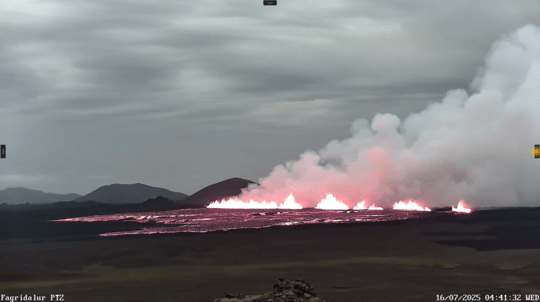
It began about five hours ago and, per IMO (autotranslated), it is apparently small and doesn’t threaten infrastructure.
Here is their map of the location:
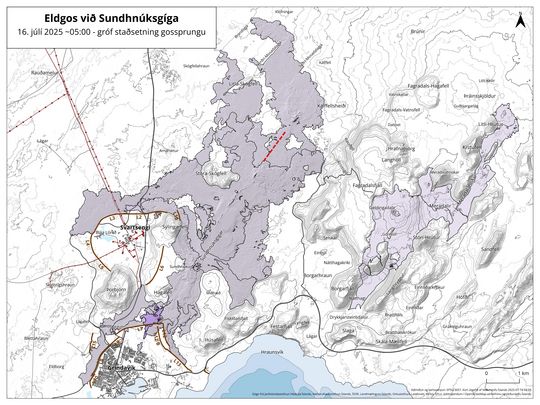
There aren’t updates just yet, as I just heard of this, but there soon will be after I check the news.
Links
Updates
July 16, 2025, 11:51 p.m., Pacific: Well, things seem to have quieted down some, although reportedly (autotranslated) there was impressive phreatomagmatic activity yesterday evening as the lava met groundwater, and authorities reassured everyone that there are no geothermal pipes in the area.
According to RUV (via Google Translate):
- Volcanic activity has decreased significantly, seismic activity has almost completely dropped, and no deformation is measured in the area. Lava flows are still present, although they have decreased in the southernmost part of the fissure.
- At nine o’clock, the civil protection level was lowered from emergency to danger level, and as a result, residents of Grindavík were given access to the town. The Blue Lagoon was then opened.
Per an mbl.is article, Grindavik is open to residents only, not tourists or the general public, and workers are sealing cracks and raising dams in that area.
The main hazards now are still volcanic gas and also wildfire smoke.
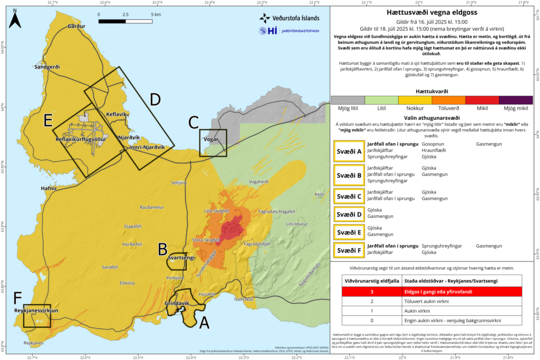
IMO has lots more information at the link at the top of this post, and here is their current risk assessment — it’s not labeled on the map, but Reykjavik is to the right (east and north) of Vogar:
July 16, 2025, 7:11 a.m., Pacific: A second fissure has opened, per IMO, and the original one is longer.
Via Google Translate:
Updated at 12:00
The latest observations show that the eruption is no longer confined to a single fissure. The larger fissure at the Sundhnúkagígaróðin is estimated to be about 2.4 km long. A smaller fissure has also opened west of Fagradalsfjall and was estimated to be about 500 meters long in a reconnaissance flight by the Icelandic Meteorological Office and the Coast Guard.
Armann Hoskuldsson, however, told MBL.IS (autotranslated) —
…Ármann says, however, that he is not certain that this is a new crack, but rather that the new formation could also be a diagonal continuation of the previous crack…
He also notes that landrise seems to be continuing on the GPS readouts, though Benedikt noted earlier today that it seems to be slowing down.
IMO’s Kristin Jonsdottir told RUV that it would be very surprising if the eruption increases.
July 16, 2025, 4:57 a.m., Pacific: As I understand it, mainly from IMO’s website and the RUV live feed, seismicity began shortly before midnight local time. A roughly 6.5-km dike formed over the next 3-1/2 hours but didn’t start to surface until around 3:45; it broke through at 3:54 and has been going ever since.
The erupting fissure lengthened to about 1.5 km and then apparently stopped growng. It’s way to the north and east, away from human stuff, and there isn’t a big flood as there was with many of the earlier eruptions.
Volcanologist Benedikt, with IMO, told RUV that it doesn’t appear to be a very large eruption. Ground deformation has not been intense and not a lot of lava has come out.
The deformation and seismicity continued for a while after the eruption began, but Benedikt was quoted as saying that they have begun to subside. He doesn’t think there will be breakouts anywhere else.
The main problems right now are gas and “witches’ hair,” a/k/a Pele’s hair in Hawaii — long strands of volcanic glass that can be very irritating.
The gas pollution is extreme enough to block RUV’s webcams and to darken the Keflavik area. Residents in and around Reykjanesbaer are sheltering indoors because of it.
Thorvaldur told Visir that he was not surprised, and this is indeed the case since he told Dr. Val Troll in this lighthearted July 9 video that an eruption could come in the last week of July or first week of August:
It did.
MBL.IS has lots of coverage but they also have a historic headline (autotranslated) published shortly before the eruption began:

😎
Featured image: Icelandic Met Office
 Flight To Wonder