
That is a big cat!
It’s Smilodon populator, staring at you with surprisingly small eyes, mouth closed but nonetheless showing two long fangs that extend a disconcertingly long way below either side of the cat’s rather boxy but lion-like muzzle.
Don’t you wish you had a cat that was merely the size of an African lion in front of you now!
S-pop has just realized you’re there. What are you going to do now?
Read some interesting facts about Smilodon sabercats, that’s what! Fortunately for you, it’s only a picture.
If this was real life, you’d also have going for you the fact that you surprised the cat, not the other way around.
While no one has ever documented a living sabertooth — not even in cave drawings, as far as I know — various pieces of evidence suggest that all Smilodon species were ambush predators. (Antón)
If old S-pop up there had meant business, you wouldn’t have even known what hit you.
So try to look big and not worth the trouble of investigating, move casually over to the nearest tree (without turning your back on the cat) if an accessible bunker is not handy, and work your way up to the branch level that will easily support you but not the weight of a quarter- to half-ton beast.
Comfy? Now let’s check out a few details about the world’s most famous saber-toothed cat.
🐾🐾🐾
Location: The Americas only. Smilodon fossils have been found as far north as Alberta, Canada, and south into Patagonia near the Strait of Magellan. (Wikipedia)
Time: All of the Pleistocene to (maybe, though unlikely) very early Holocene. (Wikipedia)
Satellite view:
Weather report: Glacial-interglacial.
Setting:
Glacial (Glasser et al.; Adams/Oak Ridge; Prothero):
- Ice across all of Canada and most of northern US.
- North America: South of ice cap, lots of loess as well as a broad belt of tundra through places like Iowa and Ohio; spruce taiga; and in the southeast, pine-hardwood stands like those around today’s Great Lakes. Cove forests in the Smokies and elsewhere are ice-age refuges for the Northeast’s modern beech-birch-maple hardwoods, as I learned in Dendrology class back in the 1980s. West of all of this is steppe and prairie.
- In South America, ice sheets cover the western Andes and extend down to the Pacific, while the eastern Andes sport a more “alpine glacier” look. Amazon lowlands: a mosaic mixture of savanna and forest, with prairies but also, in central Amazonia, a few rainforest refuges. Deserts and semideserts cover parts of Argentina and Venezuela. Much of Brazil’s Atlantic coast is grassland, and tundra vegetation grows in Patagonia.
Interglacial (we’re in one of these periods today, called the Holocene):
- In North America, vegetation zones follow the melting ice poleward. Pine/cypress forests and swamps reappear in Florida and parts of the Deep South, with oak and pine dominating the woods north of that, followed by mostly oak forest, and then by the plant-cover groups that never went away — south to north, pine-hardwood, boreal spruces, and finally tundra close to the remaining ice fronts up within or near the Arctic Circle.
There are also widespread mosaic savanna/forest landscapes, particularly in southwestern North America, including the famous La Brea region, and overall climate is temperate and humid.
- It isn’t clear to me what South America was like during interglacial times, other than being at least a little less arid.
There were certainly still open prairies and savanna/woodland mosaics. Some tropical vegetation might have returned only to die back into refuges like central Amazonia or lower mountain slopes and valleys again as a new glacial cycle cooled and dried out the world again.
Glacial or interglacial, all species of Smilodon could thrive on the diverse Pleistocene animals that inhabited this rich assortment of habitats.
Smilodon
A genus currently thought to have had three species. (Antón; Wikipedia)

Wikimedia, CC BY-SA 4.0.
From oldest to youngest, these were (Anton; Wikipedia):
- S. gracilis, “slender Smilodon,” at least when compared to its two relatives, although it was no lightweight at 120 to 220 pounds. (Wikipedia) Gracilis was jaguar-sized and built rather like a jaguar, too, but with a longer neck, a shorter tail, and adaptations that probably made it a good climber. It migrated into northern South America during the Great Interchange, but the most complete Gracilis fossils to date have been found in Florida. The other two Smilodon species evolved from this early to middle Pleistocene sabercat. More information, and also this.
- S. fatalis, “deadly Smilodon.” This lion-sized sabertooth, 39 inches tall at the shoulder, is the one we all know and love from La Brea’s sticky asphalt carnivore trap, although it also was widespread across North and South America (mostly west of the Andes). Weight estimates vary considerably, but because of its stockier build, big bones, and hefty front-end musculature, Fatalis probably at minimum was somewhat heavier than a modern lion, which can get up to 600 pounds or so in Africa.
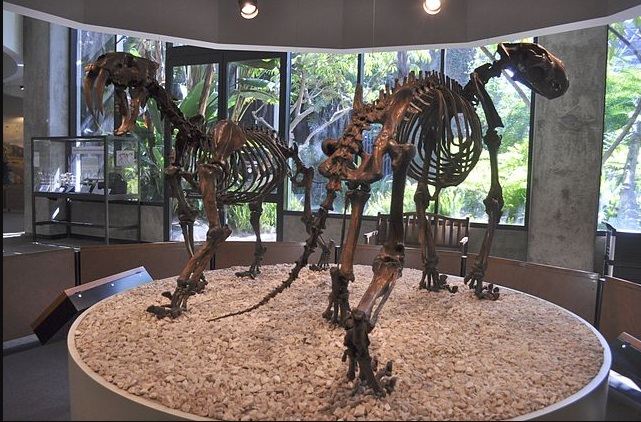
The American “lion” (right) and Smilodon fatalis at the La Brea museum. (Image: Joe Mabel, via Wikimedia, CC BY-SA 3.0)
- S. populator, “Smilodon, the destroyer.” The largest saber-toothed carnivorans ever, S-pop stood 47 inches tall at the shoulder, and estimates of its weight, per Wikipedia, range between roughly 500 and 960-plus pounds.
It had shorter toe bones than Fatalis, per Antón, but these fossilized pawprints, found on a twenty-first-century Argentine beach, nevertheless measure 6.9 x 7.6 inches, bigger than a Bengal tiger’s.
S-pop was a BIG cat!

Note the absence of claw marks — Smilodon populator, like most cats, had fully retractable claws! (Image: Grupopaleowiki via Wikimedia, CC BY-SA 4.0)
Smilodon populator was a South American native and an apex predator in ecosystems east of the Andes from Venezuela to Patagonia, while most Smilodon fatalis fossils have been found west of the Andes.
I’d keep a mountain range between me and “Smilodon the Destroyer,” too!

Wikipedia briefly mentions a fourth Smilodon species, Smilodon californicus, that was proposed in 2018. I’m not sure of its taxonomic status.
Ecomorph/Tribe: Dirktooth/Smilodontini (Antón); see Antón’s in-depth discussion of these two terms.
Prey: According to Antón, in North America Smilodon’s main prey would have been bison, horses, and young mammoths or mastodons. Wikipedia adds in camels — a North American taxon that went extinct here during the Pleistocene, although it survived elsewhere the world. (Prothero)
In South America, Smilodon could feed on liptoterns and toxodonts, along with horses and the mammoth and mastodon elephant relatives.
However, isotope studies suggest that, in Florida’s Pleistocene subtropical forests and savannas, S. gracilis was flexible and included peccaries and other critters in its diet. In South America, the studies show, S. populator also ate some large armadillo relatives, glyptodonts, llamas, ground sloths, and crocodilians. (Wikipedia)
Although we can’t be sure just how Smilodon used its 11-inch sabers for hunting, like all cats it was probably opportunistic, taking whatever came along, and it probably was not above a little carcass scavenging from time to time, too.
Turtles (not really) were a problem.
Competition:
Medium to large carnivorans in Pleistocene North America included (but weren’t limited to) extinct and modern bear species, primitive wolves and coyotes, the dire wolf, and a variety of cats: now-extinct Miracinonyx, Homotherium, and the American “lion”, as well as modern pumas, jaguars, and lynxes. (Prothero)
In South America, S-pop’s main competition was the short-faced bear — together with its northern relative Arctodus, one of the largest known carnivoran ever.
On the southern continent Fatalis would have had to deal with other large predators, including its own close relative “Smilodon the destroyer.” (Antón; Prothero)
In North America, basically only the American lion and dire-wolf packs were serious food-chain competitors for Smilodon. (Antón)
However, according to Wikipedia, there was apparently some niche partitioning going on to relieve competitive pressures.
Isotope studies suggest that Fatalis might have gone after tapirs, deer, and some bison species, all of which lived (and in most cases still live) in forests.
Dire wolves, on the other hand, would have been out chasing prey on the open savanna.
This hypothetical coexistence, if it existed, would have broken down if S. fatalis was a social cat like modern lions and, occasionally, cheetahs. Smilodon’s sociality is an open question, per Antón.
Regardless of preferred hunting grounds, all nearby predators would have been drawn to La Brea by the cries of animals trapped in the asphalt seep. As we know, this did not go well for many of those same predators.
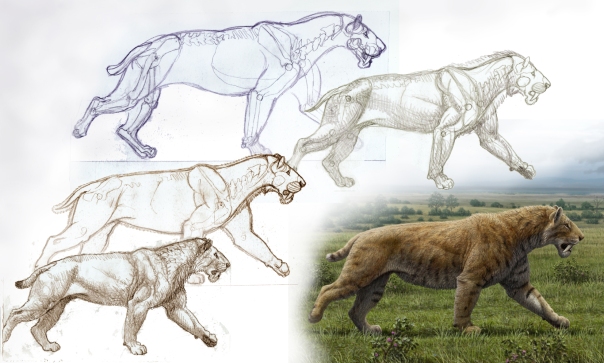
Featured image: Figure 3.68 in Antón’s book Sabertooth. CC BY-NC-ND-SA 4.0 I watermarked it, as he does with images on his blog, and hope that it might encourage you to purchase his book, with all its wonderful artwork and detailed information on sabertooths from Permian times on down to yesterday, some 12,000 years ago.
Disclosure: I am just a fan of this paleoartist and have no personal, financial, or business connection with Mauricio Antón. I just think that readers of my blog should know about th book Sabertooth.
Sources:
- Adams, J./Oak Ridge National Laboratory. n.d. South America during the last 150,000 years. https://www.esd.ornl.gov/projects/qen/nercSOUTHAMERICA.html
- Agnolin, F. L.; Chimento, N. R.; Campo, D. H.; Magnussen, M.; and others. 2019. Large carnivore footprints from the late Pleistocene of Argentina. Ichnos, 26(2): 119-126.
- Agustí, J., and Antón, M. 2002. Mammoths, sabertooths, and hominids: 65 million years of mammalian evolution in Europe. New York and Chichester: Columbia University Press. Retrieved from https://play.google.com/store/books/details?id=O17Kw8L2dAgC
- Antón, M. 2013. Sabertooth. Bloomington: Indiana University Press. Retrieved from https://play.google.com/store/books/details?id=dVcqAAAAQBAJ
- Glasser, N. F.; Jansson, K. N.; Harrison, S.; and Kleman, J. 2008. The glacial geomorphology and Pleistocene history of South America between 38 S and 56 S. Quaternary Science Reviews, 27(3-4): 365-390.
- Prothero, D. R. 2006. After the Dinosaurs: The Age of Mammals. Bloomington and Indianapolis: Indiana University Press. Retrieved from https://play.google.com/store/books/details?id=Qh82IW-HHWAC.
- Wikipedia. 2025. Smilodon. https://en.m.wikipedia.org/wiki/Smilodon Last accessed June 21, 2025
 Flight To Wonder