This swarm seems to be getting stronger and so it deserves its own post (the previous one switched focus to a local volcano, Satsuma, which continues to be merely a little restless).
This tweet and the associated story convinced me to pay attention to the swarm:
悪石島・有川さん「揺れた時はガソリン補給の途中で、タンクに車が当たるのではないかと驚いた。電柱も抜けそうなくらい揺れた。今は学校のグラウンドにいるが、島民の半分以上が集まっている。皆、疲れています」
鹿児島 悪石島で震度6弱 津波の心配なし(16:13) | NHK https://t.co/0UglJ9I5Yk
— 藤島新也@災害担当記者🌏 (@shinyahoya) July 3, 2025
https://platform.twitter.com/widgets.js
X translation: “Akuseki Island, Mr. Arikawa: “When it shook, I was in the middle of refueling with gasoline, and I was shocked, thinking the car might hit the tank. The utility poles were shaking so much it seemed like they might come loose. Now, I’m at the school grounds, but more than half of the islanders are gathered here. Everyone is exhausted.”
Kagoshima, Akuseki Island, seismic intensity just below 6, no tsunami concerns (16:13) | NHK”
From the story, via Google translation (values given are shaking intensity, not magnitude; today’s big one was M5.5):
…Seismic activity has been increasing around Akusekijima Island and Kodakarajima Island since the 21st of last month, and by 5pm on the 3rd, there had been 1,050 earthquakes with a seismic intensity of 1 or higher.
This area also experienced active seismic activity two years ago and four years ago, but the number of earthquakes with a magnitude of 1 or above was 346 over a 15-day period in September of last year, and 308 over a 26-day period in December four years ago, so this time it is more than three times as many…
I still don’t have any idea as to whether this is volcanic or tectonic. As mentioned in the first post, it’s occurring in a very complex tectonic situation associated with a subduction zone; volcanoes also litter the seafloor here, none of them seen to be erupting yet but none of them ancient.
So this swarm could be either tectonic or related to deep magma movement, or both.
Edit: Just came across an in-depth look at the situation by the seismologists at Earthquake Insights, including this:
…these differences suggest that the new swarm is doing something different than the old swarms. What this difference means is less clear.
So, what can we expect? Unfortunately, swarms don’t tend to follow rules very well. This seismicity could continue at its current level for days or weeks, or it could die down. There is also the possibility that a larger earthquake could be triggered. If that happens, we can expect that the triggering would occur within the region of the current swarm — the shallow faults around the volcanic arc — rather than on the subduction megathrust, which is quite far away.
Given the data we are looking at, we cannot tell if this swarm is associated with movement of fluids along fault zones, or if there is involvement of actual magma. This is a volcanic region, so both options are possible. Magma movement might cause specific seismic signals like tremor, or deformation of the ground surface (although most of the ground surface here is below water, and thus very hard to track), so looking for those signals could help resolve this issue…
Updates:
December 8, 2025, 2:20 p.m., Pacific: I’m updating these posts and have both geophysical and volcanism news from this fall.
First, per Japan’s Geospatial Information Authority, a few centimeters of horizontal movement was detected at Takarajima Island — that’s a lot of movement for an island, even in this complex tectonic setting.
Unfortunately, the changes are too small to show up, if present, on the sonar bathymetry scan that oceanographers in the Japan Coast Guard did this summer from July 31 to August 5.
Per Google translation of their report, they looked at the area where seismic swarming had increased, starting on June 21st, and compared it to scans done there between 2008 and 2015, before the current round of earthquake swarms.
No significant topographic changes were noted, but they do say that equipment would not pick up centimeter-scale changes.
Also, they didn’t study the shallows because a volcanic center (Kappa Sone) is there, endangering the ship and crew.
According to the Coast Guard report, Akusekijima, Kodakarajima, and Takarajima islands, although part of the volcanic front in this subduction zone, are not active volcanoes — they are built on older volcanic structures.
The study did detect active gas bubbling and hot water (fumaroles) near the submerged high sea-floor points of Shirahama Sone, Gogo Sone Tako, and Nakanosone Tako, as well as in 17 areas around Takarajima and Kodakarajima islands.
These signs of volcanism were not found in the sea area between Akusekijima and Kodakarajima islands where much of the recent seismicity has been centered.
No discolored seawater or floating debris, indicating a submarine eruption, has been seen, either.
The Coast Guard notes that previous surveys have found fumaroles northwest of the Tokaras at Shirahama Sone, but they don’t know about possible relationships between the newly documented fumarolic activity and the Tokara swarm or whether the seismicity might have intensified that activity.
August 4, 2025, 8:18 a.m., Pacific: The number of quakes remains lower than in some previous months.
Per this NHK report (Japanese), Kagoshima University and a number of other entities will do an in-depth study.
Via Google translation:
…According to the plan presented by the Ministry of Education, Culture, Sports, Science and Technology (MEXT), the investigation will
include: (1) setting up temporary seismic observation stations on Kodakarajima and other locations for monitoring. (2) using satellites to investigate crustal movements; ( 3) installing seismometers on the seafloor where seismic activity is occurring and analyzing the recorded data; and (4 ) investigating the relationship between earthquakes and underground magma activity. Furthermore, the university will cooperate with Toshima Village to conduct interviews with residents to investigate the environment of evacuation sites and the psychological impact on residents. Kagoshima University plans to hold a press conference on the 8th of this month to provide a detailed explanation of the contents of the investigation…
July 24, 2025, 7:46 a.m., Pacific: Activity has subsided a bit, as this graph of quakes since June 21st, by an unofficial but informed person, shows:
トカラ列島近海の地震、6月21日からのM-T図。昨日までは気象庁、今日はHi-net震源データによる。全体として活動はおさまってきているように見えるが、とくに7月18日頃より大粒の地震は無く数も大幅に減っている。 pic.twitter.com/AOLEXco3qW
— hacchan9642 (@hacchan9642) July 24, 2025
https://platform.twitter.com/widgets.js
From news sources, JMA says that intensity 6-level quakes are still possible.
It might not be relevant but JMA and Tokyo VAAC report that Suwanosejima continues to have intermittent low-level eruptions, and JMA notes that Satsuma still has glow and a white plume. They have not raised alert levels any farther at either volcano.
July 17, 2025, 10:57 p.m., Pacific: Per NHK (Japanese), by browser translation:
…Since the 21st of last month, 2,147 earthquakes with seismic intensity of 1 or higher were observed by 5:00 pm on the 17th near the Tokara Islands, and active seismic activity continues.
In the past few days, there were 32 earthquakes on the 15th, 52 on the 16th, and 18 by 5:00 pm on the 17th…
July 13, 2025, 7:11 a.m., Pacific: Per a Weather News story (Japanese) today, via browser translator:
…the 11th (Friday), there were more than 100 earthquakes for the first time in five days, and on the 12th (Saturday), although there were fewer felt earthquakes, there were three earthquakes with a seismic intensity of 3 and one with a seismic intensity of 4.
It has been active for more than three weeks and has had more than 1900 felt earthquakes. We believe that we will still need to wait and see if the situation will come to an end.
There was one with seismic intensity 3 reported just a little while ago. I don’t know how many have occurred today in total.
July 11, 2025, 00:44 a.m., Pacific: Most of the inhabitants of one of the larger islands had evacuated a few days ago — “This brings the total number of people who have evacuated from Toshima Village to 64, including 49 from Akusekijima Island and 15 from Kohojima Island” per the live Akusejima video below (link added) — and yesterday it was reported that they could return if the seimicity remained less frequent and if no 4-pointers occurred between now and mid-month.
Well, that’s gone out the window. Some 3- and 4-pointers are occurring today.
Weather News has a graph and story at the link.
<トカラの地震 午前中に5回の震度3>
トカラ列島近海の地震活動は今日11日(金)になり、やや活発になっています。震度1以上の地震は11時までに50回を超え、マグニチュード4以上の地震も3日ぶりに発生しています。https://t.co/gynjy7hIhf pic.twitter.com/3riEBU2PLL— ウェザーニュース (@wni_jp) July 11, 2025
https://platform.twitter.com/widgets.js
ANN News started this livestream from Akusejima 20 hours ago:
This report (Japanese) by another news source includes footage showing the camera shaking with each of the two large quakes today. It also reports that they will review the evacuation situation when four days have passed without such strong temblors.
I don’t know. Given the fact that two of those islands moved several inches apart over just three days, I would want more quantitative, in-depth evacuation criteria. Also, live cameras on Kohojima and Hojima, the two skitterish islands, would be nice (but probably very expensive and difficult to install, maintain, and watch 24/7).
Trouble is, it’s all happening underwater over a relatively large area, as well as underground, and so is very difficult to investigate.
July 9, 2025, 11:57 p.m., Pacific: This essay (autotranslated) on the Japanese Research Institute of Marine Geodynamics website, by Dr. Yoshiko Tamura, made me decide to pin this post, although the volcanic process described, if — a big “if” — this is what is causing the swarm, could go on for geological spans of time. Or not. 😦
I had some thoughts along those lines, given the large number of calderas on the seafloor — not to mention the presence of sleeping Kikai, a little closer to Kyushu — but I’m just a layperson.
This is the first commentary by a knowledgeable person that I’ve seen online about the possibility — and that’s all it is, one of several possibilities here which also include a major earthquake or the swarm stopping, as previous swarms here have done.
BTW, “magma fingers” is this researcher’s term and concept of the Tokara region magmatic plumbing. I don’t know that it is in widespread use: there is ongoing debate about the structure and dynamics of volcanic plumbing systems in subduction zones, though not about the basic fact that magma forms here, rises due to buoyancy, and along the way gets more explosive for geochemical and, I think, geophysical reasons.
The papers listed for Dr. Tamura on Google Scholar are highly cited, though.
Also, per this X thread (Japanese) by NHK disaster reporter Shinya Fujishima (which I’m unable to embed), the Tokara Islands of Kohojima and Hojima moved apart almost 10 cm between July 2 and July 5.
That’s way too fast for typical tectonic-generated movements.
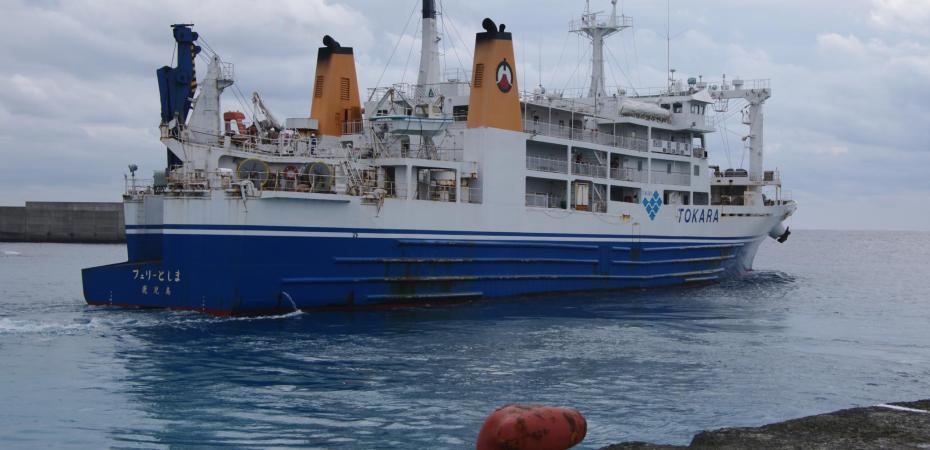
Featured image: The Toshima ferry at Kodakarajima Island by Tsuda, CC BY-SA 2.0
 Flight To Wonder