
This cutie is only slightly bigger than Asia’s teeny tiny rusty-spotted cat, and there aren’t many images of it online.
Kodkod is its name in a local native language, while in Spanish this small spotted wild kitty is a guiña (“whee-nya”).
Some experts suspect that “kodkod” could also refer to the pampas cat, so let’s stick with “guiña.”
For quite a while, no one was sure where guiñas fit into the cat family tree. Then genetic testing, reported in 2006, showed that they’re part of the ocelot line.
The scientific name now is Leopardus guigna (you sometimes still see the pre-2006 moniker Oncifelis guigna).
Guiñas have two recognized subspecies:
- Leopardus guigna tigrillo, in northern and central Chile.
- Leopardus guigna guigna, in southern Chile and southwestern Argentina.
Outstanding Features:
- Guiñas are the smallest native cat in the Americas. Globally, only the black-footed and rusty-spotted cats, in Africa and Asia, respectively, are smaller.
- Guiñas also have the smallest distribution of any cat, being limited to part of Chile and a very narrow strip of adjacent western Argentina. Much of this forested area is humid and so it isn’t unusual to see black (melanistic) guiñas — their spots still show in the right lighting!
- This is the only native carnivore in Patagonia’s Andean forest.
- Along with the Andean cat, guiñas are the most threatened cat in South America. (Cat Specialist Group) The guiña needs dense cover, and its habitat is fragmented from human activities and development, especially in the northern part of its range where more than half of Chile’s human population lives.
Data:
This information is from the Cat Specialist Group website unless otherwise noted.
However, keep in mind something Freer (in source list at end of post) notes:
Very little is known of the ecology and life history of the guigna, and much of that which has been published to date relies heavily upon speculation and folklore.
- Weight: 3 to 7 pounds
- Height at the shoulder: 9 inches (Freer)
- Body length: 15 to 22 inches
- Tail length: 8 to 10 inches
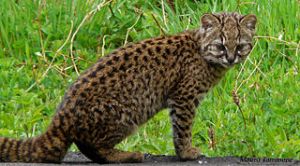
Mauro Tammone, via Wikimedia, CC BY-SA 3.0
- Coat: The background color of this dark-spotted cat is usually buff to grayish or reddish brown, with a lighter color on its spotted tummy. The adorably rounded face has fur markings unique to each individual, and the tail is banded. In some places, almost 30% of the southern subspecies population may melanistic (CSG; Freer), but the coat pattern is still visible in bright light:
The narration is in Spanish, but “nom-nom-nom” is a language all cats and cat lovers speak!
- Average litter size: 1 to 4 kittens
Where found in the wild:

Look for guiñas in central and southern Chile, as well as along the border with Argentina. (Image: BhagyaMani via Wikimedia, CC BY-SA 4.0)
Habitat:
- Range of environments: Guiñas have been observed up to 8,200 feet in the western Andes. Such wee cats need dense vegetation for protection as well as for cover while hunting. That’s why guiñas are always found in forests, typically the southern rainforest and Patagonia’s open beech woodlands for Leopardus guigna. guigna. Farther north, Leopardus guigna tigrillo uses the drier, more open matorral of Central Chile.
- Prey base: Guiñas are very difficult to study in the wild. At first, no one was even certain whether they hunted on the ground or in trees (they’re agile climbers). Thanks to camera traps, a consensus is building that guiñas are indeed terrestrial predators and hunt either at night or during the day. When they’re not active, guiñas have been seen resting in trees or in dense brush piles along streams and gullies.
This diminutive cat goes after small prey, of course, including rodents, birds, lizards, and even bugs!
Many small cats, and even some medium-sized ones, will eat insects, which are high in protein and technically considered “meat.” Don’t laugh — all modern carnivores probably evolved from insect-eaters.
- Example of guild: The presence in Argentina of Geoffroy’s cat — our friend from last time — may keep guiñas from spreading to the eastern slopes of the Andes. These two felines are closely related and often are mistaken for one another.
Red-list status:
Vulnerable (high risk for extinction). See the IUCN online assessment and the Cat Specialist Group page for more information.
Featured image: tya.studio/Shutterstock
Sources:
Allen, W. L.; Cuthill, I. C.; Scott-Samuel, N. E.; and Baddeley, R. 2011. Why the leopard got its spots: relating pattern development to ecology in felids. Proceedings of the Royal Society B. 278: 1373-1380.
Cat Specialist Group. 2019. http://www.catsg.org/index.php?id=92 Last accessed September 2, 2019.
Ewer, R. F. 1973. The carnivores. The World Naturalist, ed. Carrington, R. London: Weidenfeld and Nicolson.
Freer, R. A. 2004. The spatial ecology of the güiña (Oncifelis guigna) in southern Chile (pp. 1-219). Durham (UK): University of Durham. Available at Durham E-Theses Online http://etheses.dur.ac.uk/3050/
Johnson, W. E.; Eizirik, E.; Pecon-Slattery, J.; Murphy, W. J.; and others. 2006. The Late Miocene Radiation of Modern Felidae: A Genetic Assessment. Science, 311:73-77.
Kitchener, A. C.; Breitenmoser-Würsten, C.; Eizirik, E.; Gentry, A.; and others. 2017. A revised taxonomy of the Felidae: The final report of the Cat Classification Task Force of the IUCN Cat Specialist Group. https://repository.si.edu/bitstream/handle/10088/32616/A_revised_Felidae_Taxonomy_CatNews.pdf
Macdonald, D. W.; Loveridge, A. J.; and Nowell, K. 2010b. Dramatis personae: An introduction to the wild felids, in Biology and Conservation of Wild Felids, eds. Macdonald, D. W., and Loveridge, A. J., 3-58. Oxford: Oxford University Press.
Napolitano, C.; Johnson, W. E.; Sanderson, J.; O’Brien, S. J.; and others. 2014. Phylogeography and population history of Leopardus guigna, the smallest American felid. Conservation genetics, 15(3): 631-653.
Napolitano, C.; Gálvez, N.; Bennett, M.; Acosta-Jamett, G.; and Sanderson, J. 2015. Leopardus guigna. The IUCN Red List of Threatened Species 2015: e.T15311A50657245. https://www.iucnredlist.org/species/15311/50657245
Nyakatura, K., and Bininda-Emonds, O. R. P. 2012. Updating the evolutionary history of Carnivora (Mammalia): a new species-level supertree complete with divergence time estimates. BMC Biology. 10:12.
O’Brien, S. J., and Johnson, W. E. 2007. The evolution of cats. Scientific American. 297 (1):68-75.
Schneider, A.; Henegar, C.; Day, K.; Absher, D.; and others. 2015. Recurrent evolution of melanism in South American felids. PLoS Genetics, 11(2), e1004892.
Shostell, J. M., and Ruiz-Garcia, M. 2013. An introduction to neotropical carnivores, in Molecular Population Genetics, Evolutionary Biology and Biological Conservation of the Neotropical Carnivores. p, 1-36.
Sunquist, M. and Sunquist, F. 2002. Wild Cats of the World. Chicago and London: University of Chicago Press. Retrieved from https://play.google.com/store/books/details?id=IF8nDwAAQBAJ
Turner, A., and M. Antón. 1997. The Big Cats and Their Fossil Relatives: An Illustrated Guide to Their Evolution and Natural History. New York: Columbia University Press.
Werdelin, L.; Yamaguchi, N.; Johnson, W. E.; and O’Brien, S. J.. 2010. Phylogeny and evolution of cats (Felidae), in Biology and Conservation of Wild Felids, eds. Macdonald, D. W., and Loveridge, A. J., 59-82. Oxford: Oxford University Press.
Wikipedia. 2019. Kodkod. https://en.wikipedia.org/wiki/Kodkod Last accessed September 2, 2019.
 Flight To Wonder