I decided to focus on this volcano rather than the ongoing Tokara Islands seismic swarm. It isn’t a major impending volcanic crisis affecting hundreds of thousands of people, but does it have to be? People do live there and tourists visit. Most of all, Satsuma is not a well-known volcano outside of Japan, as far as I can tell, and so it is also worth watching as something new to many of us.
Any further updates will go below, at the link.
Original post:
I’m not sure this is even volcanic but it's on a volcanic front.
Japan's public broadcaster NHK tweeted this today (the 22nd in Japan):
トカラ列島近海では21日から地震が相次いでいて、22日夕方には十島村の悪石島で震度4の揺れを観測しました。震度1以上の揺れは午後6時までに120回以上にのぼっていて、気象台は当分の間、強い揺れを伴う地震に注意するよう呼びかけています。https://t.co/vxgMfIu5It
— NHK鹿児島放送局 (@nhk_kagoshima) June 22, 2025
https://platform.twitter.com/widgets.js
X translation: “A series of earthquakes have been occurring off the coast of the Tokara Islands since the 21st, and on the evening of the 22nd, a magnitude 4 earthquake was observed on Akuseki Island in Toshima Village. There had been more than 120 earthquakes of magnitude 1 or higher by 6pm, and the Meteorological Agency is calling for people to be on the lookout.”
I know that these islands are near the Kagoshima Graben, which hosts some respectable caldera volcanoes, and are offshore south of Kyushu. I looked it up on Google Scholar and found that it’s a complex area, with both subduction and extension going on, on either side of the Tokara Strait.
There are plenty of relatively small seafloor caldera volcanoes in the area, and the Tokara Islands themselves are the tops of volcanoes.
According to the Global Volcanism Program, there probably were Pleistocene eruptions there, but none have occurred since the last ice age ended.
This is a setup for either volcanism or major seismicity, and I just want to get a heads-up post on it.
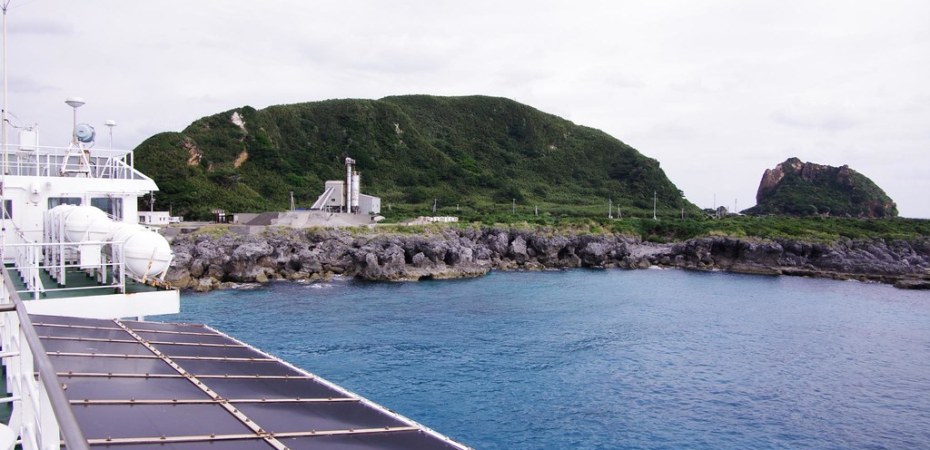
Either way, it’s too bad because it looks like a nice area:
Time will tell, or maybe (hopefully) the swarm will slow down or stop.
Updates:
- JMA updates (Japanese)
- Tokyo VAAC advisories
December 30, 2025, 6:42 a.m., Pacific: JMA update via Google Translate:
December 29, 2025, 09:00 AM, Fukuoka Regional Meteorological Observatory and Kagoshima Local Meteorological Observatory Announcement
An eruption occurred at the Iwo-dake crater on Satsuma Iwojima Island at 02:07 AM today (29th). Be aware of large ballistic projectiles ejected from the eruption within approximately 0.5 km of the Iwo-dake crater center.
Volcanic Activity Status
An eruption occurred at the Iwo-dake crater on Satsuma Iwojima Island at 02:07 AM today (29th).
The eruption plume rose to 200 meters above the crater rim. No large ballistic projectiles were observed during this eruption. This is the first eruption observed on Satsuma Iwojima Island since September 3, 2024.Volcanic earthquakes have been infrequent, and no significant changes were observed before or after the eruption. Volcanic tremors have not been observed.
In the long term, since thermal activity and plume activity have remained elevated, with nighttime incandescence observed and occasional increases in plume height, there is a possibility of eruptions that could affect the surrounding area.
Precautions for Disaster Prevention
Within approximately 0.5 km of the Iwo-dake crater center, be aware of large ballistic projectiles ejected from the eruption.
Downwind, be aware that not only volcanic ash but also small projectiles may be carried by the wind to distant areas. Also, be aware of volcanic gases.
Do not enter dangerous areas in accordance with the instructions of local authorities.
June 30, 4:33 a.m., Pacific: Per today’s JMA update, Satsuma is still sporting a tall white plume and there is glow at night, as well as some local seismicity.
June 23, 2025, 9:39 p.m., Pacific: I had thought the Tokaras were south of Kikai — and some of them are — but it turns out that frequently active Satsuma volcano, on Kikai’s rim and not close to the probably tectonic seismic swarm, is one of them, and it emitted a white plume today.
Per the Global Volcanism Program Kikai page:
Multiple eruption centers have exhibited recent activity at Kikai, a mostly submerged, 19-km-wide caldera near the northern end of the Ryukyu Islands south of Kyushu. It was the source of one of the world’s largest Holocene eruptions about 6,300 years ago when rhyolitic pyroclastic flows traveled across the sea for a total distance of 100 km to southern Kyushu, and ashfall reached the northern Japanese island of Hokkaido. The eruption devastated southern and central Kyushu, which remained uninhabited for several centuries. Post-caldera eruptions formed Iodake (or Iwo-dake) lava dome and Inamuradake scoria cone, as well as submarine lava domes. Recorded eruptions have occurred at or near Satsuma-Iojima (also known as Tokara-Iojima), a small 3 x 6 km island forming part of the NW caldera rim. Showa-Iojima lava dome (also known as Iojima-Shinto), a small island 2 km E of Satsuma-Iojima, was formed during submarine eruptions in 1934 and 1935. Mild-to-moderate explosive eruptions have occurred during the past few decades from Iodake, a rhyolitic lava dome at the eastern end of Satsuma-Iojima.
Per the Japanese Meteorological Agency, via Volcano News:
Activities of Satsuma Iwo Jima
Crater Area Warning (Eruption Alert Level 2, Crater Area Restrictions)Interpretive information on the status of the volcano
June 23, Reiwa 7, 16:00 Fukuoka Regional Meteorological Observatory / Kagoshima Regional Meteorological Observatory announcement
Status of volcanic activity
At Iwo-dake crater, a white plume rose up to 400 m above the crater rim.
At night, we occasionally observed the fire with high-sensitivity surveillance cameras.Volcanic earthquakes have passed in a low number. No volcanic tremor was observed.
In the long term, there is a possibility that an eruption will occur to a degree that affects the area around the crater due to the continued state of increased thermal and plume activity, such as the observation of a fire at night and occasional high plumes.
If there is any connection between Satsuma’s plume/glow and the Tokara seismic swarm — a big and very unlikely “if” — it would probably be that Satsuma was getting ready for another eruption anyway and the shaking either has unsettled it or speeded up the process.
Still, the area is populated and popular with tourists, and Satsuma might go off, so I’ll pin this now — under “Tokara” NOT “Kikai” (which is a whole ‘nother and currently dormant thing). There is no need to mobilize the pop-music contingent.
June 22, 2025, 10:48 p.m., Pacific: Some technical (but unofficial) posts on X suggest to this layperson that the swarm is tectonic, including this one:
トカラ列島で続いている地震は、小宝島のすぐ北のあたりの、良くこうやって地震が続く場所ですね。震源が東西に並んで東側が浅く出るところと、なぜか悪石島の震度が高く出るのも、いつもどおり。気象庁震央分布 pic.twitter.com/lRd4ddC7YZ
— 上川瀬名 Kamikawasena (@Yokohama_Geo) June 22, 2025
https://platform.twitter.com/widgets.js
X translation: “The earthquakes that have been occurring in the Tokara Islands are located just north of Kodakarajima, a place where earthquakes occur frequently. The epicenters are aligned from east to west, with the eastern side being shallower, and for some reason the seismic intensity of Akusekijima being higher, as usual. Japan Meteorological Agency Epicenter Distribution”
And this one:
震度1以上が続くトカラ列島近海の地震、F-netで多くのCMT解が求まっている。多くはストライクスリップ型に近いが、最大のM5.2(22日17:15)とその前のM3.9は正断層型。共通するのは北西・南東伸長のメカニズム。M5.2の次の逆断層に見えるのはCMTの決め間違いかもしれない。 pic.twitter.com/Cdtsfo7F4N
— hacchan9642 (@hacchan9642) June 23, 2025
https://platform.twitter.com/widgets.js
X translation (emphasis added): “F-net has found many CMT solutions for the earthquakes off the coast of the Tokara Islands, which continue to have a seismic intensity of 1 or higher. Many of them are close to strike-slip type, but the largest M5.2 (17:15 on the 22nd) and the previous M3.9 are normal fault types. What they have in common is a mechanism of northwest-southeast extension. What appears to be a reverse fault following the M5.2 may be a misdetermination of the CMT.”
Extension is something we’ve recently seen in another complicated tectonic setting loaded with volcanoes: the more powerful Amorgos seismic swarm near Santorini and Kolombo in the Aegean Sea
And it settled down without any associated eruption. Perhaps this latest round of Tokara Islands quakes will, too.
About four hours ago, Weather News reports, there was another 4-pointer there.
Featured image: Kodakara Island in the Tokaras, by Tsuda, CC BY-SA 2.0.
 Flight To Wonder