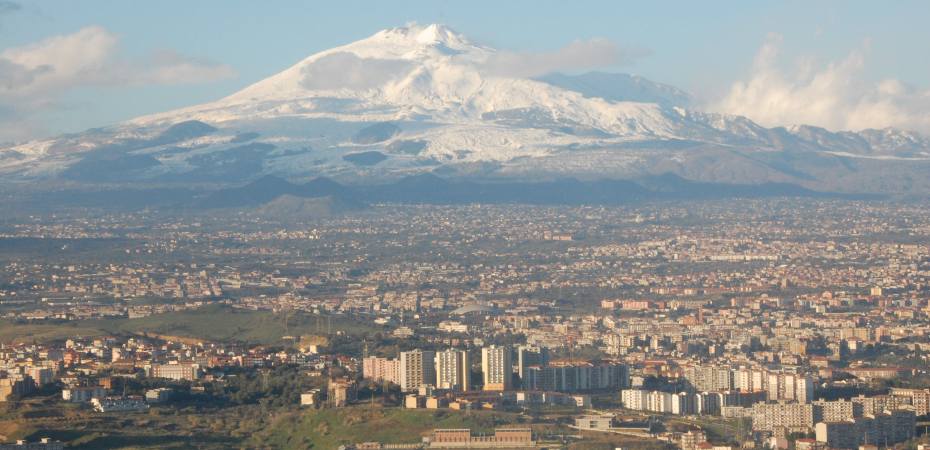
Massive Mount Etna (Image showing the snow-capped fire mountain on a sunny day with the city of Catania in the foreground by Ben Aveling, via Wikimedia, CC BY-SA 4.0) – 37 miles long, 25 miles wide, and towering 2 miles above the blue Mediterranean — was a natural for the Decade Volcano selection committee.
This volcano is so large, it would dominate eastern Sicily even if it weren’t in the frequent habit of shooting tall lava fountains out of its summit craters and brightening the night with glowing streams of molten rock down its vast flanks.
How can a fire mountain get that big?
And what can be done to minimize hazards here?
While perishing in fiery Vesuvian death clouds might be everyone’s worst volcano nightmare (influenced by what we see today at Pompeii), a strong contender for the Number Two horror spot is seeing lava coming and having no way to escape it — only this is no dream for Sicilians who live near or on Mount Etna.
While they themselves can make it out, Etna routinely buries their land and other property, as well as the occasional village, under lava. (Behncke, Part 3; INGV) Once or twice, it has almost wiped out the entire city of Catania, some twenty miles away — a part of Catania and its suburbs is shown in the image above, at the sleeping volcano’s feet.
Yet everyone calls their incandescent neighbor “the friendly giant”! (Bonaccorso)
That’s hardcore, but Mount Etna is incredibly beautiful, especially during eruptions. It really does have a host of fans locally and worldwide.
Too, it has killed fewer than a hundred people — ever, in recorded times. That’s a welcome change from Mount Vesuvius, and it is also a remarkably low casualty count for such an active volcano.
Mount Etna is very active, and this is rough on human property.
Lava definitely is the main issue here. (INGV)
People can get out of the way, but sometimes there is nothing else to do except stand there and watch as that lava engulfs everything you own and couldn’t move out of the way.
Or can something be done?
At Mount Etna (and a few other places), people occasionally have tried to divert it.
Since Earth is a lot more powerful than we are, these attempts often fail — but not always.
The Italians had had some success with diverting lava on Etna during a 1983 eruption (OSU), so they tried again in 1992, during the International Decade, when a massive flow headed for the town of Zafferana Etnea.
And it worked! The lava instead went into an uninhabited part of the flow field on public land.
They’ve had other successes since then (Barberi and Carapezza) — Mount Etna erupts almost all the time — but what if authorities could only save a town by shifting the lava onto private property, or worse, toward another town?
With almost a million people living on Mount Etna’s fertile slopes, this ethical dilemma is bound to come up eventually.
As tough as that might be, it’s not the only challenge geology throws down here for us puny humans.
During the 21st century, volcanologists — who were already concerned that Etna’s eruptions are getting larger in volume and more explosive — have noticed that the giant’s southern and eastern flanks are unstable. (Behncke, Part 2; Branca and Del Carlo; Puglisi et al.; Urlaub et al.)
They’re working on it.
Etna and the Decade Volcano program
Volcanologists in the 1990s made Mount Etna first a European Laboratory Volcano, and then a Decade Volcano.
This resulted in “huge efforts…mostly focused on the continuous as well as multidisciplinary monitoring of the volcano.” (Bonaccorso et al.)
What I think that means is that Laboratory and Decade Volcano projects streamlined and broadened existing studies.
There are many such studies. People have a long history together with volcanoes in Italy.
Per Branca and Del Carlo, records of eruptions at Etna go back some 3500 years, although there are archive gaps. Also, investigators run into problems with the older material because much of it, from Greek and Roman times, is a mixture of gossip and legend, not hard data.
Branca and Del Carlo note that formal documentation of eruptions began in the 1500s, and Etna’s major rampage in 1669 drew even more scholarly attention and political support for studies.
The Etnean Observatory was founded in 1879, and detailed observation continued on into the 20th century, especially after the University of Catania established an Etnean Volcanology Institute in 1926.
Neither Mussolini nor World War II could completely upstage fiery Mount Etna. The observatory was rebuilt after the war, and volcanological work continued at Mount Etna intermittently under various national organizations.
Starting in the 1980s, that work became more systematic. During the International Decade, Mount Etna got round-the-clock monitoring in 1993, and its data became available online to international researchers in 1995. Since then, the Etna volcanologists have installed almost every new technological monitoring improvement that has come along. (Branca and Del Carlo; Bonaccorso et al.)
Zafferana Etnea
Mount Etna seemed to respond to all this attention by staging its biggest flank eruption in three centuries during 1991-1993, and threatening to obliterate the town of Zafferana Etnea, which was downhill and about 5-1/2 miles away from the vent.
The last town lost to Etna was Mascali, in 1928. (INGV)
In 1992, humanity refused to surrender Zafferana without a fight.
The researchers Barberi and Carapezza go into detail on this and other diversion attempts at Mount Etna. Briefly, here’s how they describe the 1992 effort.
First, field workers exploited the terrain that lava was already flowing through — a small valley that, until this eruption, had been a popular camping spot.
They constructed a big earthen dam at the valley’s entrance and waited, hoping that Etna might ease off the flow.
True to form, though, Etna did not ease off, although it took a month to fill up the valley. When lava finally poured over the dam, it was just a mile from Zafferana.
Authorities quickly erected three small barriers and put Zafferana on evacuation notice while they made their last efforts at diversion.
The flow had crusted over and molten rock was advancing through lava tubes, which keep lava hot and can carry it long distances.
These tubes had roof openings, called skylights.
Workers blocked the active tube by dropping tons of rock into its skylights, using helicopters. It was a huge project, yet it bought Zafferana only two weeks, tops.
The lava kept coming.
Diversion efforts focused next on digging a big channel that led away from Zafferana and out onto uninhabited public land.
Then crews blasted a hole in the active lava tube. Explosives hadn’t been very effective in 1983, but when lessons learned from that attempt were applied in 1992, explosives worked.
After the huge blast, two-thirds of the flow went into the channel right away; the rest followed after workers once more plugged the tube with rock.
The advancing lava front farther downstream then slowed and finally stopped — just half a mile from Zafferana Etnea!
But not everyone was cheering.
People living in areas outside the lava’s natural path fought diversion efforts tooth and nail through the courts and also applied political pressure to stop them.
Those residents had no grudge against Zafferana. Instead, I think, they instinctively understood what Barberi and Carapezza would later write: that if the lava ever travels “…in [such a] densely urbanized zone that any diversion will unavoidably cause some significant damage…a strong political will is needed to impose the choice of the lesser damage, obviously ensuring compensation for all damages produced by the diverted flow.”
“Obviously.”
Public trust in the authorities is not high in Italy. (Solana et al.) Those opposed to the 1992 diversion probably did not want to see a precedent set that could, during future eruptions, force them to trade their property for promises of future compensation.
Such a social and political crisis will occur, sooner or later. At Mount Etna, the lava just keeps coming.
Which is how the volcano has gotten so big.
What is Mount Etna?
It’s a huge stratovolcano made out of many smaller volcanoes. (Del Carlo et al.; INGV)
To put it another way, Mount Etna is like one of those Russian nested doll sets – open up the big one and you’ll find a series of progressively smaller dolls inside, each one smiling enigmatically and hiding its own secrets.
Try figuring out how a complex, fire-filled structure like that works! Especially while it deforms and cracks as you watch, because you can only study it during a car crash (the continental collision between Africa and Eurasia).
Earth scientists, unlike the rest of us, are up to the task and probably would have undertaken it out of curiosity even if people and their property and livelihoods weren’t at risk.
No geonerd can resist peeking inside a geologic structure. And Mount Etna is open just a bit, even when it isn’t erupting.
That majestic mountain is dotted with outcrops. It is riddled with gaping fractures from the ongoing continental collision. Etna is scarred by a series of Mesolithic to early Neolithic landslides on its eastern flank that have exposed tens of thousands of years’ worth of volcanic history in the impressive walls of 5 x 3-mile-wide Valle del Bove. (Azzaro; Bousquet and Lanzafame; Branca et al., 2021; Calvari et al.; Del Carlo et al.)
Field geologists, piecing together whatever glimpses of the inner “dolls” they can get through these openings, have constructed a very general model of Mount Etna from the inside out, not only for geologic mapping purposes but also to help researchers who are trying to understand Etna’s plumbing system and assessing the stability of the southern and eastern flanks.
In this chapter, we do need to take a brief look at this model in order to see why these two hazards — Etna’s increasing eruption intensity and that flank instability — are so difficult to deal with, despite this being one of the most intensively studied volcanoes on Earth, especially during the last thirty years.
But those issues, while very serious ones, play out over geologic amounts of time, and you and I aren’t boffins. We therefore can afford to be a little more relaxed about it than the volcanologists are.
Still, this Decade Volcano is enormous and takes some time to describe. Are you really ready for the Etna challenge?
You’re up for this? Great!
Put on some Italian opera or other mood music, if you like, and then let’s enjoy the very beautiful names that Italian geoscientists have given to each of Etna’s nested volcanic “dolls.”
Who do we have in the Mount Etna “set”?
The “dolls”
Mongibello erupts at the summit through one or more vents, covering almost the whole structure with its volcanic debris. (Branca et al., 2021) Those online videos of steaming craters and lava fountains/pahoehoe rivers? That’s Mongibello. But what’s this underneath 12 thousand years’ worth of tephra deposits and lava flows?
It’s Ellittico! — a rocky ellipse that forms the mountainous bulk we think of as “Mount Etna.” The flanks crack open now and then, each time in a different place, pouring out lava in a property-eating, town-destroying eruption that can go on for months to years. Zafferana was saved from such an event.
And outcrops on Ellittico show the remains of three older, extinct volcanoes:
- Fase dei Centri eruttivi della Valle del Bove.
- Fase delle Timpe.
- Fase delle Tholeiiti Basali.
At the very center? Creamy chocolatey nougat! Evidence of a mid-Pleistocene lava-oozing crack, long since cooled and hardened, in an ancient seafloor!
Extinct “dolls”
That’s right. Enormous Mount Etna began as a little fissure in a long-vanished seafloor.
It was in some part of the ancient Mediterranean that Etna expert Dr. Boris Behncke calls “the pre-Etnean gulf.”
This underwater fissure eruption 500,000 to 600,000 years ago launched Mount Etna’s lengthy Tholeiiti Basali phase. (Bousquet and Lanzafame; INGV)
Time passed. The lava kept coming, but that pre-Etnean gulf vanished some 300,000 to 400,000 years ago – around (or a little bit before) the time that our own H. sapiens ancestors were laying down their oldest known fossils in Africa. (Branca et al., 2004; Bousquet and Lanzafame; Vidal et al.)
Why did it vanish? What could be powerful enough to first break apart a seabed and then close an ocean gulf?
Africa could. It’s a massive continent, and it is moving — slowly, but with unrelenting pressure.
More specifically, the seafloor cracked and the pre-Etnean gulf closed because of a combination of forces related to plate tectonics, which has been driving the African continent on a collision course with the continent of Eurasia for millions of years.
From the chapter before this one, we know that plate tectonics fires up Vesuvius and other Campanian volcanoes over on the mainland, too. However, around Sicily these great geological forces make for an insanely complex tectonic situation.
Let’s just take the experts’ word for it that this complexity has a lot to do with Etna’s forming in an unusual setting: a continental collision zone. (Azzaro; Behncke, Part 1; Bousquet and Lanzafame; Branca et al., 2004; Calvari et al.; Mauriello et al.; Patanè et al.)
Why is it unusual?
Because volcanoes, including the other Decade Volcanoes, are typically associated with subduction zones or hotspots.
There should be tall mountain ranges, like the Alps or the Himalayas, forming in a continental collision, right?
But nooo — glacier-capped Alpine peaks are far away, and for some mysterious reason, here is this intraplate basalt volcano sitting on Sicily, just north of the Eurasia-Africa plate boundary!
So, the seafloor cracked, at the start of Mount Etna’s construction, right at the intersection of several major regional fault zones (just about where Italy’s “toe” looks like it’s about to connect with the edgy “soccer ball” that is Sicily). (Behncke, Part 1; Calvari et al.; Mauriello et al.; Patanè et al.)
You’re welcome for that image of a towering lava fountain erupting when someone wearing a boot kicks a soccer ball.
But there weren’t fire fountains in the early Tholeiiti Basali days, although Dr. Behncke notes in Part 1 of his series that there may have been some explosive Surtsey-like, island-forming eruptions.
Once it had begun, the underwater eruption mostly just oozed Hawaiian-style pillow lava out onto marine clays and mud (Calvari et al.), piling up heavy basaltic rocks on top of — flank instability foreshadowing here! — what would become relatively soft sedimentary rocks.
Millennia slowly passed. The pillow lava kept coming.
Volcanoes can change our lives so quickly and violently that we forget how long it takes to actually build one from the ground up.
Meanwhile, the African continent inched its way northward, eventually closing the pre-Etnean gulf and arching that former seabed almost half a mile (Calvari et al.) up into the air to construct part of southeastern Sicily.
Geology usually takes its own sweet time, but the results are always awesome!
This continental collision has formed some mountains, north and west, that support the volcano’s weight; however, to this day Etna’s unbuttressed southern and eastern sectors still sit on those relatively soft mid-Pleistocene sedimentary rocks. (Branca et al., 2004; Calvari et al.; Puglisi et al.)
The transformation from submarine to land volcanism stopped Tholeiiti Basali pillow formation but not the lava itself, which kept coming up through a series of fissures, sporadically and always in a different spot.
These monogenic eruptions (as such one-off activity is called) built up a 9-mile-long shield volcano in Timpe times, which started around 220,000 years ago. The relatively small shield was the first of many volcano edifices in Mount Etna’s history. And those fissures on step-like faults — timpe means “steps” — continued their monogenic eruptions in what was now recognizable as the eastern coast of Sicily. (Behncke, Part 1; Branca et al., 2004; INGV)
The lava kept coming – wait. By now, you might be wondering where all this lava is coming from.
The volcanologists would like to know that, too. (Behncke, Part 1)
Even with the latest seismic tomographic techniques, they have not yet been able to locate a clear-cut magma chamber in the crust underneath Mount Etna, although there are suggestions of some sort of a collection point at around 2 miles down and then again at 24 miles below the surface. (Bonaccorso and Davis; Chiarraba et al.; Corsaro and Pompilio)
More foreshadowing for the next section: With intensifying eruptions at this massive Sicilian giant now, some of the best minds on the planet, wielding the most advanced tech ever seen in the history of earth science, still cannot be sure of THE basic fact: where its lava is coming from!
Whatever its source, the lava was still coming, back towards the end of the Timpe phase about 110,000 years ago, when something — perhaps a change in regional stress fields — shifted the vents away from that early coastal shield volcano to a location much closer to what is now the core of Mount Etna. (Behncke, Part 1; INGV)
Another piece of foreshadowing: That shift was westward, away from the Timpe “steps” that are located on what is now Etna’s unstable eastern flank.
And recent studies do show that activation of the Timpe faults is part of the very complex pattern of flank slippage going on here. (Bonanati)
Back in the day, when the action shifted west, central-vent volcanism replaced the earlier fissure eruption style and built up a densely packed group of volcanic centers now known as the Centri eruttivi della Valle del Bove.
These composite volcanoes — the pointy kind that most of us think of when we hear the word “volcano” — are the nested centers whose remains are exposed in the Valle del Bove cliffs.
Those circling peaks smoked and blazed for a while, as mammoths and sabercats roamed late Pleistocene Sicily far below — what a wild but beautiful scene it must have been!
However, at that point in its history, Etna’s plumbing (whatever that might be) apparently was not quite stable yet.
Active “dolls”
About 60,000 years ago — coincidentally, not too long before H. sapiens began the Paleolithic Revolution — Mount Etna’s magmatic plumbing system stabilized, after shifting slightly northwest from the Centri eruttivi della Valle del Bove, and then it really got down to business, pumping out enough lava over the next forty-plus millennia to build Ellittico, whose basaltic volume makes up the bulk of today’s roughly 300-cubic-mile Decade Volcano. (Behncke, Part 1; Branca et al., 2004; INGV)
Ellittico was probably much taller than the present structure (Behncke, Part 1), but then it blew its top in a series of four Plinian blasts 15,000 years ago, shortly before the last ice age ended.
Yet more foreshadowing: the “friendly giant” may not show it very much at present, but it does have an explosive temper.
Still, four plinian blasts were a big enough deal to actually stop the lava from coming for a few millennia!
But lava flows that had a slightly different chemistry from the old material (Behncke, Part 3) returned in a subplinian explosive eruption at around the end of the last ice age — as H. sapiens was settling down in Eurasia’s Fertile Crescent, inventing agriculture. Mongibello then began to grow in the summit caldera, which it has now completely filled. (Behncke, Part 1; Del Carlo et al.; INGV)
Okay, all this information might be making you feel as though Mount Etna has just rolled over you, but congratulations!
You did it — you completed the challenge!
We started with that mid-Pleistocene seafloor crack and have now gone full volcano!
It had two active centers at first but, during the last five millennia or so, Mongibello has been operating where we see it now: atop Ellittico, at Etna’s summit. (Branca et al., 2004)
It currently has four named craters: Voragine (“chasm,” per Google Translate) and Bocca Nuova (“new mouth”) formed out of the old Central Crater that existed up there in the early 20th century, while the Northeast Crater appeared in 1911 and the Southeast Crater in 1971.
The Southeast Crater hosts a new little crater that opened during the 2011-2013 eruption — this one doesn’t have a formal name yet, per the INGV. Most recently, in July 2023, a new pit formed (autotranslated) in Bocca Nuova.
Mongibello’s arrival completed the “big doll” that we know today as Mount Etna. This is also the giant fire mountain that people saw when they first settled in the area around 5500 BC. (Branca et al., 2021)
H. sapiens has been here ever since. Eastern Sicily, and Etna’s green slopes are good places to live, most of the time.
But the lava keeps coming, and Mount Etna also apparently has its own agenda. Volcanologists are hard at work here, trying to find out what that might be.
What makes everything so iffy is the fact that this volcanic giant shows “almost continuous evolution.” (Branca et al., 2004)
In what directions will it evolve next, and how will that affect people living or traveling nearby?
Hazards at Mount Etna
Mount Etna’s summit is almost continuously active.
The view is spectacular up there, but it can be a dangerous place to visit, especially when ballistics — things like debris and blobs of fresh lava — are flying during a paroxysm.
Steam explosions are another summit hazard, but pyroclastic flows, so deadly at some other volcanoes, are rare – the flows that do occur don’t travel very far.
Summit events can’t directly affect people living on slopes thousands of feet below (indirect effects do occur from toxic gases and from volcanic plume fallout).
It’s more of a concern that, as we have seen, lava from Mount Etna sometimes erupts through those flanks, close to inhabited areas, endangering life and property.
No one knows why Mount Etna’s lower slopes crack open in these fissure eruptions, which tend to have different dynamics than those at the summit. (Behncke, Part 2; Bousquet and Lanzafame)
Who knows when or where the next lava-spewing crack will appear? In 1971, one opened just above the 19th-century Etna Observatory building, and lava destroyed the structure! (Branca et al., 2021a)
This didn’t affect monitoring, which is done now from centers located a respectful distance away from the volcano precisely because of such hazards.
Some experts are working on computerized forecasts of lava flow directions to use during a flank eruption. (Barca et al.; Bonaccorso)
But this overall improved picture of Mount Etna, thirty years after the Decade Volcano program, also raises new concerns.
Intensifying eruptions
Generally speaking, individual lava flows have always been the main threat here; however, Mount Etna has been laid back about it, compared to some volcanoes.
That is to say, eruptions are spectacular and frequent, but in modern times they have been only VEI 1 or 2 (OSU), producing a total of less than 2 cubic kilometers of igneous material since 1865. (Behncke and Neri, 2003a)
Compare that to Vesuvius, in AD 79, blasting out some 4 cubic kilometers in a matter of hours during the Pompeii eruption!
Etna can be explosive, too, with occasional subplinian activity (and one plinian eruption) since the last ice age ended. (Del Carlo et al.)
This is not surprising, since Mongibello’s magma contains a lot of water vapor, carbon dioxide, and other gases. (Caltabiano et al.; Del Carlo et al.)
What has the volcanologists puzzled is the increasing frequency of both explosive fountaining at Etna’s summit and pyroclastic events during flank eruptions since the 1970s. (Del Carlo et al.; INGV)
Volume is up, too. Over half of Etna’s post-1865 lava output has come since 1950. (Behncke and Neri, 2003a)
And it keeps coming, in more summit and flank eruptions, as well in an increased rate of lava flow, noted particularly since the Southeast Crater’s formation at the summit in 1971. (Branca et al., 2021a)
This uptick is part of an overall trend that has been going on at Etna for the last four millennia (Branca et al., 2004), a fact that doesn’t make things any easier to understand.
What is going on inside that set of nested volcanic dolls?
The Etna Ultra challenge facing researchers is a lot tougher than the one that we just passed — and the stakes are much, much higher.
Flank instability
Don’t panic, but some of our planet’s best known basalt giants, like Kilauea in Hawaii, slip and slide around a little bit.
That’s bound to happen with such big structures made out of dense igneous rock.
Since the 1980s, several volcanologists have speculated that Mount Etna’s eastern flank might be on the move, too, but they had no way to prove it with direct measurements. (Puglisi et al.)
Then, shortly after an eruption in 2002, as scientists were going over the data, they unexpectedly found evidence that a large section of Etna’s unbuttressed southern and eastern flanks had indeed shifted seaward. (Behncke, Part 2)
The question no longer was whether the volcano is slipping — now the question was, and continues to be, how likely is its southeastern flank to collapse? (Bonanati)
As of this writing, there is no answer to the question. This section just continues to move episodically, averaging about 2 inches eastward and less than half an inch down toward the sea each year. (Behncke, Part 2; Urlaub et al.)
Data collection is ongoing. Scientists have installed fault monitoring equipment on land and along the seafloor to study this movement over the next few years. Satellites are also tracking the ground deformation that occurs on land. (Bonanati; INGV, 2022a)
Coda
As Bousquet and Lanzafame put it, “From this large amount of geological and geophysical data, anything but a coherent general framework emerges.”
“The friendly giant” still draws tourists and much needed income to Sicily, while putting everyone in the neighborhood at considerable risk.
Volcanologists continue their studies and keep decision-makers up to date.
For us, Etna’s Decade Volcano opera is now over, and it has ended inconclusively.
It’s anyone’s guess what the next act will be.
Experts can’t guess, though. They need to thoroughly understand what is happening inside this set of nested fire mountains in order to give civil defense people and all other stakeholders a realistic idea of what to expect – and when.
They’re not there yet (Bousquet and Lanzafame; Branca et al, 2004), but they’ve made tremendous progress since the 1990s.
Stats
Location:
37.748° N, 14.999° E, Sicily. The GVP Volcano Number is 211060.
Nearby Population:
Per the Global Volcanism Program:
- Within 5 km (3 miles): 78.
- Within 10 km (6 miles): 3,291.
- Within 30 km (19 miles): 1,016,540.
- Within 100 km (62 miles): 3,052,770.
CURRRNT STATUS:
Check Toulouse VAAC (linked in Monitoring section) for the latest Aviation Code; it’s usually Orange or Red, depending on Etna’s activity level.
Biggest recorded event:
A Plinian eruption in 122 BC damaged Catania so badly that Rome’s Senate gave the city ten tax-free years.
However, many experts regard the 1669 AD event as Etna’s most destructive eruption in recorded times.
About one cubic kilometer of lava poured out of the volcano’s flank and traveled through an extensive complex of lava tubes (which kept it hot and flowing) all the way to the sea.
I can’t verify the death toll, but lava covered at least nine villages and destroyed fields and vineyards. Besides messing up a medieval castle and adding almost a kilometer to the shoreline here, it also overtopped Catania’s wall, damaging some neighborhoods in the western part of the city.
Of note, Catanians did try to divert the lava in 1669, using pickaxes, but residents of Palermo — where the redirected lava would have gone — drove them away before they broke open the active lava tube. (Kauahikaua et al.)
Monitoring:
The National Institute of Geophysics and Volcanology (INGV) and its Etna Observatory. (Italian)
Mount Etna probably keeps observers at the Toulouse Volcanic Ash Advisory Center (VAAC) very busy.
Volcano Discovery has a page of embedded INGV webcams as well as a couple of unofficial Etna cameras.
Sources:
- Aiuppa, A.; Allard, P.; D Alessandro, W.; Giammanco, S.; and others. 2004. Magmatic gas leakage at Mount Etna (Sicily, Italy): relationships with the volcano-tectonic structures, the hydrological pattern and the eruptive activity, in Mt. Etna: Volcano Laboratory. Washington DC. American Geophysical Union Geophysical Monograph Series, 143, 129-146.
- Azzaro, R. 2004. Seismicity and active tectonics in the Etna region: constraints for a seismotectonic model, in Mt. Etna: Volcano Laboratory. Washington DC American Geophysical Union Geophysical Monograph Series, 143, 205-220.
- Barberi, F., and Carapezza, M. L. 2004. The control of lava flows at Mt. Etna., in Mt. Etna: Volcano Laboratory. Washington DC American Geophysical Union Geophysical Monograph Series, 143: 357-369.
- Barca, D.; Crisci, G. M.; Rongo, R.; Di Gregorio, S.; and Spataro, W. 2004. Application of the cellular automata model SCIARA to the 2001 Mount Etna crisis, in Mt. Etna: Volcano Laboratory. Washington DC American Geophysical Union Geophysical Monograph Series, 143, 343-356.
- Behncke, B. and Neri, M. 2003. The July–August 2001 eruption of Mt. Etna (Sicily). Bulletin of Volcanology, 65(7): 461-476.
- Behncke, B. and Neri, M. 2003a. Cycles and trends in the recent eruptive behaviour of Mount Etna (Italy). Canadian Journal of Earth Sciences, 40(10): 1405-1411.
- Behncke, B. 2010. Etna Week (Part 1) – Brief Anatomy of an Exceptional Volcano. https://www.wired.com/2010/08/etna-week-part-1-brief-anatomy-of-an-exceptional-volcano/
- ___. 2010. Etna Week (Part 2) – The current dynamics and activity of Etna. https://www.wired.com/2010/08/etna-week-part-2-the-current-dynamics-and-activity-of-etna/
- ___. 2010. Etna Week (Part 3) – Etna’s Volcanic Hazards. https://bigthink.com/guest-thinkers/etna-week-part-3-etnas-volcanic-hazards/
- Bonaccorso, A. 2004. Mt. Etna: Volcano Laboratory: Preface. Washington DC American Geophysical Union Geophysical Monograph Series, 143.
- Bonanati, C. 2022. Detecting ground deformation across the shore at Etna’s southeastern flank. https://www.pre-collapse.eu/blog/detecting-ground-deformation-across-the-shore-at-etnas-unstable-southeastern-flank Last accessed September 15, 2022.
- Bonaccorso, A., and Davis, P. M. 2004. Modeling of ground deformation associated with recent lateral eruptions: Mechanics of magma ascent and intermediate storage at Mt. Etna, in Mt. Etna: Volcano Laboratory. Washington DC American Geophysical Union Geophysical Monograph Series, 143, 293-306.
- Bonaccorso, A.; Calvari, S.; Coltelli, M.; Del Negro, C.; and Falsaperla, S. 2004. Mt. Etna: volcano laboratory: Introduction. Washington DC American Geophysical Union Geophysical Monograph Series, 143.
- Bousquet, J. C., and Lanzafame, G. 2004. The tectonics and geodynamics of Mt. Etna: synthesis and interpretation of geological and geophysical data, in Mt. Etna: Volcano Laboratory, Washington DC American Geophysical Union Geophysical Monograph Series, 143, 29-47.
- Branca, S., and Del Carlo, P. 2004. Eruptions of Mt Etna during the past 3.200 years: a revised compilation integrating the historical and stratigraphic records, in Mt. Etna: Volcano Laboratory, Washington DC American Geophysical Union Geophysical Monograph Series, 143, 1-28.
- Branca, S.; Coltelli, M.; and Groppelli, G. 2004. Geological evolution of Etna volcano, in Mt. Etna: Volcano Laboratory. Washington DC. American Geophysical Union Geophysical Monograph Series, 143, 49-63.
- Branca, S.; Privitera, F.; Palio, O.; and Turco, M. 2021. Prehistoric human presence on Mount Etna (Sicily), in relation to the geological evolution. Annals of Geophysics, 64, 5, VO542.
- Brown, S.K.; Jenkins, S.F.; Sparks, R.S.J.; Odbert, H.; and Auker, M. R. 2017. Volcanic fatalities database: analysis of volcanic threat with distance and victim classification. Journal of Applied Volcanology, 6: 15.
- Caltabiano, T.; Burton, M.; Giammanco, S.; Allard, P.; and others. (2004). Volcanic gas emissions from the summit craters and flanks of Mt. Etna, 1987-2000, in Mt. Etna: Volcano Laboratory. Washington DC. American Geophysical Union Geophysical Monograph Series, 143, 111-128.
- Calvari, S.; Tanner, L. H.; Groppelli, G.; and Norini, G. 2004. Valle del Bove, eastern flank of Etna volcano: a comprehensive model for the opening of the depression and implications for future hazards, in Mt. Etna: Volcano Laboratory. Washington DC. American Geophysical Union Geophysical Monograph Series, 143, 65-76.
- Chiarabba, C.; De Gori, P.; and Patanè, D. 2004. The Mt. Etna plumbing system: the contribution of seismic tomography, in Mt. Etna: Volcano Laboratory. Washington DC American Geophysical Union Geophysical Monograph Series, 143, 191-204.
- Corsaro, R. A., and Pompilio, M. 2004. Dynamics of magmas at Mount Etna, in Mt. Etna: Volcano Laboratory. Washington DC. American Geophysical Union Geophysical Monograph Series, 143, 91-110.
- Del Carlo, P.; Vezzoli, L.; and Coltelli, M. 2004. Last 100 ka tephrostratigraphic record of Mount Etna, in Mt. Etna: Volcano Laboratory. Washington DC. American Geophysical Union Geophysical Monograph Series, 143, 77-89.
- Del Negro, C., and Napoli, R. 2004. Magnetic field monitoring at Mt. Etna during the last 20 years, in Mt. Etna: Volcano Laboratory. Washington DC American Geophysical Union Geophysical Monograph Series, 143, 241-262.
- Del Negro, C.; Cappello, A.; Neri, M.; Bilotta, G.; and others. 2013. Lava flow hazards at Mount Etna: constraints imposed by eruptive history and numerical simulations. Scientific Reports, 3: 3493.
- INGV. 2022. Mount Etna. http://www.ct.ingv.it/index.php/ricerca/i-vulcani-siciliani/etna (via Google Translate). Last accessed September 10, 2023.
- ___. 2022a. New tools to integrate the study of the Etna faults. https://www-ct-ingv-it.translate.goog/index.php/formazione-e-divulgazione/news/329-nuovi-strumenti-ad-integrazione-dello-studio-delle-faglie-dell-etna?_x_tr_sl=auto&_x_tr_tl=en&_x_tr_hl=en-US
- Global Volcanism Program (GVP) 2022. Etna. https://volcano.si.edu/volcano.cfm?vn=211060&vtab=GeneralInfo.
- ___. Bulletin reports. https://volcano.si.edu/volcano.cfm?vn=211060&vtab=Bulletin
- Kauahikaua, J. P.; Gaddis, B.; Kanahele, K.; Hon, K.; and Wasser, V. 2019. The lava flow that came to Hilo—The 1880–81 eruption of Mauna Loa volcano, Island of Hawai ‘i (No. 2019-5129). US Geological Survey.
- Lester, L. 2020. Et tu, Etna? https://eos.org/articles/podcast-et-tu-etna Last accessed April 19, 2020.
- Mauriello, P.; Patella, D.; Petrillo, Z.; Siniscalchi, A.; and others. 2004. A geophysical study of the Mount Etna volcanic area, in Mt. Etna: Volcano Laboratory. Washington DC American Geophysical Union Geophysical Monograph Series, 143, 273-291.
- Newhall, C. 1996. IAVCEI/International Council of Scientific Unions Decade Volcano projects: Reducing volcanic disaster. status report. US Geological Survey, Washington, DC. Retrieved from https://web.archive.org/web/20041115133227/http://www.iavcei.org/decade.htm
- ___. 1999. IAVCEI’s Primary IDNDR Project: Decade Volcanoes. IAVCEI News 1999. 2:8-9. https://tinyurl.com/ycxtsu4h (PDF)
- Oppenheimer, C. 2011. Eruptions That Shook the World. Cambridge: Cambridge University Press. Retrieved from https://play.google.com/store/books/details?id=qW1UNwhuhnUC
- Oregon State University (OSU). 2020. Etna. http://volcano.oregonstate.edu/etna Last accessed April 18, 2020.
- Patanè, D.; Cocina, O.; Falsaperla, S.; Privitera, E.; and Spampinato, S. 2004. Mt. Etna volcano: a seismological framework, in Mt. Etna: Volcano Laboratory. Washington DC. American Geophysical Union Geophysical Monograph Series, Washington DC. American Geophysical Union Geophysical Monograph Series, 143, 147-165.
- Puglisi, G.; Briole, P.; Bonforte, A. 2004. Twelve years of ground deformation studies on Mt. Etna volcano based on GPS surveys, in Mt. Etna: Volcano Laboratory. Washington DC American Geophysical Union Geophysical Monograph Series, 143, 321-341.
- Sable, J.; Houghton, B.; del Carlo, P.; and Coltelli, M. (2001, December). Mechanisms for Basaltic Plinian Volcanism: A Quantitative Study of the Products of the 122BC Eruption of Mount Etna. In AGU Fall Meeting Abstracts.
- Solana, M. C.; Calvari, S.; Kilburn, C. R. J.; and others. 2018. Supporting the development of procedures for communications during volcanic emergencies: Lessons learnt from the Canary Islands (Spain) and Etna and Stromboli (Italy), in Observing the Volcano World: Volcano Crisis Communication, 289-305. https://link.springer.com/book/10.1007/978-3-319-44097-2
- Stenmark, J. 2020. GNSS and precise positioning to help understand movement in volcanoes. https://www.geospatialworld.net/blogs/a-major-eruption/amp/ Last accessed April 18, 2020.
- Urlaub, M.; Petersen, F.; Gross, F.; Bonforte, A.; and others. 2018. Gravitational collapse of Mount Etna’s southeastern flank. Science Advances, 4(10): eaat9700.
- Vidal, C. M.; Lane, C. S.; Asrat, A.; Barfod, D. N.; and others. 2022. Age of the oldest known Homo sapiens from eastern Africa. Nature, 601(7894), 579-583.
- Wikipedia. 2022. Mount Etna. https://en.m.wikipedia.org/wiki/Mount_Etna Last accessed September 15, 2022.
- Wikipedia (Italian, via Google Translate): 2020. Catania https://it.wikipedia.org/wiki/Catania Last accessed April 18, 2020.
- ___. 2020. Etna. https://it.wikipedia.org/wiki/Etna
- ___. 2020. Linear system of eastern Sicily. https://it.wikipedia.org/wiki/Sistema_lineare_della_Sicilia_orientale
 Flight To Wonder