
Ferenc Szelepcsenyi/Shutterstock
Once upon a time, a stratovolcano fumed and rumbled in northern Sundaland, which is a peninsula that juts off Eurasia’s southern coast and becomes dry land whenever sea level drops as the polar ice caps, north and south, advance towards the Equator.
This isn’t the “Snowball Earth” era, so the ice never reaches the Equator, let alone this volcano that used to sit about a hundred miles to its north.
Instead, our planet always warms up again, stopping the advancing glacial fronts and raising sea level with melted ice to drown all of Sundaland except its highest points — on the northernmost of which once sat our active volcano.

(Image: Joe mambo via Wikimedia, CC BY 2.0)
Earth built the promontory of Sundaland slowly, sending various bits and pieces of a former supercontinent called Gondwana smashing into the current not-quite-a-supercontinent Eurasia over 90 million years or more and compressing the resulting jumble into one big chunk of fractured bedrock through which magma sometimes leaks to light up our ancient stratovolcano (which no longer exists) and many others that are still active today.
This fire awakens in Sundaland from time to time as the heavy tectonic plate carrying those fragments of Gondwana dances and collides with the lighter Eurasian continental plate in various places, slipping underneath the continent’s edge and sloping down into the planetary mantle through a subduction zone.
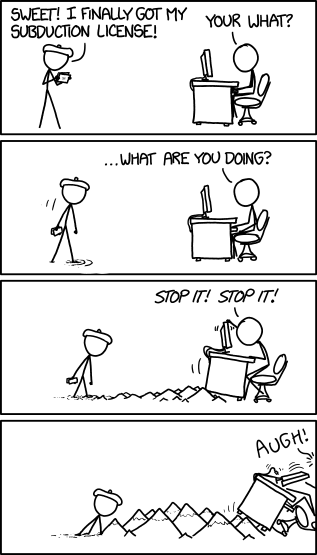
Sundaland is on fire now. The present dance is about 45 million years old, and it is bringing Australia into collision with eastern Eurasia as the next supercontinent continues to grow.
Obviously this is going to take a while.
But the subduction that’s involved in this dance did keep the fire going in our ancient north Sundaland stratovolcano and it still feeds fires there today.
Subduction and tectonics have had other effects on that area, too — some of them very impressive.
For instance, the angle between the dancing seafloor and continental plates changed slightly here, causing some cracks in northern Sundaland between what we know today as the islands of Java and Sumatra (whose northern region hosted our old volcano).
One of these cracks became, in complex ways, the widening Sunda Strait, Krakatoa’s home.
Another ran up the western side of Sumatra as the Great Sumatra Fault, and the Barisan Mountains began to rise.
On either side of this fault, land moves in different directions, causing pull-apart basins that allow subduction-related heat, hydrothermal fluids, and sometimes even molten rock to leak out onto the land.
It’s this leakage of lava in what became the Toba pull-apart basin that built up our old stratovolcano.
While that fire mountain is gone now, we know it existed because of the traces it left all over the local geological record, a million years ago, when it exploded in what we moderns would call a “Crater-Lake” sized eruption, venting about 35 km3 of magma in a magnitude 6.9 eruption (magnitude is based on mass and is similar to but considered more precise than VEI, which essentially goes by the volume of erupted material).
Then that was over and things carried on much as before, once the world of life nearby had recovered.
Or so it seemed on the surface.
A few miles underground, unfortunately, the right conditions had somehow come together for formation and storage of huge volumes of magma — much larger than anything the ancient stratovolcano was capable of handling.
Studies of its eventual eruption deposits suggest that this magma accumulated for some four hundred millennia.
Then, about 788,000 years ago, ground in and around the Toba basin began to rise and the volcanic system there had its first supereruption (magnitude 8.7) spewing out an estimated 2,300 km3 of magma.
Life eventually recovered and carried on after that, but the ground continued to bulge.
Down deep, the stores of magma must have been almost emptied by this supereruptiion since it took almost three hundred thousand years for the next eruption to occur at Toba and that one was not supersized, just large — 60 km3 of magma, magnitude 7.1, or about half again as big as Tambora’s infamous 1815 blast that caused “the year without a summer.”
Again volcanism here quieted down for hundreds of thousands more years, but the land rise continued.
During this interval, far to the west in Africa where some primates had evolved into the Homo genus, our own group H. sapiens appeared.
Life could be hard and population changes occurred that left genetic traces of “bottlenecks,” but we held on and eventually wandered out of Africa, north into Europe and eastward through southern Asia and on into Melanesia and Australia.
Somewhere around this same time, the regional swelling of what had been the Toba pull-apart basin was now almost a mile above sea level:
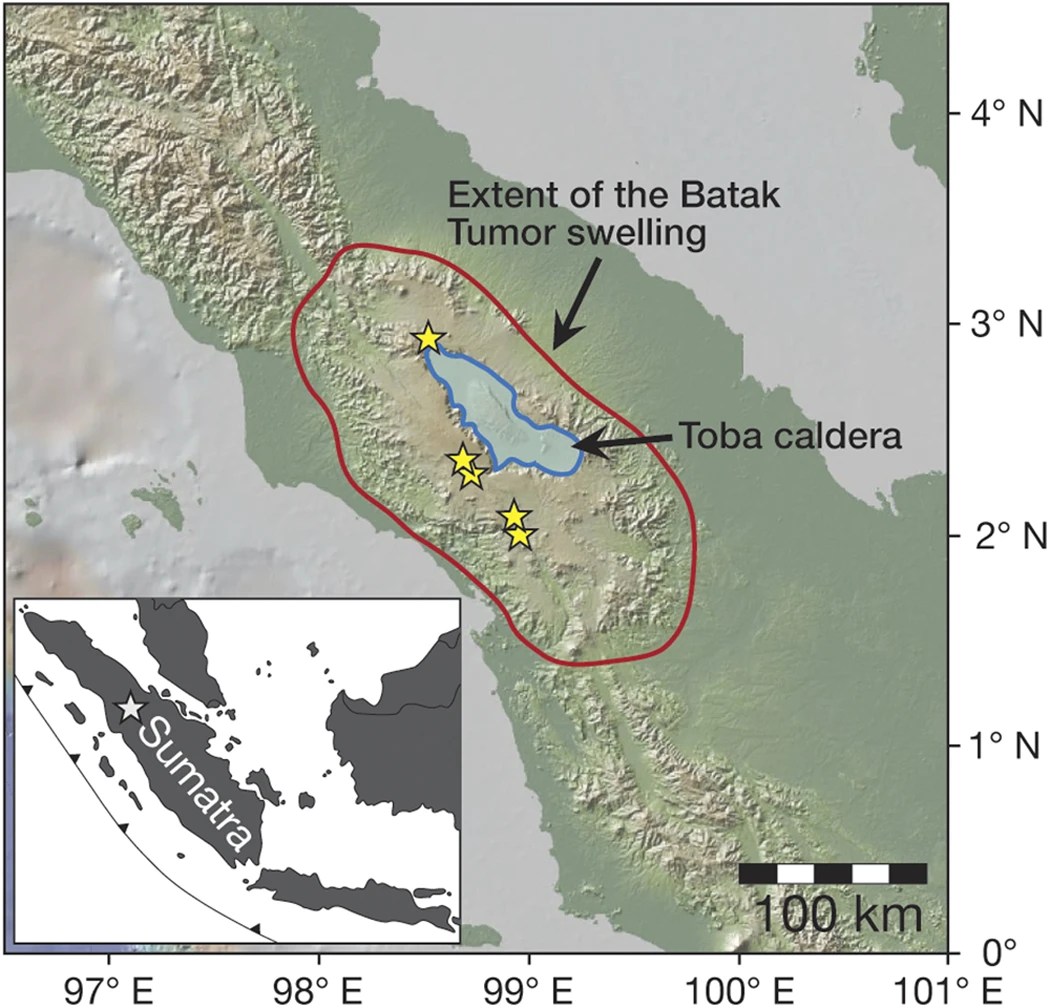
The bulge is outlined in red on this figure from Budd et al. (CC BY-NC-ND 4.0)
The pressure became too much for Earth’s crust to sustain. Great circular cracks opened up at the bulge’s highest point, and a 60 by 20-mile-wide chunk of real estate foundered.
Down went our ancient stratovolcano, located at the northern end of these cracks. Down went most of the old supereruption caldera and the subsequent magnitude 7.1 caldera, too.
Up surged vast clouds of pyroclastic debris, up and out over the land and sea as an estimated 5,300 km3 of magma shattered into glassy ash in this second and most recent Toba supereruption — at magnitude 9.1, the largest one known in the last two million years.
When it was over, there was a 1.3-mile-deep new hole in northern Sumatra, mostly filled in by pyroclastic deposits that, outside the caldera, are still almost two hundred feet deep now, after some 74,000 years of tropical weathering and erosion.
After this Youngest Toba Tuff supereruption, an estimated 1% or more of Earth’s surface was covered in volcanic ash 4 inches or more deep.
The ash has been found from Africa to the Arabian Sea, India and the Indian Ocean, mainland Southeast Asia, various islands, and the South China Sea.
Over the next 1,600 years, the world’s largest volcanic lake formed here. It took about 66,000 years for caldera resurgence to form Samosir Island, which now gives Lake Toba very much of an eye-of-Sauron appearance from space.

The hobbits over on Flores Island were okay. (Image: NASA via Wikimedia, public domain)
While the “big one” had been all pyroclastic flows, during resurgence a few lava flows occurred along the edges of Samosir and elsewhere.
Toba has been quiet now, except for some fumaroles, for at least three thousand years.
It is still considered active, though, with a magmatic system that starts about four and a half miles below the lake, centered under Samosir and extending, it was thought until recently, from Pardepur in the south to Sipisupisi (Tandukbenua) and Singgalang in the north.

Note, too, the volcano Sinabung in the upper left. (Image: Mucek et al., Figure 1, CC BY-NC-ND 4.0)
In 2017, Mucek et al. reported finding chemical similarities between the Youngest Toba Tuff eruption (the last one, 74,000 years ago) and lava erupted by an ordinary stratovolcano called Sinabung, 19 miles north of Toba.
Sinabung began to form soon after the Youngest Toba Tuff eruption and surprised everyone by suddenly erupting in August 2010 for the first time in about 1,200 years.
“Hi!”
It soon got down to serious business —
— and got angrier and angrier.
Here it is in 2020.
Today Sinabung is a bit more calm but still at Level II alert.
Although the present consensus is that Sinabung and Toba are two separate volcanoes, if Mucek et al. are correct, Sinabung is somehow tapping the Youngest Toba Tuff magma system, which means:
- Toba’s magma system extends at least 19 miles farther north than thought.
- The Youngest Toba Tuff magma reservoir still contains some eruptible material.
Not necessarily supereruptible — no one knows for sure how much is down there, but probably not very much. Toba is likely to follow its past patterns and take hundreds of thousands more years to accumulate a huge volume of magma for its next tantrum.
In any case, now another stratovolcano sits just north of the old one — a reminder that we still know very little about volcanism here, where the world’s largest young supervolcano currently sleeps.
🌋🌋🌋
It was necessary to frame Toba’s history as “once upon a time” for a couple of reasons:
- The time scale involved in making Toba the awesome supervolcano and ongoing natural hazard that it is.
To us, just a couple of centuries ago is “once upon a time” and, quite understandably, many of us sort of feel as though the last ice age, which ended about 12,000 years ago, came right after the K/T (or K/Pg nowadays) extinction 65 million years ago.
Ordinarily that mixup with deep time doesn’t matter very much in our daily lives, but to figure out whether we do need to be terrified of Toba today — short answer: no, but see the rest of this post — a feel for the scale of hundreds of thousands of years over which Toba operates is helpful.
- Simplicity. As we’re about to discover, those points are basically the only facts about Toba that scientists agree on.
And to complicate things further, that enormous Youngest Toba Tuff eruption came at a critical time in human evolution, which raises more questions than there are currently answers for.
Humans: The “bottleneck” hypothesis
Disaster was very much on everyone’s mind at the turn of the twenty-first century, and not just because of terrorist attacks, deadly natural disasters, and the Y2K problem (which did exist and was skillfully dodged).
A research paper published in 1998 had connected up the Youngest Toba Tuff eruption, dated to around 74,000 years ago, with features in our mitochondrial DNA that indicated a severe loss of genetic diversity between 50,000 and 100,000 years ago.
That loss of diversity is the “bottleneck.”
What’s a bottleneck?
There’s usually a broad gene pool among different members of a healthy population, providing genetic variations that are the basis for natural selection and evolution.
Bottlenecks are often seen in endangered species — cheetahs, for example, or the Iberian lynx — because their numbers are very low and there is a lot of inbreeding.
But what could have made us an endangered species?
Something called “volcanic winter,” answered researcher Stanley Ambrose in a very influential 1998 paper. (Oppenheimer)
Volcanic winter
This concept was suggested by Rampino and Self in 1992 in reference to the start of an ice age.
It grew out of the “nuclear winter” idea that scientists began to discuss in great detail during the 1980s.
They say that soot from urban firestorms after a global nuclear exchange could reach the stratosphere, where it would block sunlight and dramatically lower global temperatures and rainfall amounts, leading to famine, drought, and other problems. (Wikipedia)
“Volcanic winter” is like that but it replaces soot with vast volumes of aerosol droplets that form when a major explosive eruption injects sulfur dioxide into the stratosphere.
Ambrose pointed out that Toba’s Youngest Tuff eruption — the quintessential major explosive eruption, so to speak — sat right there in the middle of this proposed human bottleneck’s time frame.
Coincidence or cause and effect?
Toba and people
The Ambrose paper’s shocking arguments inspired much research into supereruptions (Oppenheimer) while we laypeople first encountered the terrifying but thrilling word “supervolcano” in docudramas and documentaries at around the same time.
There is another level to this, too.
It’s possible that Homo sapiens was moving out into the world beyond Africa between 60,000 and 80,000 years ago — again, within the Toba time frame.
How might the massive Youngest Toba Tuff supereruption have affected them?
This Toba bottleneck hypothesis sparked debate about the influence of volcanism on human evolution, a question that also extends into the future and the effects a supereruption would have on our globally interconnected civilization.
If we can figure out what the Toba supereruption did to our ancestors, we will better understand what Earth’s next supereruption could do to our descendants.
The debate today
This all started more than twenty years ago. How is it going now?
In a word, messy.
Messy, that is, from the standpoint of a layperson who is trying to follow it all and pass it along to you.
Scientists see the Toba-and-people issue clearly, although what one group sees is sometimes almost the opposite of what another group sees. (Anil et al.; Cohen et al.; Crick et al.; Guballa et al.; Lin et al.; Oppenheimer; Osipov et al.; Scaillet and Oppenheimer; Williams et al.)
This always happens when some of our best and brightest look closely at anything, no matter how straightforward it initially seems.
With lots of effort and the right technology, we humans occasionally realize that the Universe is complex, but we never can achieve a god-like understanding of all its details and interconnections.
The first connections that were suggested between Toba and people seemed obvious, but more details have emerged since then.
There is still a school of thought that supports the Toba bottleneck idea. (Costa et al.; Guballa et al.; Oppenheimer; Rampino and Ambrose; Williams et al.; Winstead and Jacobson)
Since that is both dramatic and a fairly simple concept, it is usually what gets mentioned by lay writers when Toba comes up as a topic.
But it’s not yet an established scientific fact, no matter how often or by whom the hypothesis is repeated.
Mud
Another school of thought, with many supporters, argues that the Toba supereruption had little effect on human evolution — and they’ve got data to support their argument, too.
The most convincing part of that data comes from drill cores at Lake Malawi, about 600 miles south of Olduvai Gorge in southeastern Africa.
Why study a supereruption in Indonesia by drilling into the muddy bottom of an African Great Lake?
Partly because the lake is so close to an important anthropology site — we know that early humans who left their remains in and around Olduvai Gorge experienced the climate conditions that affected Lake Malawi — and partly because there is a treasure trove of data on the supereruption’s possible climate effects down there.
Everything from pollen to wind-blown sand falls into oceans and lakes, constantly accumulating on the seafloor and in lake beds to form layers that, in lakes, can record environmental and climate events at the decade or even yearly level. (Cohen et al.)
This is the only known part of the geological record that provides data on a time scale close to both human experience and the length of realistic climate model runs, which makes it highly valuable for fact checking our theorizing and modeling. (Cohen et al.)
Lake Malawi’s cores do contain Toba ash at the appropriate point in time, around 74,000 years ago, but they do not show any evidence of the significant environmental upheavals that would have come with a volcanic winter and left traces in the lake deposits. (Cohen et al.; Guballa et al.; Hawks; Osipov et al.)
A point for the “Toba had little effect” group! — but not game.
As we’ll see next time, computer modeling by Black et al. shows that even the most dire Youngest Toba Tuff scenario might not have caused severe impacts at latitudes where our ancestors were evolving in Africa, or in other parts of the Southern Hemisphere.
(Spoiler: Their studies do suggest that parts of the Northern Hemisphere were hit hard.)
Genetics
Understanding of the human genome has improved during the last twenty-five years, and this, too, raises questions about the Toba bottleneck hypothesis
According to current research into bottlenecks described by Osipov et al., human genetic diversity dropped twice — once between 130,000 and 150,000 years ago, and again at around 50,000 years ago — but now it’s believed that nothing in our DNA can specifically be linked to the Youngest Toba Tuff time at around 74,000 years.
This sounds impressive, but it isn’t as conclusive as the lake core evidence is for a number of reasons.
For one thing, DNA findings can be interpreted in different ways.
For another, human fossils and archaeological sites from that crucial Middle Paleolithic period in human history between 80,000 and 60,000 years ago are few and far between.
It’s difficult to get an in-depth, continuous understanding of human life back then.
And as Cohen et al. note, timing isn’t the only issue involved in Toba and the ways it might have affected our ancestors:
Correlation in time alone is insufficient…a theoretical understanding of how landscapes and resources would have regulated evolutionary change must underpin the connection.
(If this topic interests you, Caley et al. take a non-Toba-focused look at human evolution and climate over the last four million years.)
Volcanic winter (if it occurred and had reached Africa) certainly would affect “landscapes and resources,” but right now “theoretical understanding” of human evolution is not even clear about how or when modern humans migrated out of Africa (Black et al.), let alone about how their surroundings might have shaped and influenced them.
Overall, the connection between the Youngest Toba Tuff eruption and our ancestors is quite controversial, with discussions sometimes conducted not only with dueling studies but also occasionally in letters and comments from one side or the other appearing in science journals.
Most of that is way above our pay grade, but we all do have a stake in it, given the 2017 report that Sinabung might be tapping a still molten Toba magma reservoir, one that seems to extend much farther north than anyone suspected.
What exactly is the hazard here?
The answer to that question depends on what you think might have happened at Toba 74,000 years ago.
And you’ll be surprised at how much we don’t yet know about that.
There isn’t room to go into that today. Next time, we’ll look at how Toba might have affected Earth and examine, among other notions, the unexpected possibility that two supervolcanoes might have tag-teamed the planet some 75,000 years ago!
Edited April 28, 2025
Featured image: Samosir Island, Lake Toba, by John Hill, via Wikimedia, CC BY-SA 3.0.
Sources:
- Anil, D.; Devi, M.; Blinkhorn, J.; Smith, V.; and others. 2023. Youngest Toba Tuff deposits in the Gundlakamma River basin, Andhra Pradesh, India and their role in evaluating Late Pleistocene behavioral change in South Asia. Quaternary Research, 115, 134-145.
- Black, B. A.; Lamarque, J. F.; Marsh, D. R.; Schmidt, A.; and Bardeen, C. G. 2021. Global climate disruption and regional climate shelters after the Toba supereruption. Proceedings of the National Academy of Sciences, 118(29): e2013046118.
- Budd, D. A.; Troll, V. R.; Deegan, F. M.; Jolis, E. M.; and others. 2017. Magma reservoir dynamics at Toba caldera, Indonesia, recorded by oxygen isotope zoning in quartz. Scientific Reports, 7(1): 40624.
- Caley, T.; Souron, A.; Uno, K. T.; and Macho, G. A. 2024. Climate and Human Evolution: Insights from Marine Records. Annual Review of Marine Science, 17.
- Caron, B.; Del Manzo, G.; Villemant, B.; Bartolini, A.; and others 2023. Marine records reveal multiple phases of Toba’s last volcanic activity. Scientific Reports, 13(1): 11575.
- Cashman, K. V., and Sparks, R. S. J. 2013. How volcanoes work: A 25-year perspective. Bulletin, 125(5-6): 664-690.
- Chesner, C. A. 2012. The Toba caldera complex. Quaternary International, 258: 5-18.
- Cohen, A. S.; Campisano, C. J.; Arrowsmith, J. R.; Asrat, A.; and others. 2022. Reconstructing the environmental context of human origins in Eastern Africa through scientific drilling. Annual Review of Earth and Planetary Sciences, 50(1): 451-476.
- Costa, A.; Smith, V. C.; Macedonio, G.; and Matthews, N. E. 2014. The magnitude and impact of the Youngest Toba Tuff super-eruption. Frontiers in Earth Science, 2: 16.
- Crick, L.; Burke, A.; Hutchison, W.; Kohno, M.; and others. 2021. New insights into the ~74 ka Toba eruption from sulfur isotopes of polar ice cores. Climate of the Past Discussions, 2021, 1-28.
- DeSilva, S. and Self, S. 2022. Capturing the extreme in volcanology: the case for the term “supervolcano”. Frontiers in Earth Science, 10: 859237.
- Donovan, A., and Oppenheimer, C.
2018. Imagining the unimaginable: communicating extreme volcanic risk. Observing the Volcano World: Volcano Crisis Communication, 149-163. - Global Volcanism Program. 2025. Toba. https://volcano.si.edu/volcano.cfm?vn=261090.
- Guballa, J. D.; Bollmann, J.; Schmidt, K.; and Lückge, A. 2024. The Toba eruption 74,000 years ago strengthened the Indian winter monsoon‐evidence from coccolithophores. Paleoceanography and Paleoclimatology, 39(4): e2023PA004823.
- Gunawan,H.; Budianto,A.; Prambada,O.; McCausland, W.; and others. 2017. Overview of the eruptions of Sinabung eruption, 2010 and 2013–present and details of the 2013 phreatomagmatic phase. Journal of Volcanology and Geothermal Research. https://www.sciencedirect.com/science/article/pii/S0377027317304900
- Hall, R. 2012. Late Jurassic–Cenozoic reconstructions of the Indonesian region and the Indian Ocean. Tectonophysics, 570, 1-41.
- Hall, R. 2014, November. The origin of Sundaland, in Proceedings Of Sundaland Resources Annual Convention (pp. 17-18).
- Hall, R., and Morley, C. K. 2004. Sundaland basins. Continent-ocean interactions within East Asian marginal seas, 149, 55-85.
- Hawks, J. 2018. The so-called Toba bottleneck didn’t happen. https://johnhawks.net/weblog/the-so-called-toba-bottleneck-didnt-happen/
- Indrastuti, N.; Nugraha, A. D.; McCausland, W. A.; Hendrasto, M.; and others. 2019. 3-D seismic tomographic study of Sinabung Volcano, Northern Sumatra, Indonesia, during the inter-eruptive period October 2010–July 2013. Journal of Volcanology and Geothermal Research. https://www.sciencedirect.com/science/article/pii/S0377027319301507
- Jaxybulatov, K.; Shapiro, N. M.; Koulakov, I.; Mordret, A.; and others. 2014. A large magmatic sill complex beneath the Toba caldera. Science, 346(6209): 617-619.
- Koulakov, I.; Kasatkina,E.; Shapiro,N. M.; Jaupart, C.; and others. 2016. The feeder system of the Toba supervolcano from the slab to the shallowrese-
rvoir. Nature Communications, 7: 12228. - Liu, P. P.; Caricchi, L.; Chung, S. L.; Li, X. H.; and others. 2021. Growth and thermal maturation of the Toba magma reservoir. Proceedings of the National Academy of Sciences, 118(45): e2101695118.
- Lowenstern, J. B.; Smith, R. B.; and Hill, D. P. 2006. Monitoring super-volcanoes: geophysical and geochemical signals at Yellowstone and other large caldera systems. Philosophical Transactions of the Royal Society A: Mathematical, Physical and Engineering Sciences, 364(1845): 2055-2072.
- Marshall, L. R.; Maters, E. C.; Schmidt, A.; Timmreck, C.; and others. 2022. Volcanic effects on climate: recent advances and future avenues. Bulletin of Volcanology, 84(5): 54.
- Mason,B. G., Pyle,D. M., and Oppenheimer, C. 2004. The size and frequency of the largest explosive eruptions on Earth. Bulletin of Volcanology, 66:735–748.
- Miller, C. F. and Wark, D. A. 2008. Supervolcanoes and their explosive supereruptions. Elements, 4(1): 11-15.
- Mucek, A. E.; Danišík, M.; de Silva, S. L.; Schmitt, A.K.; and others. 2017. Post-supereruption recovery at Toba Caldera. Nature Communications, 8:15248.
- Oppenheimer, C. 2011. Eruptions That Shook the World. Cambridge: Cambridge University Press. Retrieved from https://play.google.com/store/books/details?id=qW1UNwhuhnUC
- Osipov, S.; Stenchikov, G.; Tsigaridis, K.; LeGrande, A. N.; and others. 2021. The Toba supervolcano eruption caused severe tropical stratospheric ozone depletion. Communications Earth & Environment, 2(1), 71.
- Pyle, D. M. 2018. What can we learn from records of past eruptions to better prepare for the future?. Observing the Volcano World: Volcano Crisis Communication, 445-462.
- Rampino, M. R., and Ambrose, S. H. 2000. Volcanic winter in the Garden of Eden: The Toba supereruption and the late Pleistocene human population crash, in McCoy, F. W., and Heiken, G., eds., Volcanic Hazards and Disasters in Human Antiquity: Boulder, Colorado, Geological Society of America Special Paper 345.
- Rampino, M. R., and Self, S. 1992. Volcanic winter and accelerated glaciation following the Toba super-eruption. Nature, 359(6390): 50-52. Abstract only.
- Scaillet, B., and Oppenheimer, C. 2024. On the budget and atmospheric fate of sulfur emissions from large volcanic eruptions. Geophysical Research Letters, 51: e2023GL107180
- Self, S. 2006. The effects and consequences of very large explosive volcanic eruptions. Philosophical Transactions of the Royal Society A: Mathematical, Physical and Engineering Sciences, 364(1845): 2073-2097.
- Smithsonian 2025. Human evolution. https://naturalhistory.si.edu/education/teaching-resources/anthropology-and-social-studies/human-evolution Last accessed April 15, 2025.
- Sulpizio, R.; Dellino, P.; Doronzo, D. M.; and Sarocchi, D. 2014. Pyroclastic density currents: state of the art and perspectives. Journal of Volcanology and Geothermal Research, 283: 36-65.
- Szymanowski, D.; Forni, F.; Phua, M.; Jicha, B.; and others. 2023. A shifty Toba magma reservoir: Improved eruption chronology and petrochronological evidence for lateral growth of a giant magma body. Earth and Planetary Science Letters, 622: 118408.
- U. S. Geological Survey (USGS) 2024 Questions About Supervolcanoes
- Vazquez, J. A., and Reid, M. R. 2004. Probing the accumulation history of the voluminous Toba magma. Science, 305(5686): 991-994. Abstract only.
- Wikipedia. 2025. Homo. https://en.m.wikipedia.org/wiki/Homo Last accessed April 15, 2025.
- ___. 2025. Human evolution. https://en.m.wikipedia.org/wiki/Human_evolution# Last accessed April 15, 2025.
- ___. 2025. Nuclear winter. https://en.m.wikipedia.org/wiki/Nuclear_winter Last accessed April 15, 2025.
- Williams, M. 2012. The ~73 ka Toba super-eruption and its impact: History of a debate. Quaternary International, 258: 19-29.
- Williams, M. A.; Ambrose, S. H.; van der Kaars, S.; Ruehlemann, C.; and others. 2009. Environmental impact of the 73 ka Toba super-eruption in South Asia. Palaeogeography, Palaeoclimatology, Palaeoecology, 284(3-4): 295-314.
- Wilson, C. J.; Cooper, G. F.; Chamberlain, K. J.; Barker, S. J.; and others. 2021. No single model for supersized eruptions and their magma bodies. Nature Reviews Earth & Environment, 2(9): 610-627.
- Winstead, D. J., and Jacobson, M. G. 2022. Forest resource availability after nuclear war or other sun‐blocking catastrophes. Earth’s Future, 10(7): e2021EF002509.
 Flight To Wonder