This is an excellent video, and to explore things a bit, below it I’m including a chapter on melanism from the first 25 Facts About Housecats eBook:
Fact #22. Scientists don’t know why Nature favors black cats of any species.
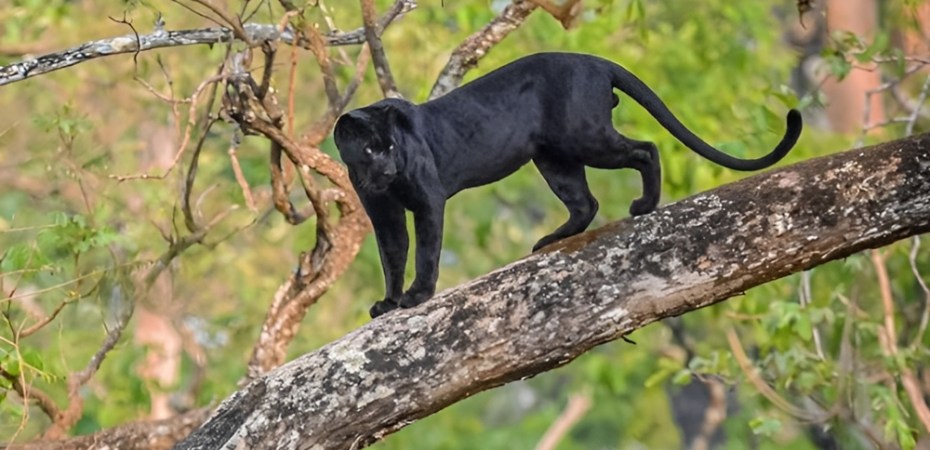
Black house cats and black panthers have a couple of things in common. Beautiful, beautiful things.
- They’re felids, i.e., members of the cat family Felidae.
- Many individuals in both species show melanism (the technical name for black fur).
This color variation happens in over a third of all felid groups. Clearly it works well for some cats—but how?
Aren’t cats black because of a genetic mutation?
Short answer: Yes, but there are at least two different types of genetic mutation. House cats and a few other cat species get the ASIP mutation; some felines, like the jaguar, have MC1R mutations, which work differently. Overall, melanism has happened in the cat family at least four separate times.
Details: As we’ve already seen, black is not the original color of domestic cats.
Ancient Egyptian artwork shows that they all started out as brown tabbies (like their African wildcat ancestor).
Studies suggest that the rest of the cat family initially had either flecked fur (like a lion’s coat) or blotches (like clouded leopards and marbled cats). Then the various cats, big and small, evolved a rich variety of patterns down through geologic time.
You would think black fur would be very helpful to these night hunters, but apparently it’s not. If melanism gave cats a major advantage, all of their coats would be black.
Yet it keeps coming back, over and over again.
At least two genes can be affected:
- ASIP. This one is behind the usual agouti-style light-dark color banding on mammal hair. In black cats, a nonagouti mutation takes out the light bands. House cats and at least five other species, including leopards (which are the original “black panthers”), Asian golden cats, kod-kods, and the Pampas cat, have this “loss-of-function” in ASIP. Precise details are different in each species, but the mutation always happens in this gene.
- MC1R. Signals from this gene affect hair pigment cells that produce blacks and browns. Some melanistic Latin American felids — Geoffroy’s cat, jaguars, and jaguarondis (despite their names, these last two cats aren’t closely related) — have a “gain-of-function” mutation in MC1R that produces more pigment. Again, the exact mutation can vary from species to species, but it is always in this gene.
A few other cats, like the little spotted oncilla in Amazonia, can be black, too, but Science has yet to identify the genetic basis for that.
What use is black fur to a cat?
Short answer: Zoologists are still trying to work this out.
Details: Color matters in the wild, but not always in obvious ways. Fur patterns and hues definitely have some camouflage value, but only up to a point. Tigers hunt from ambush (and often at night) while displaying some of the most flamboyant fur colors in the world.
Something as mysterious and complex as a tiger’s coat colors (but unrelated to those) must be going on with the black fur mutation.
Melanism is very common—many domestic cats, leopards, and jaguars have it — but it’s not as widespread as it would be if cats simply used black fur to conceal themselves at night.
A few hypotheses to explain melanism are:
- Gloger’s rule. This says that skin pigments in warm-blooded animals get denser — for example, brighter bird feathers and darker mammal skin and hair — as humidity increases near the Equator. (da Silva andothers, in source list at chapter’s end)
- Adaptation to some local circumstances. This is backed up by varying details of the melanism mutation among species. (Eizirik and others)
- Disruptive selection. While not as familiar to most of us as natural selection is, this comes into play when natural selection favors extremes of some sort, like striped or spotted fur — animals “in the middle” are left with more ecological opportunities. No one yet knows what those might be for black cats. (Allen and others) One suggestion is that extreme fur contrasts stand out in moonlight. Prey animals quickly learn to hide on bright nights, but they’re not as watchful of the shadows. Melanism might work well for some cats, though not enough for the whole species to evolve black fur. (Graipel and others)
Domestic cats are a special case, because they live with us. As we’ve seen, studies suggest that Fluffy’s black fur mutation probably happened around 2,500 years ago, somewhere in the eastern Mediterranean, perhaps in Phoenicia or Greece.
Black cats then spread west along Mediterranean shores and north across Europe into the British Isles, along with various human groups.
Despite being a target during Europe’s witch-hunting hysteria, black cats now are very common in the UK, along the northwestern coast of Africa, and in a natural trading corridor along the Seine and Rhône river valleys that was once a barge shortcut between Britain and the Mediterranean.
As well, high numbers of black cats occur in Utrecht (Netherlands), Chiang Mai (Thailand), Denton (Texas), and in some other US cities.
Black house cats, in other words, are ignoring Gloger’s rule and clustering in urban areas regardless of the relative humidity or distance to the Equator.
Why?
It’s a mystery, but possibilities include:
- Black cats somehow can tolerate the hubbub and close quarters of a town or city better. (Todd)
- Associated genetic effects may make black cats friendlier and more likely to associate with people. (Robinson)
- Since the invention of street lighting, night in the city has been almost as bright as day, but with many deep shadows. Perhaps black cats are the most successful nocturnal hunters there.
Black cats are an exception to the general rule that we have influenced domestic cats much more than they have shaped us.
In this case, black cats seem to get a special benefit from associating with us.
Perhaps someday we will figure out what that is.
Featured image: Chethan295/Shutterstock
Sources:
- Allen, W. L.; Cuthill, I. C.; Scott-Samuel, N. E.; and Baddeley, R. 2011. Why the leopard got its spots: relating pattern development to
ecology in felids. Proceedings of the Royal Society B, 278: 1373-1380. - Arendt, J., and Reznick, D. 2008. Convergence and parallelism reconsidered: what have we learned about the genetics of adaptation? Trends in Ecology and Evolution, 23(1): 26-32.
- Bradshaw, J. 2013. Cat Sense: How the New Feline Science Can Make You A Better Friend to Your Pet. New York: Basic Books. Retrieved from https://play.google.com/store/books/details?id=iU8PAAAAQBAJ
- Cieslak, M.; Reissmann, M.; Hofreiter, M.; and Ludwig, A. 2011. Colours of domestication. Biological Reviews, 86(4): 885-899.
- Eizirik, E.; Yuhki, N.; Johnson, W. E.; Menotti-Raymond, M.; and others. 2003. Molecular genetics and evolution of melanism in the cat family. Current Biology, 13: 448-453.
- Engels, D. W. 2015. Classical cats: the rise and fall of the sacred cat. Ebook retrieved from https://play.google.com/store/books/details?id=NwkeCwAAQBAJ (Preview only)
- Graipel, M. E.; Oliveira-Santos, L. G. R.; Goulart, F. V. B.; Tortato, M. A.; and others. 2014. The role of melanism in oncillas on the temporal segregation of nocturnal activity. Brazilian Journal of Biology, 74(3): S142-S145.
- Kawanishi, K.; Sunquist, M. E.; Eizirik, E.; Lynam, A. J.; and others. 2010. Near fixation of melanism in leopards of the Malay Peninsula. (Abstract only) Journal of Zoology, 282(3): 201-206.
- Kinnear, J. 1983. Feline genetics, in Felis domesticus: A Manual of Feline Health 1982-1983, 121-134. Ithaca: Cornell Feline Health
Center. https://ecommons.cornell.edu/handle/1813/34858 - Lyons, L. 2015. DNA mutations of the cat: The good, the bad and the ugly. Journal of Feline Medicine and Surgery, 17(3): 203-219.
- Robinson, R. 1977. Genetics for Cat Breeders. Second edition. London: Pergamon Press. Quoted in Mendl, M., and Harcourt, R. 2000. Individuality in the domestic cat: Origins, development and stability, in The Domestic Cat: The Biology of its Behaviour, eds. Turner, D.
C., and Bateston, P., 47-64. Cambridge: Cambridge University Press. - Schneider, A.; Henegar, C.; Day, K.; Absher, D.; and others. 2015. Recurrent evolution of melanism in South American felids. PLoS Genetics, 11(2): e1004892.
- da Silva, L. G.; Kawanishi, K.; Henschel, P.; Kittle, A.; and others. 2017. Mapping black panthers: Macroecological modeling of
melanism in leopards (Panthera pardus). PLOS ONE. 12(4): e0170378. - Sunquist, M. and Sunquist, F. 2002. Wild Cats of the World. Chicago and London: University of Chicago Press. Retrieved from
https://play.google.com/store/books/details?id=IF8nDwAAQBAJ - Todd, N. B. 1977. Cats and Commerce. Scientific American, 237: 100-107.
- Werdelin, L.; Yamaguchi, N.; Johnson, W. E.; and O’Brien, S. J. 2010. Phylogeny and evolution of cats (Felidae), in Biology and Conservation of Wild Felids, eds. Macdonald, D. W., and Loveridge, A. J., 59-82. Oxford: Oxford University Press.
- Wikipedia. 2018. Black cat. https://en.wikipedia.org/wiki/Black_cat Accessed August 25, 2018.
- ___. 2018. Gloger’s rule. https://en.wikipedia.org/wiki/Gloger’s_rule Accessed August 25, 2018.
 Flight To Wonder